Texas Annual Financial Checkup Package
About this form package
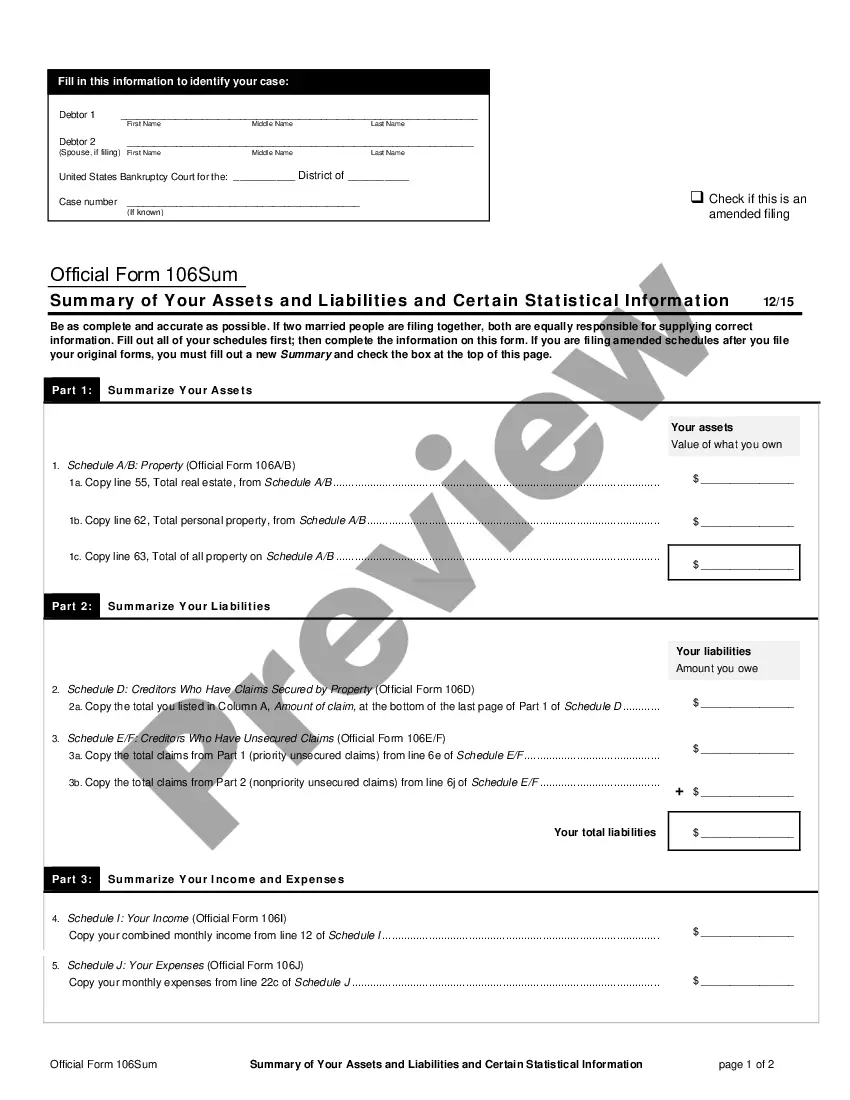
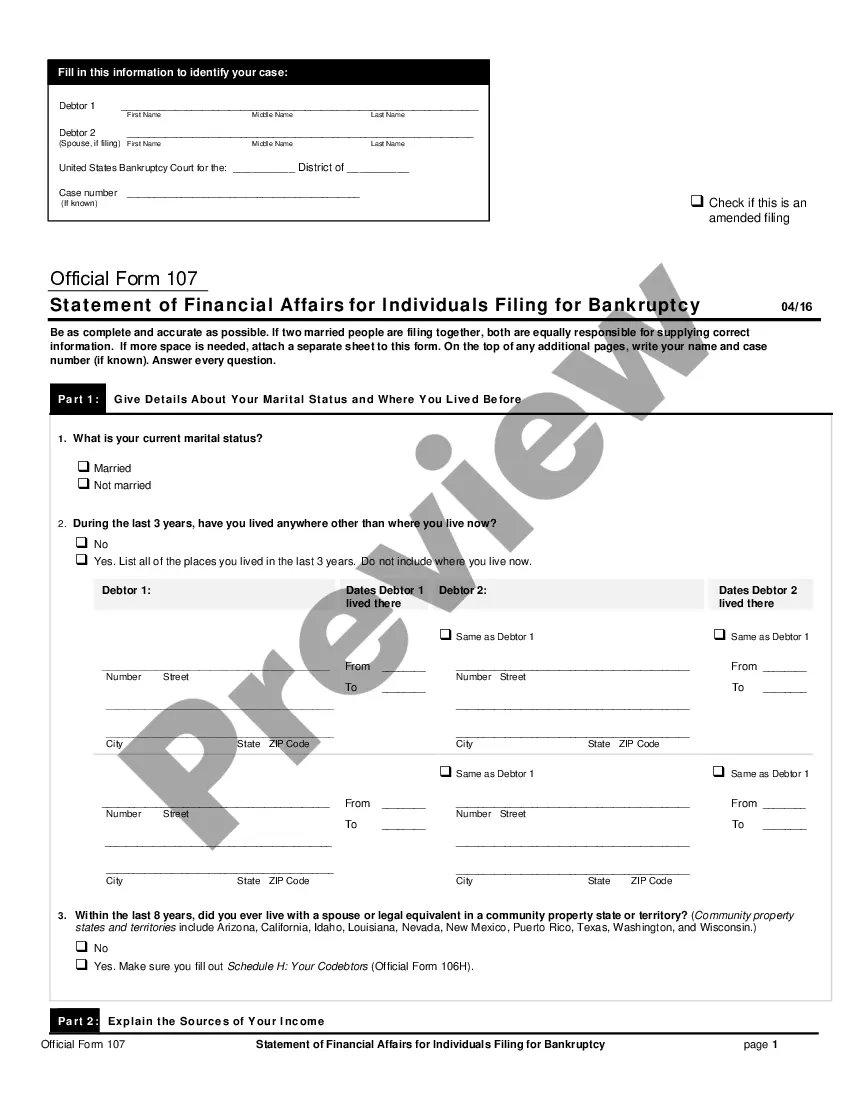
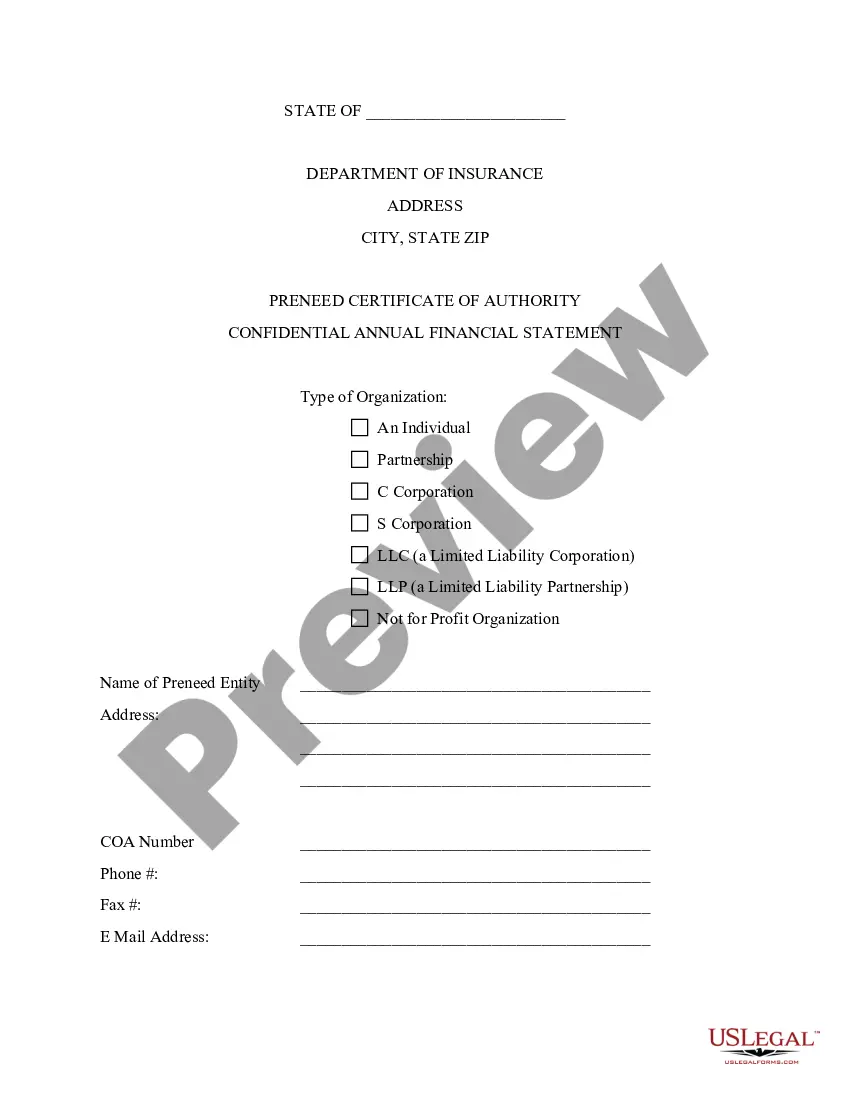
The Texas Annual Financial Checkup Package is designed to help individuals annually assess their financial status and maintain accurate financial records. This package stands out by providing a comprehensive set of forms specifically tailored for reviewing and updating your financial documents based on changes in your personal circumstances. It includes essential forms needed to conduct a thorough financial evaluation.
Forms provided in this package
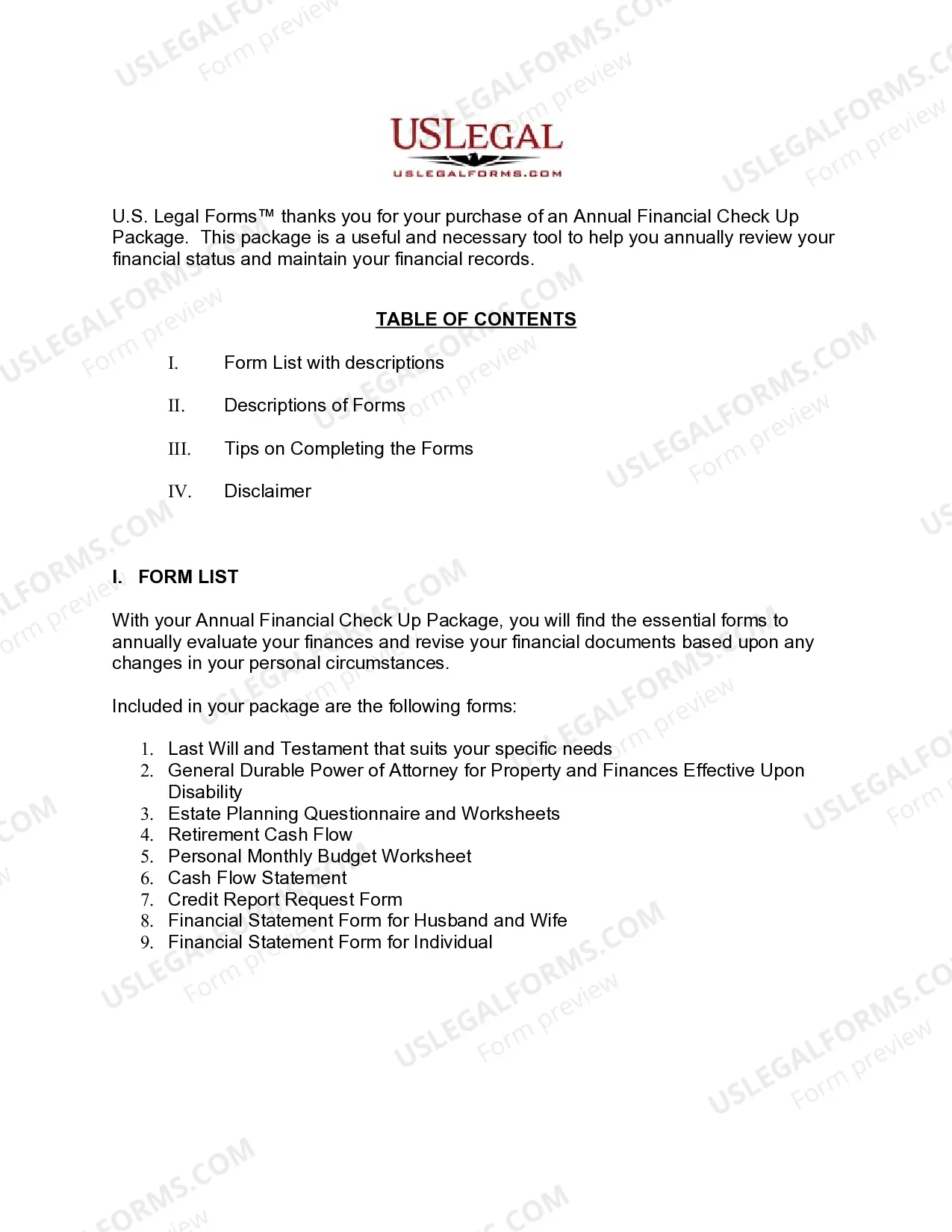
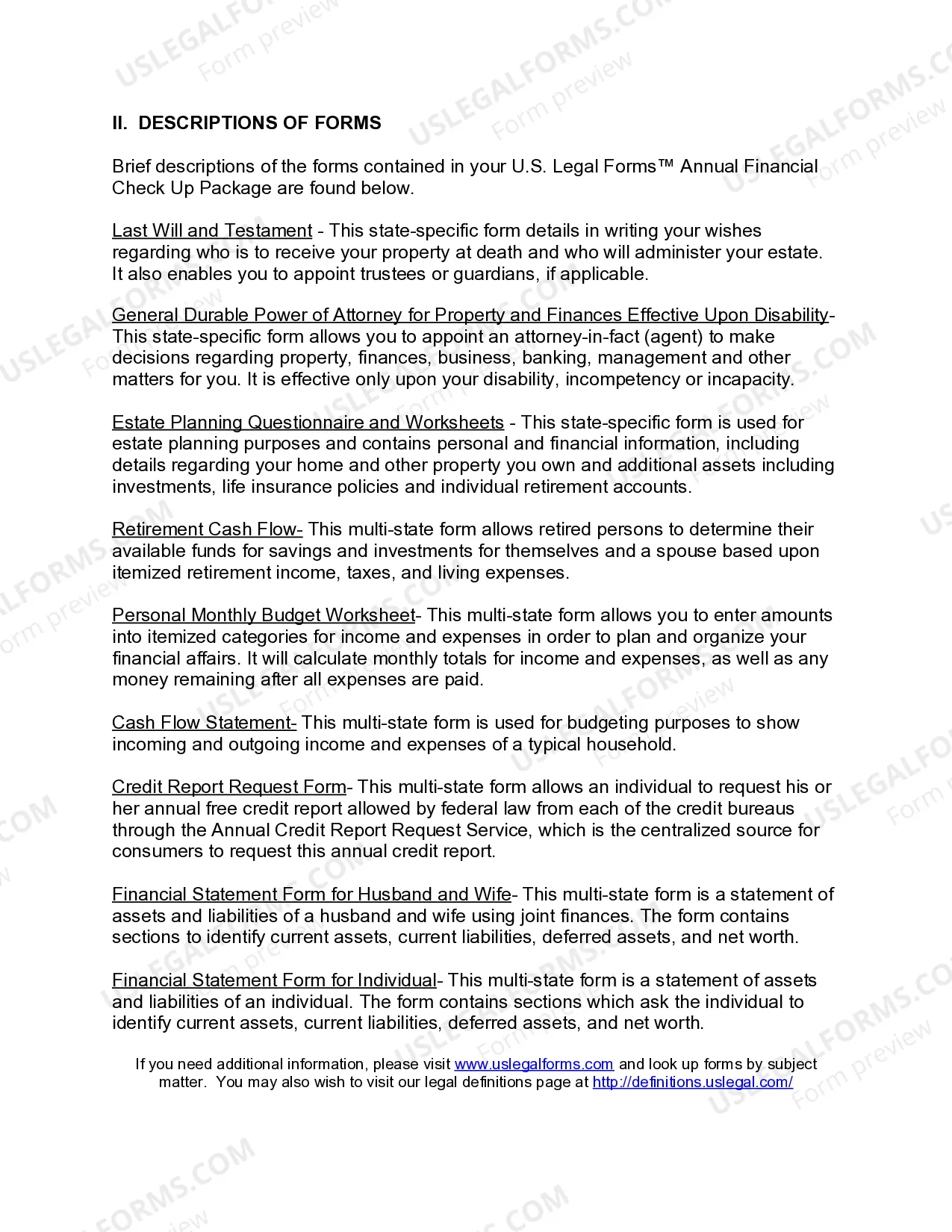
- General Durable Power of Attorney for Property and Finances or Financial Effective upon Disability
- Estate Planning Questionnaire and Worksheets
- Financial Statement Form - Husband and Wife Joint
- Financial Statement Form - Individual
- Sample Letter for Request for Free Credit Report Allowed by Federal Law
- Cash Flow Statement
- Retirement Cash Flow
- Personal Monthly Budget Worksheet

When this form package is needed
This package is particularly useful when you need to:
- Conduct an annual financial review.
- Update estate planning documents in response to life changes, such as marriage, divorce, or the birth of a child.
- Establish or revise a durable power of attorney in case of incapacity.
- Budget for retirement and manage monthly expenses effectively.
Who needs this form package
- Individuals looking to organize their finances.
- Married couples needing joint financial statements.
- Those seeking to prepare or update their wills.
- Anyone planning for retirement or assessing their retirement cash flow.
Steps to complete these forms
- Review each included form to understand its purpose and requirements.
- Fill out the forms with accurate personal and financial information.
- Consult the Estate Planning Questionnaire to gather necessary details for your will and power of attorney.
- Utilize the budgeting forms to assess and organize your monthly income and expenses.
- Store your completed forms securely for future reference and updates.
Do forms in this package need to be notarized?
Certain documents in this package must be notarized for legal effectiveness. Our online notarization service, powered by Notarize, lets you verify and sign documents remotely through an encrypted video session, available anytime.
Get your form ready online
Our built-in tools help you complete, sign, share, and store your documents in one place.
Make edits, fill in missing information, and update formatting in US Legal Forms—just like you would in MS Word.
Download a copy, print it, send it by email, or mail it via USPS—whatever works best for your next step.
Sign and collect signatures with our SignNow integration. Send to multiple recipients, set reminders, and more. Go Premium to unlock E-Sign.
If this form requires notarization, complete it online through a secure video call—no need to meet a notary in person or wait for an appointment.
We protect your documents and personal data by following strict security and privacy standards.

Make edits, fill in missing information, and update formatting in US Legal Forms—just like you would in MS Word.

Download a copy, print it, send it by email, or mail it via USPS—whatever works best for your next step.

Sign and collect signatures with our SignNow integration. Send to multiple recipients, set reminders, and more. Go Premium to unlock E-Sign.

If this form requires notarization, complete it online through a secure video call—no need to meet a notary in person or wait for an appointment.

We protect your documents and personal data by following strict security and privacy standards.
Common mistakes to avoid
- Failing to update the Last Will and Testament after important life events.
- Providing incomplete information in the Estate Planning Questionnaire.
- Not reviewing and adjusting the Personal Monthly Budget Worksheet regularly.
- Overlooking signatures or notarization requirements for certain documents.
Advantages of online completion
- Convenience of downloading and completing forms at your own pace.
- Editability allows for easy revisions as your financial situation changes.
- Access to professionally drafted forms ensures legal reliability and compliance.
Legal use & context
- These forms are designed to be legally valid in Texas, ensuring proper execution is followed.
- Users should be aware of any specific legal requirements that may apply to their individual circumstances.
- Consulting with an attorney can help clarify the enforceability of completed forms.
Key takeaways
- The Texas Annual Financial Checkup Package is essential for annual financial assessments.
- It includes multiple forms catering to various financial and estate planning needs.
- Users should regularly update forms to reflect life changes and financial conditions.
Looking for another form?




Form popularity
FAQ
Types of Finance As individuals, businesses, and government entities all need funding to operate, the finance field includes three main subcategories: personal finance, corporate finance, and public (government) finance.
The four main areas of finance are corporate finance, investments, financial institutions and markets, and international finance.
Term loan. A lump sum repiad over a fixed time. Line of credit/credit card. Funds that are available to use when needed. Peer-to-peer lending. A crowdfunded loan. Friends and family. When those close to you lend you money. Invoice financing. An advance on the invoices you've issued.
What are the 3 types of financial management decisions? The three types of financial management decisions are capital budgeting, capital structure, and working capital management.
The four main areas of finance are corporate finance, investments, financial institutions and markets, and international finance.
Finance is a broad term that describes activities associated with banking, leverage or debt, credit, capital markets, money, and investments. Basically, finance represents money management and the process of acquiring needed funds.
Financing is the process of funding business activities, making purchases, or investments. There are two types of financing: equity financing and debt financing. The main advantage of equity financing is that there is no obligation to repay the money acquired through it.
Finance is a broad term that describes activities associated with banking, leverage or debt, credit, capital markets, money, and investments. Basically, finance represents money management and the process of acquiring needed funds.
The four main areas of finance are corporate finance, investments, financial institutions and markets, and international finance.
Finance consists of three interrelated areas: (1) money and credit markets, which deals with the securities markets and financial institutions; (2) investments, which focuses on the decisions made by both individuals and institutional investors; and (3) financial management, which involves decisions made within the