Texas Special Warranty Deed - Trust to Two Individuals as Joint Tenants with Rights of Survivorship
About this form
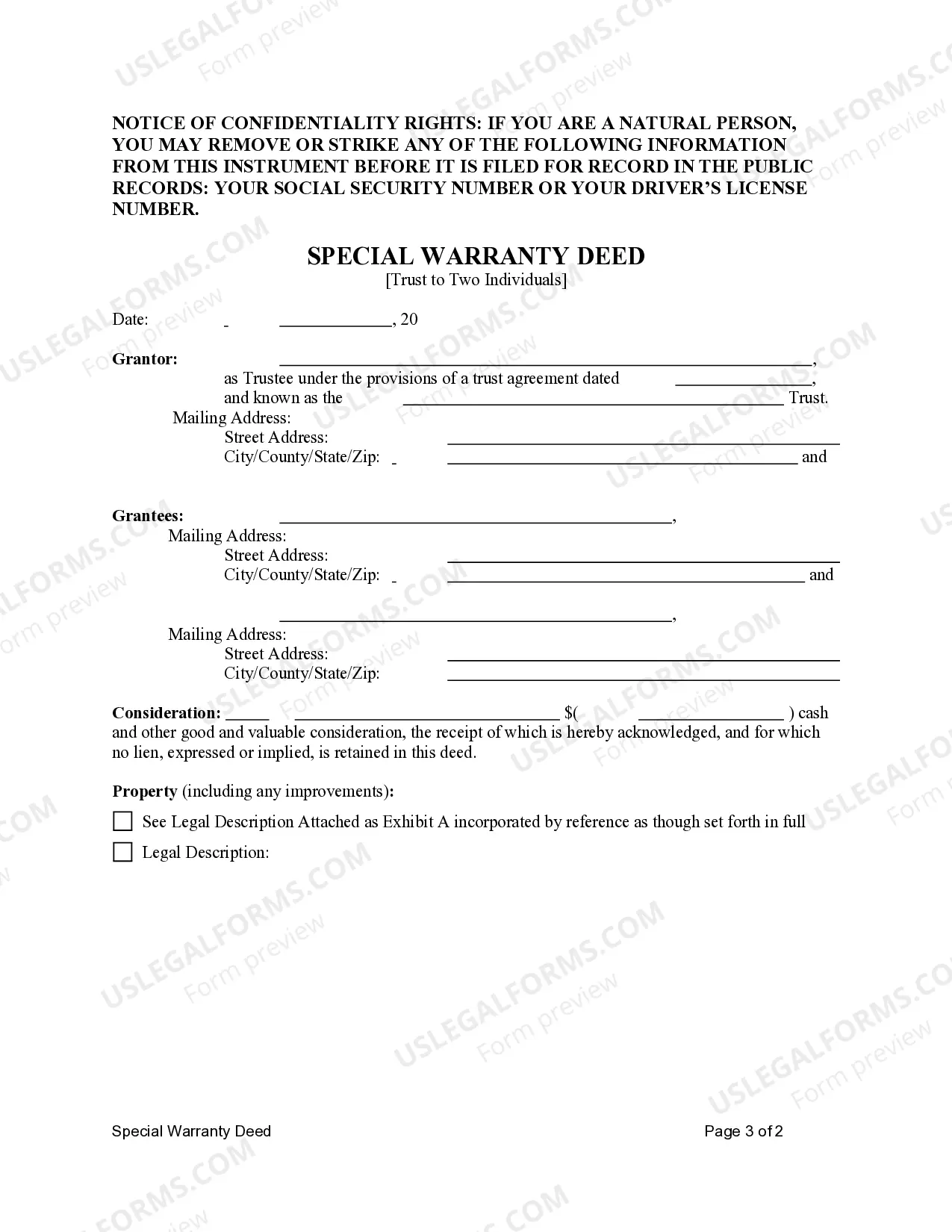
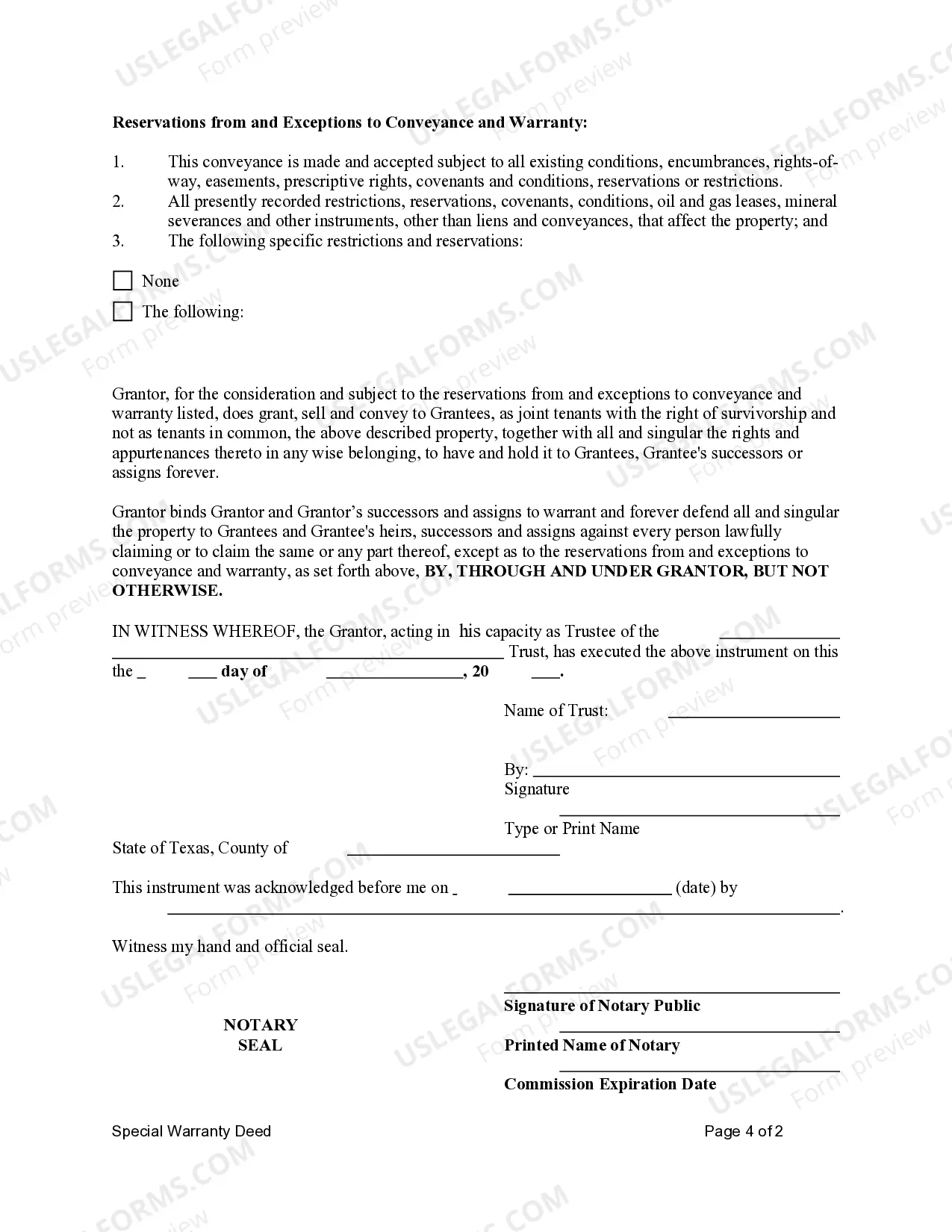
This Special Warranty Deed facilitates the transfer of property from a trust to two individuals who will hold the property as joint tenants with rights of survivorship. This means that upon the death of one tenant, the surviving tenant automatically inherits the deceased tenant's share. Unlike a general warranty deed, this form only provides a limited warranty regarding claims made against the property by the grantor, ensuring clarity in property rights for the grantees.
Key parts of this document
- Grantor and Grantees: The trust acts as the grantor, while the two individuals are the grantees.
- Property Description: Includes a legal description of the property being transferred.
- Survivorship Clause: Specifies that the property is owned as joint tenants with rights of survivorship.
- Limited Warranty: Provides a limited warranty from the grantor, protecting against claims made by persons asserting rights through the grantor.
- Signatures: Requires signatures from all involved parties to validate the deed.






When to use this document
This form is commonly used when a trust is transferring real estate to two individuals who wish to co-own the property with rights of survivorship. It is particularly relevant for couples or partners looking to ensure that if one passes away, the other automatically gains full ownership without the property needing to go through probate. It may also be utilized in estate planning to simplify property transfer processes in the future.
Who this form is for
This form is suitable for:
- Trustees acting on behalf of a trust that owns real estate.
- Individuals seeking to co-own property with survivorship rights.
- Estate planners wanting to transfer property efficiently between parties.
How to prepare this document
Follow these steps to complete the form:
- Identify the parties involved: include the full legal names of the grantor (trust) and the grantees (individuals).
- Specify the property: provide a detailed legal description of the property being transferred.
- Include the date of transfer: write the date when the property is to be transferred.
- Obtain signatures: have all parties sign the deed to make it legally binding.
- Consider notarization: check if notarization is required to complete the transaction.
Does this document require notarization?
This form does not typically require notarization unless specified by local law. However, it is advisable to check your jurisdictionâs requirements to ensure the deed's validity.
Get your form ready online
Our built-in tools help you complete, sign, share, and store your documents in one place.
Make edits, fill in missing information, and update formatting in US Legal Forms—just like you would in MS Word.
Download a copy, print it, send it by email, or mail it via USPS—whatever works best for your next step.
Sign and collect signatures with our SignNow integration. Send to multiple recipients, set reminders, and more. Go Premium to unlock E-Sign.
If this form requires notarization, complete it online through a secure video call—no need to meet a notary in person or wait for an appointment.
We protect your documents and personal data by following strict security and privacy standards.

Make edits, fill in missing information, and update formatting in US Legal Forms—just like you would in MS Word.

Download a copy, print it, send it by email, or mail it via USPS—whatever works best for your next step.

Sign and collect signatures with our SignNow integration. Send to multiple recipients, set reminders, and more. Go Premium to unlock E-Sign.

If this form requires notarization, complete it online through a secure video call—no need to meet a notary in person or wait for an appointment.

We protect your documents and personal data by following strict security and privacy standards.
Common mistakes
- Failing to include the full legal names of all parties involved.
- Neglecting to obtain signatures from all required parties.
- Missing the propertyâs legal description, leading to ambiguity.
- Not consulting local regulations that may affect the deed's validity.
Benefits of completing this form online
- Convenience of downloading the form and completing it digitally.
- Editability allows users to tailor the document to specific needs.
- Reliable formats ensure compatibility with standard document editing software.
- Clarity in legal language guides users through the completion process.
Legal use & context
- Valid for transferring property ownership in joint tenancy, offering a straightforward process with specified protections.
- Limitations of claims only include those made through the Grantor, providing some security to Grantees.
- Understand that despite the form's legal strength, local laws may impact its effectiveness.
Quick recap
- The Special Warranty Deed allows for smooth property transfer between a trust and two individuals.
- Joint tenancy with rights of survivorship provides automatic inheritance benefits.
- Ensure all necessary signatures and property descriptions are included to avoid legal complications.
Looking for another form?
Form popularity
FAQ
With a Survivorship Deed in place, when one of the parties in a joint tenancy dies, the other party (or parties) takes over the deceased party's interest in the property instead of it passing to the deceased's heirs or beneficiaries.
Property held in joint tenancy, tenancy by the entirety, or community property with right of survivorship automatically passes to the survivor when one of the original owners dies. Real estate, bank accounts, vehicles, and investments can all pass this way. No probate is necessary to transfer ownership of the property.
A person who is a party to a deed, and owns it as a joint tenancy with a right of survivorship can create a trust. The party can then transfer his/her share of the property into the trust.
Survivorship rights take precedence over any contrary terms in a person's will because property subject to rights of survivorship is not legally part of their estate at death and so cannot be distributed through a will.
Joint Tenancy With Right of Survivorship Property owned in joint tenancy automatically passes, without probate, to the surviving owner(s) when one owner dies.
In Texas, two forms of joint ownership have the right of survivorship: Joint tenancy. Property owned in joint tenancy automatically passes to the surviving owners when one owner dies. (The survivor must, however, live at least 120 hours longer than the deceased co-owner.
Can a trust ever be a joint tenant? Summary Response: Yes, California Civil Code § 683, subdivision (a) specifies that a joint tenancy may be created by grant or devise to trustees as joint tenants.
So yes California law does seem to allow a trust to be a joint tenant.It has to be the person who transfers it to the trust. So, for example, Able and Buddy own a property together as joint tenants. Able wants to transfer his half to his trust.
Unlike most states Texas does not automatically recognize joint tenancies as having a right of survivorship. Instead the parties must agree, in writing, to include a right of survivorship.