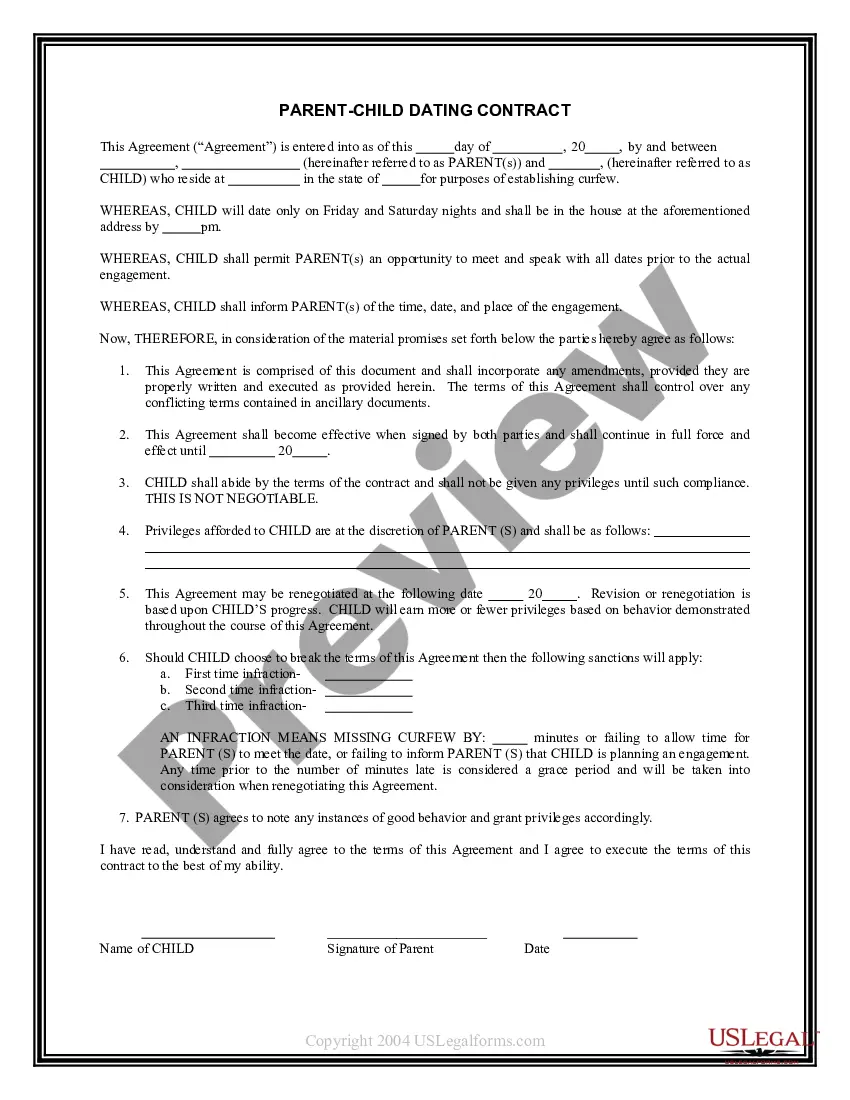
This is a contract between parent(s) and child detailing the days that child is allowed to go on a date and the time that child is required to be home. This contract also indicates what repercussions will follow if child refuses to abide by its terms.
Tennessee Parent - Child Dating Contract
Category:
State:
Multi-State
Control #:
US-PC06
Format:
Word;
Rich Text
Instant download
Description
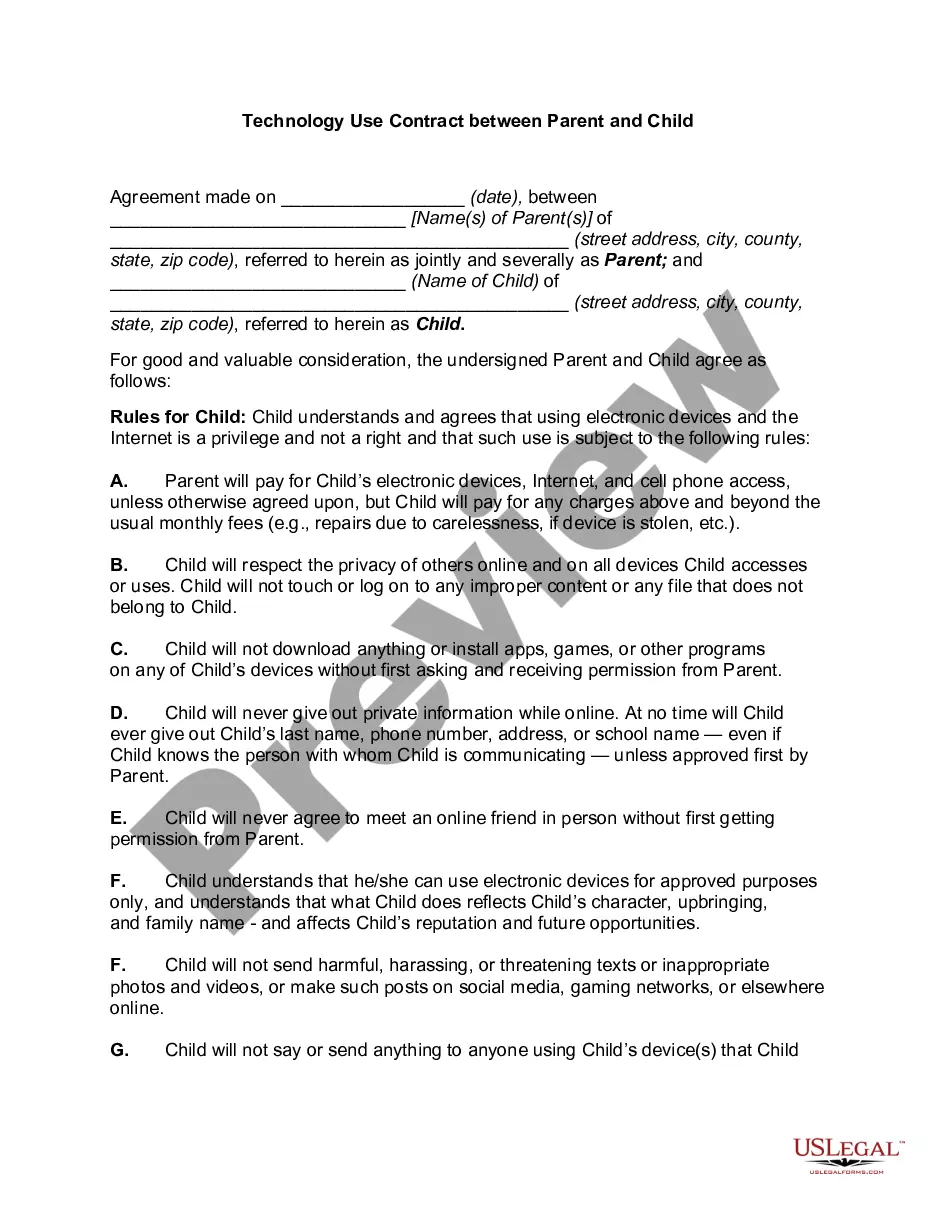
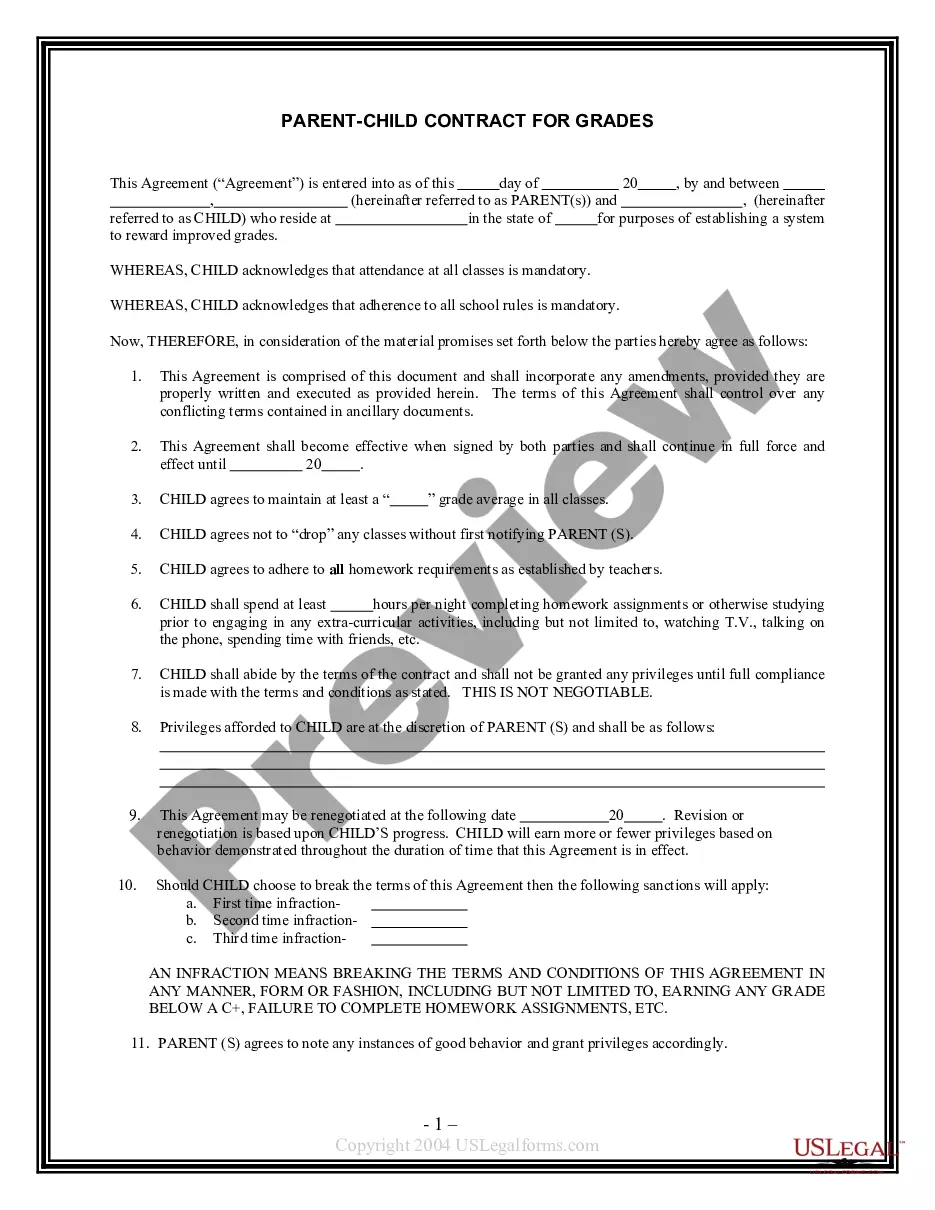
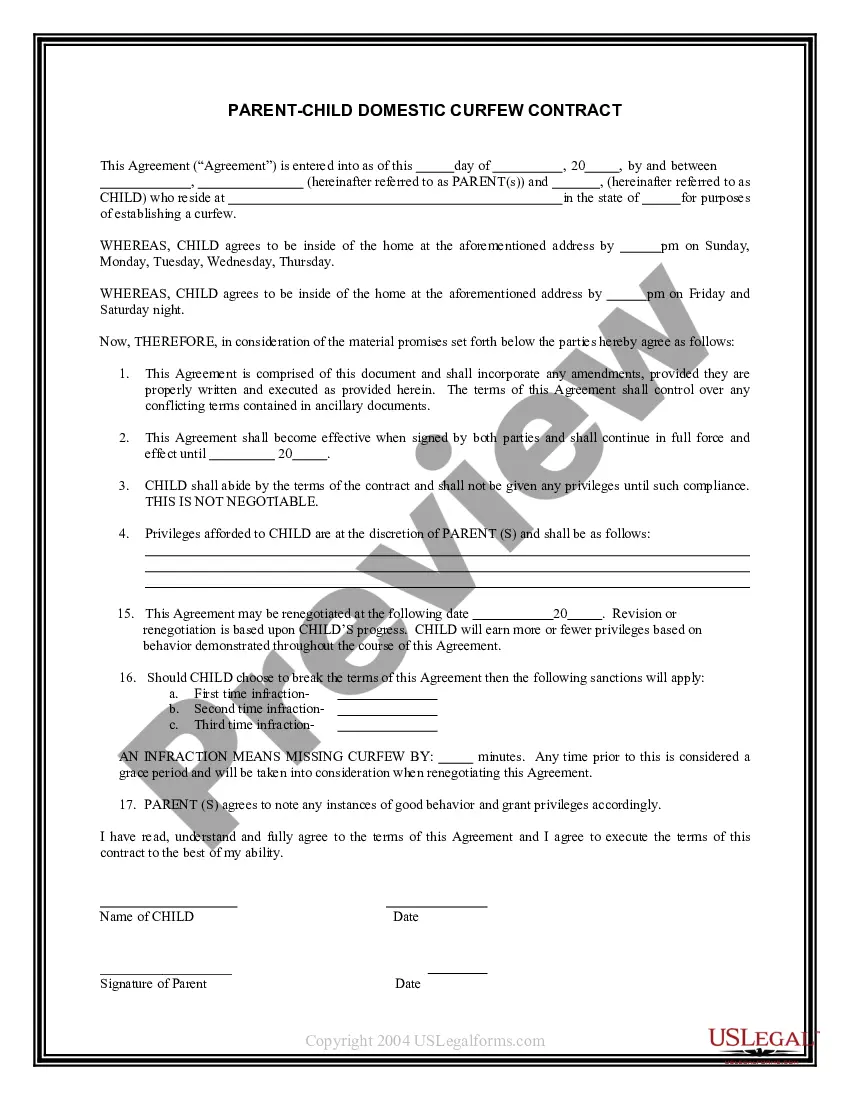
Get your form ready online
Our built-in tools help you complete, sign, share, and store your documents in one place.
Built-in online Word editor
Make edits, fill in missing information, and update formatting in US Legal Forms—just like you would in MS Word.
Export easily
Download a copy, print it, send it by email, or mail it via USPS—whatever works best for your next step.
E-sign your document
Sign and collect signatures with our SignNow integration. Send to multiple recipients, set reminders, and more. Go Premium to unlock E-Sign.
Notarize online 24/7
If this form requires notarization, complete it online through a secure video call—no need to meet a notary in person or wait for an appointment.
Store your document securely
We protect your documents and personal data by following strict security and privacy standards.

Make edits, fill in missing information, and update formatting in US Legal Forms—just like you would in MS Word.

Download a copy, print it, send it by email, or mail it via USPS—whatever works best for your next step.

Sign and collect signatures with our SignNow integration. Send to multiple recipients, set reminders, and more. Go Premium to unlock E-Sign.

If this form requires notarization, complete it online through a secure video call—no need to meet a notary in person or wait for an appointment.

We protect your documents and personal data by following strict security and privacy standards.
Looking for another form?

How to fill out Parent - Child Dating Contract?
US Legal Forms - one of the most extensive collections of legal templates in the United States - offers a range of legal document formats that you can download or print.
By utilizing the website, you can find thousands of forms for business and personal use, organized by categories, states, or keywords. You can locate the latest templates like the Tennessee Parent - Child Dating Agreement within moments.
If you already possess a subscription, Log In and download the Tennessee Parent - Child Dating Agreement from the US Legal Forms library. The Download button will appear on every form you view. You have access to all previously downloaded forms in the My documents section of your account.
Complete the transaction. Use your credit card or PayPal account to finalize the transaction.
Select the format and download the form onto your device. Make modifications. Fill out, amend, and print and sign the downloaded Tennessee Parent - Child Dating Agreement. Each template you added to your account has no expiration date and is yours permanently. Therefore, if you wish to download or print another copy, simply visit the My documents section and click on the form you need. Access the Tennessee Parent - Child Dating Agreement with US Legal Forms, the most comprehensive collection of legal document formats. Utilize thousands of professional and state-specific templates that fulfill your business or personal needs and requirements.
- If you are using US Legal Forms for the first time, here are simple instructions to get you started.
- Ensure you have selected the correct form for your city/state.
- Click on the Preview button to examine the content of the form.
- Read the form description to ensure you have selected the right one.
- If the form does not meet your requirements, use the Search field at the top of the screen to find one that does.
- If you are satisfied with the form, confirm your choice by clicking the Purchase now button.
- Then, select the pricing plan you desire and provide your details to sign up for an account.
Form popularity
FAQ
The new paternity law in Tennessee simplifies the process of establishing legal fatherhood. Under this law, a Tennessee Parent - Child Dating Contract can be used to assert paternity when both parents agree. This agreement helps clarify parental rights and responsibilities, making it easier for fathers to be involved in their children’s lives. It is essential to understand these changes to navigate custody and support issues effectively.
In a child custody case, the burden of proof lies with the parent seeking custody. This means they must present evidence that supports their claims for custody. Factors that may influence the decision include the child's best interests, parental fitness, and the existing relationship with the child. A well-structured Tennessee Parent - Child Dating Contract can strengthen your position in court.
To establish a custody agreement, first discuss your preferences with the other parent. Draft a comprehensive Tennessee Parent - Child Dating Contract that clearly outlines the custody terms, including living arrangements and visitation rights. Once both parents agree, consider having the document reviewed by a legal expert. Filing the agreement with the court can provide additional legal protection for both parties.
Absolutely, you can write your own custody agreement. Creating a Tennessee Parent - Child Dating Contract allows you to customize the terms according to your family’s unique needs. It is important to include specific details about custody arrangements, visitation schedules, and responsibilities. However, seeking legal guidance can help ensure that your agreement is enforceable in court.
Yes, you can file a custody agreement without going to court if both parents agree on the terms. This process typically involves drafting a Tennessee Parent - Child Dating Contract that outlines the custody arrangements. Once both parents sign the agreement, you can submit it to the court for approval. However, it is advisable to consult a legal professional to ensure that the agreement meets all legal requirements.
In Tennessee, unmarried parents share custodial rights regarding their children, but specific rights may differ based on paternity status. Both parents have the right to seek custody and visitation, although establishing paternity is crucial for unmarried fathers to exercise these rights. It's important to understand that a Tennessee Parent - Child Dating Contract can help outline expectations and responsibilities, fostering a healthy relationship between parents and children.
To write a contract between a parent and child regarding dating, start by clearly defining the purpose of the agreement. Include essential details such as boundaries, expectations, and responsibilities. Make sure to use language that is easy for your child to understand, and encourage open communication throughout the process. Utilizing a Tennessee Parent - Child Dating Contract template from US Legal Forms can simplify this task and ensure all important aspects are covered.
One of the biggest mistakes in a custody battle is failing to prioritize the child's best interests above all else. Parents may become so focused on winning that they neglect to consider how their actions affect their children emotionally and psychologically. A Tennessee Parent - Child Dating Contract can help parents navigate their dating lives while keeping the child's well-being at the forefront. By focusing on constructive communication and cooperation, parents can avoid common pitfalls and create a healthier environment for their children.
The 3-3-3 rule for dating suggests that a parent should wait three months after a separation or divorce before dating, three months of dating before introducing a partner to the child, and three months of the partner being involved in the child's life before making significant commitments. This rule serves as a guideline for parents navigating the delicate balance between their dating life and their responsibilities to their children. By adhering to the 3-3-3 rule, parents can ensure a thoughtful approach, reducing the risks associated with unfamiliar relationships. Utilizing a Tennessee Parent - Child Dating Contract can help formalize these timelines and expectations.
The dating clause in a custody agreement outlines the rules surrounding a parent’s dating life while sharing custody of their children. This clause aims to protect the child's emotional well-being by setting boundaries on when and how a parent can introduce a new partner to the child. In the context of a Tennessee Parent - Child Dating Contract, this clause can provide clarity and promote healthy interactions between parents and their children. By establishing clear guidelines, parents can prevent potential conflicts and ensure a stable environment for their kids.