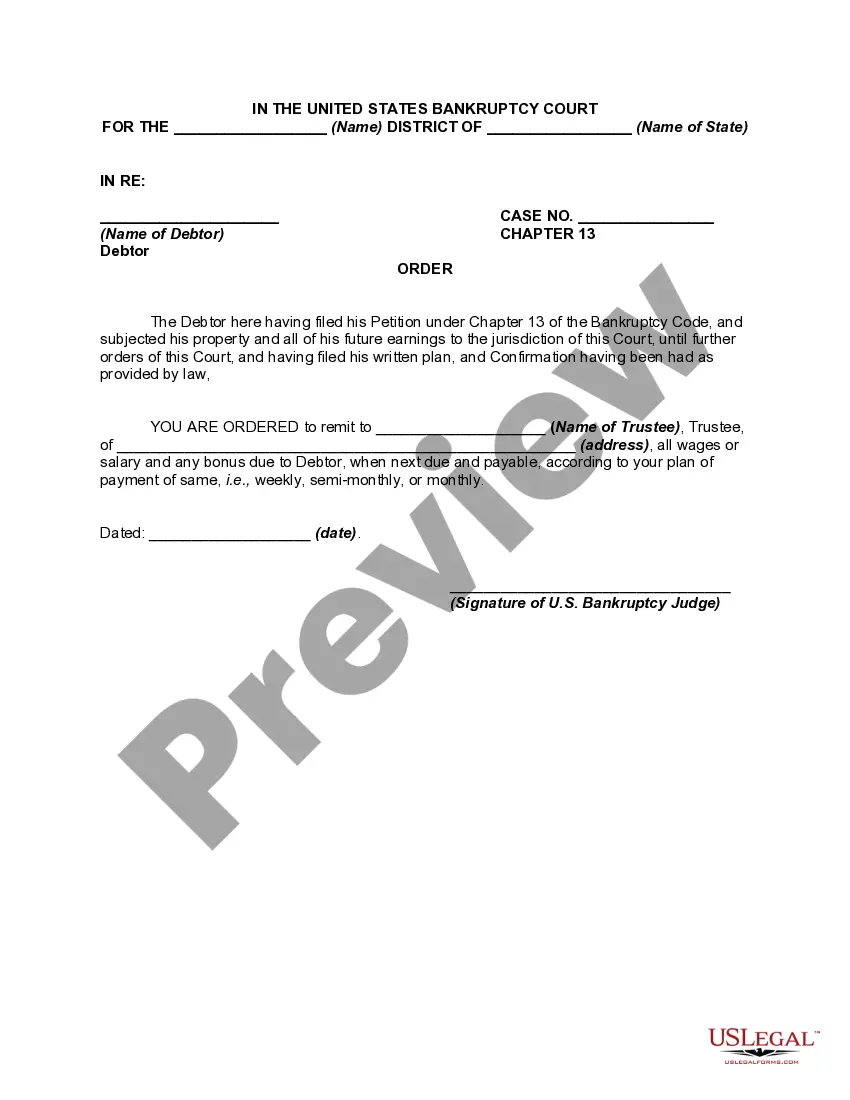
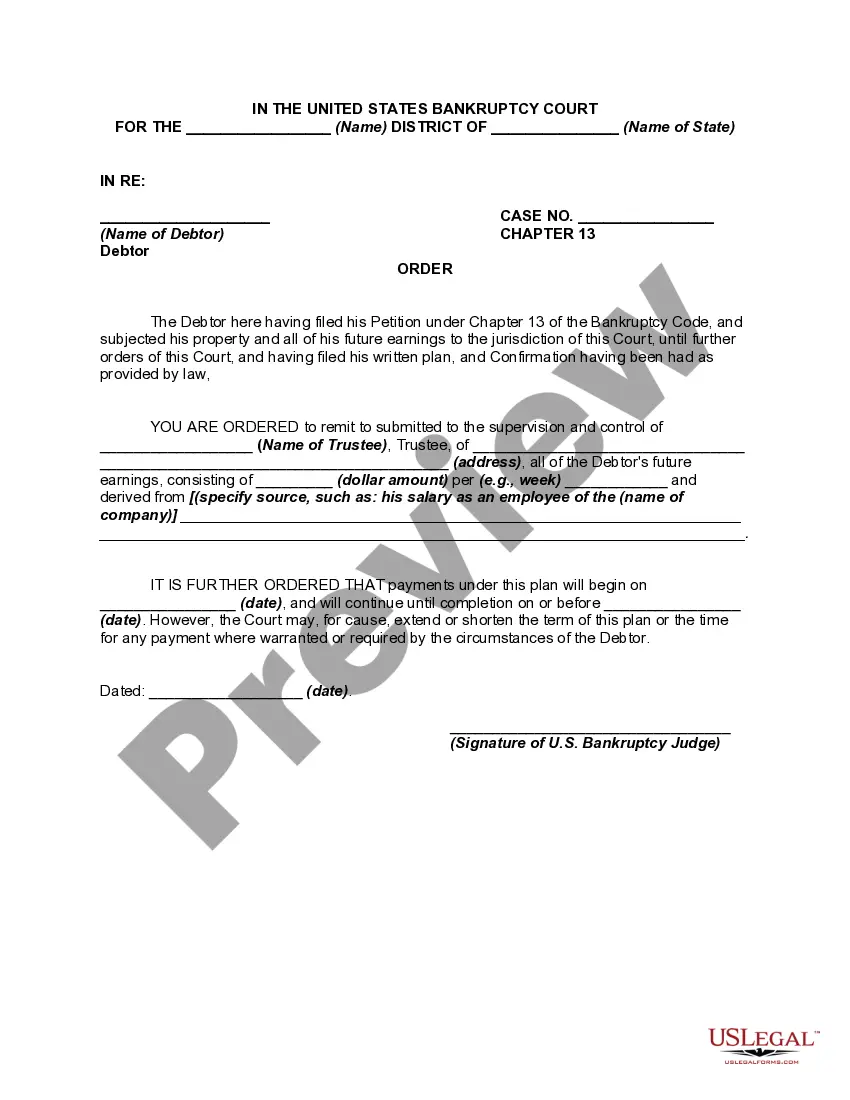
Tennessee Order Requiring Debtor's Employer to Remit Deductions from a Debtor's Paycheck to Trustee

State:
Multi-State
Control #:
US-02136BG
Format:
Word; 
Rich Text
Instant download

Description

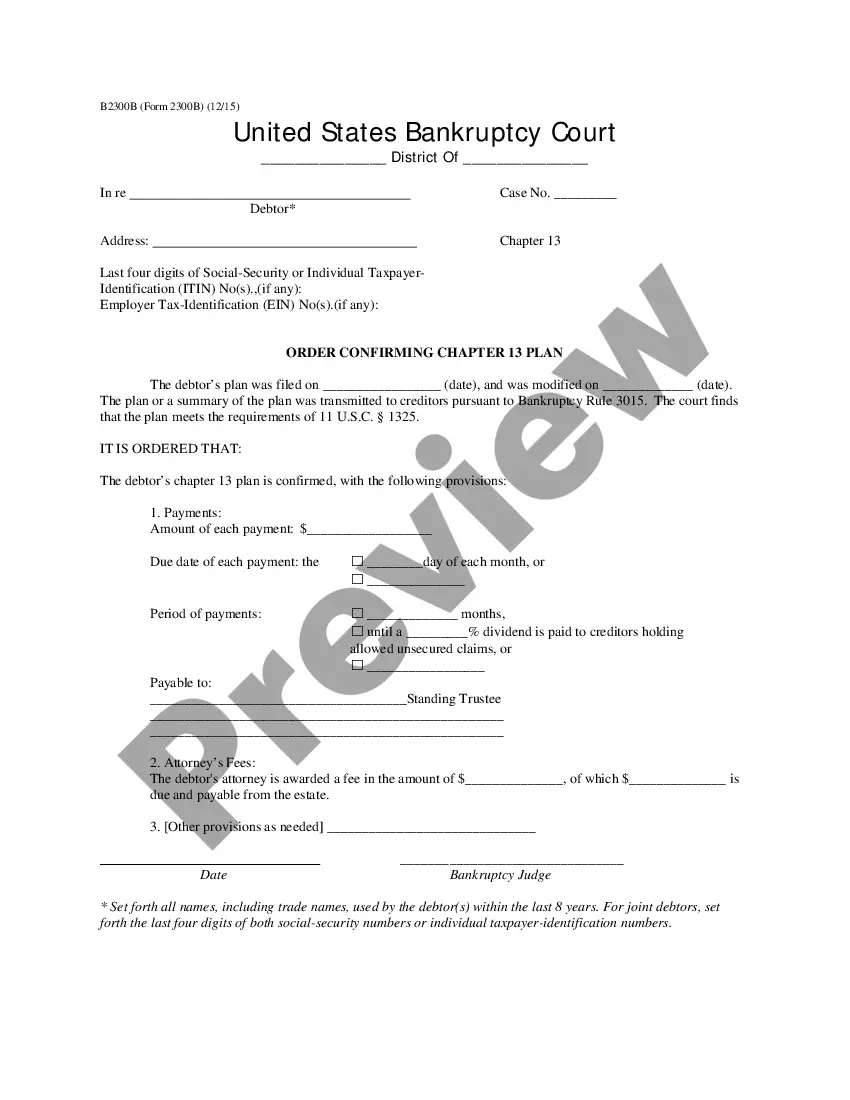
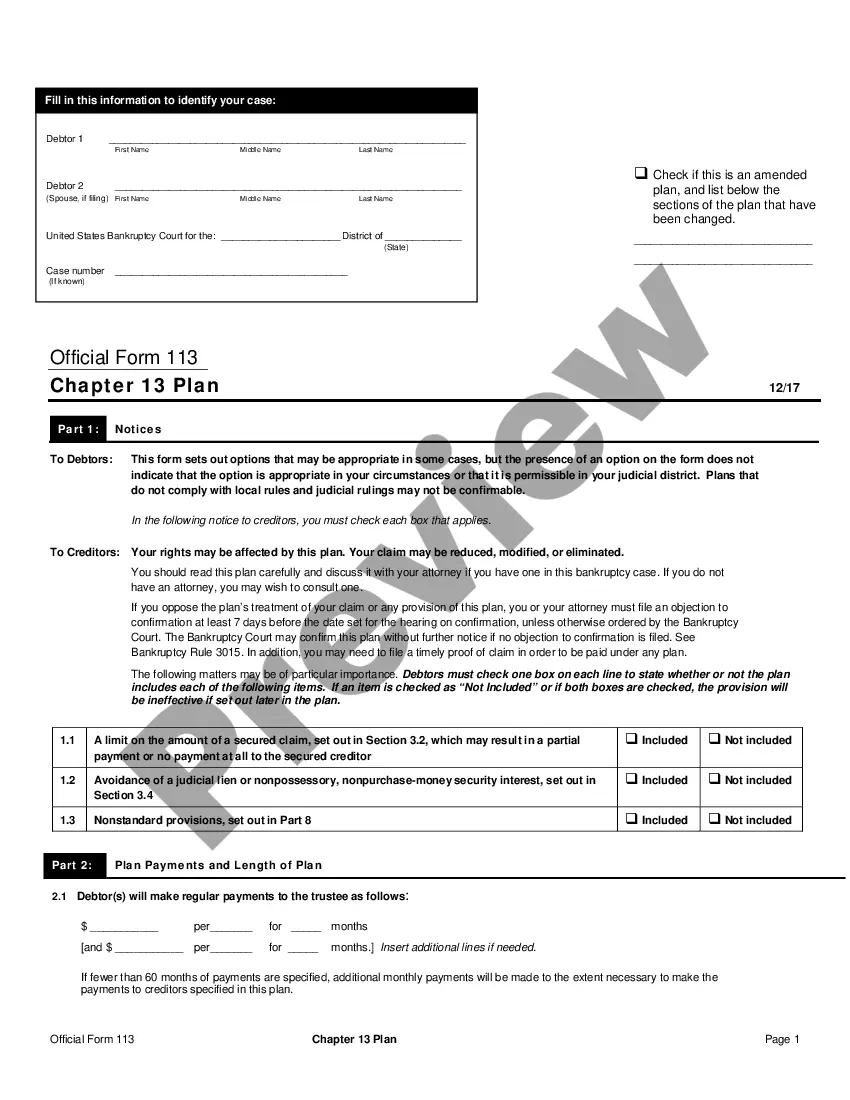
The U.S. Bankruptcy Code also allows individual debtors who meet certain financial criteria to adopt extended time payment plans for the payment of debts. An individual debtor on a regular income may submit a plan for installment payment of outstanding debts. This is called a Chapter 13 Plan. This plan must be confirmed by the court. Once it is confirmed, debts are paid in the manner specified in the plan. After all payments called for by the plan are made, the debtor is given a discharge. The plan is, in effect, a budget of the debtor's future income with respect to outstanding debts. The plan must provide for the eventual payment in full of all claims entitled to priority under the Bankruptcy Code. The plan will be confirmed if it is submitted in good faith and is in the best interest of the creditors.


A Chapter 13 plan must provide for the submission of all or such portion of future earnings or other future income of the debtor to the supervision and control of the trustee as is necessary for the execution of the plan. After the confirmation of a Chapter 13 plan, the court may exercise its discretion and order any entity from whom the debtor receives income to pay all or part of such income to the trustee.
How to fill out Order Requiring Debtor's Employer To Remit Deductions From A Debtor's Paycheck To Trustee?

If you need to full, download, or produce authorized record web templates, use US Legal Forms, the largest variety of authorized forms, that can be found on the web. Take advantage of the site`s simple and practical look for to find the papers you require. Various web templates for company and individual uses are categorized by groups and says, or keywords and phrases. Use US Legal Forms to find the Tennessee Order Requiring Debtor's Employer to Remit Deductions from a Debtor's Paycheck to Trustee in a handful of click throughs.

When you are previously a US Legal Forms consumer, log in to your profile and click on the Acquire switch to obtain the Tennessee Order Requiring Debtor's Employer to Remit Deductions from a Debtor's Paycheck to Trustee. You can even access forms you formerly saved in the My Forms tab of your respective profile.

If you use US Legal Forms the very first time, refer to the instructions under:

  • Step 1. Be sure you have chosen the shape for that proper area/region.
  • Step 2. Utilize the Review choice to examine the form`s information. Don`t overlook to learn the description.
  • Step 3. When you are unhappy with all the type, make use of the Research field near the top of the screen to get other versions of the authorized type design.
  • Step 4. When you have discovered the shape you require, click the Purchase now switch. Pick the prices plan you favor and include your qualifications to sign up to have an profile.
  • Step 5. Process the purchase. You can use your charge card or PayPal profile to finish the purchase.
  • Step 6. Find the formatting of the authorized type and download it in your system.
  • Step 7. Complete, edit and produce or sign the Tennessee Order Requiring Debtor's Employer to Remit Deductions from a Debtor's Paycheck to Trustee.

Every single authorized record design you acquire is yours for a long time. You possess acces to each and every type you saved within your acccount. Go through the My Forms segment and choose a type to produce or download yet again.

Compete and download, and produce the Tennessee Order Requiring Debtor's Employer to Remit Deductions from a Debtor's Paycheck to Trustee with US Legal Forms. There are thousands of professional and state-specific forms you can use for your company or individual requirements.

Form popularity

FAQ

However, it is rare for them to keep close tabs on every account. In most cases, your bank account trustee will generally look at your account balance on the filing date of your petition to ensure it matches the information submitted.

In Chapter 13 bankruptcy, you pay the Chapter 13 bankruptcy trustee the monthly payment required by your Chapter 13 repayment plan and the trustee distributes the funds to creditors each month.

After Plan Completion: After all payments have been completed, the Chapter 13 Trustee will file a Motion to Return any Excess Funds to Debtor and to Terminate any Payroll Deduction by Employer. If the Motion is granted, the Court will enter an order granting the motion and issue two notices.

To preserve the assets for creditors, some banks will freeze your account as soon as they receive notice of your bankruptcy. If the funds are yours?for instance, the money is post-filing income?you or your attorney should contact the bankruptcy trustee. The trustee will instruct the bank to lift the freeze.

What does my Chapter 13 discharge order look like? While every court is slightly different, the Chapter 13 discharge order looks similar. It is signed by a judge and states that ?A discharge under 11 U.S.C. § 1328(a) is granted to: Your Name?.

Whether the trustee can take money you receive after filing your case depends on whether you were entitled to the money at the time your case was filed and how it was listed on your forms, if at all.

The trustee will use these statements to get a glimpse into your financial history. Your bankruptcy trustee can ask for up to two years of bank statements. The trustee will look at your statements to verify your monthly payments to make sure they match the expenses you put on your bankruptcy forms.

Summary. Your trustee may exercise their legal function to review your finances including your bank accounts. However, they are not permitted to touch any of your funds. Unless, of course, you have stipulated that in your repayment plan.

Trusted and secure by over 3 million people of the world’s leading companies

Tennessee Order Requiring Debtor's Employer to Remit Deductions from a Debtor's Paycheck to Trustee