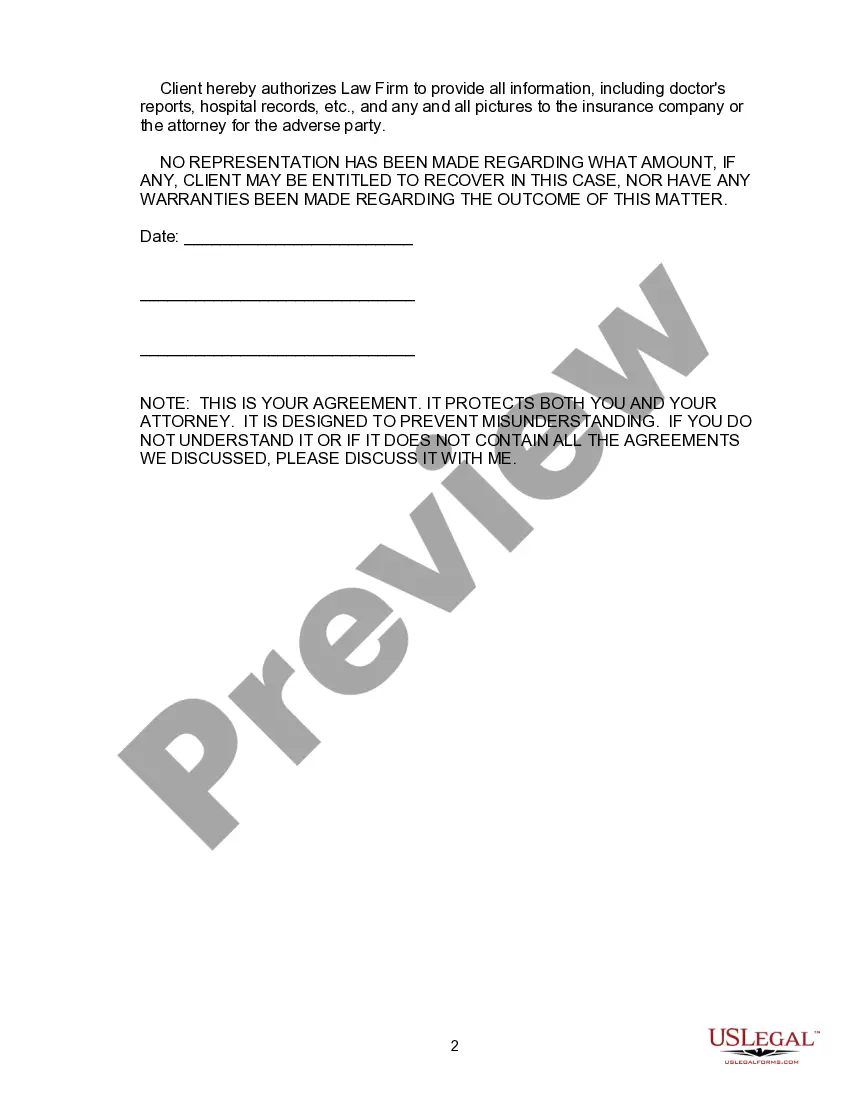
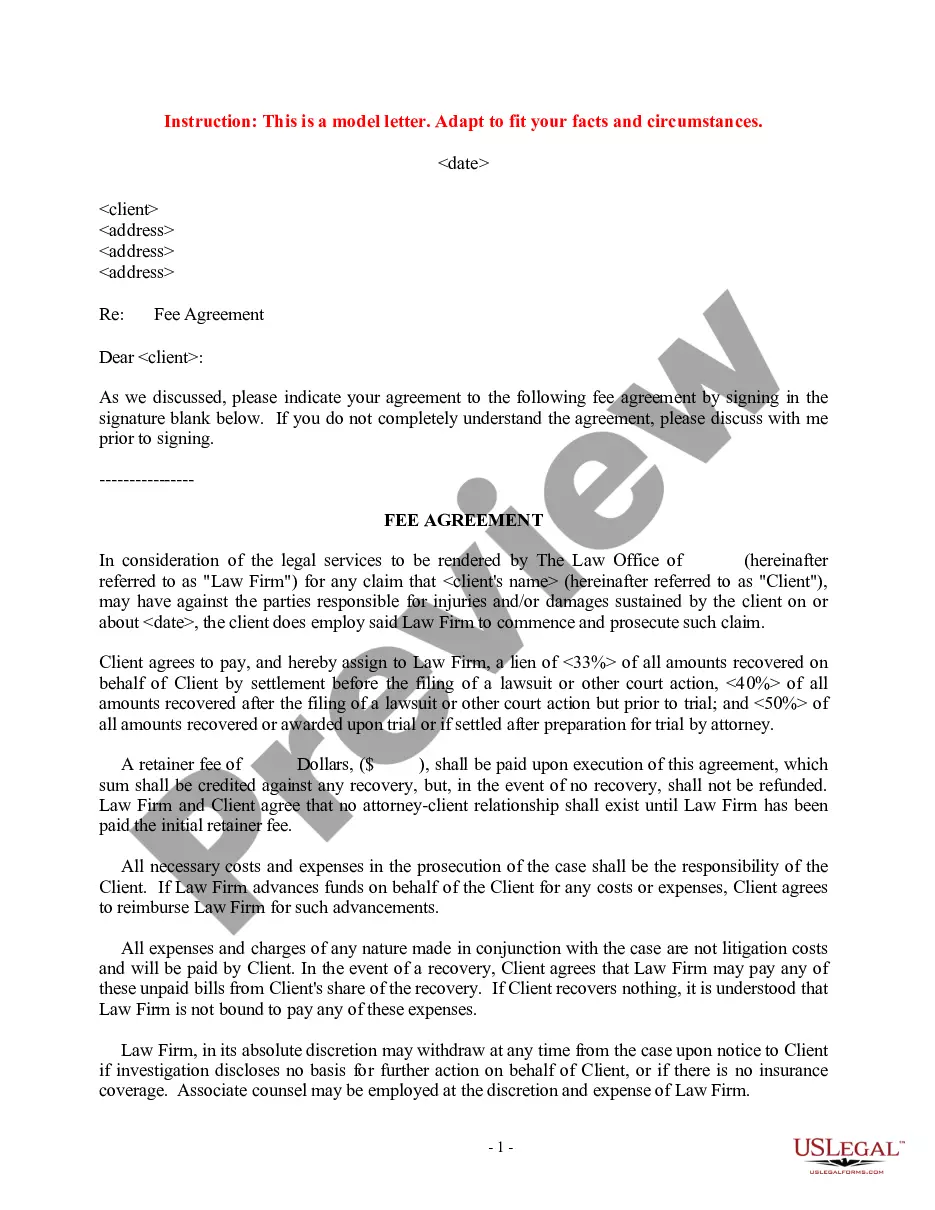
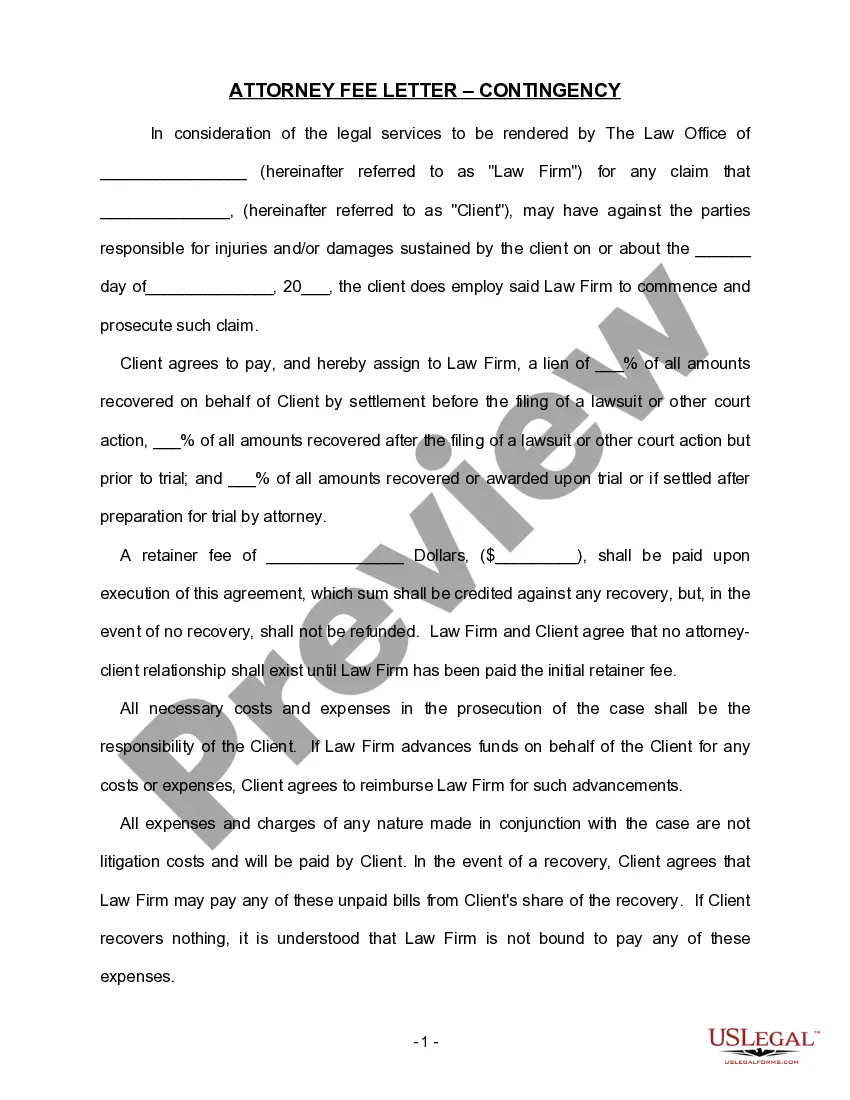
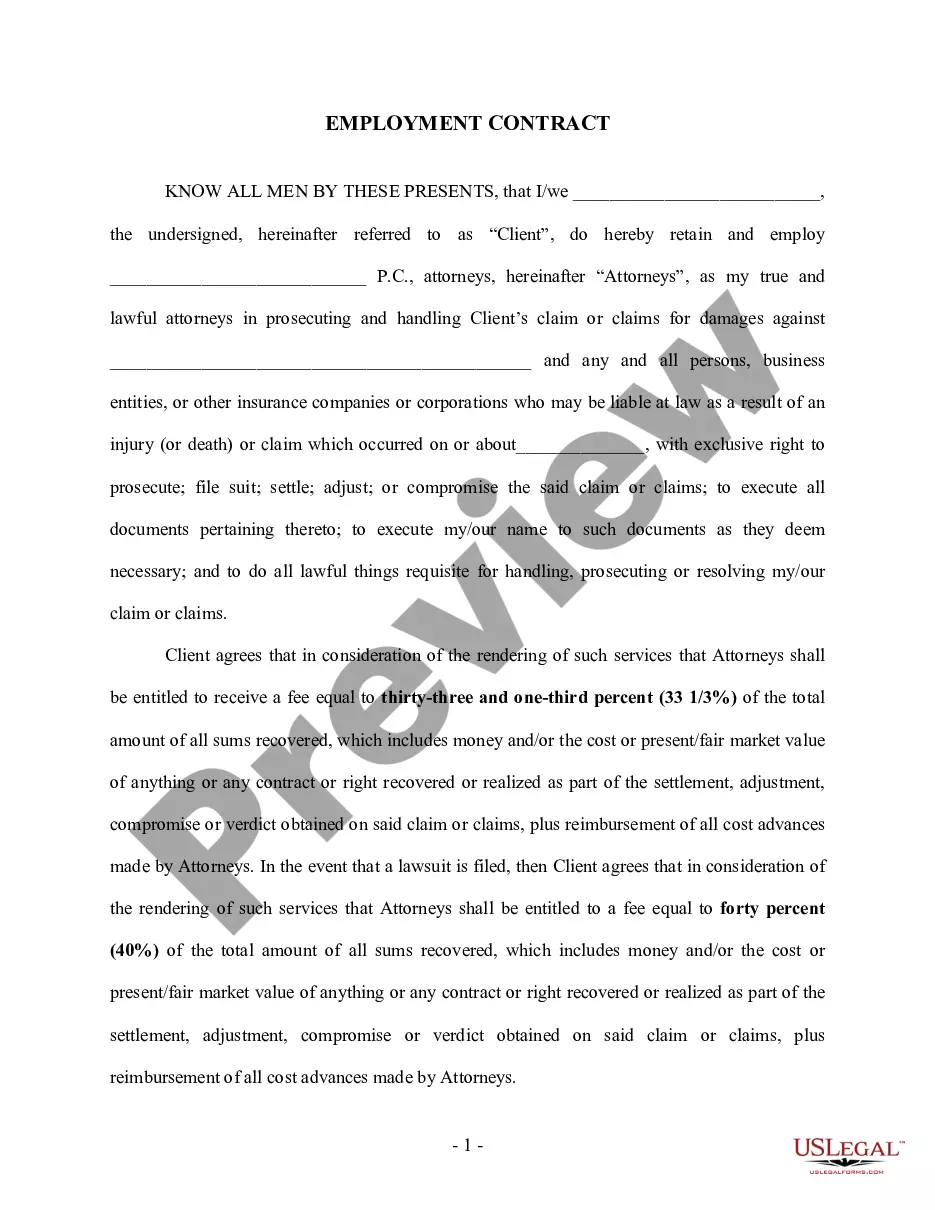
The attorney fee letter states that the client agrees to pay, and assign to the law firm prosecuting his/her claim, a lien of 33% of all amounts recovered on behalf of client by settlement before the filing of a lawsuit or other court action, 40% of all amounts recovered after the filing of a lawsuit or other court action but prior to trial; and 50% of all amounts recovered or awarded upon trial or if settled after preparation for trial by attorney.
Tennessee Attorney Fee Letter - Contingency Agreement
0 downloads
Description
Free preview



Get your form ready online
Our built-in tools help you complete, sign, share, and store your documents in one place.
Built-in online Word editor
Make edits, fill in missing information, and update formatting in US Legal Forms—just like you would in MS Word.
Export easily
Download a copy, print it, send it by email, or mail it via USPS—whatever works best for your next step.
E-sign your document
Sign and collect signatures with our SignNow integration. Send to multiple recipients, set reminders, and more. Go Premium to unlock E-Sign.
Notarize online 24/7
If this form requires notarization, complete it online through a secure video call—no need to meet a notary in person or wait for an appointment.
Store your document securely
We protect your documents and personal data by following strict security and privacy standards.

Make edits, fill in missing information, and update formatting in US Legal Forms—just like you would in MS Word.

Download a copy, print it, send it by email, or mail it via USPS—whatever works best for your next step.

Sign and collect signatures with our SignNow integration. Send to multiple recipients, set reminders, and more. Go Premium to unlock E-Sign.

If this form requires notarization, complete it online through a secure video call—no need to meet a notary in person or wait for an appointment.

We protect your documents and personal data by following strict security and privacy standards.
Looking for another form?

How to fill out Attorney Fee Letter - Contingency Agreement?
Are you presently in the situation where you frequently require documents for various corporate or specific objectives almost all the time.
There are numerous legal document templates accessible online, but finding ones you can trust is not simple.
US Legal Forms provides thousands of template forms, such as the Tennessee Attorney Fee Letter - Contingency Agreement, which are designed to comply with state and federal regulations.
Access all the document templates you have purchased in the My documents section.
You can obtain another copy of the Tennessee Attorney Fee Letter - Contingency Agreement at any time, if necessary. Just navigate to the required form to download or print the document template.
- If you are already familiar with the US Legal Forms website and possess an account, simply Log In.
- Then, you can download the Tennessee Attorney Fee Letter - Contingency Agreement template.
- If you do not have an account and wish to start using US Legal Forms, follow these steps.
- Locate the form you need and ensure it is for your specific city/county.
- Use the Review button to inspect the form.
- Read the description to confirm that you have selected the correct form.
- If the form is not what you are looking for, use the Search field to find the form that meets your needs and requirements.
- Once you find the appropriate form, click Get now.
- Select the pricing plan you prefer, fill in the required information to create your account, and complete the payment using your PayPal or credit card.
- Choose a convenient document format and download your copy.
Form popularity
FAQ
US OGE. The term ?contingency fee? refers to a type of fee arrangement in a case in which an attorney or firm agrees that the payment of legal fees will be contingent upon the successful outcome of the case.
Disadvantages. The main problem with a contingency fee agreement is that it could cost the plaintiff more than standard hourly rates for a lawyer if the case settles quickly. A standard contingency fee can range between 30-40% of the final award.
This type of fee is often used in accident, personal injury, or other types of legal cases in which someone is being sued. Contingency fees mean you will pay the lawyer a certain percentage of the money you receive if you win the case or settle the matter out of court.
In a standard contingency fee agreement, the plaintiff is only responsible for paying their attorney if they win the case. In these instances, the payments are percentages of the winnings.
That said, the most common lawyer contingency fee average ends up being 33%, or ? of the total earnings of a case, but can go up to 40% (in some jurisdictions) as the complexity and risk involved in taking the case increases.
In the United States, lawyers are unable to use contingency fees for criminal cases, divorce and family law cases, and domestic relations cases, with similar rules in Canada. With criminal cases, there is usually no financial recovery, so using a contingency agreement to cover payment would be useless.
In Tennessee, contingency fees are capped at one third (33 1/3%) of the total recovery. When a lawyer is retained, he and the client will agree on the percentage before representation and case work begins. Filing and court costs. The attorney's fee is only one of several costs that may be deducted from the settlement.
Contingent fees are unfair because plaintiffs are not allowed to recover the cost of the fee from the defendant--that is, add the fee to the judgment awarded. Plaintiffs must prove the economic worth of their injuries.