Tennessee Order for Name Change
Understanding this form
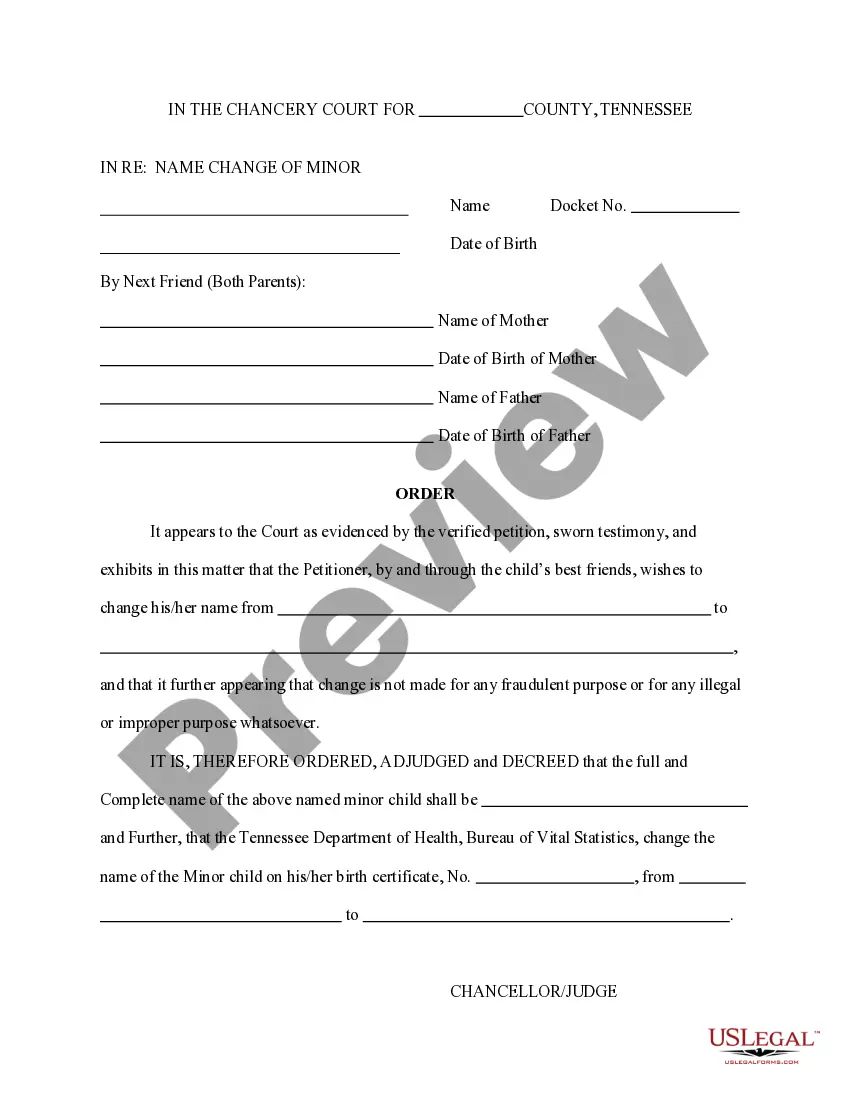
The Order for Name Change is a legal document that finalizes an individual's request to change their name. Once signed by a judge and filed with the court, the name change becomes effective. This form is essential for both minors and adults seeking to amend their legal identity, as it formally recognizes the new name in legal records.
Key parts of this document
- Case identification, including the name of the minor petitioner and case number.
- Details of the minor's current name and the proposed new name.
- Jurisdictional confirmations regarding residency and the minor's status.
- Reason for the requested name change, which must not harm others' interests.
- Judge's order confirming the name change, making it legally effective.
Common use cases
This form is used when a minor or their guardian wishes to legally change the child's name. Common situations for using the Order for Name Change include changes due to marriage, divorce, familial preferences, or social reasons. It ensures that the new name is recognized by legal and governmental entities.
Who should use this form
The Order for Name Change is intended for:
- Guardians or parents of minor children seeking a name change.
- Minors wishing to address personal, cultural, or familial name issues.
- Legal representatives assisting in the name change process.
How to complete this form
- Enter the case number and the full name of the minor petitioner.
- Provide the minor's current name and the new name desired.
- Detail the reasons for the name change, ensuring they align with legal standards.
- Indicate the minor's residency information and marital status if applicable.
- Sign and date the form in the presence of a judge during the court hearing.
Does this document require notarization?
This form does not typically require notarization unless specified by local law. Ensure to check specific state requirements before submission.
Get your form ready online
Our built-in tools help you complete, sign, share, and store your documents in one place.
Make edits, fill in missing information, and update formatting in US Legal Forms—just like you would in MS Word.
Download a copy, print it, send it by email, or mail it via USPS—whatever works best for your next step.
Sign and collect signatures with our SignNow integration. Send to multiple recipients, set reminders, and more. Go Premium to unlock E-Sign.
If this form requires notarization, complete it online through a secure video call—no need to meet a notary in person or wait for an appointment.
We protect your documents and personal data by following strict security and privacy standards.

Make edits, fill in missing information, and update formatting in US Legal Forms—just like you would in MS Word.

Download a copy, print it, send it by email, or mail it via USPS—whatever works best for your next step.

Sign and collect signatures with our SignNow integration. Send to multiple recipients, set reminders, and more. Go Premium to unlock E-Sign.

If this form requires notarization, complete it online through a secure video call—no need to meet a notary in person or wait for an appointment.

We protect your documents and personal data by following strict security and privacy standards.
Avoid these common issues
- Failing to include the correct case number.
- Not providing sufficient reasons for the name change.
- Omitting necessary signatures from guardians or parents.
- Not verifying residency before filing the petition.
Benefits of using this form online
- Convenient access to a legally vetted form that can be completed from home.
- Easy editing features allowing for adjustments before finalizing.
- Quick download enables immediate filing with the court.
Looking for another form?





Form popularity
FAQ
You will be asked to pay a fee for submitting a name change petition and order, typically around $150. The court clerk will assign a court and hearing date.
Minor degree refers to a supplemental second discipline of study and concentration that often complements the major. Some students use a minor degree to pursue personal interests, while other students may pursue a minor to gain specific specialization and make themselves more attractive to employers.
Adjective. lesser, as in size, extent, or importance, or being or noting the lesser of two: a minor share. not serious, important, etc.: a minor wound; a minor role. having low rank, status, position, etc.: a minor official.
1 : inferior in importance, size, or degree : comparatively unimportant a minor artist. 2 : not having reached majority (see majority sense 2) He is the father of minor children. 3a : having half steps between the second and third, the fifth and sixth, and sometimes the seventh and eighth degrees minor scale.
In law, the term minor (also infant or infancy) refers to a person who is under the "age of majority" - the age at which a person is legally recognized as an adult.Minors are considered to be under the care of a parent or guardian, unless they are emancipated.