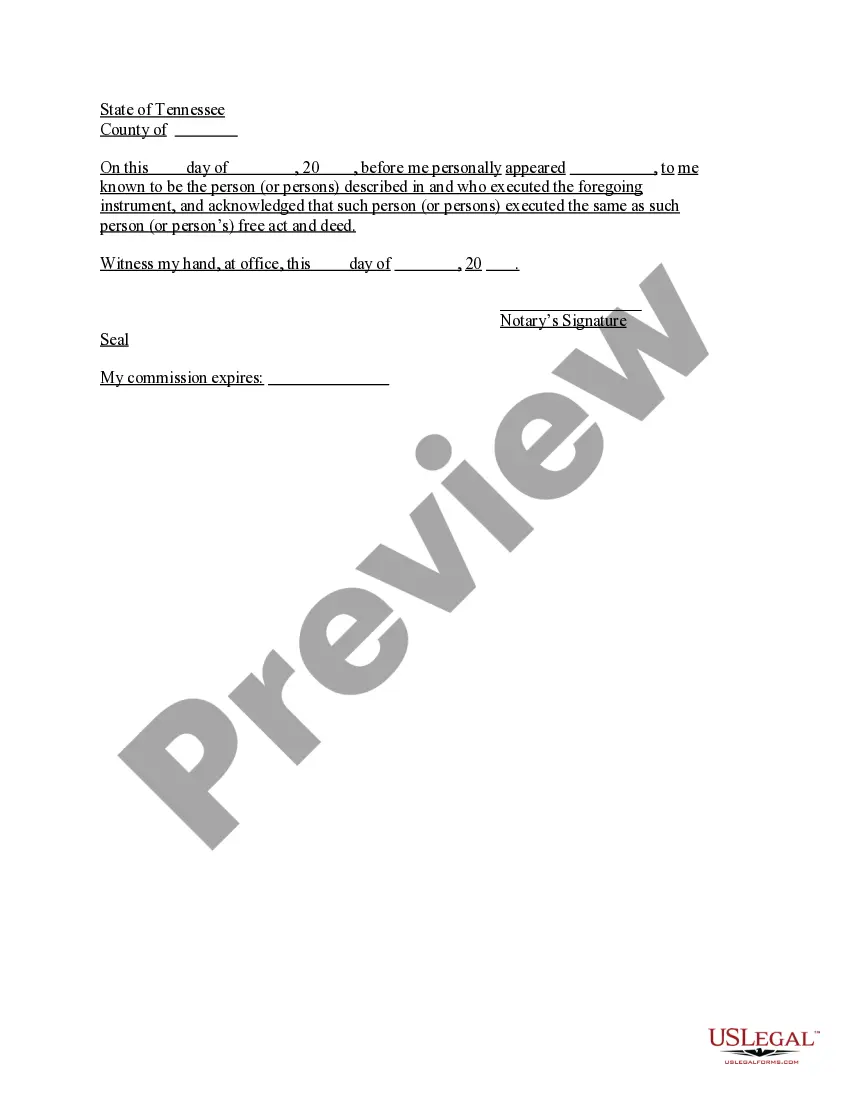
Tennessee Acknowledgment for Natural Person
What this document covers
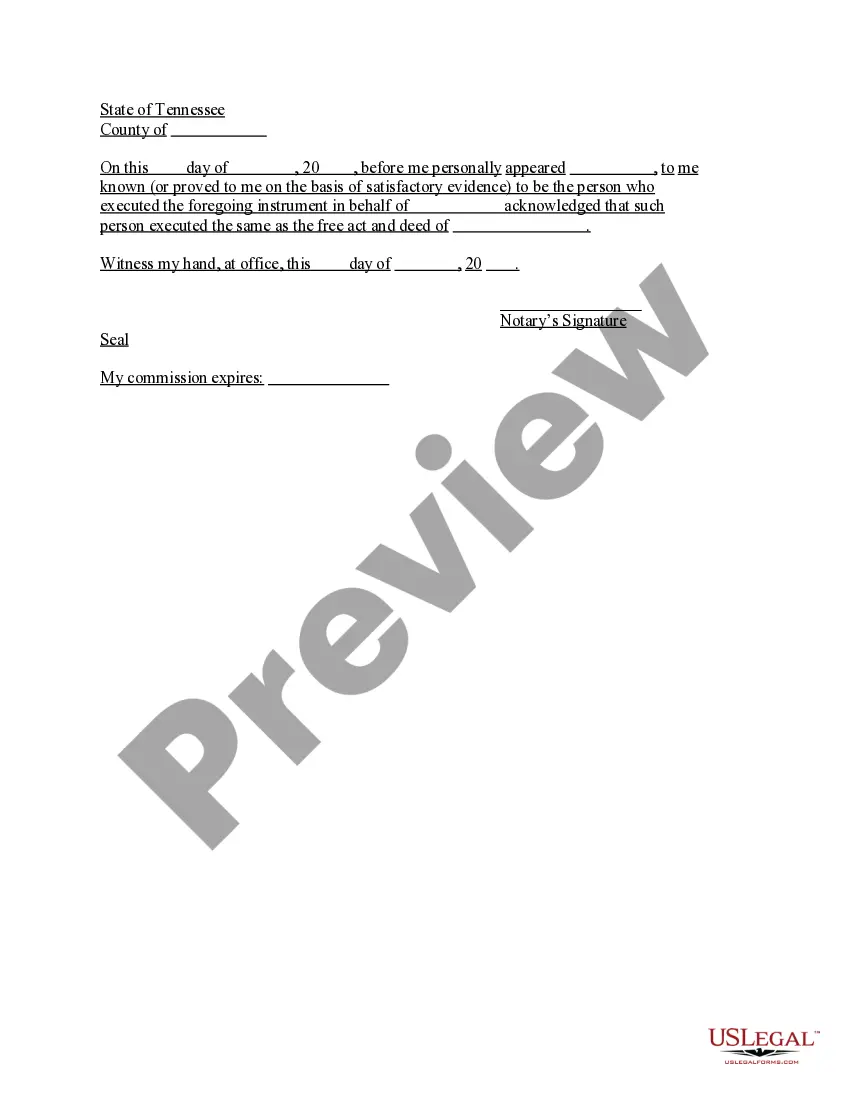
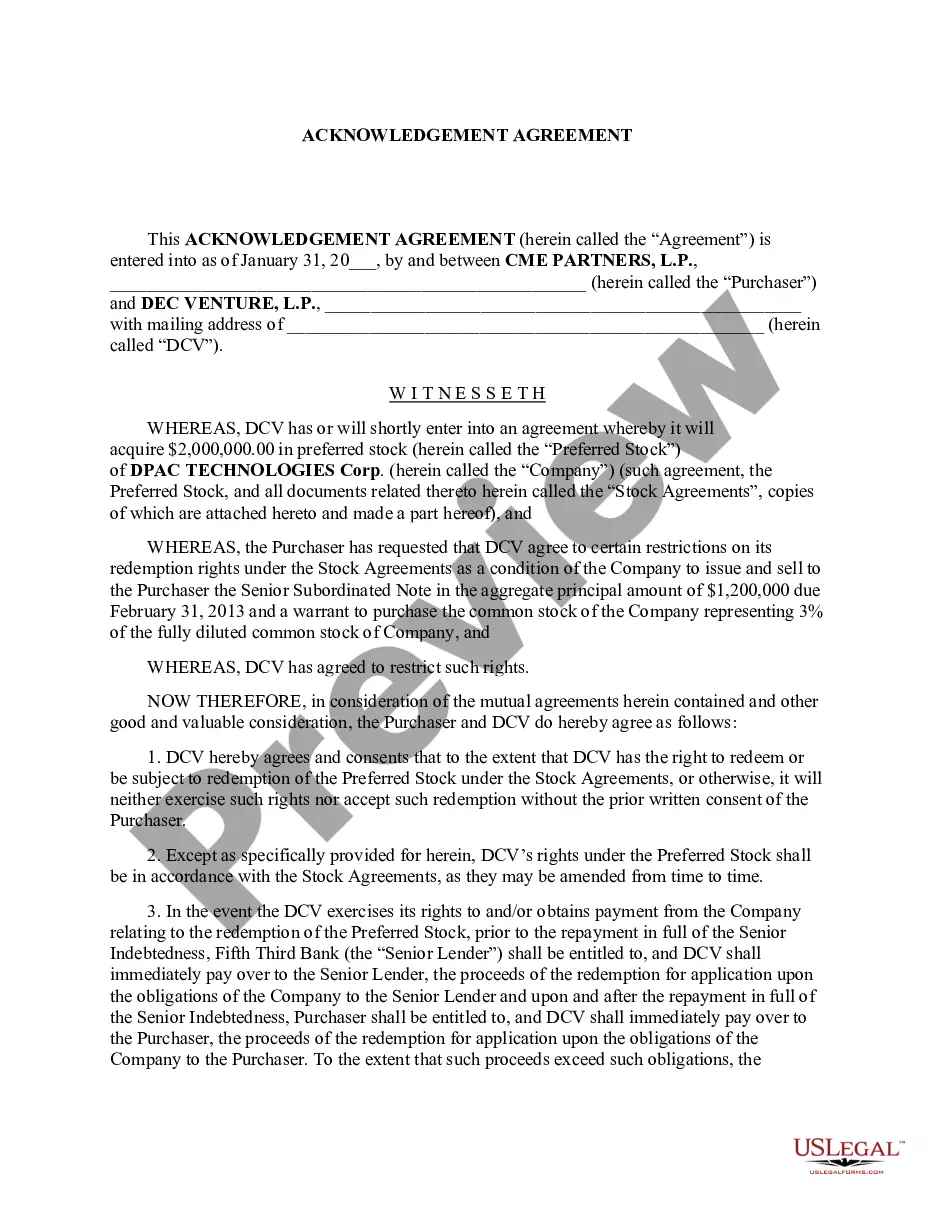
The Acknowledgment for Natural Person is a legal document that certifies the identity of an individual who has signed another legal instrument. This form serves to confirm that the signer is the same person named in the document, ensuring that the execution of the document is valid and enforceable. Unlike other forms that may serve similar purposes, this acknowledgment is specifically geared towards identifying natural persons in legal contexts, making it essential for authenticity in legal transactions.
Main sections of this form
- Identification of the person appearing before the notary.
- Date of the acknowledgment.
- Signature of the person acknowledging the document.
- Notary's signature and seal, which validate the acknowledgment.
- Statement confirming that the signer executed the document as a free act.

Situations where this form applies
This form is utilized when an individual needs to formally acknowledge their signature on a document in the presence of a notary. It may be required in situations such as signing contracts, property deeds, or other legal documents where authenticity and identity verification are crucial. Using this acknowledgment ensures that the legal effects of the signed document are upheld.
Who needs this form
- Individuals executing legal documents who want to ensure their signing is acknowledged officially.
- Notaries public who are tasked with facilitating the acknowledgment of signatures.
- Legal professionals requiring a recognized method of verifying the identity of signers.
How to complete this form
- Identify the individual who is acknowledging their signature.
- Enter the date on which the acknowledgment is being made.
- Have the named person sign the form in the presence of a notary.
- Ensure the notary fills in their details, signs, and affixes their seal.
- Retain a copy for personal records and provide the original to the relevant parties.
Notarization guidance
Yes, this form must be notarized to be legally valid. Having a notary public witness the signing ensures that the identity of the individual is confirmed, providing legal protection in various transactions. US Legal Forms offers integrated online notarization, available 24/7, through secure video calls, enabling users to meet notarization requirements without needing to travel.
Get your form ready online
Our built-in tools help you complete, sign, share, and store your documents in one place.
Make edits, fill in missing information, and update formatting in US Legal Forms—just like you would in MS Word.
Download a copy, print it, send it by email, or mail it via USPS—whatever works best for your next step.
Sign and collect signatures with our SignNow integration. Send to multiple recipients, set reminders, and more. Go Premium to unlock E-Sign.
If this form requires notarization, complete it online through a secure video call—no need to meet a notary in person or wait for an appointment.
We protect your documents and personal data by following strict security and privacy standards.

Make edits, fill in missing information, and update formatting in US Legal Forms—just like you would in MS Word.

Download a copy, print it, send it by email, or mail it via USPS—whatever works best for your next step.

Sign and collect signatures with our SignNow integration. Send to multiple recipients, set reminders, and more. Go Premium to unlock E-Sign.

If this form requires notarization, complete it online through a secure video call—no need to meet a notary in person or wait for an appointment.

We protect your documents and personal data by following strict security and privacy standards.
Common mistakes
- Failing to sign the form in front of a notary.
- Leaving required fields blank, such as the date or notary's seal.
- Using incorrect or ambiguous identification information for the signer.
Advantages of online completion
- Convenient access to legally sound templates drafted by licensed attorneys.
- Easy to download and print, allowing for immediate use.
- Editable fields facilitate quick completion tailored to individual needs.
- Affordability compared to consulting with legal professionals for the same form.
Legal use & context
- The Acknowledgment for Natural Person is used to ensure that documents are executed correctly.
- It plays a vital role in validating documents for legal proceedings and transactions.
- Failure to use this acknowledgment could lead to disputes regarding the authenticity of signatures.
Key takeaways
- The form is essential for verifying the identify of individuals signing important legal documents.
- Notarization is required for legal validity.
- It is tailored specifically for use in Tennessee and may not meet requirements in other jurisdictions.
Looking for another form?
Form popularity
FAQ
An acknowledgment is a formal declaration before an authorized official such as a notary, by a person who has signed a document, that the document is his or her act. The person acknowledging the document must personally appear before the notary.
Step 1: Require Personal Appearance. Step 2: Check Over The Document. Step 3: Carefully Identify The Signer. Step 4: Record Your Journal Entry. Step 5: Complete The Notarial Certificate. A Last Note: Never Give Advice.
They key difference is that for a signature witnessing, the signer must always sign the document in the Notary's presence.An acknowledgment, on the other hand, does not require the Notary to witness the signature in most states (one exception is Maryland).
A notary public can take an acknowledgment or affidavit of a nonresident of the State of Tennessee if that person is physically present within this state.A notary should not notarize his or her spouse's signature because of the requirement that notaries discharge their duties "without favor or partiality." Op. Tenn.
The Individual Acknowledgment certificate is used when an individual is signing and acknowledging on his or her own behalf.
When you see (here insert the name and character of the officer) next to a blank as shown below, it means you should insert Your name, Notary Public in the blank.
Require Personal Appearance. Review The Document. Screen The Signer And Verify The Facts. Record The Notarization. Complete The Notarization.
For an acknowledgment, the signer must always: Be positively identified by the Notary. The Notary must always identify the signer for an acknowledgement; whether the signer personally knows the Notary, presents an ID document, or is identified by a credible witness depends on the circumstances.