South Dakota Agreement to Toll Statute of Limitations
Description
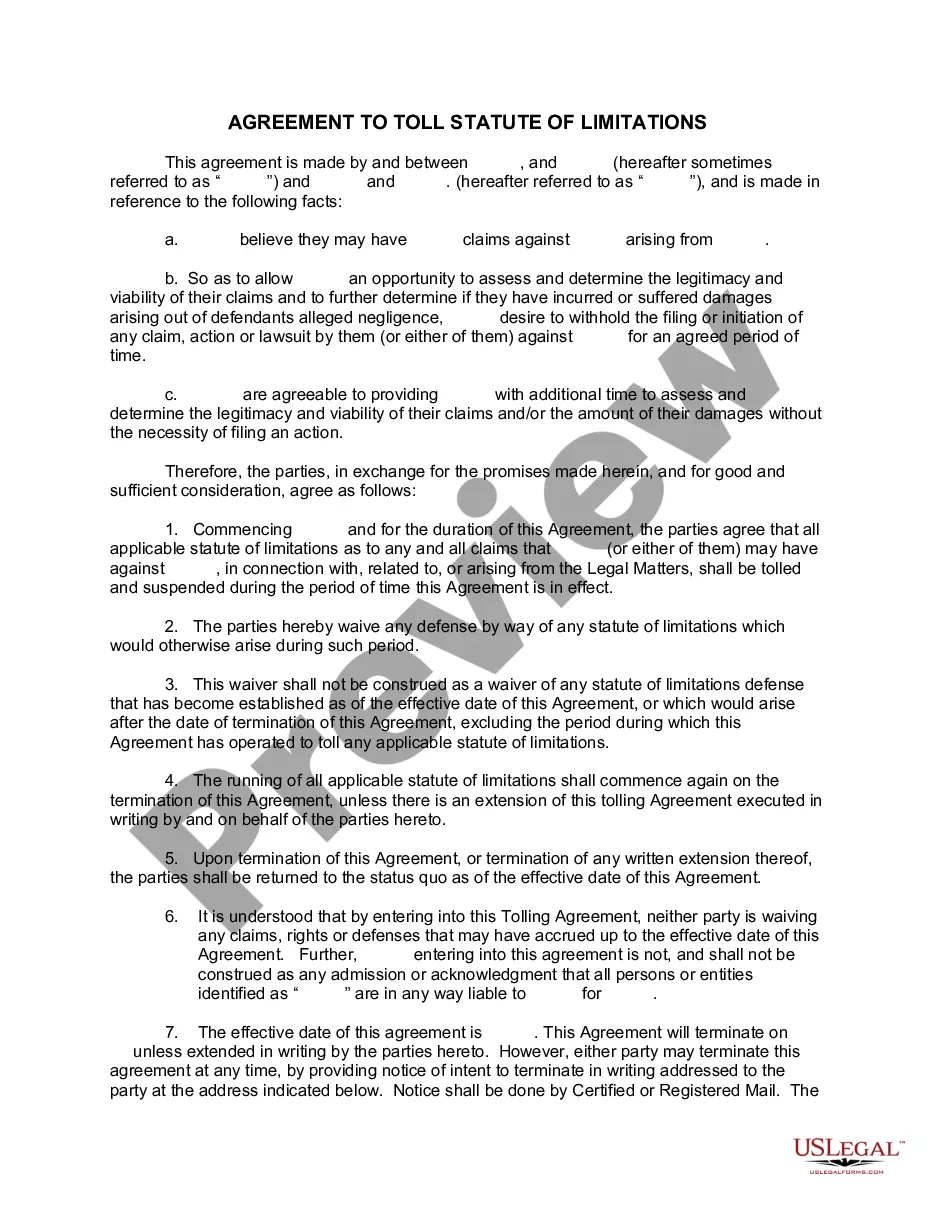
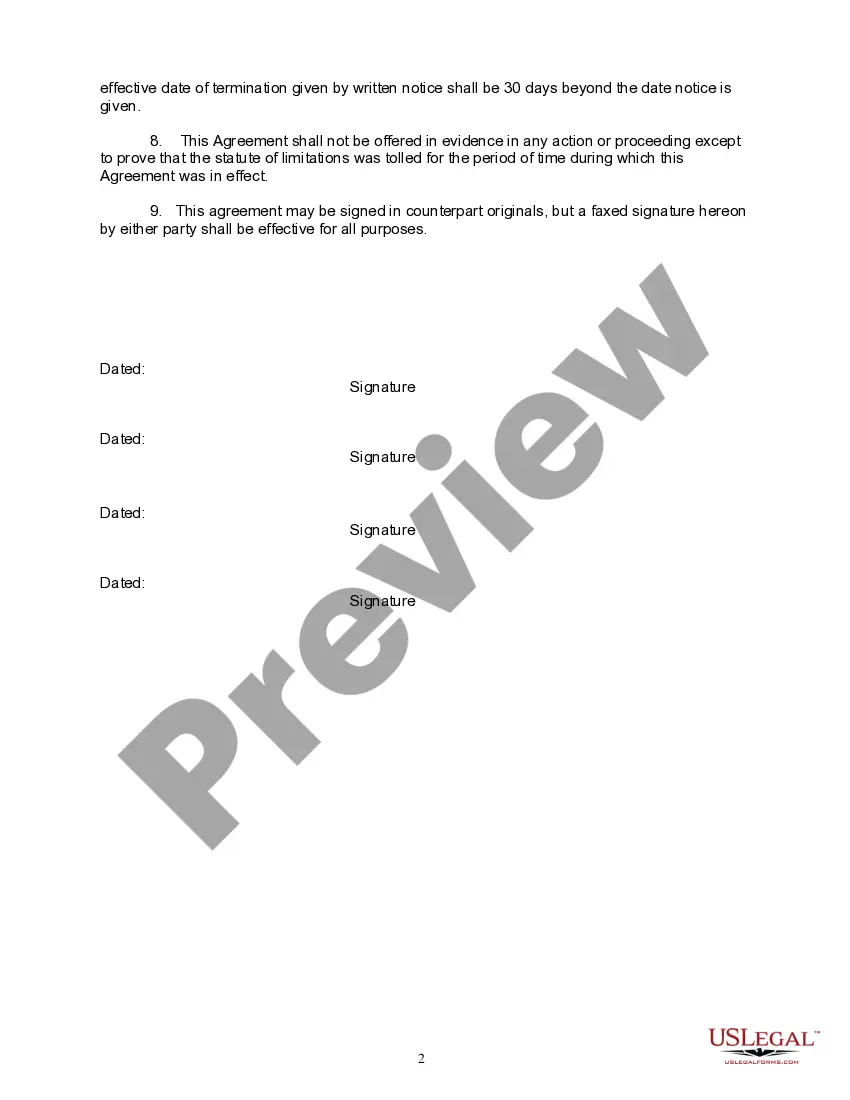
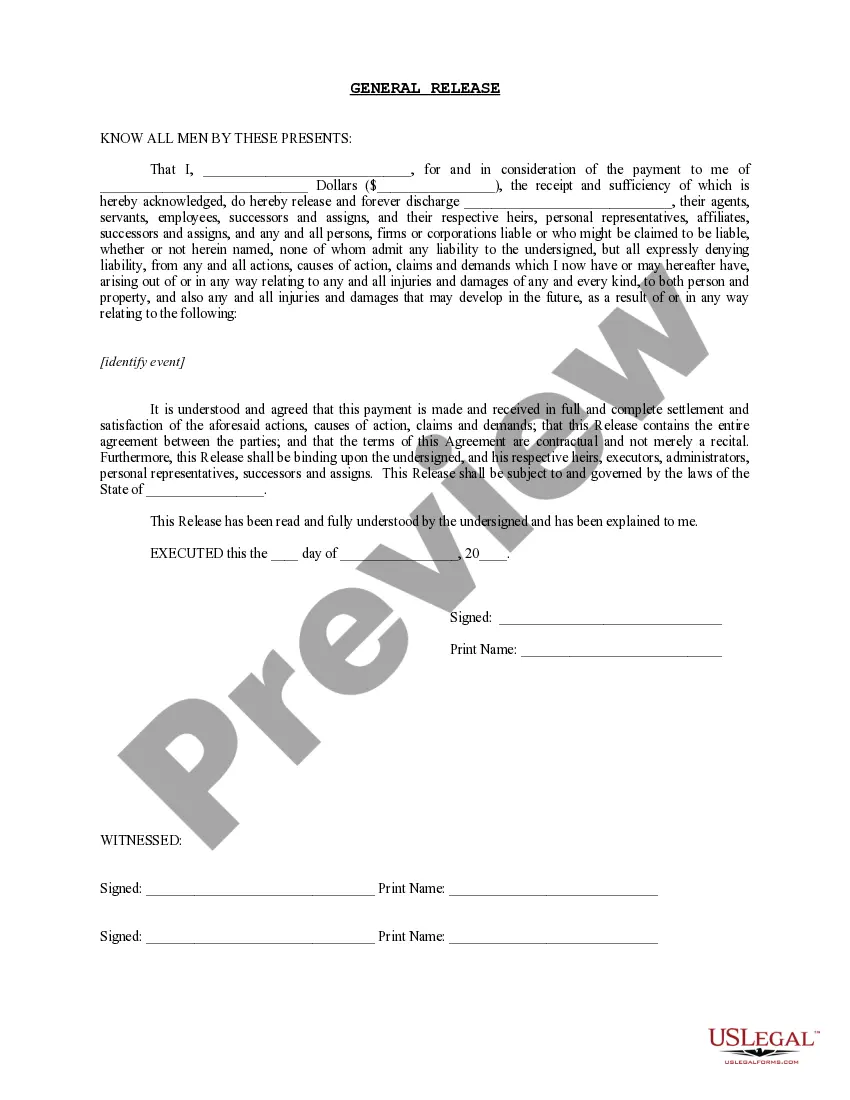

How to fill out Agreement To Toll Statute Of Limitations?
If you need to finalize, obtain, or generate legal document templates, utilize US Legal Forms, the largest compilation of legal forms available online. Take advantage of the site’s straightforward and user-friendly search to find the documents you require. A range of templates for business and personal applications are categorized by type and state, or keywords.
Utilize US Legal Forms to locate the South Dakota Agreement to Toll Statute of Limitations in just a few clicks. If you are already a US Legal Forms user, sign in to your account and click on the Download button to obtain the South Dakota Agreement to Toll Statute of Limitations. You can also access forms you previously saved in the My documents tab in your account.
If you are using US Legal Forms for the first time, refer to the instructions below: Step 1. Ensure you have selected the form for the correct state/country. Step 2. Use the Preview option to review the form’s details. Don’t forget to check the summary. Step 3. If you are dissatisfied with the form, use the Search field at the top of the screen to find other variations of the legal form template. Step 4. Once you have located the form you need, click the Purchase now button. Choose the pricing plan you prefer and enter your credentials to register for the account. Step 5. Complete the payment. You can use your credit card or PayPal account to finalize the transaction. Step 6. Select the format of your legal form and download it to your device. Step 7. Complete, edit, and print or sign the South Dakota Agreement to Toll Statute of Limitations.
Avoid altering or deleting any HTML tags. Only synonymize plain text outside of the HTML tags.
- Every legal document template you download is yours permanently.
- You will have access to every form you saved in your account.
- Click the My documents section and select a form to print or download again.
- Compete and obtain, and print the South Dakota Agreement to Toll Statute of Limitations with US Legal Forms.
- There are numerous professional and state-specific forms you can use for your business or personal needs.
Form popularity
FAQ
The 22-42-5 law in South Dakota pertains to the statute of limitations for various legal claims and actions. Specifically, it outlines the time frames within which a party must initiate legal proceedings. Understanding this law is crucial, especially when considering a South Dakota Agreement to Toll Statute of Limitations, as it can impact your ability to enforce rights. Staying informed about such regulations can empower you to take timely and effective legal action.
Yes, a tolling agreement, such as the South Dakota Agreement to Toll Statute of Limitations, can extend the time allowed to file a claim. This agreement pauses the running of the statute of limitations, providing both parties additional time to negotiate or settle. This can be particularly beneficial if circumstances arise that require more time for resolution. Using this legal tool can help you avoid the pitfalls of running out of time to pursue your claims.
The statute of limitations in South Dakota varies depending on the type of claim. For most civil cases, including contract disputes, the statute is six years. However, utilizing a South Dakota Agreement to Toll Statute of Limitations can effectively pause this clock, giving you breathing room to resolve issues without the pressure of immediate legal deadlines. It's essential to consult legal resources or professionals to ensure you stay informed about your rights.
In South Dakota, a debt becomes uncollectible after a specific period defined by the statute of limitations. Generally, this period is six years for most debts, including personal loans and credit cards. However, the South Dakota Agreement to Toll Statute of Limitations can extend this timeframe, allowing parties to negotiate more favorable terms. Understanding these timelines can help you manage your financial obligations better.
The one bite rule in South Dakota refers to a legal principle that holds dog owners liable for injuries caused by their dogs only after the owner has had prior knowledge of the dog's aggressive behavior. Essentially, if a dog has not previously bitten someone, the owner may not be held responsible for the first incident. This rule emphasizes the importance of awareness in liability cases. If you are dealing with a situation related to dog bites, understanding the South Dakota Agreement to Toll Statute of Limitations can be crucial in managing your legal options.
The second chance law in South Dakota provides individuals with the opportunity to have certain criminal convictions expunged under specific conditions. This law helps people move forward by clearing their records, which can improve their chances of employment and housing opportunities. It aligns with the South Dakota Agreement to Toll Statute of Limitations, allowing parties more time to address legal matters effectively. If you need assistance navigating this process, consider using the US Legal Forms platform for reliable resources and templates.
According to the Florida Statutes, the statute of limitations for most breach of contract lawsuits is five years. This means that if the non-breaching party takes more than five years to file a lawsuit after the breach occurred, the breaching party can use a statute of limitations defense to have the lawsuit dismissed.
Normally, the statute of limitations in South Carolina is three years for personal injuries. However, it doesn't start for three more years until the boy is 18 years old. Therefore, he has until he is 21 years old to sue the person who hit him with a car. Another reason the time limit may be extended is disability.
In South Dakota, you have three years to file a lawsuit over an accident or personal injury. The clock starts running on the date of the accident or incident that caused the harm. It's very important to know when the statute of limitations on your case ends and to make sure your suit gets filed before that deadline.
In Florida, however, under Florida Statutes section 95.03, parties are unable to alter the default statutes of limitations. This means that parties cannot lengthen or shorten the amount of time either party has to file a case against the other.