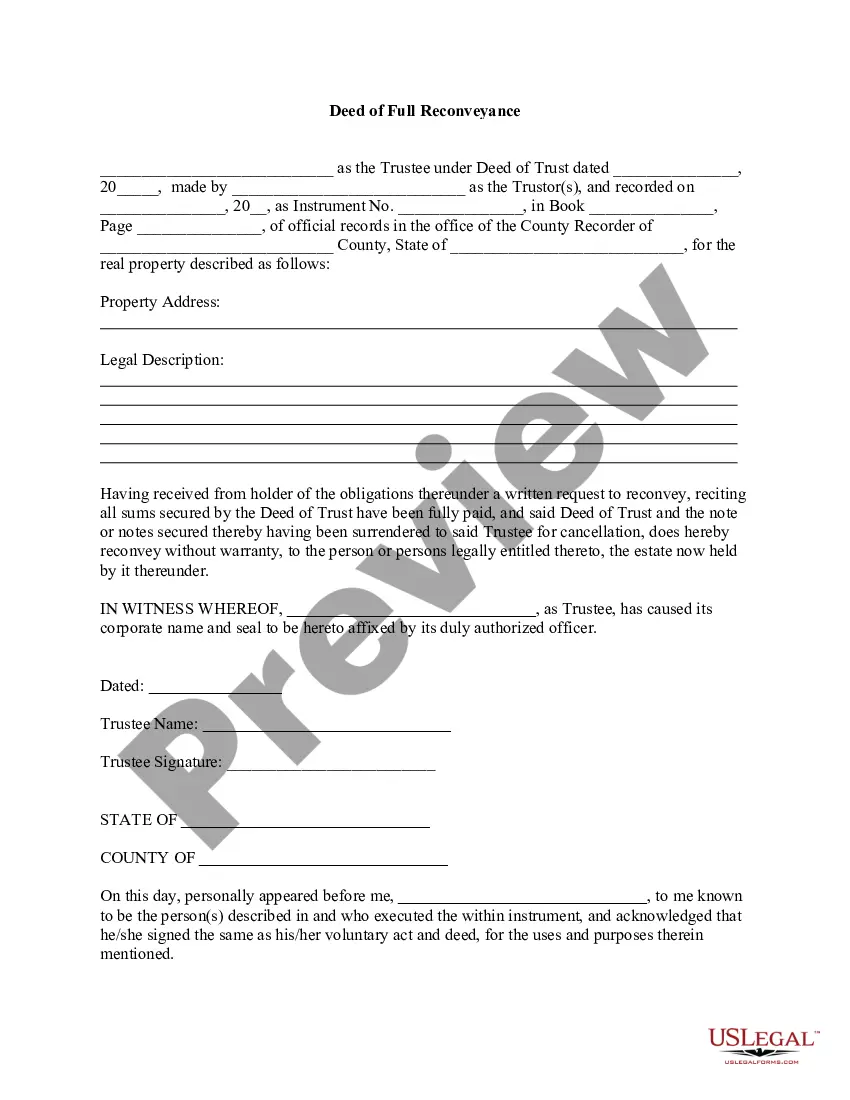
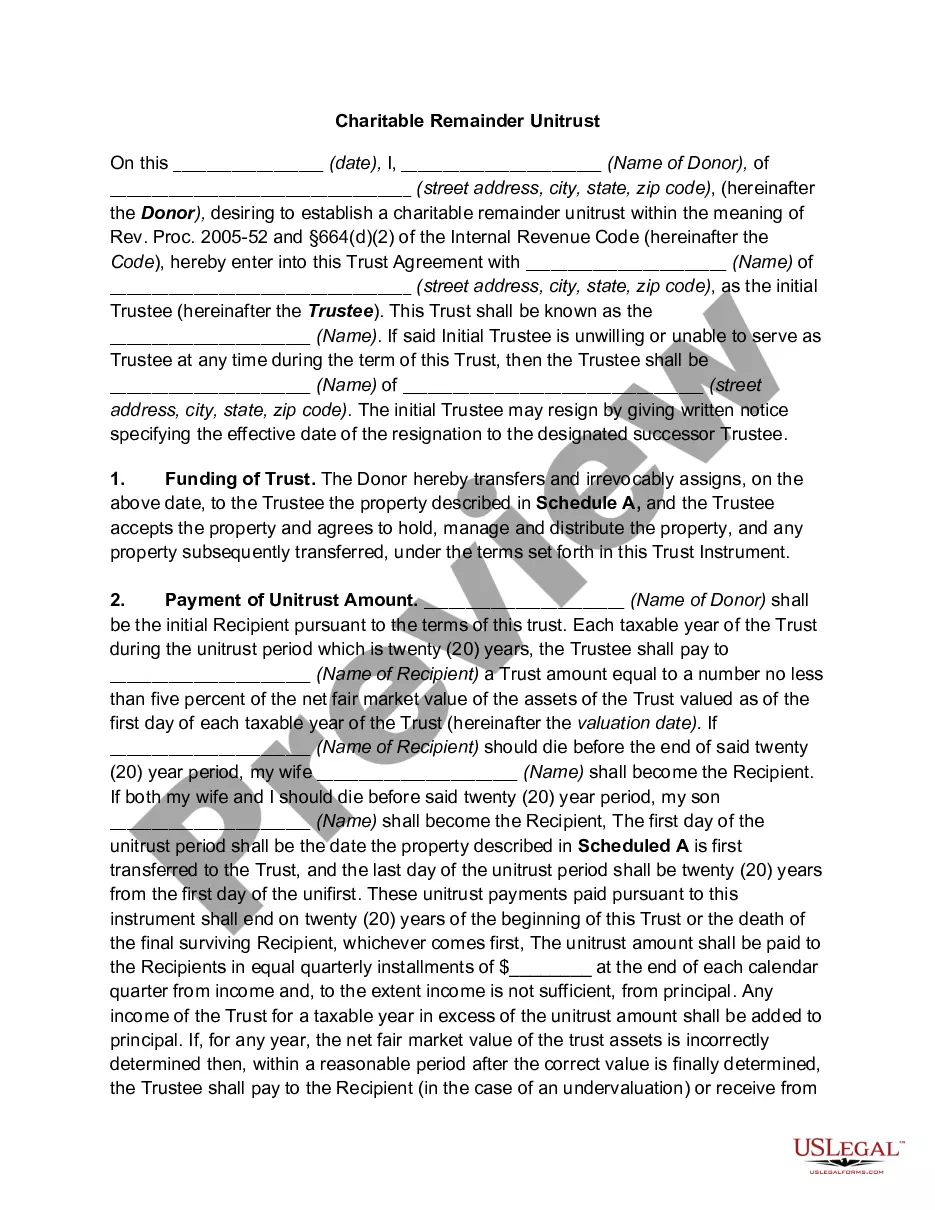
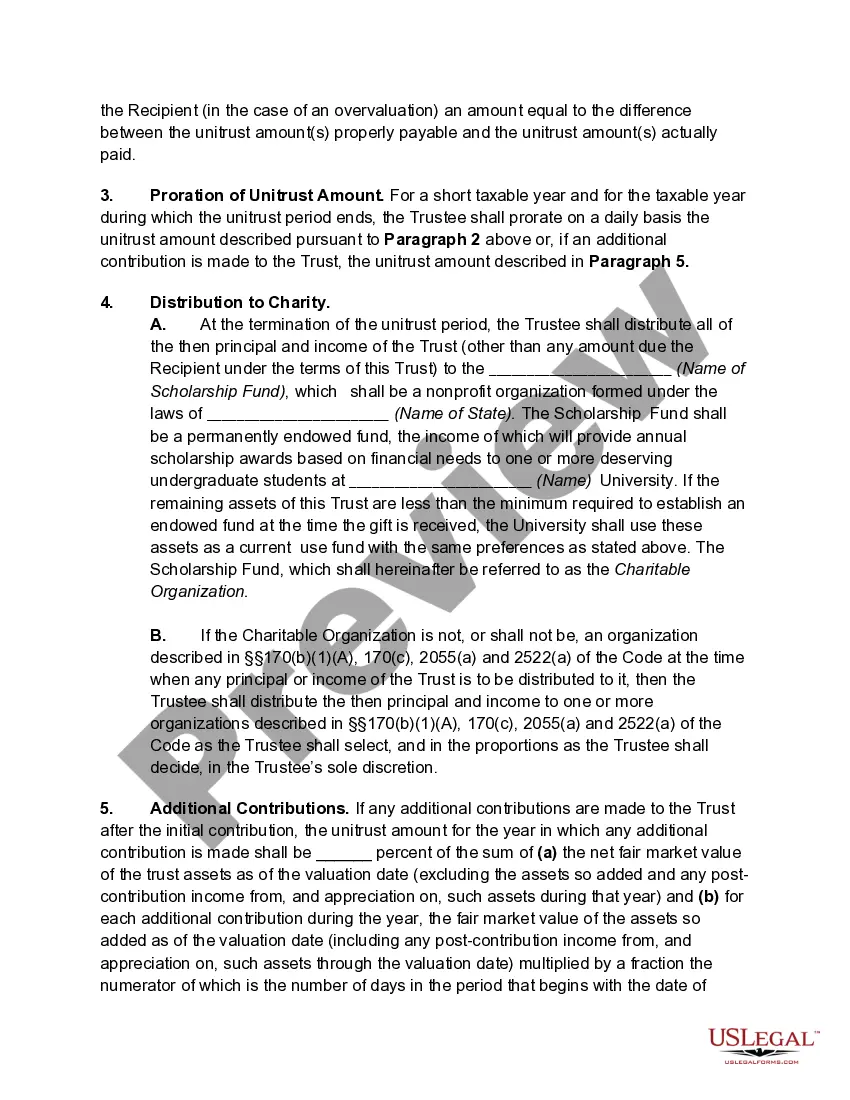
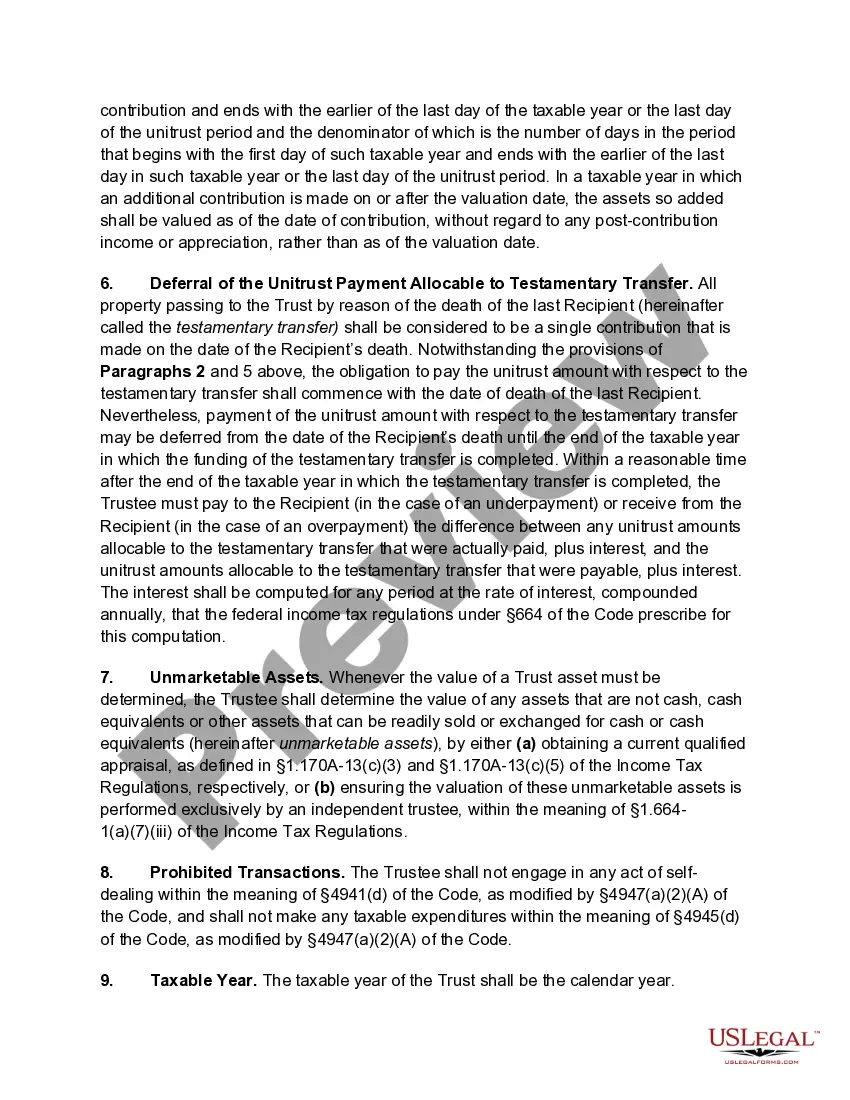
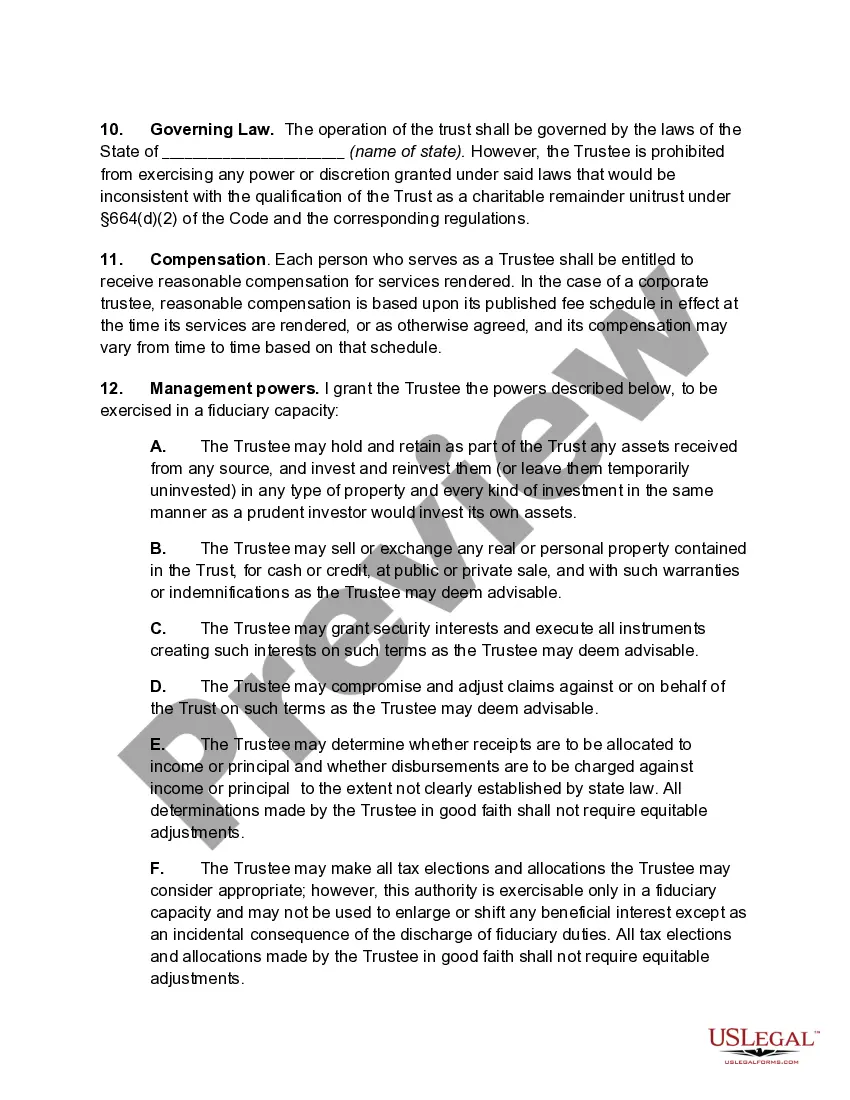
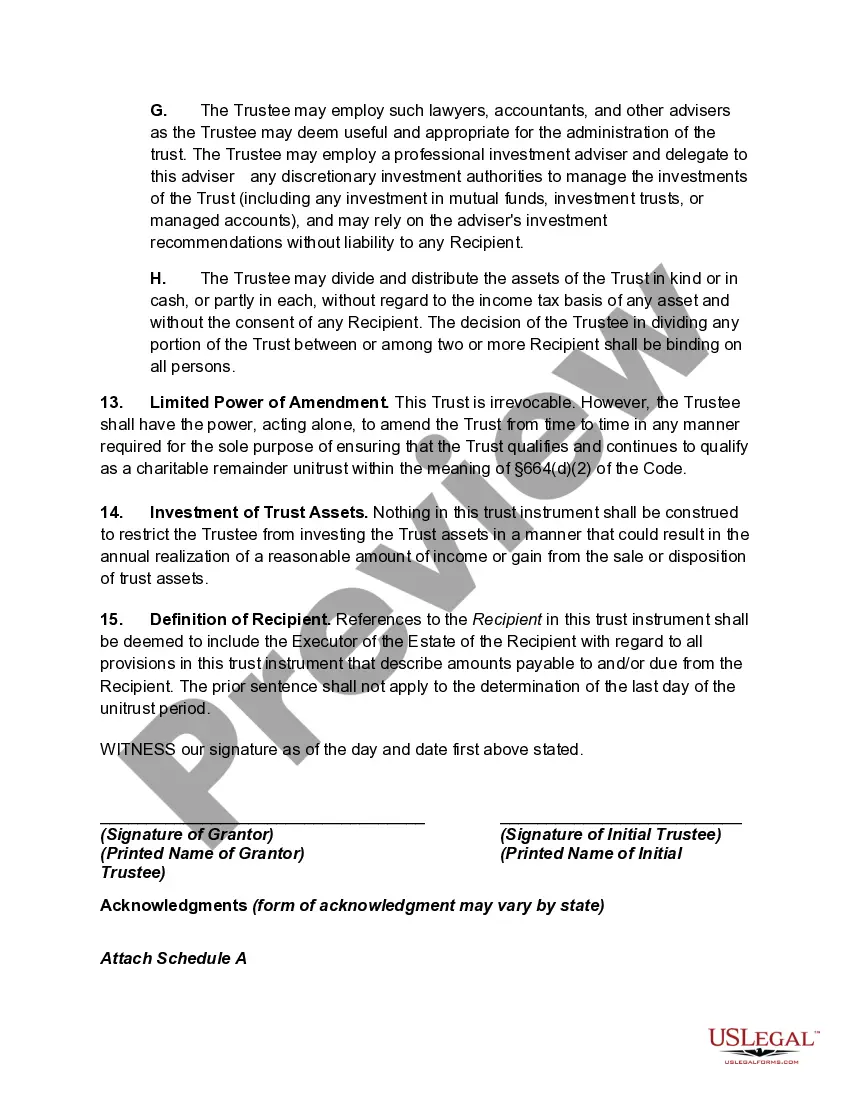
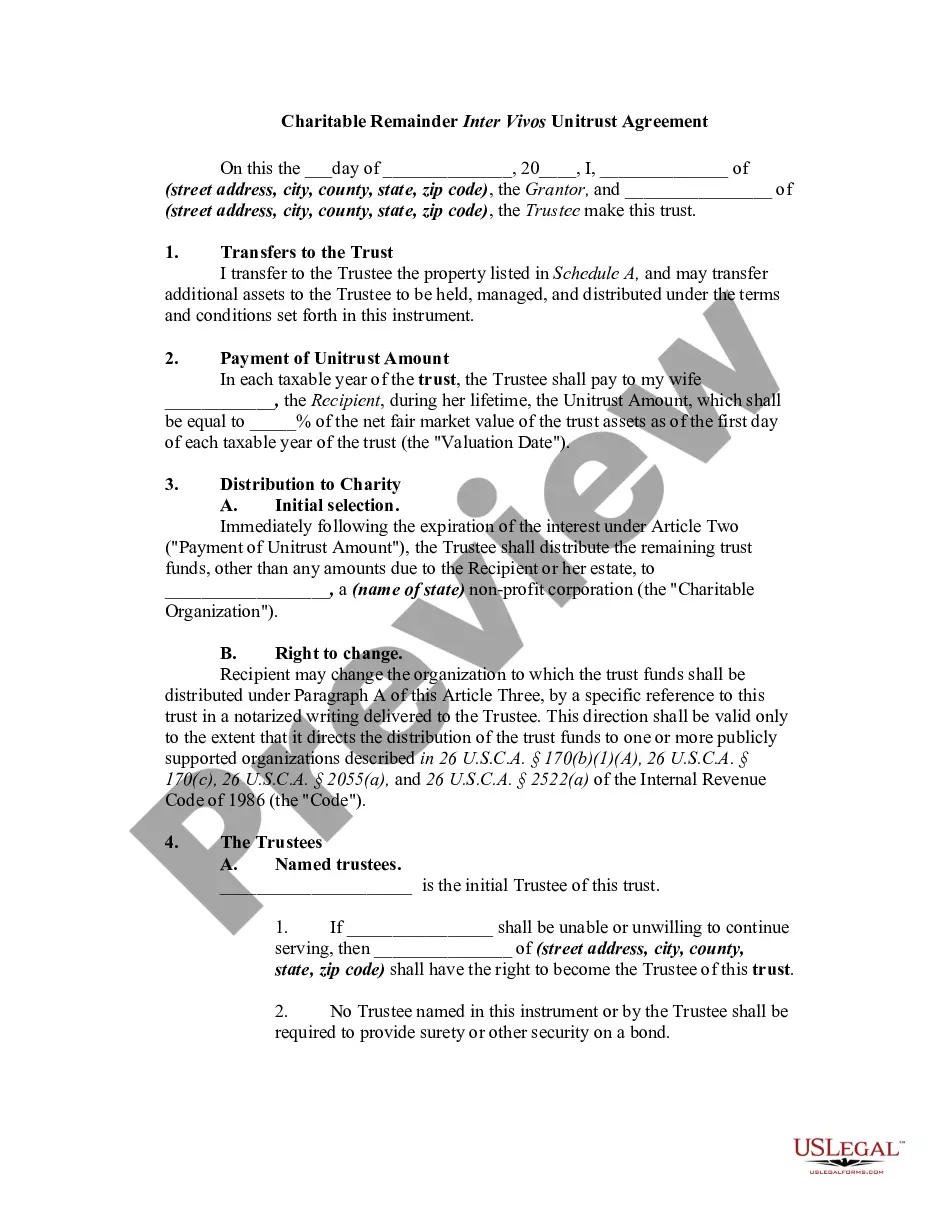
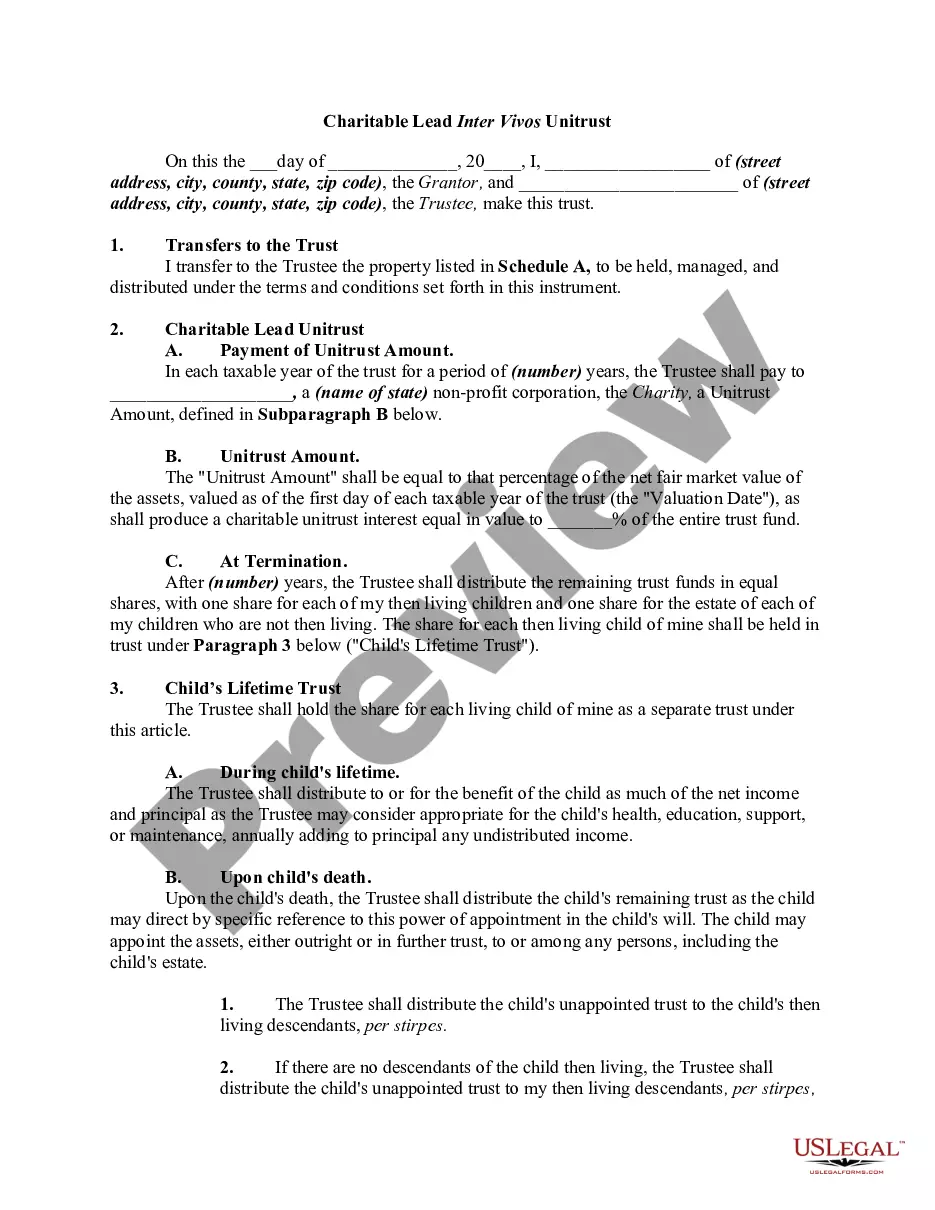
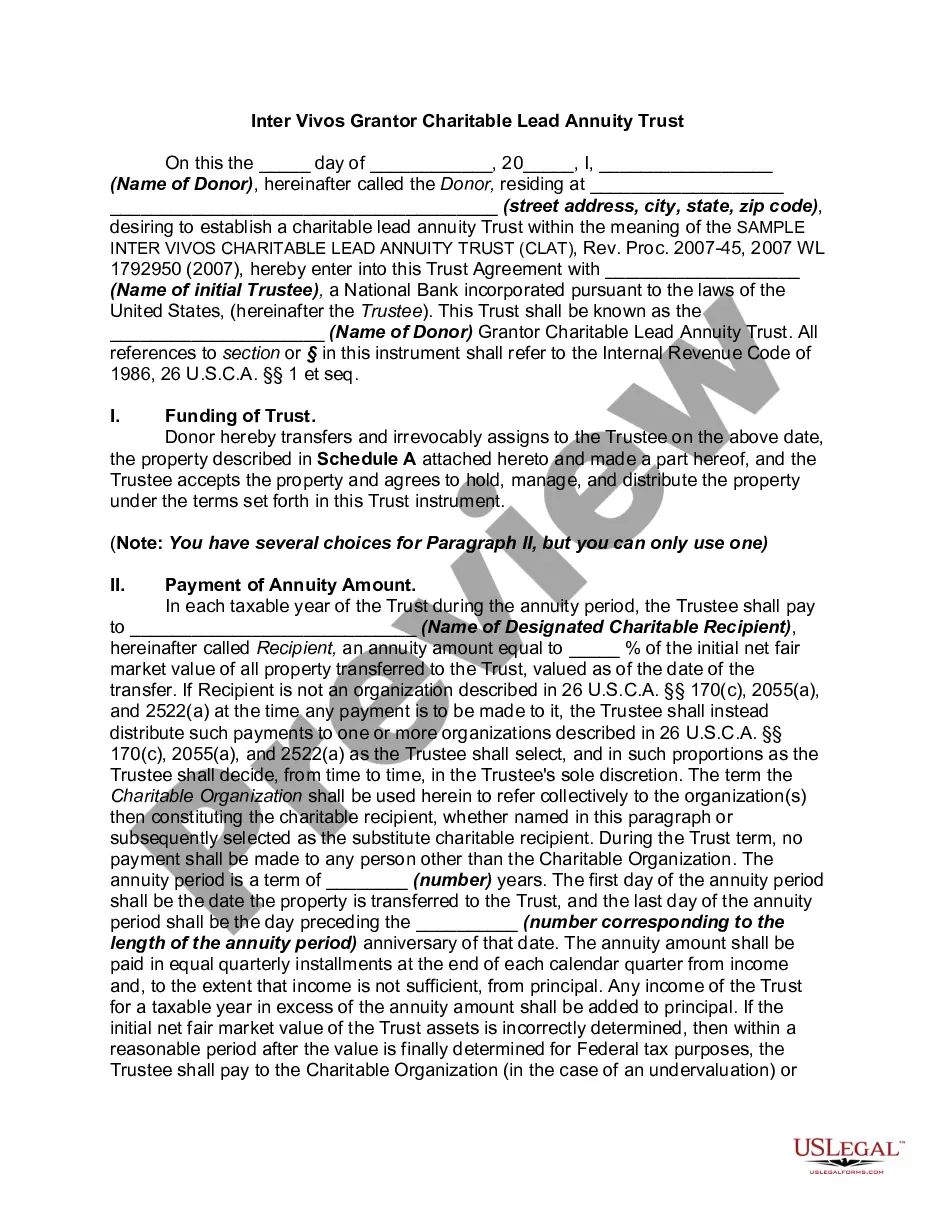
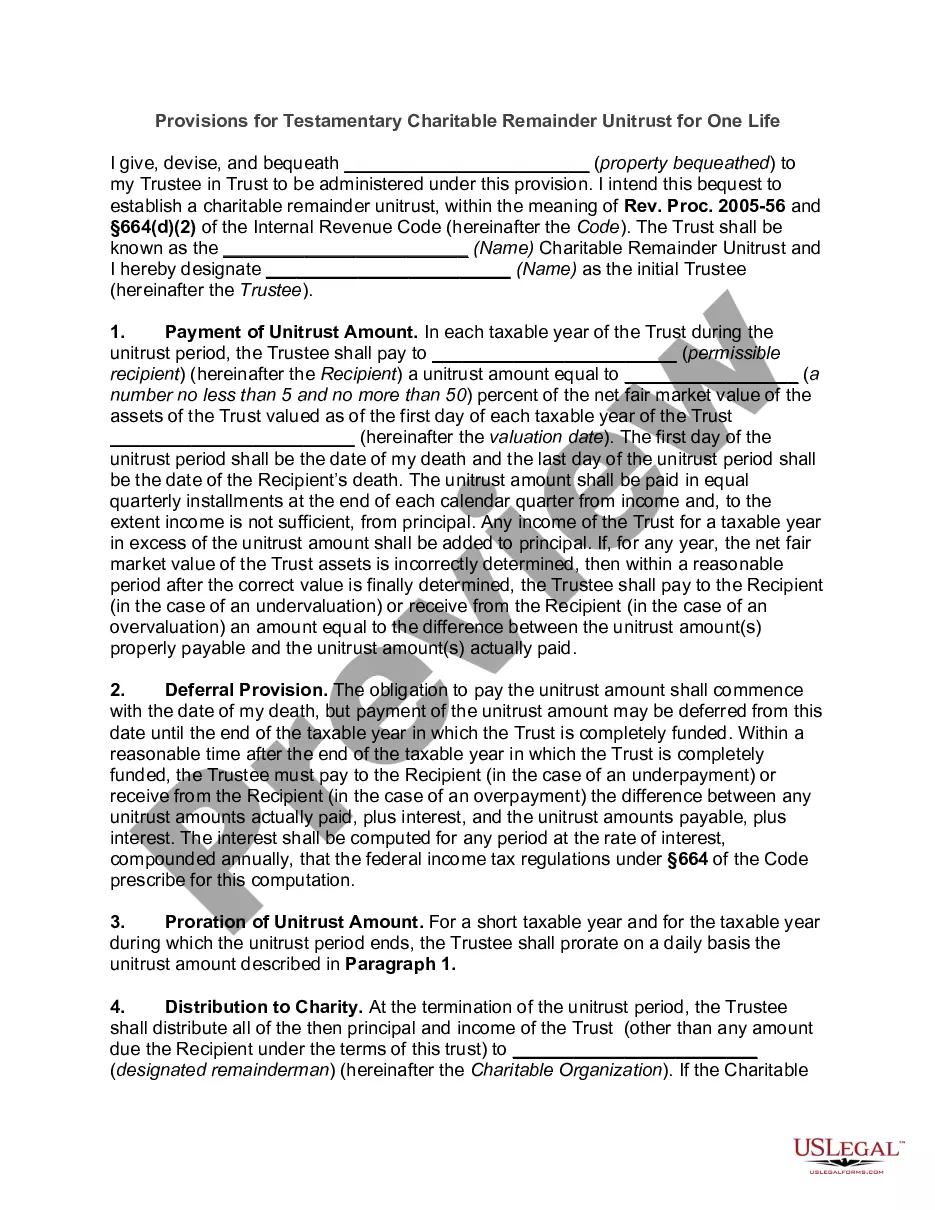
A Unitrust refers to a trust from which a fixed percentage of the net fair market value of the trusts assets valued annually, is paid each year to a beneficiary. In these trusts, the donor transfers property to a trust after retaining the right to receive payments from the trust for a specified term. Once the term ends, the trust estate is paid to a public charity designated by the donor. During a unitrust's term, a trustee invests the unitrust's assets and pays a fixed percentage of the unitrust's current value, as determined annually, to the income beneficiaries. If the unitrust's value goes up, its payout increases proportionately. Likewise, if the unitrust's value goes down, the amount it distributes also declines. Payments must be at least five percent of the trust's annual value and are made out of trust income, or trust principal if income is not adequate.
South Dakota Charitable Remainder Unitrust
Description

Get your form ready online
Our built-in tools help you complete, sign, share, and store your documents in one place.
Make edits, fill in missing information, and update formatting in US Legal Forms—just like you would in MS Word.
Download a copy, print it, send it by email, or mail it via USPS—whatever works best for your next step.
Sign and collect signatures with our SignNow integration. Send to multiple recipients, set reminders, and more. Go Premium to unlock E-Sign.
If this form requires notarization, complete it online through a secure video call—no need to meet a notary in person or wait for an appointment.
We protect your documents and personal data by following strict security and privacy standards.

Make edits, fill in missing information, and update formatting in US Legal Forms—just like you would in MS Word.

Download a copy, print it, send it by email, or mail it via USPS—whatever works best for your next step.

Sign and collect signatures with our SignNow integration. Send to multiple recipients, set reminders, and more. Go Premium to unlock E-Sign.

If this form requires notarization, complete it online through a secure video call—no need to meet a notary in person or wait for an appointment.

We protect your documents and personal data by following strict security and privacy standards.
Looking for another form?
How to fill out Charitable Remainder Unitrust?
Selecting the appropriate valid document format can be a challenge.
Of course, there are numerous templates accessible online, but how do you find the correct type you seek.
Use the US Legal Forms website. This service offers thousands of templates, such as the South Dakota Charitable Remainder Unitrust, which you can utilize for both business and personal purposes.
If you are a new user of US Legal Forms, here are simple steps for you to follow: First, ensure you have selected the correct type for your city/county. You can review the form using the Review button and examine the form summary to confirm it is the right one for you.
- All the forms are verified by experts and comply with state and federal regulations.
- If you are already a member, sign in to your account and click the Download button to access the South Dakota Charitable Remainder Unitrust.
- Leverage your account to browse the legitimate forms you have previously ordered.
- Go to the My documents section of your account to retrieve another copy of the document you need.
Form popularity
FAQ
A charitable remainder unitrust (also called a CRUT) is an estate planning tool that provides income to a named beneficiary during the grantor's life and then the remainder of the trust to a charitable cause. The donor or members of the donor's family are usually the initial beneficiaries.
CRUT lie in what the trust pays out on a yearly basis and whether additional contributions are permitted once the trust has been created. With a CRAT, the annuity amount paid each year is fixed. Once you establish a CRAT and make the initial contribution, no further contributions are allowed.
How to Set up a Charitable Remainder TrustCreate a Charitable Remainder Trust.Check with the IRS that the charity you want to benefit is approved.Transfer assets into the Trust.Name the charity as Trustee.Create a provision that states who the lead beneficiary is - remember, this can be yourself or someone else.More items...
These trusts, which cost around $1,000 to set up, can be prepared by any attorney familiar with estate planning.
Any income that you receive from your charitable trust could reduce the total contribution that you end up leaving to your charity. You may risk leaving nothing to your charity if you plan to receive high payments from the trust while you're alive.
A charitable remainder trust is a tax-exempt irrevocable trust designed to reduce the taxable income of individuals. A charitable remainder trust dispenses income to one or more noncharitable beneficiaries for a specified period and then donates the remainder to one or more charitable beneficiaries.
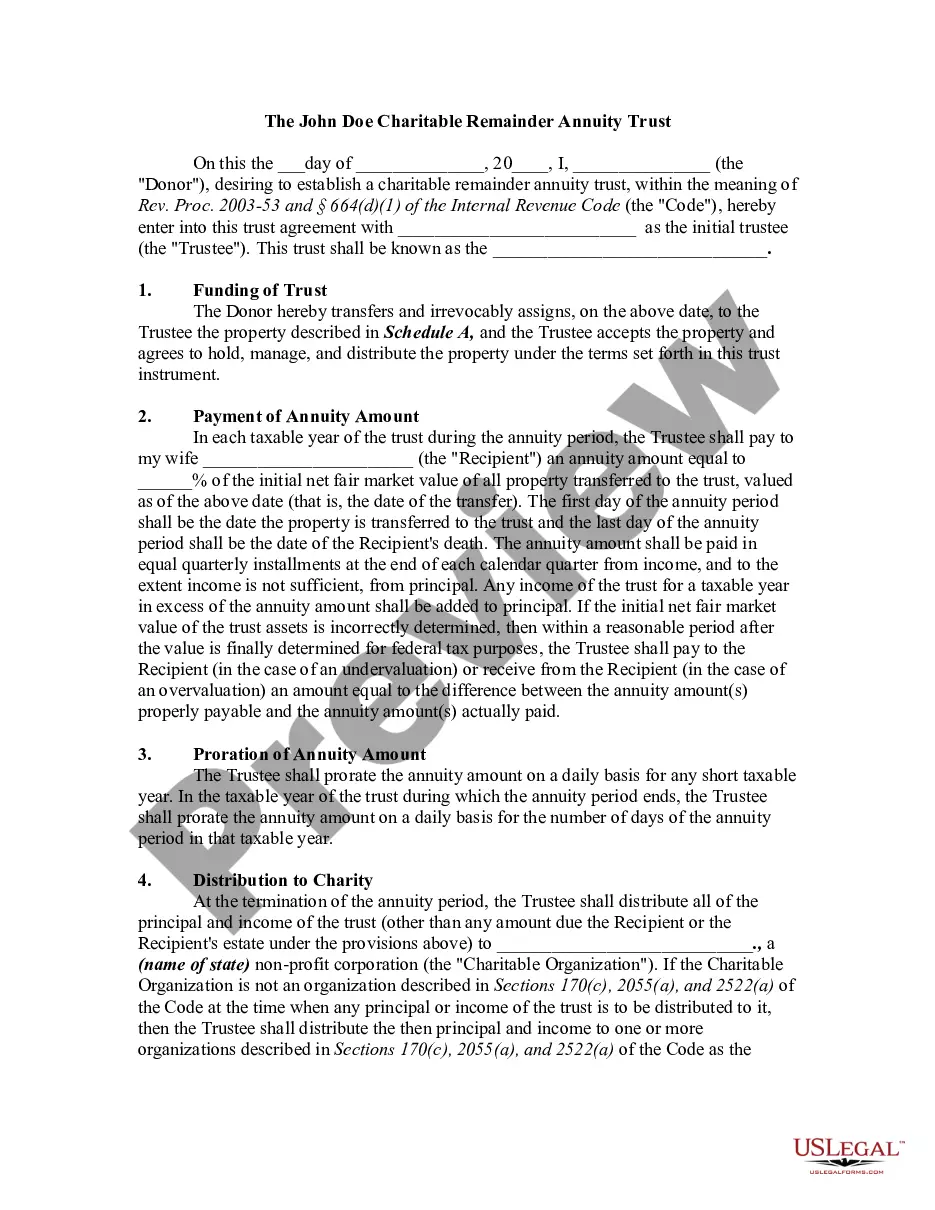
Charitable remainder annuity trusts (CRATs) distribute a fixed annuity amount each year, and additional contributions are not allowed. Charitable remainder unitrusts (CRUTs) distribute a fixed percentage based on the balance of the trust assets (revalued annually), and additional contributions can be made.
Any income that you receive from your charitable trust could reduce the total contribution that you end up leaving to your charity. You may risk leaving nothing to your charity if you plan to receive high payments from the trust while you're alive.
The minimum funding amount to establish a charitable remainder unitrust with Stanford as trustee is at least $200,000, with the actual minimum determined based on the term of the trust and the payout rate.
Yes, in most cases you can name yourself (and/or spouse) as trustee. As a matter of fact, according to a recent IRS Statistics of Income Bulletin, trust grantors or beneficiaries were the most common listed trustee of charitable remainder trusts.