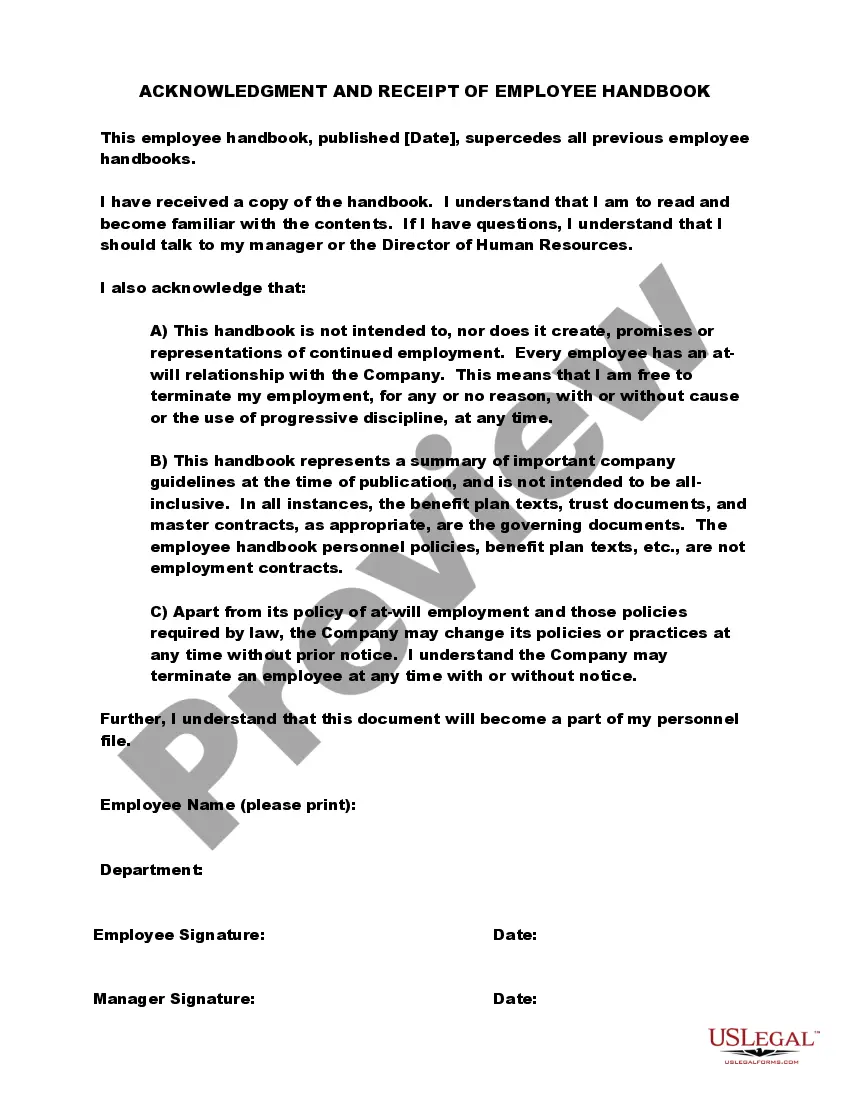
South Carolina Acknowledgment and Receipt of Employee Handbook
Description
Get your form ready online
Our built-in tools help you complete, sign, share, and store your documents in one place.
Make edits, fill in missing information, and update formatting in US Legal Forms—just like you would in MS Word.
Download a copy, print it, send it by email, or mail it via USPS—whatever works best for your next step.
Sign and collect signatures with our SignNow integration. Send to multiple recipients, set reminders, and more. Go Premium to unlock E-Sign.
If this form requires notarization, complete it online through a secure video call—no need to meet a notary in person or wait for an appointment.
We protect your documents and personal data by following strict security and privacy standards.

Make edits, fill in missing information, and update formatting in US Legal Forms—just like you would in MS Word.

Download a copy, print it, send it by email, or mail it via USPS—whatever works best for your next step.

Sign and collect signatures with our SignNow integration. Send to multiple recipients, set reminders, and more. Go Premium to unlock E-Sign.

If this form requires notarization, complete it online through a secure video call—no need to meet a notary in person or wait for an appointment.

We protect your documents and personal data by following strict security and privacy standards.
Looking for another form?
How to fill out Acknowledgment And Receipt Of Employee Handbook?
It is feasible to spend numerous hours online seeking for the legal document template that satisfies the federal and state requirements you desire.
US Legal Forms offers a wide array of legal forms that are evaluated by experts.
You can download or print the South Carolina Acknowledgment and Receipt of Employee Handbook from our service.
Read the form description to confirm you have selected the appropriate form.
- If you already possess a US Legal Forms account, you can Log In and click the Acquire button.
- Afterwards, you can complete, modify, print, or sign the South Carolina Acknowledgment and Receipt of Employee Handbook.
- Every legal document template you purchase belongs to you permanently.
- To obtain another copy of a purchased form, navigate to the My documents tab and click the corresponding button.
- If you are using the US Legal Forms website for the first time, follow the simple instructions below.
- First, ensure you have selected the correct document template for the state/city of your choice.
Form popularity
FAQ
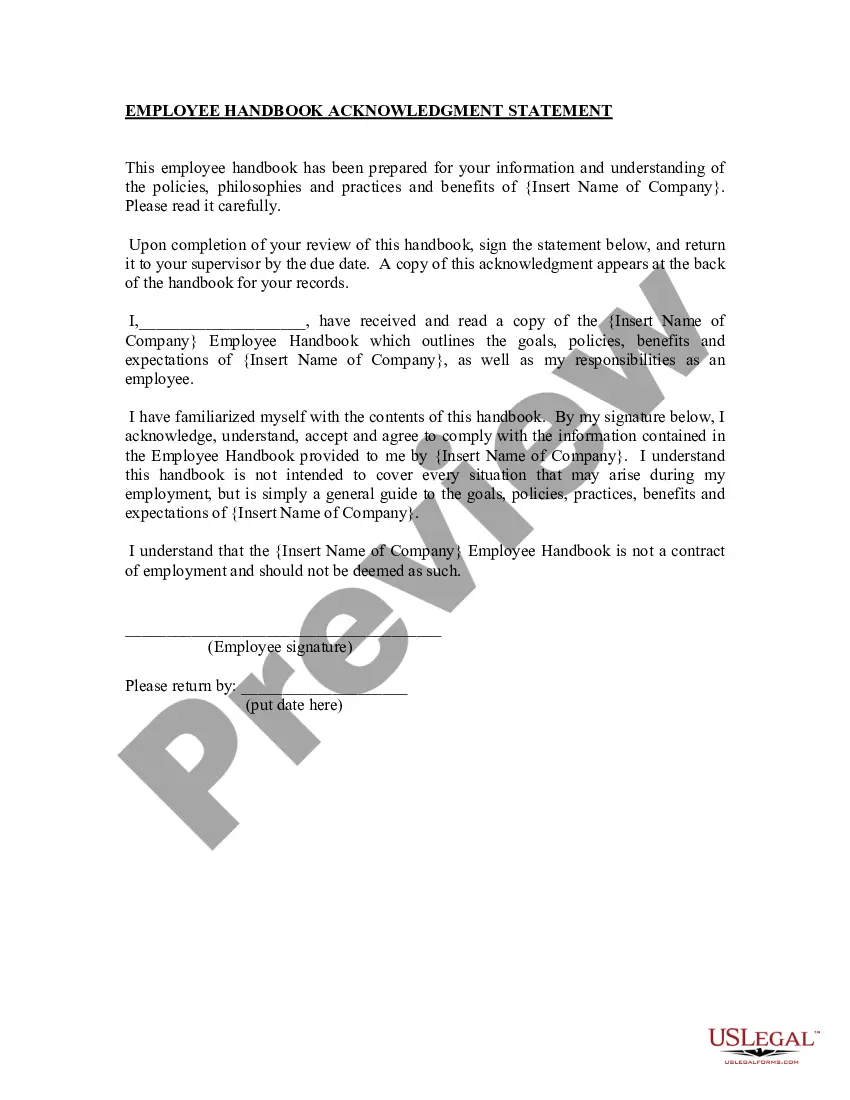
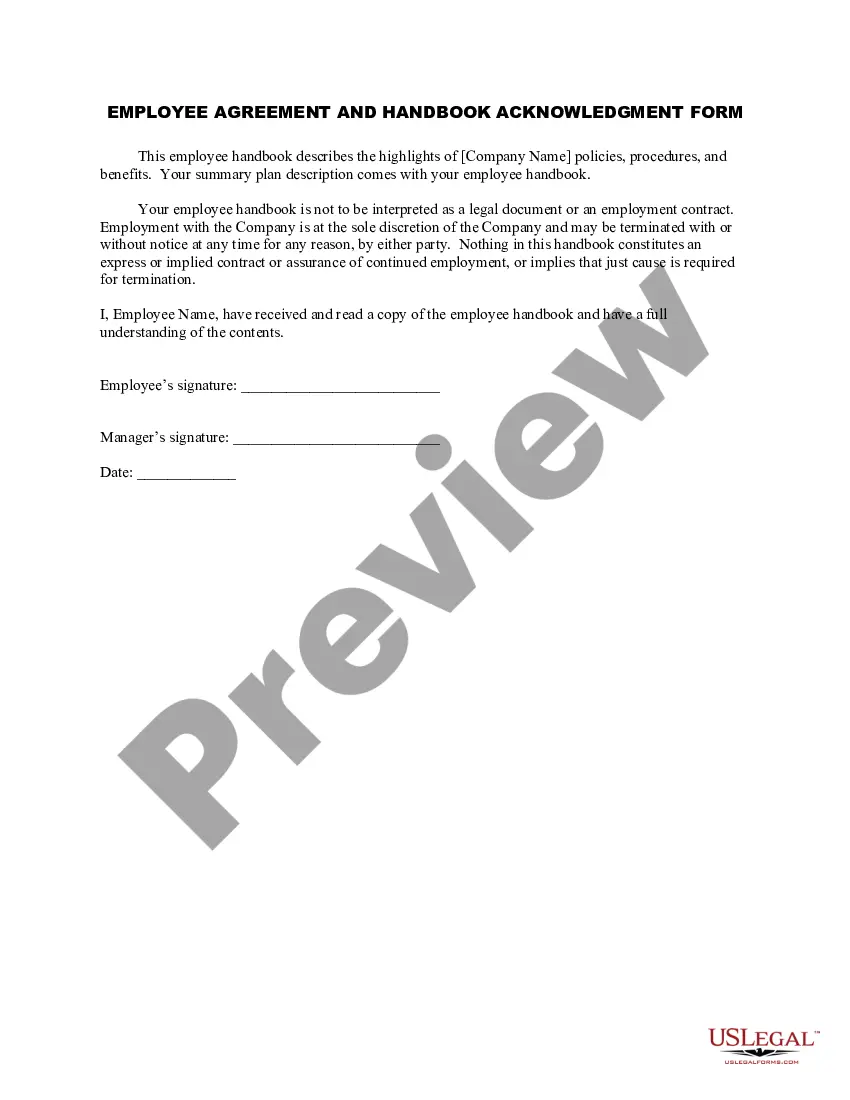
An employee handbook acknowledgement form is a document that employees sign to signify they have read, understand, and will comply with everything contained in the employee handbook. These forms should be part of the new employee onboarding process.
Start by addressing the party you are requiring to have read your policies, explain which document they are acknowledging, share your expectations regarding the implementation of the policies, and include an area for a signature. It's not as complicated as you may have thought, but it's important!
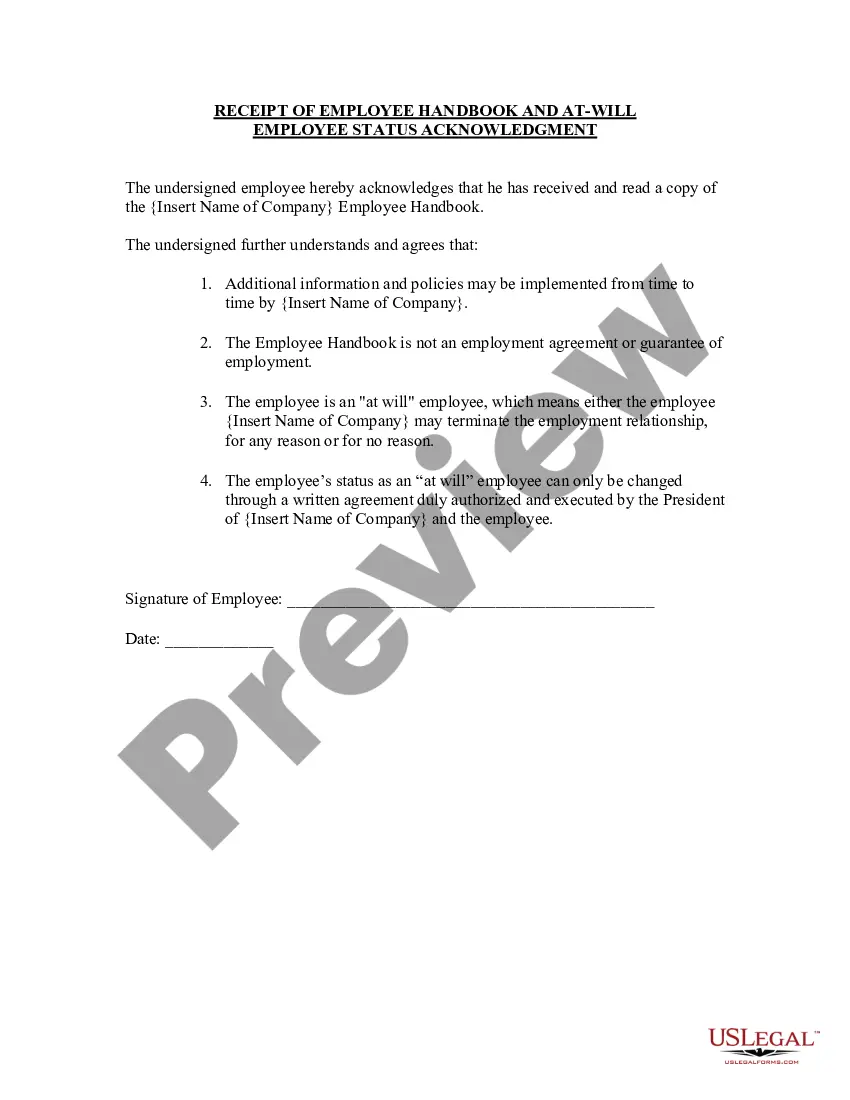
Though not required by law, employers should make every effort to receive signed handbook acknowledgments from all employees when first hired and at any time the handbook is updated.
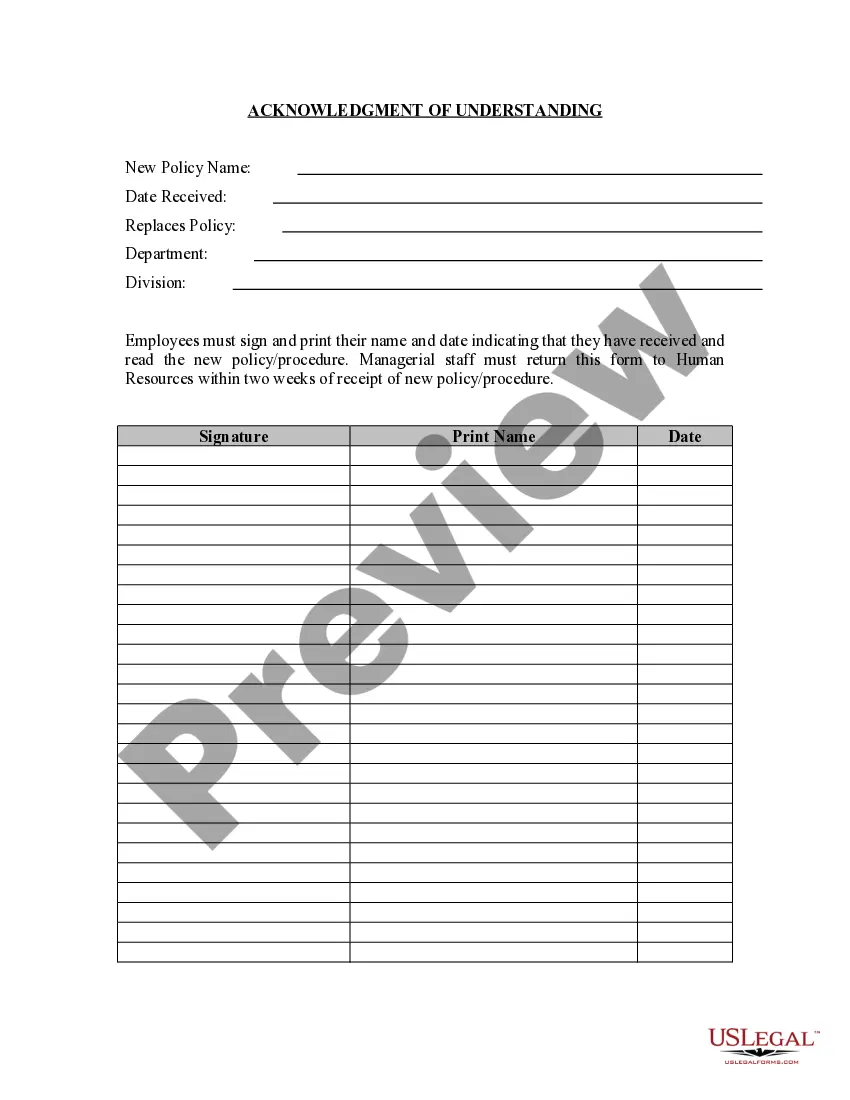
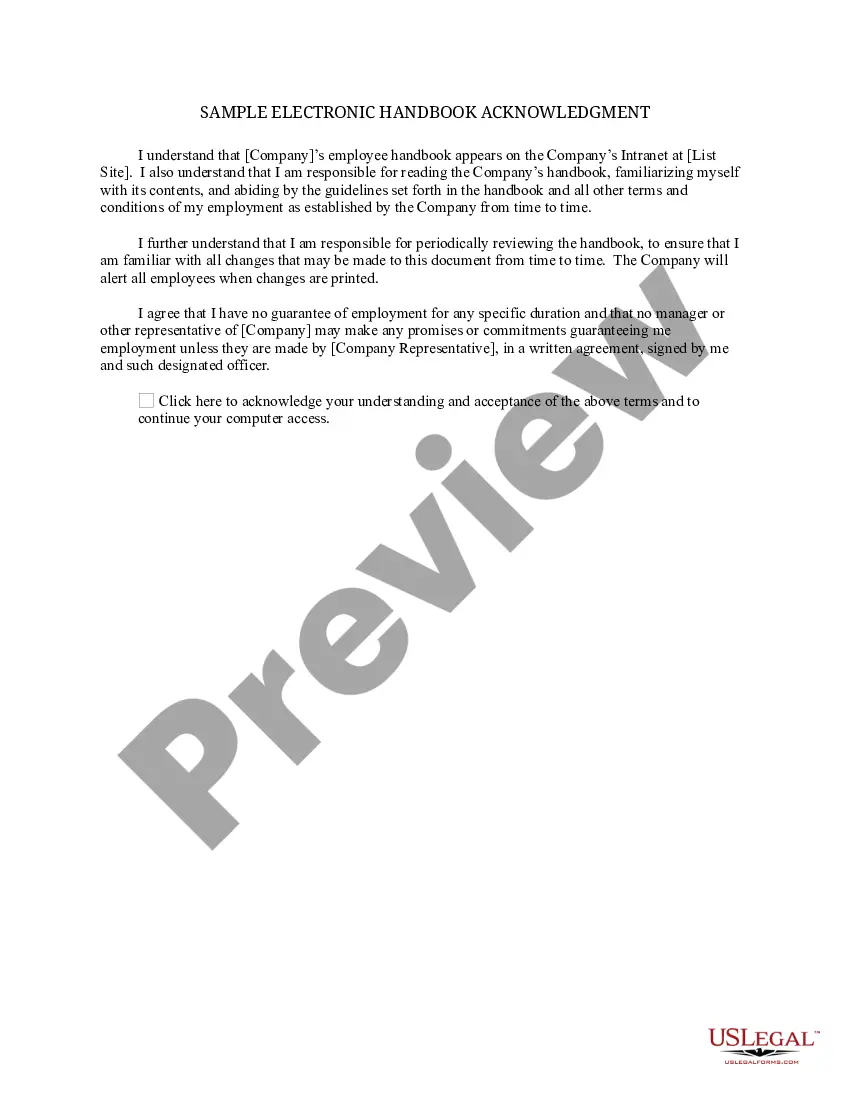
An employee acknowledgement or policy acknowledgement form is a simple form employees are asked to sign to acknowledge that they have reviewed and understood the company's policies as expressed in onboarding material, the employee handbook, or documentation announcing policy changes.
"Thank you for recognizing my hard work. I'm glad the project was a success and I enjoyed being part of it." "Thank you so much! I appreciate your recognition.
An employee handbook acknowledgement form is a document that employees sign to signify they have read, understand, and will comply with everything contained in the employee handbook. These forms should be part of the new employee onboarding process.
I acknowledge that I have received a copy of the (Your Company Name) Employee Handbook dated: (date). I understand that this employee handbook replaces any and all prior verbal and written communications regarding (Your Company Name) working conditions, policies, procedures, appeal processes, and benefits.
An employee acknowledgement or policy acknowledgement form is a simple form employees are asked to sign to acknowledge that they have reviewed and understood the company's policies as expressed in onboarding material, the employee handbook, or documentation announcing policy changes.
Though not required by law, employers should make every effort to receive signed handbook acknowledgments from all employees when first hired and at any time the handbook is updated.
I acknowledge that I have received a copy of the (Your Company Name) Employee Handbook dated: (date). I understand that this employee handbook replaces any and all prior verbal and written communications regarding (Your Company Name) working conditions, policies, procedures, appeal processes, and benefits.