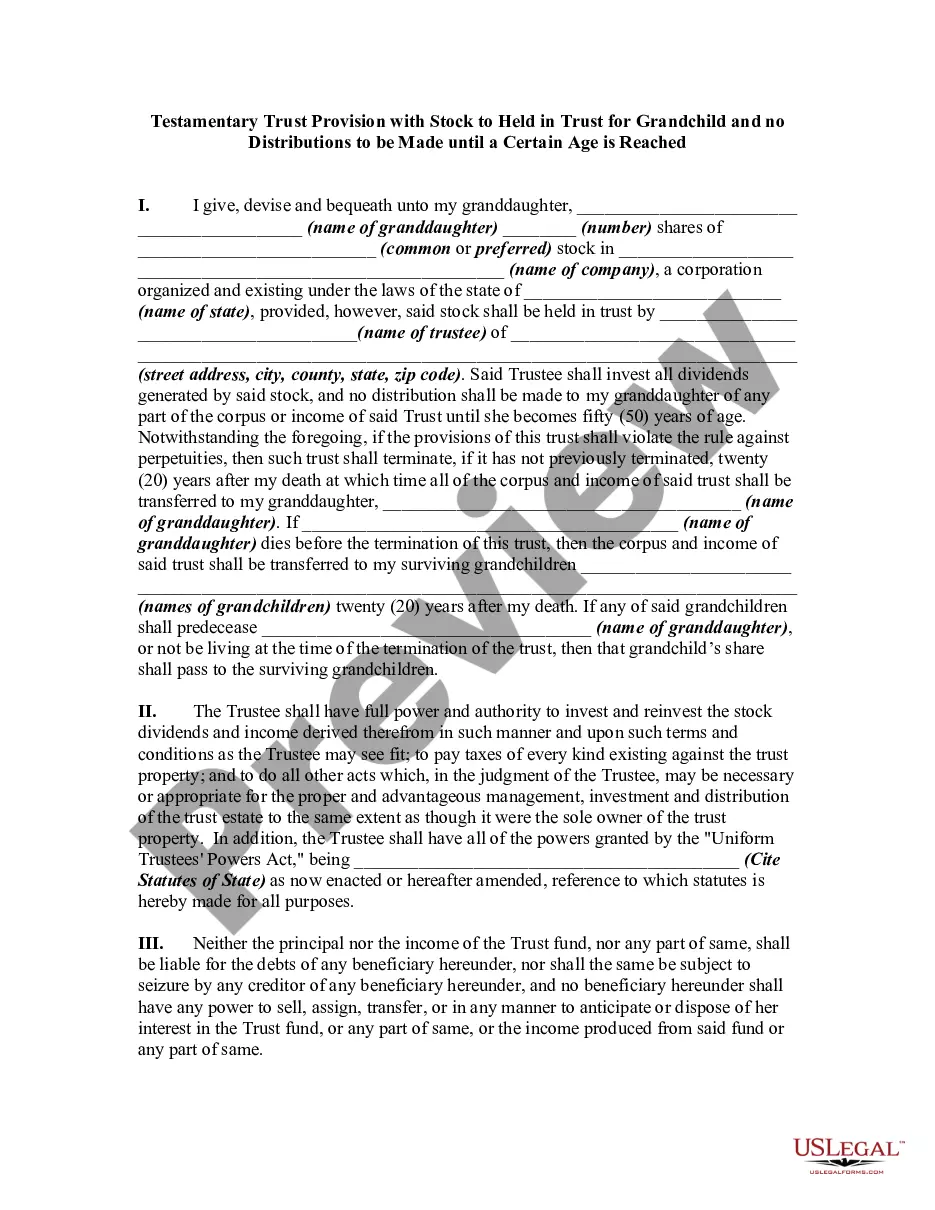
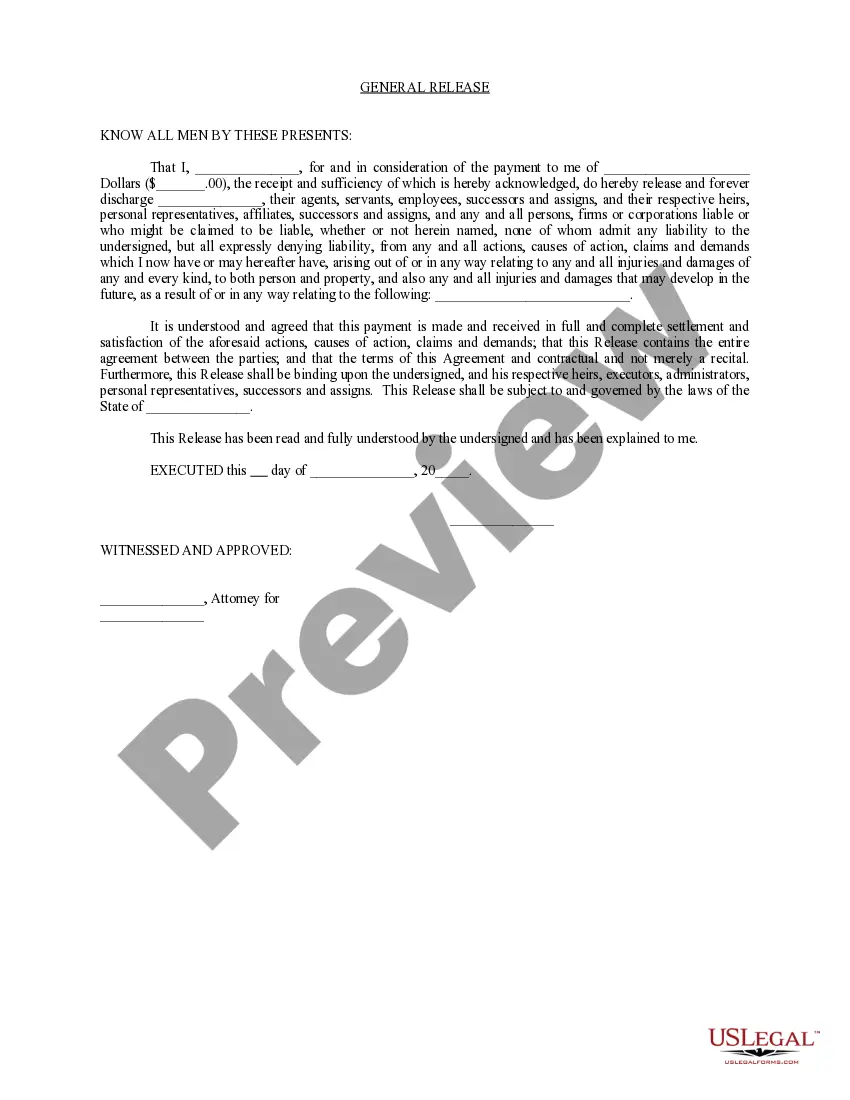
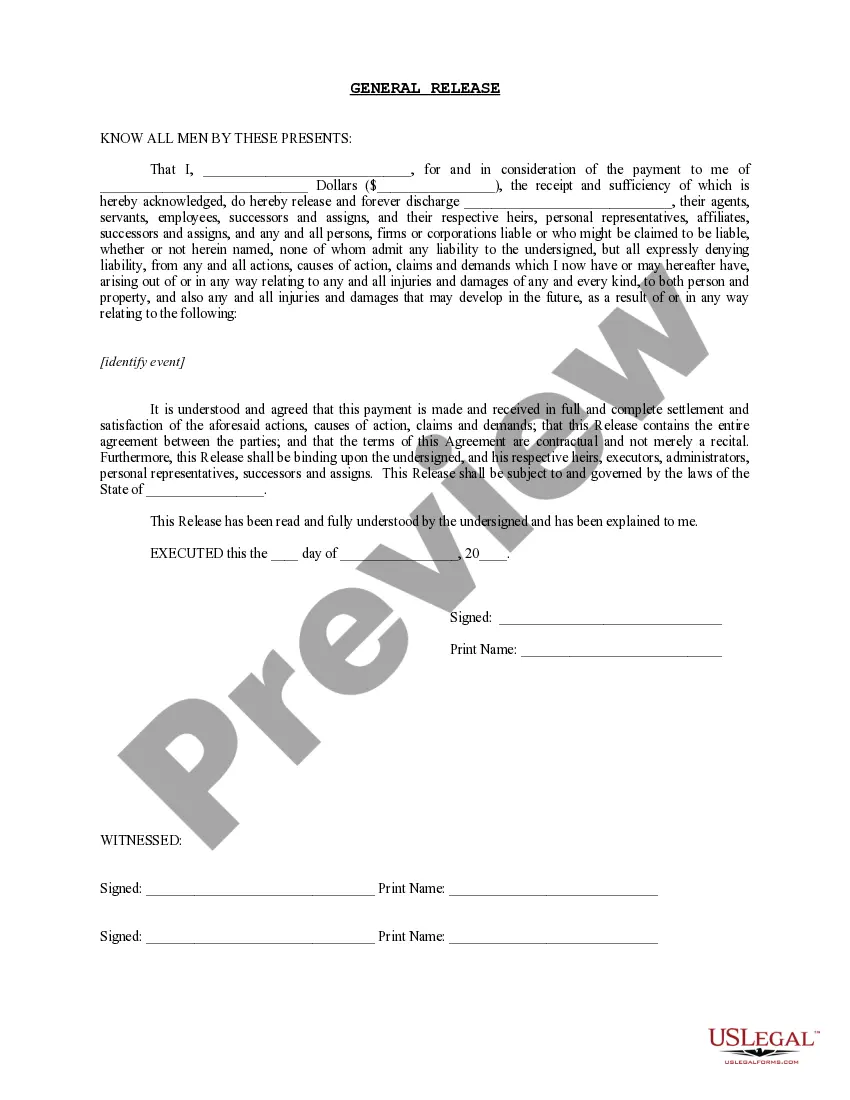
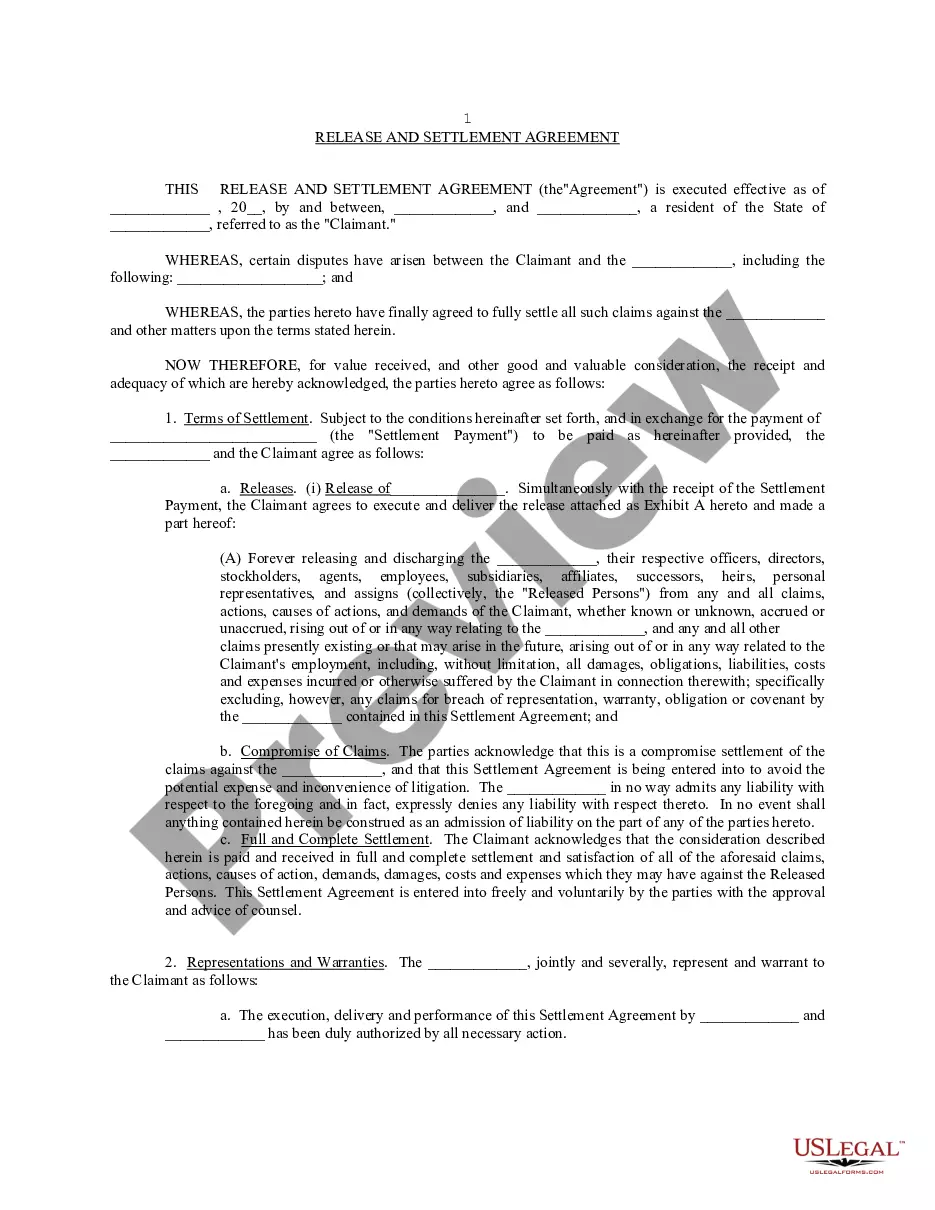
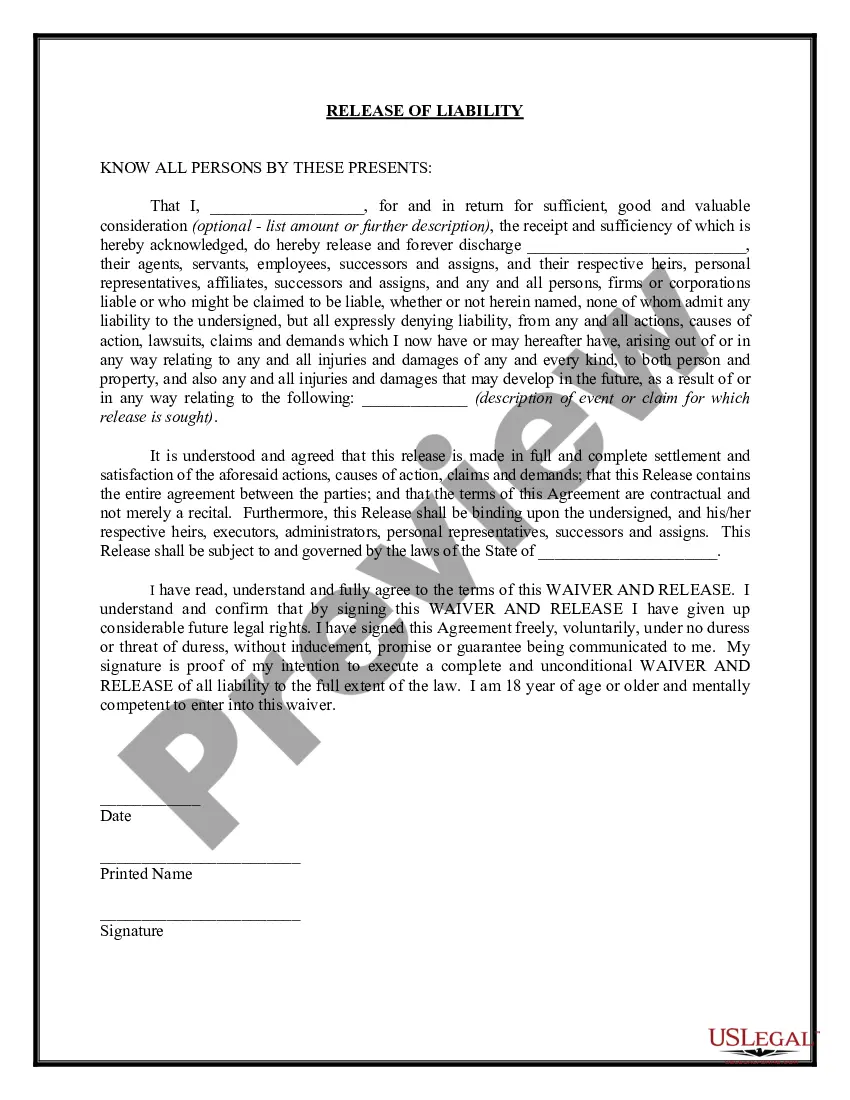
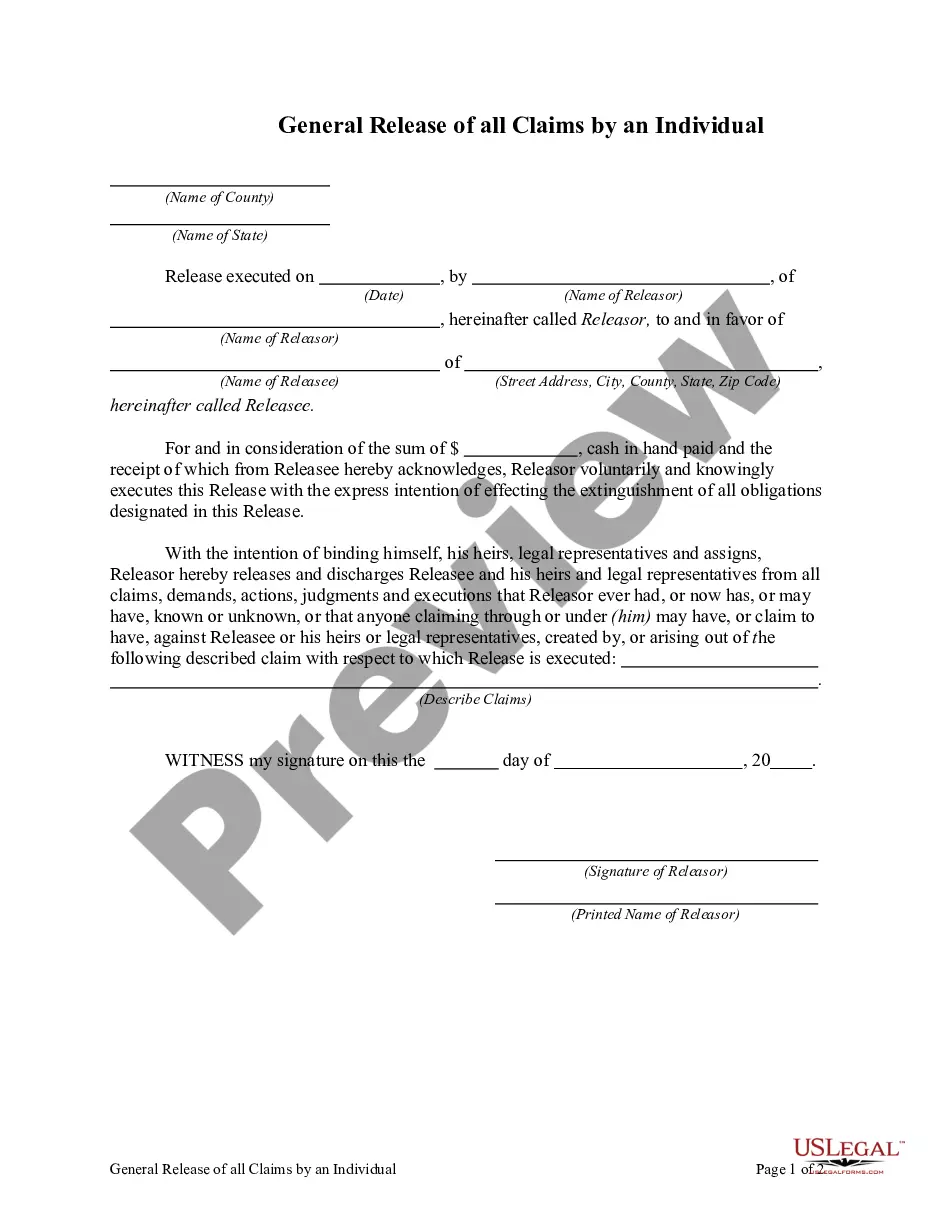
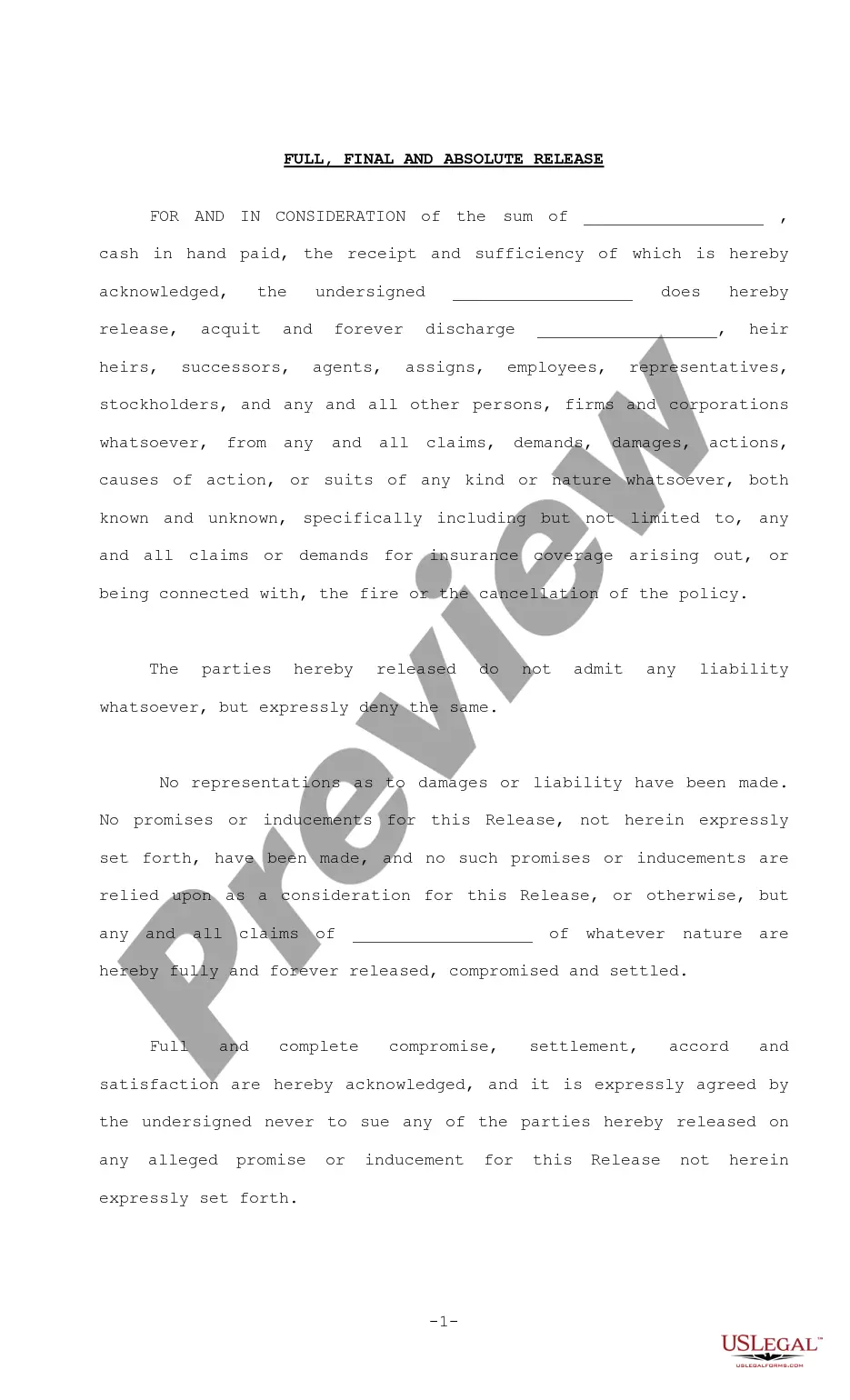
This form is a general release. The releasor agrees to release and forever discharge the releasee, and any of the releasee's agents or servants who claim to be liable for injuries and damages relating to a certain occurrence.
South Carolina Release - General
Category:
State:
Multi-State
Control #:
US-00607
Format:
Word;
Rich Text
Instant download
Description
Get your form ready online
Our built-in tools help you complete, sign, share, and store your documents in one place.
Built-in online Word editor
Make edits, fill in missing information, and update formatting in US Legal Forms—just like you would in MS Word.
Export easily
Download a copy, print it, send it by email, or mail it via USPS—whatever works best for your next step.
E-sign your document
Sign and collect signatures with our SignNow integration. Send to multiple recipients, set reminders, and more. Go Premium to unlock E-Sign.
Notarize online 24/7
If this form requires notarization, complete it online through a secure video call—no need to meet a notary in person or wait for an appointment.
Store your document securely
We protect your documents and personal data by following strict security and privacy standards.

Make edits, fill in missing information, and update formatting in US Legal Forms—just like you would in MS Word.

Download a copy, print it, send it by email, or mail it via USPS—whatever works best for your next step.

Sign and collect signatures with our SignNow integration. Send to multiple recipients, set reminders, and more. Go Premium to unlock E-Sign.

If this form requires notarization, complete it online through a secure video call—no need to meet a notary in person or wait for an appointment.

We protect your documents and personal data by following strict security and privacy standards.
Looking for another form?
How to fill out Release - General?
Are you currently in a role that requires you to obtain documents for both organizational or specific objectives nearly every working day.
There are numerous legal document templates accessible on the web, but finding reliable ones is not simple.
US Legal Forms offers a vast selection of form templates, such as the South Carolina Release - General, which are designed to comply with state and federal requirements.
When you find the right form, simply click Purchase now.
Choose the pricing plan you want, provide the necessary information to create your account, and pay for your order using PayPal or a credit card.
- If you are already familiar with the US Legal Forms website and possess an account, just Log In.
- Next, you can download the South Carolina Release - General template.
- If you do not have an account and wish to start using US Legal Forms, follow these steps.
- Select the form you need and ensure it is for the correct city/state.
- Utilize the Preview button to review the form.
- Examine the details to confirm you have selected the correct form.
- If the form does not meet your needs, use the Search box to find the form that suits your requirements.
Form popularity
FAQ
Not necessarily. Many prison sentences require a portion of time is spent behind bars, with the rest served on licence in the community. These licences require offenders to abide by a set of rules, which could include bans from certain areas, or substance rehabilitation.
Call UsGeneral Information. 1-803-734-3970.Constituent Services. 1-803-737-3953.Victim Advocacy. 1-800-213-5652.Violence Against Women Program (VAWA) 1-803-734-3717.Sexually Violent Predator. 1-803-734-3243.Securities. 1-803-734-9916.Money Services. 1-803-734-1221.National Human Trafficking Hotline. 1-888-373-7888.More items...
About one in 10 people convicted in court receives a prison sentence - with the rest given fines, community service or other punishments.
Alan Wilson was elected South Carolina's 51st Attorney General on November 2, 2010, re-elected to a second term on November 4, 2014 and re-elected to a third term on November 6, 2018. Since being elected, Wilson has focused on keeping South Carolina's families safe, defending their freedom and protecting their futures.
If no statutory aggravating circumstance is found, the defendant must be sentenced to either life imprisonment or a mandatory minimum term of imprisonment for thirty years to life.
An average of 46% of their maximum sentence length before their initial release.
South Carolina does not have sentencing guidelines.
Kinli Abee - Assistant Attorney General - South Carolina Office of the Attorney General LinkedIn.
Corey F. Ellis currently serves as the United States Attorney for the District of South Carolina. The United States Attorney's Office for the District of South Carolina has offices in Columbia, Greenville, Florence and Charleston.
In the 1990s, Truth in sentencing laws were created and aimed to abolish or curb parole so that convicts serve the period to which they have been sentenced. In South Carolina, it requires violent crime offenders to serve 85 percent of their sentences.