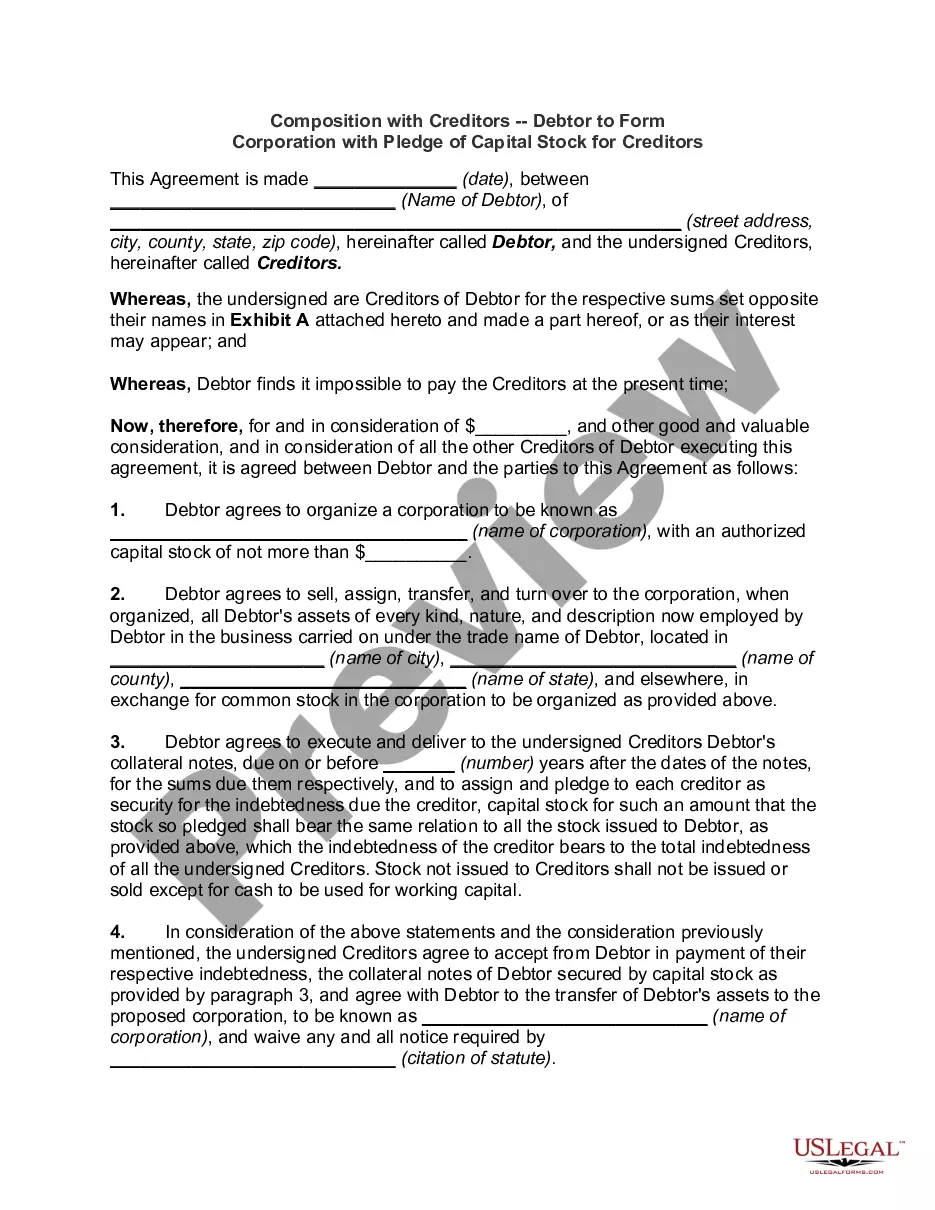
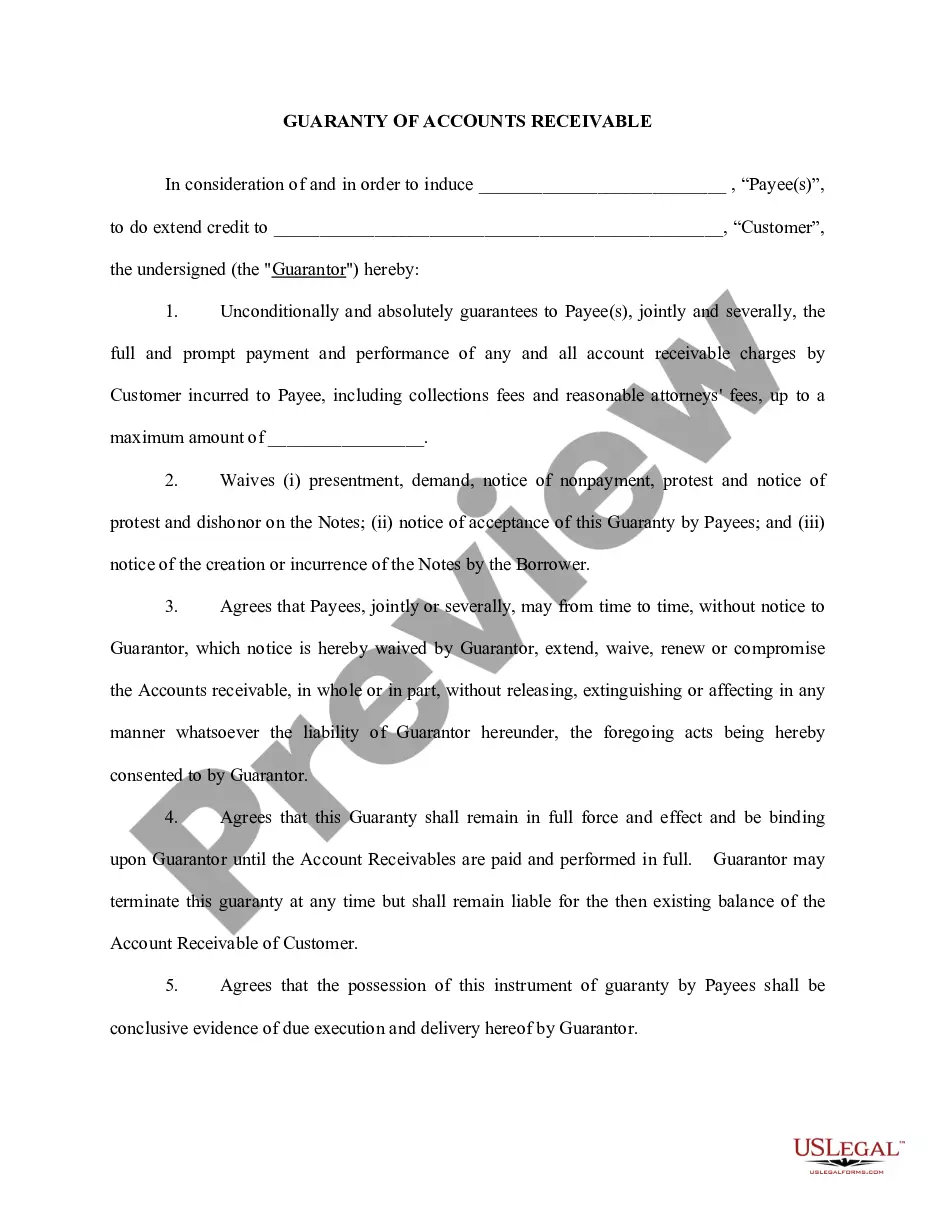
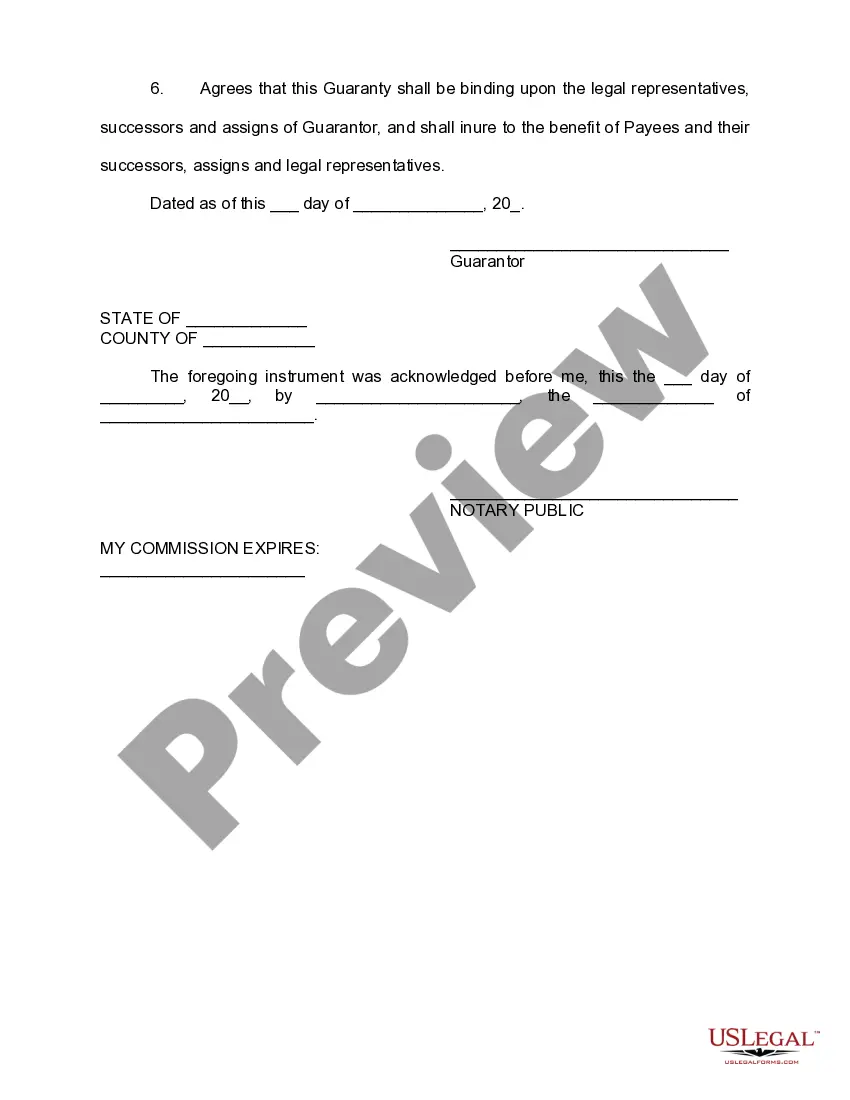
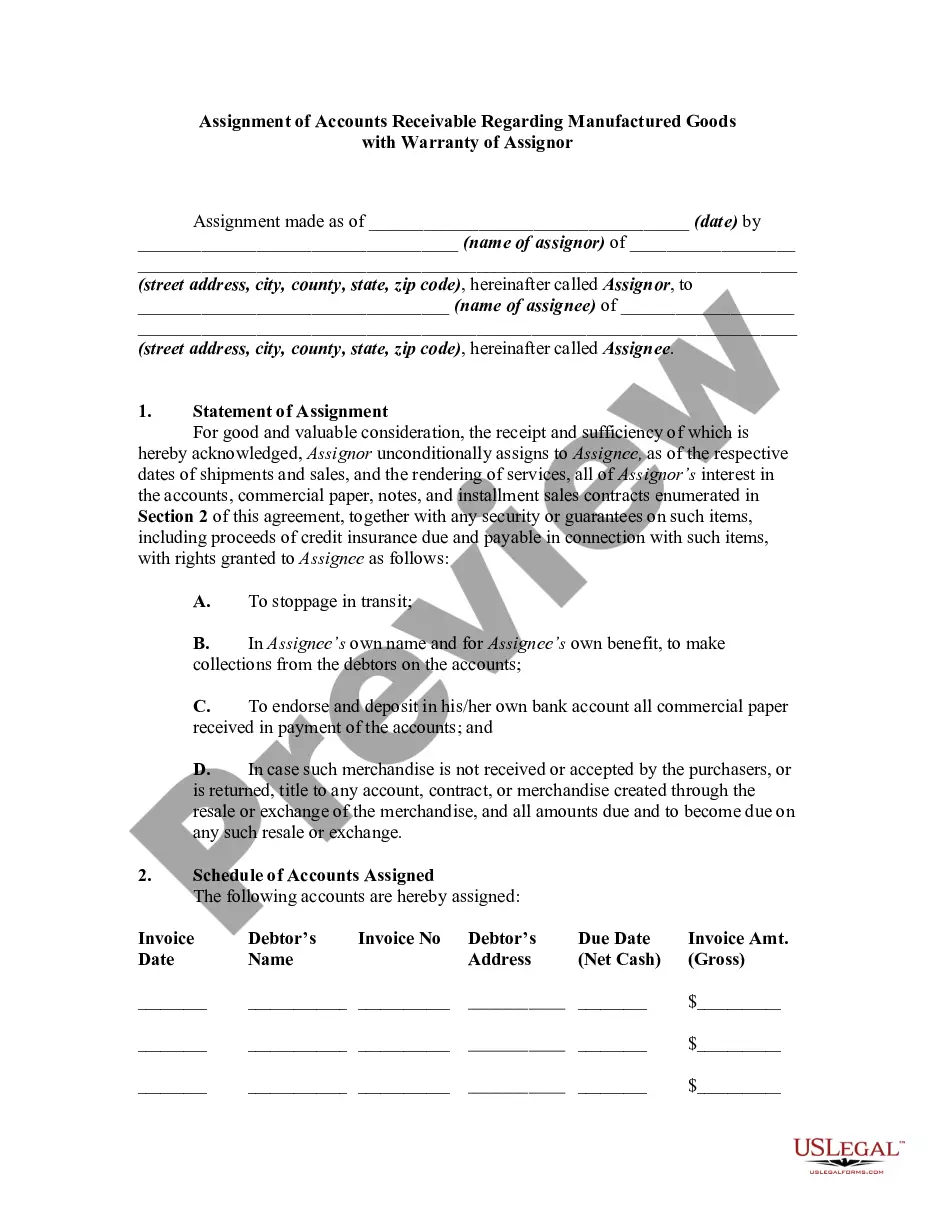
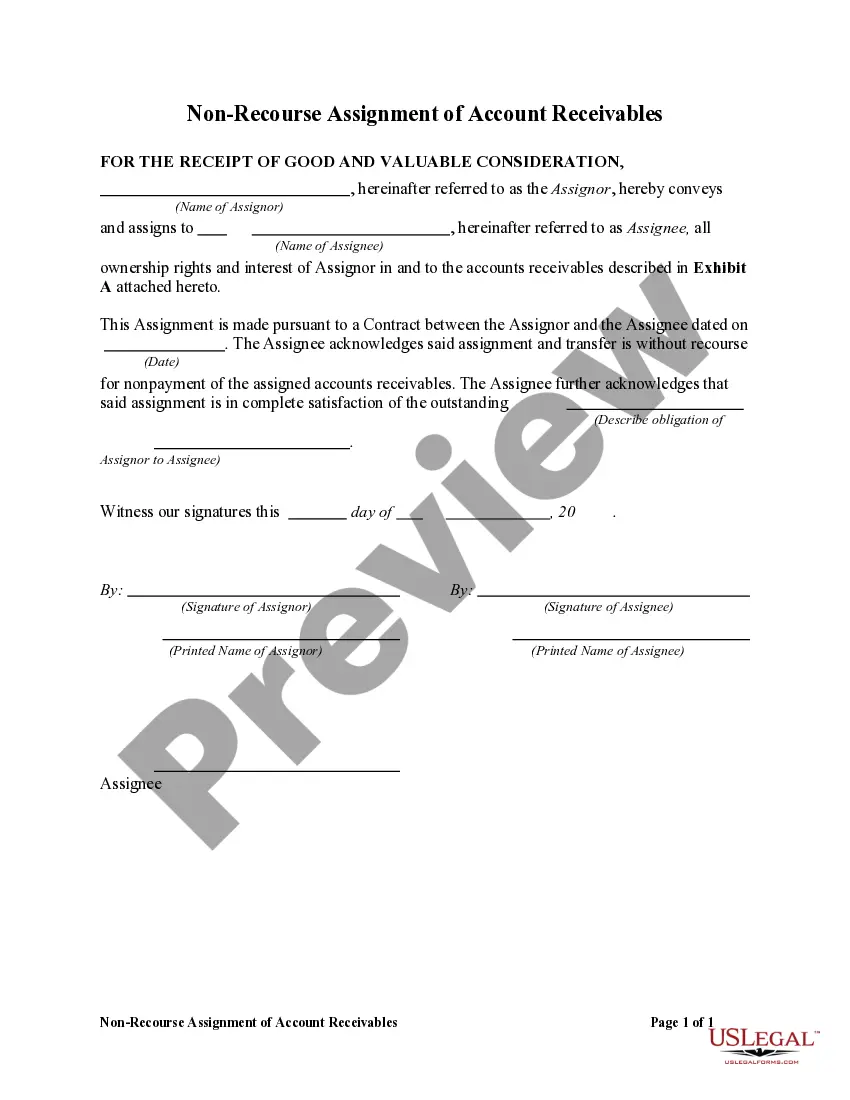
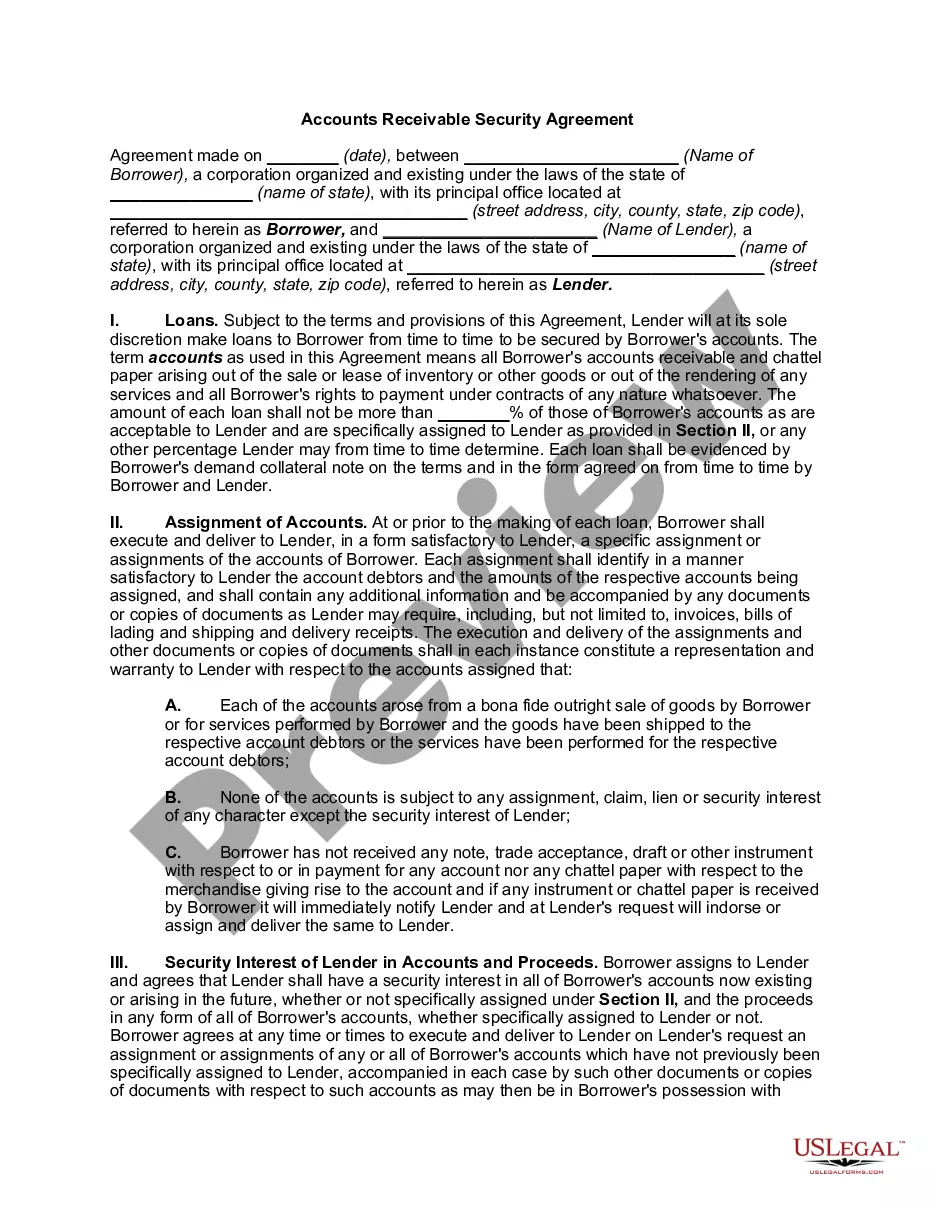
This form states that the guarantor unconditionally and absolutely guarantees to payee(s), jointly and severally, the full and prompt payment and performance of any and all account receivable charges by the customer incurred to the payee, including collections fees and reasonable attorneys' fees, up to a certain maximum amount.
South Carolina Accounts Receivable - Guaranty
Category:
State:
Multi-State
Control #:
US-00401
Format:
Word;
Rich Text
Instant download
Description
Free preview

Get your form ready online
Our built-in tools help you complete, sign, share, and store your documents in one place.
Built-in online Word editor
Make edits, fill in missing information, and update formatting in US Legal Forms—just like you would in MS Word.
Export easily
Download a copy, print it, send it by email, or mail it via USPS—whatever works best for your next step.
E-sign your document
Sign and collect signatures with our SignNow integration. Send to multiple recipients, set reminders, and more. Go Premium to unlock E-Sign.
Notarize online 24/7
If this form requires notarization, complete it online through a secure video call—no need to meet a notary in person or wait for an appointment.
Store your document securely
We protect your documents and personal data by following strict security and privacy standards.

Make edits, fill in missing information, and update formatting in US Legal Forms—just like you would in MS Word.

Download a copy, print it, send it by email, or mail it via USPS—whatever works best for your next step.

Sign and collect signatures with our SignNow integration. Send to multiple recipients, set reminders, and more. Go Premium to unlock E-Sign.

If this form requires notarization, complete it online through a secure video call—no need to meet a notary in person or wait for an appointment.

We protect your documents and personal data by following strict security and privacy standards.
Looking for another form?




How to fill out Accounts Receivable - Guaranty?
US Legal Forms - one of the largest collections of legal documents in the United States - offers a vast selection of legal document templates that you can obtain or create.
By using the website, you can find thousands of forms for both business and personal purposes, organized by categories, states, or keywords. You can access the most recent forms such as the South Carolina Accounts Receivable - Guaranty in moments.
If you are already a member, Log In and obtain the South Carolina Accounts Receivable - Guaranty from the US Legal Forms library. The Download button will appear on every form you view. You can access all previously downloaded forms in the My documents section of your account.
Choose the format and download the form to your device.
Make edits. Fill out, modify, print, and sign the downloaded South Carolina Accounts Receivable - Guaranty. Each template added to your account has no expiration date and is yours indefinitely. Therefore, if you wish to download or create another copy, simply visit the My documents section and click on the form you need.
- If you are using US Legal Forms for the first time, here are simple steps to help you get started.
- Ensure you have selected the correct form for your city/state. Click the Review button to examine the form's content.
- Check the form details to confirm that you have chosen the correct one.
- If the form does not meet your needs, use the Search field at the top of the screen to find one that does.
- If you are satisfied with the form, confirm your choice by clicking the Purchase now button. Then, select the payment plan you prefer and provide your information to register for an account.
- Complete the transaction. Use your credit card or PayPal account to finalize the transaction.
Form popularity
FAQ
In South Carolina, the statute of limitations generally sets the timeframe for collecting a debt at three to six years, depending on the type of debt. After this period, the debt may be considered uncollectible, which can significantly affect your South Carolina Accounts Receivable - Guaranty. It is crucial to stay informed about these timelines and utilize resources like US Legal Forms to ensure you manage your collections effectively.
The 7 7 7 rule for collections is a guideline that suggests contacting debtors seven times over seven weeks, with the aim of establishing communication and resolving outstanding debts. This method can be effective in managing South Carolina Accounts Receivable - Guaranty by ensuring that you maintain consistent follow-up with your clients. Implementing this rule can enhance your collection efforts and improve recovery rates.
South Carolina offers various options for debt relief, including programs that assist residents in managing their accounts receivable. These programs may provide resources for negotiating with creditors or consolidating debts. If you are seeking a structured approach, consider utilizing platforms like US Legal Forms, which can help you navigate the options available under South Carolina Accounts Receivable - Guaranty.
To file a lien in South Carolina, you need to prepare and submit a lien document to the appropriate county office. This document must include specific information about the debt and the parties involved. Using the South Carolina Accounts Receivable - Guaranty can simplify this process, as it provides guidance on the necessary steps and templates. This ensures that your lien is filed correctly and efficiently.
In South Carolina, a debt typically becomes uncollectible after three to ten years, depending on the type of debt. The statute of limitations for most accounts receivable falls within this range. If you are dealing with an uncollectible debt, consider using the South Carolina Accounts Receivable - Guaranty to effectively manage your collections. This service can guide you in understanding your rights and options.
GEAR allows continued collections when a debtor does not have an income tax return. With GEAR, governmental entity debt is treated like any State tax debt, subject to the same collection tools available to DOR such as levy and garnishment. This allows a higher collection rate for larger debts.
South Carolina allows creditors to collect medical debt, along with certain other forms of debt, by garnishing state income tax refunds. South Carolina authorizes this tax refund reduction predominantly through its Setoff Debt Collection Program (SDCP).
South Carolina state law prohibits creditors from garnishing your wages to collect past-due consumer debts like credit card debt or medical bills. Wage garnishment is only allowed when you owe money to the state or federal government or you owe money for child or spousal support.
Setoff Debt & GEAR? South Carolina law requires the SCDOR to assist qualifying entities in collecting debts through two collection programs: Setoff Debt and GEAR. Setoff Debt allows the SCDOR to assist in collecting debts owed to claimant agencies by garnishing South Carolina Individual Income Tax refunds.
Not all debts are subject to a tax refund offset. To determine whether an offset will occur on a debt owed (other than federal tax), contact BFS's TOP call center at 800-304-3107 (800-877-8339 for TTY/TDD help).