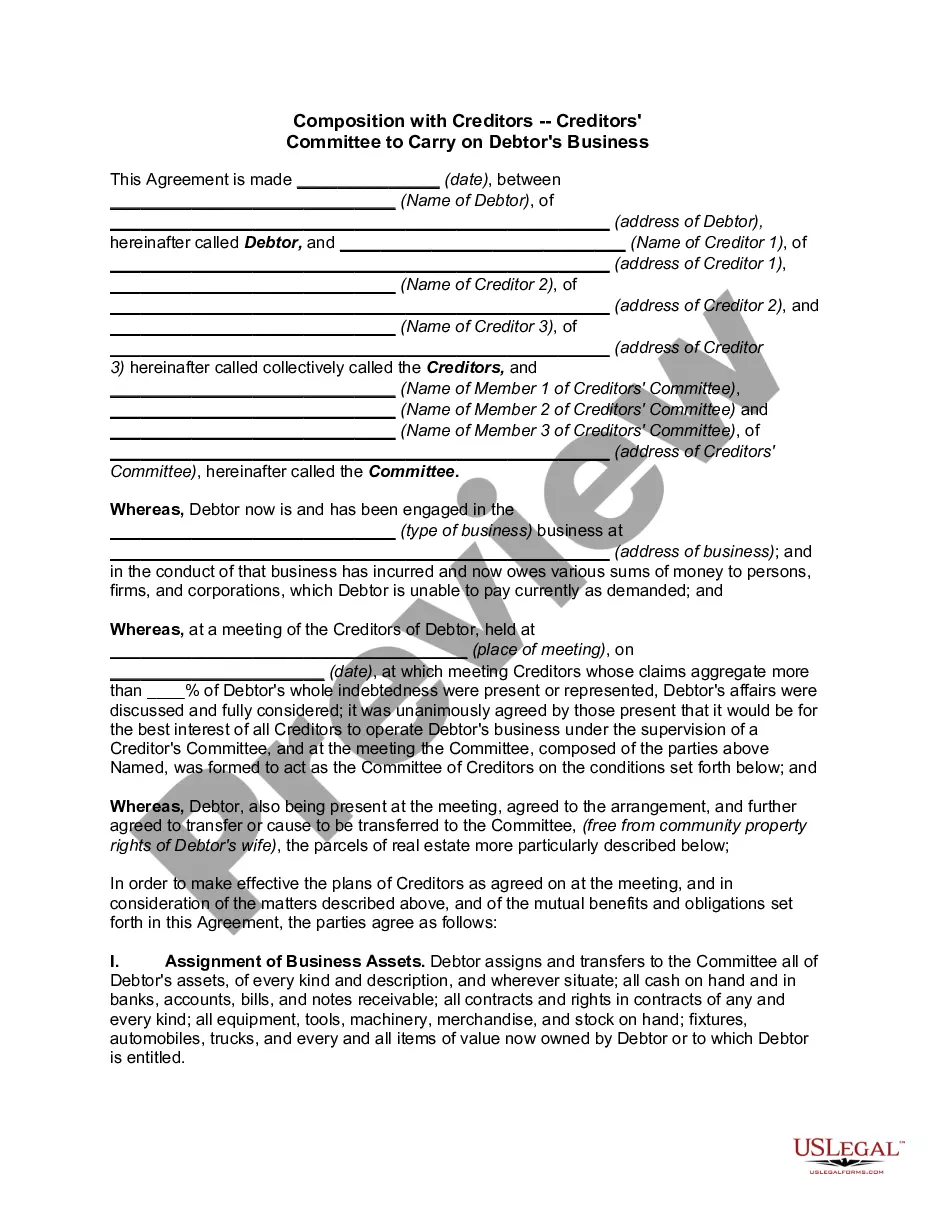
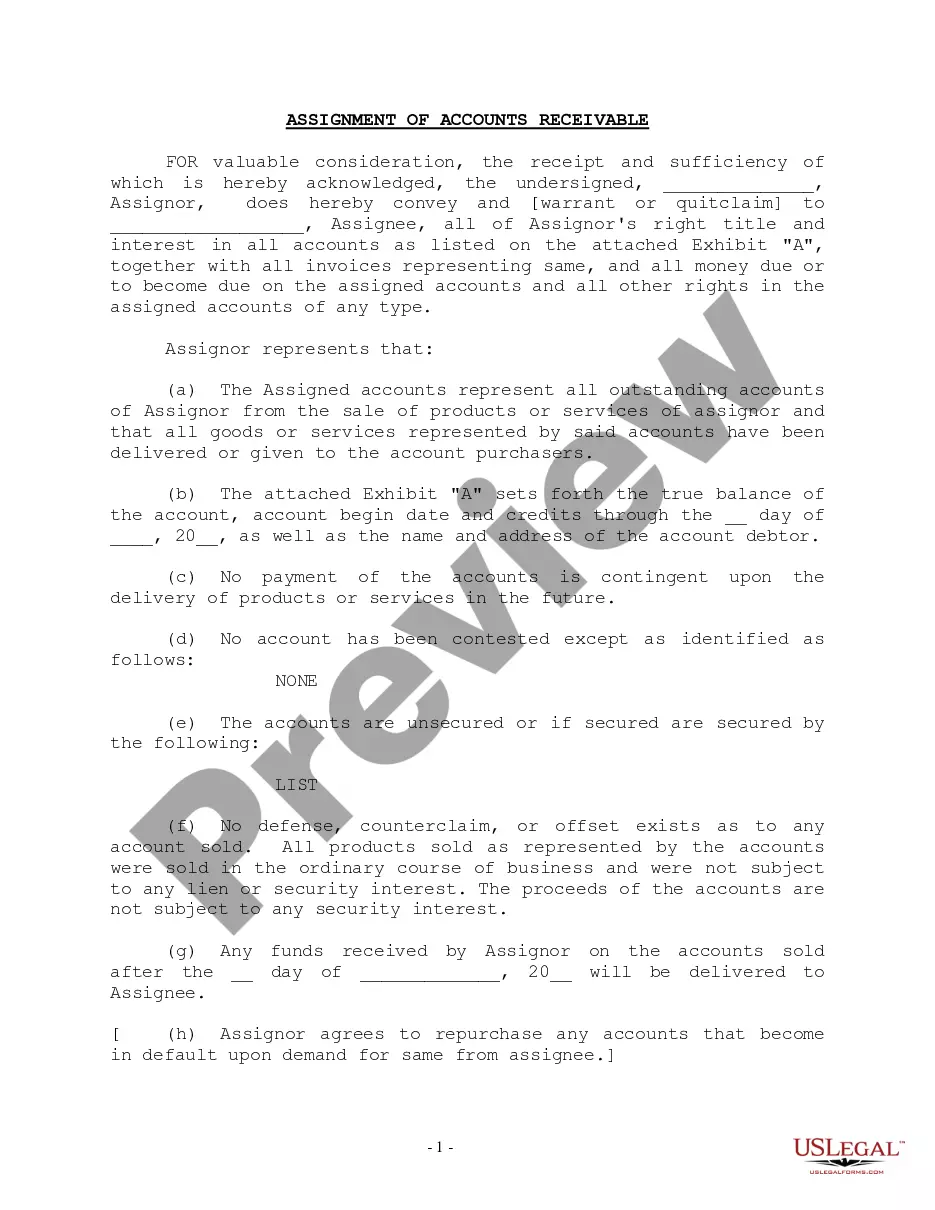
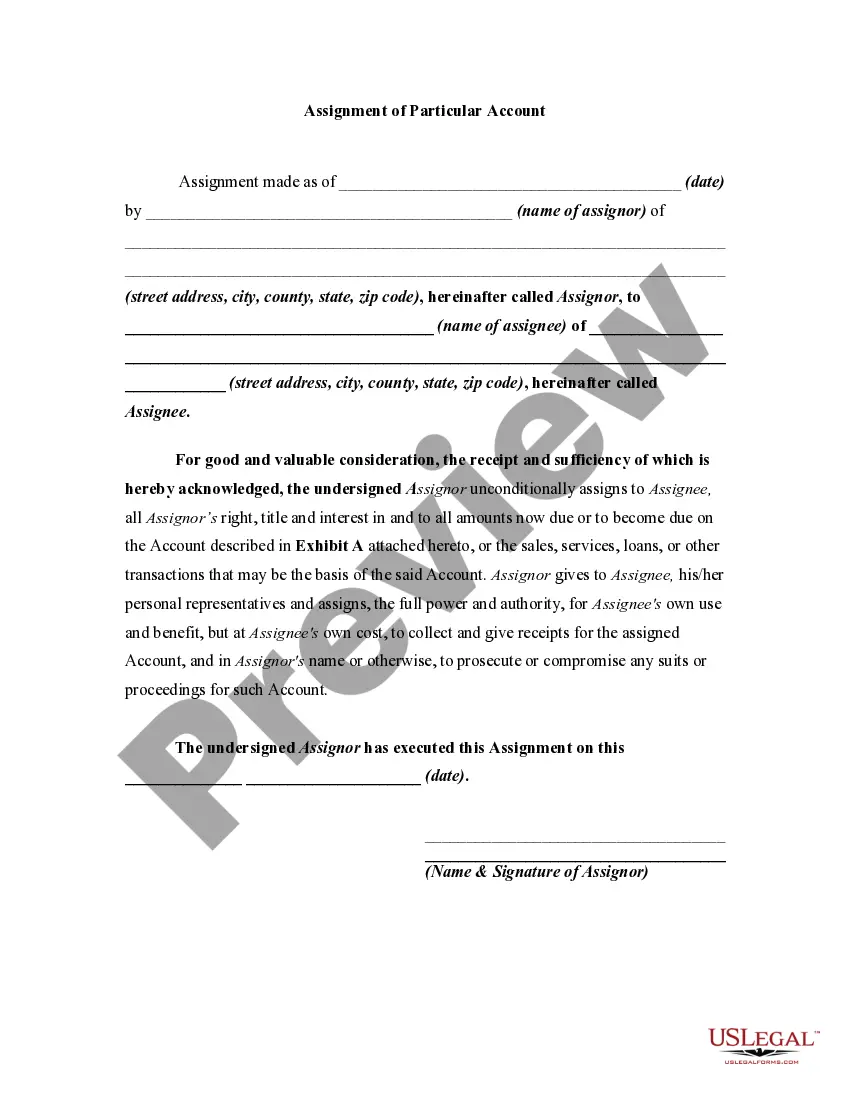
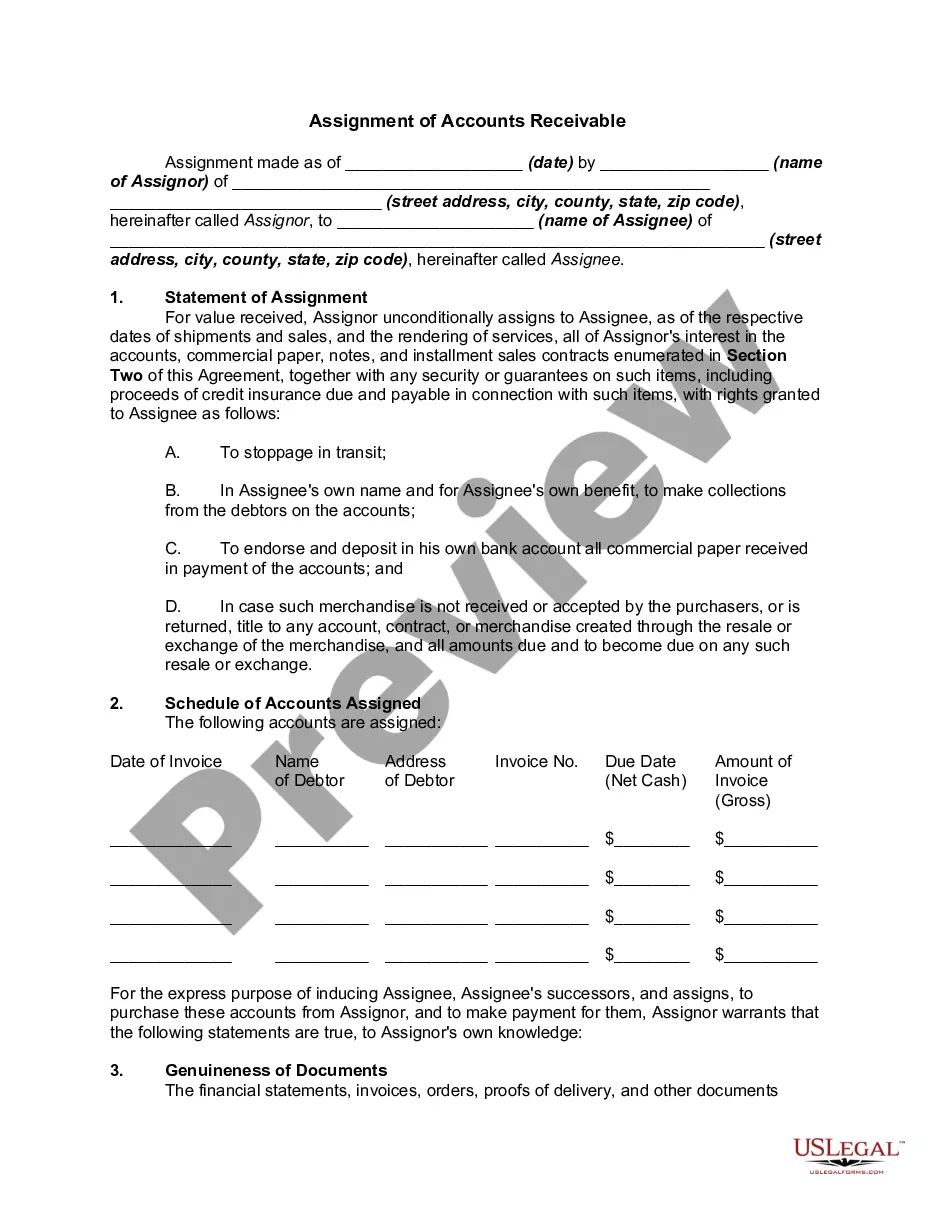
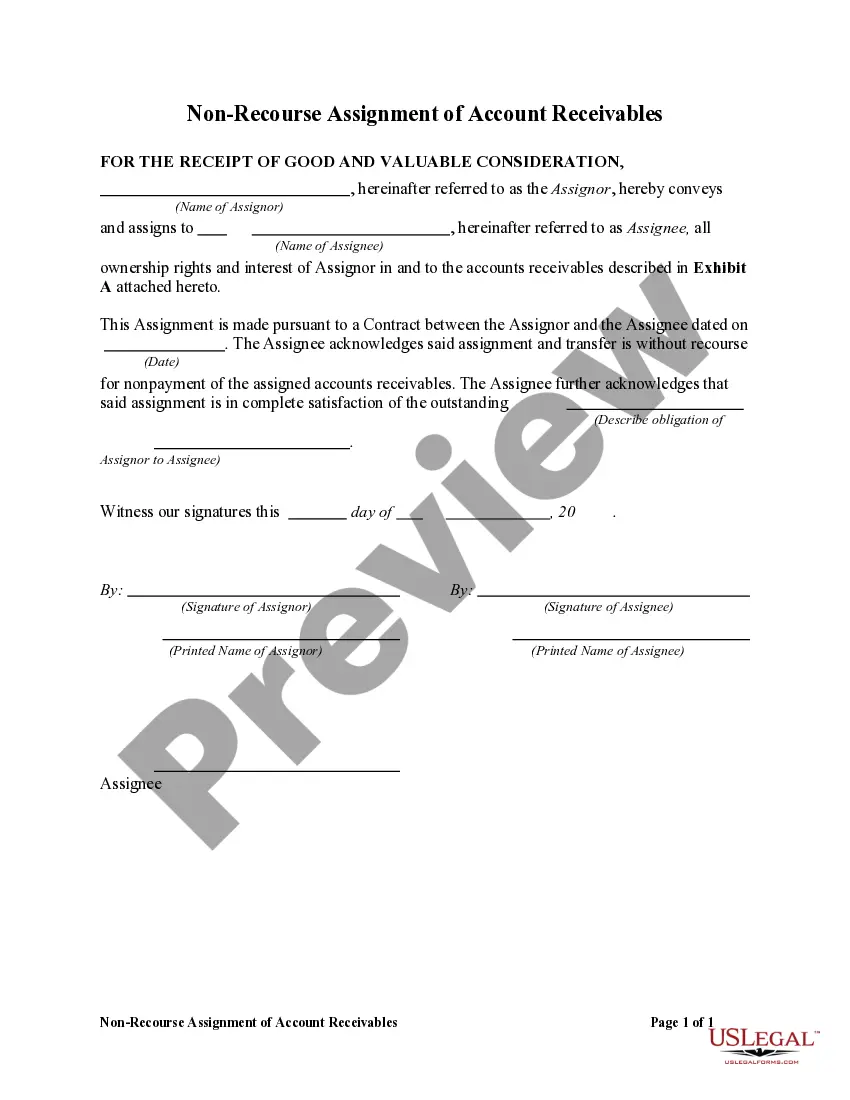
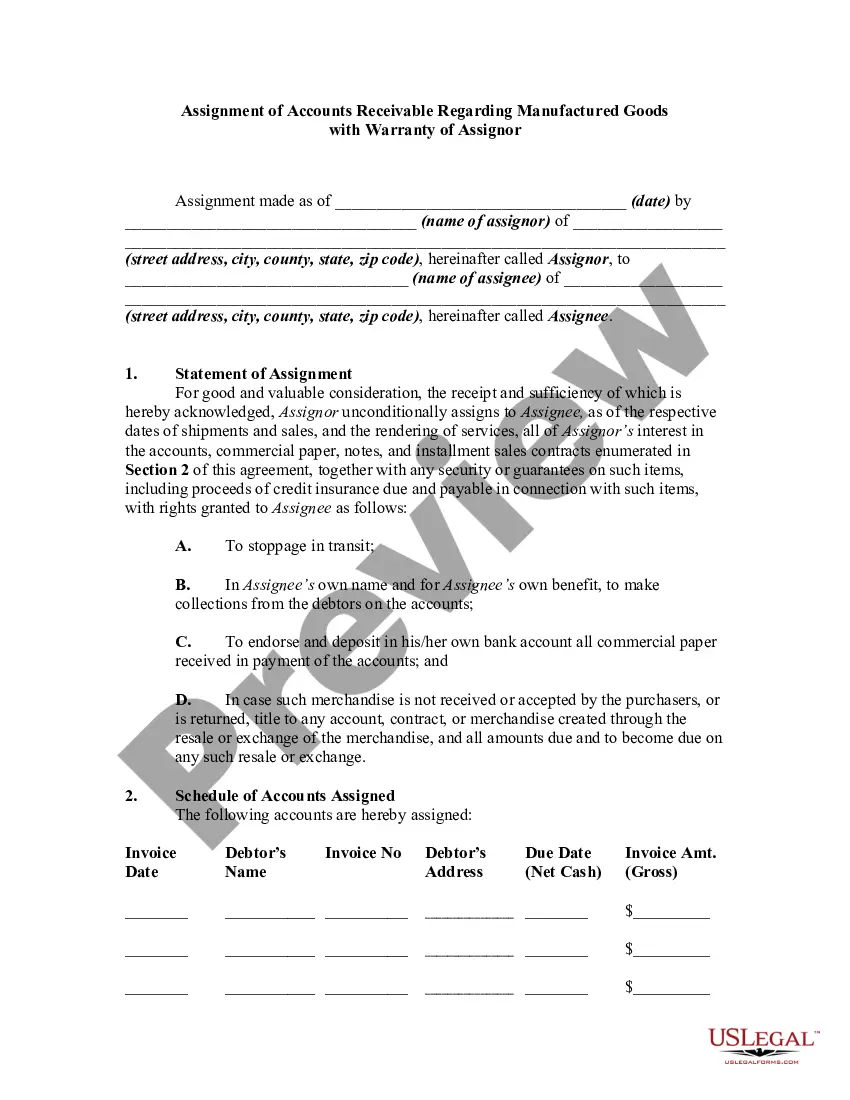
This form is an Assignment of Accounts Receivable. The assignor conveys all interest in the accounts listed on the Attachment included in the form. The accounts represent all outstanding accounts of the assignor from the sale of products or services.
South Carolina Accounts Receivable - Assignment
Category:
State:
Multi-State
Control #:
US-00400
Format:
Word;
Rich Text
Instant download
Description
Free preview

Get your form ready online
Our built-in tools help you complete, sign, share, and store your documents in one place.
Built-in online Word editor
Make edits, fill in missing information, and update formatting in US Legal Forms—just like you would in MS Word.
Export easily
Download a copy, print it, send it by email, or mail it via USPS—whatever works best for your next step.
E-sign your document
Sign and collect signatures with our SignNow integration. Send to multiple recipients, set reminders, and more. Go Premium to unlock E-Sign.
Notarize online 24/7
If this form requires notarization, complete it online through a secure video call—no need to meet a notary in person or wait for an appointment.
Store your document securely
We protect your documents and personal data by following strict security and privacy standards.

Make edits, fill in missing information, and update formatting in US Legal Forms—just like you would in MS Word.

Download a copy, print it, send it by email, or mail it via USPS—whatever works best for your next step.

Sign and collect signatures with our SignNow integration. Send to multiple recipients, set reminders, and more. Go Premium to unlock E-Sign.

If this form requires notarization, complete it online through a secure video call—no need to meet a notary in person or wait for an appointment.

We protect your documents and personal data by following strict security and privacy standards.
Looking for another form?




How to fill out Accounts Receivable - Assignment?
Are you presently in a situation where you require documentation for either business or personal purposes almost every day? There is a plethora of legal document templates available online, but locating ones you can trust is not easy.
US Legal Forms offers a vast array of form templates, including the South Carolina Accounts Receivable - Assignment, that are designed to meet federal and state requirements.
If you are already familiar with the US Legal Forms website and have an account, simply Log In. Then, you can download the South Carolina Accounts Receivable - Assignment template.
Choose a suitable file format and download your copy.
Access all the document templates you have purchased in the My documents section. You can obtain another copy of the South Carolina Accounts Receivable - Assignment at any time, if needed. Click the required form to download or print the document template. Utilize US Legal Forms, one of the most comprehensive collections of legal documents, to save time and prevent errors. The service provides expertly crafted legal document templates that can be used for a variety of purposes. Create an account on US Legal Forms and start making your life easier.
- If you do not have an account and wish to start using US Legal Forms, follow these steps.
- Obtain the form you need and ensure it is for the correct city/county.
- Use the Preview button to view the form.
- Examine the details to confirm that you have selected the right form.
- If the form isn’t what you’re looking for, use the Search field to find the form that suits your requirements.
- If you find the appropriate form, click Purchase now.
- Select the payment plan you prefer, fill in the necessary information to create your account, and complete the order using your PayPal or credit card.
Form popularity
FAQ
Yes, you can assign contracts in South Carolina, but you must follow the rules set forth in the state laws and the specific contract terms. This process is essential for managing accounts receivable effectively. Utilizing resources like US Legal Forms can provide you with the necessary tools and templates to navigate South Carolina Accounts Receivable - Assignment with ease.
Assigning a contract without consent may lead to legal complications, especially if the original agreement prohibits it. While some contracts allow for assignment without requiring consent, it's wise to seek approval to avoid potential disputes. When handling South Carolina Accounts Receivable - Assignment, obtaining consent can help ensure a smooth transition and protect your interests.
Generally, the assignment of contracts is legal, provided that the original contract does not explicitly restrict such actions. Parties should review their agreements to confirm their rights regarding assignment. When dealing with South Carolina Accounts Receivable - Assignment, it's vital to operate within the legal boundaries to maintain enforceability.
SC Code 36 2 803 refers to a section of the South Carolina Uniform Commercial Code that addresses the assignment of rights. This code outlines the requirements and limitations surrounding the assignment of contracts related to commercial transactions. Understanding SC Code 36 2 803 is essential for anyone dealing with South Carolina Accounts Receivable - Assignment to ensure compliance and legality.
Yes, the assignment of contract is legal in South Carolina as long as it complies with applicable laws and the terms of the contract. Parties involved must ensure they adhere to all legal requirements to avoid disputes. For those navigating South Carolina Accounts Receivable - Assignment, being informed about these legal frameworks can enhance your confidence in the process.
A contract can be assigned when it does not contain a clause prohibiting assignment, and both parties agree to the terms. Additionally, the assignment must be legally enforceable, meaning it should not violate any laws or public policy. In the context of South Carolina Accounts Receivable - Assignment, understanding these conditions is crucial for effective contract management.
Accounts Receivable are amounts due from customers from the sale of services or merchandise on credit. They are usually due in 30 ? 60 days. They are classified on the Balance Sheet as current assets.
Example of the Assignment of Accounts Receivable ABC Corp. approaches XYZ Bank to obtain financing using its accounts receivable as collateral. XYZ Bank agrees to provide a loan of 85% of the total accounts receivable value, which amounts to $170,000 (85% of $200,000).
Assignment of receivables would mean sale of the lease rentals, not the asset. In that case, the leased asset still remains the property of the assignor ? that is, the assignor has retained the residual interest in the asset. However, it would be different if the lessor sells the asset that has been leased out.
What are the journal entries for assigning Accounts Receivable as collateral for a loan? The entry to record assignment of Accounts Receivable as collateral would be a credit to cash, and a debit to assign Accounts Receivable. The cash account is debited because the company gave up the assigned receivables.