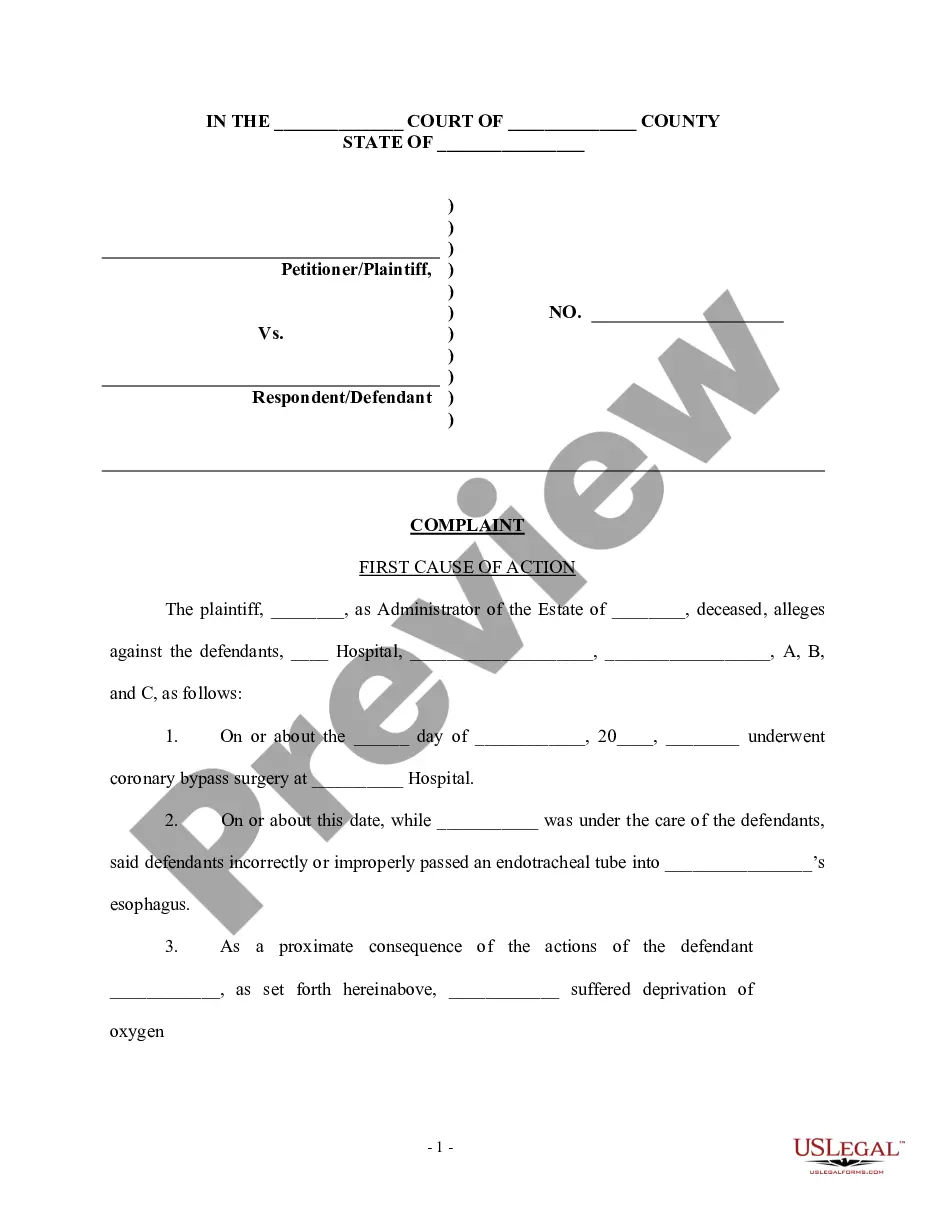
This is a Complaint pleading for use in litigation of the title matter. Adapt this form to comply with your facts and circumstances, and with your specific state law. Not recommended for use by non-attorneys.
South Carolina Complaint For Wrongful Discharge of Physician - Jury Trial Demand
Category:
State:
Multi-State
Control #:
US-000287
Format:
Word;
Rich Text
Instant download
This website is not affiliated with any governmental entity
Public form
Description





How to fill out Complaint For Wrongful Discharge Of Physician - Jury Trial Demand?
Are you in a situation where you need documents for either business or personal purposes every day? There are many legal document templates available online, but finding reliable ones can be challenging. US Legal Forms offers thousands of template options, including the South Carolina Complaint For Wrongful Discharge of Physician - Jury Trial Demand, which can be tailored to meet state and federal requirements.
If you are already familiar with the US Legal Forms website and have an account, simply Log In. After that, you can download the South Carolina Complaint For Wrongful Discharge of Physician - Jury Trial Demand template.
If you do not have an account and wish to start using US Legal Forms, follow these steps: Find the form you need and ensure it is for the correct city/county. Use the Review button to view the form. Read the summary to confirm that you have selected the right form. If the form isn’t what you’re looking for, use the Search box to find the form that suits your needs. Once you find the correct form, click on Buy now. Choose the pricing plan you want, fill out the required information to complete your payment, and finalize your order using your PayPal or credit card. Select a suitable document format and download your copy. Find all the document templates you have purchased in the My documents section. You can obtain an additional copy of the South Carolina Complaint For Wrongful Discharge of Physician - Jury Trial Demand at any time, if necessary. Click on the desired form to download or print the template.
- Use US Legal Forms, the most extensive collection of legal documents, to save time and avoid mistakes.
- The service provides well-crafted legal document templates that can be used for various purposes.
- Create an account on US Legal Forms and start making your life a bit easier.
Form popularity
FAQ
Rule 4d8 in South Carolina pertains to service of process. It outlines the required methods for delivering legal documents to defendants in civil cases. Understanding this rule is important for ensuring that your South Carolina Complaint For Wrongful Discharge of Physician - Jury Trial Demand is properly served, which is essential for moving forward with your case.
As mentioned earlier, Rule 5.5 in South Carolina prohibits unauthorized individuals from practicing law. This rule is designed to protect the public from receiving legal advice from unqualified persons. If you are facing legal challenges, especially concerning a South Carolina Complaint For Wrongful Discharge of Physician - Jury Trial Demand, ensure you consult a licensed attorney.
To establish adverse possession in South Carolina, you must meet five key requirements: actual possession, open and notorious use, exclusive possession, hostile claim, and continuous possession for at least 10 years. Each element is critical in proving your claim. If your situation involves property disputes, consider seeking legal guidance to ensure your rights are protected.
Rule 5.5 in South Carolina addresses the unauthorized practice of law. It restricts individuals who are not licensed to practice law in the state from providing legal services. Understanding this rule is crucial, especially if you are navigating issues like a South Carolina Complaint For Wrongful Discharge of Physician - Jury Trial Demand.
Yes, you can sue for wrongful termination in South Carolina. If you experience termination due to illegal reasons, such as discrimination or retaliation, you may have a valid claim. It is essential to gather evidence and consult with a legal expert who can assist you in filing a South Carolina Complaint For Wrongful Discharge of Physician - Jury Trial Demand.
Both the United States and the South Carolina Constitutions provide that no person can be charged with a capital, or death penalty" crime or other infamous crime except by indictment of a grand jury. In every criminal case, a person who is charged with a crime has a right to a jury trial.
Ing to the Supreme Court, the jury-trial right applies only when "serious" offenses are at hand?petty offenses don't invoke it. For purposes of this right, a serious offense is one that carries a potential sentence of more than six months' imprisonment. (Baldwin v. New York, 399 U.S. 66 (1970).)
The right to a jury trial refers to the right provided by the Sixth and Seventh Amendments. The Sixth Amendment states that in all criminal prosecutions, the accused criminal has the right to a trial by an impartial jury of the state and district in which the individual allegedly committed a crime.
Either party to a civil suit in magistrate's court is entitled to a trial by a jury. A party desiring a jury trial in a civil case must make a written request at least five working days prior to the original date set for trial.
Either party to a civil suit in magistrate's court is entitled to a trial by a jury. A party desiring a jury trial in a civil case must make a written request at least five working days prior to the original date set for trial.