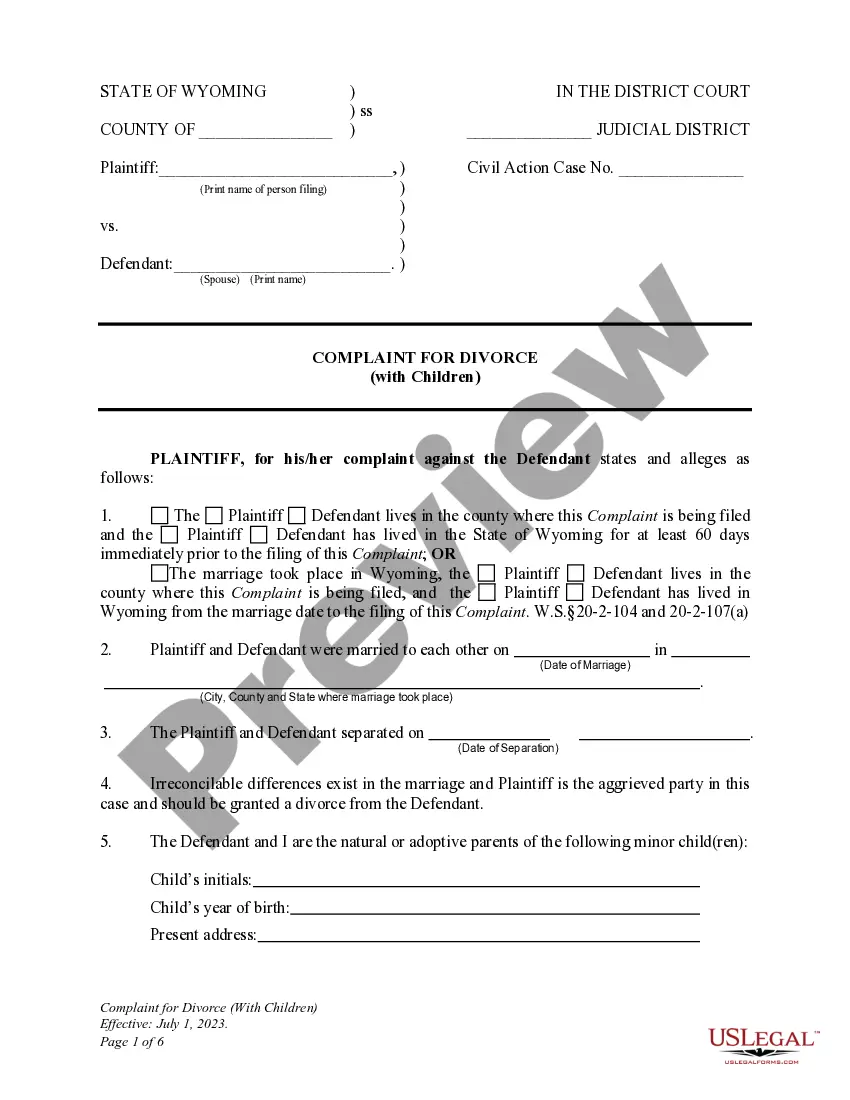
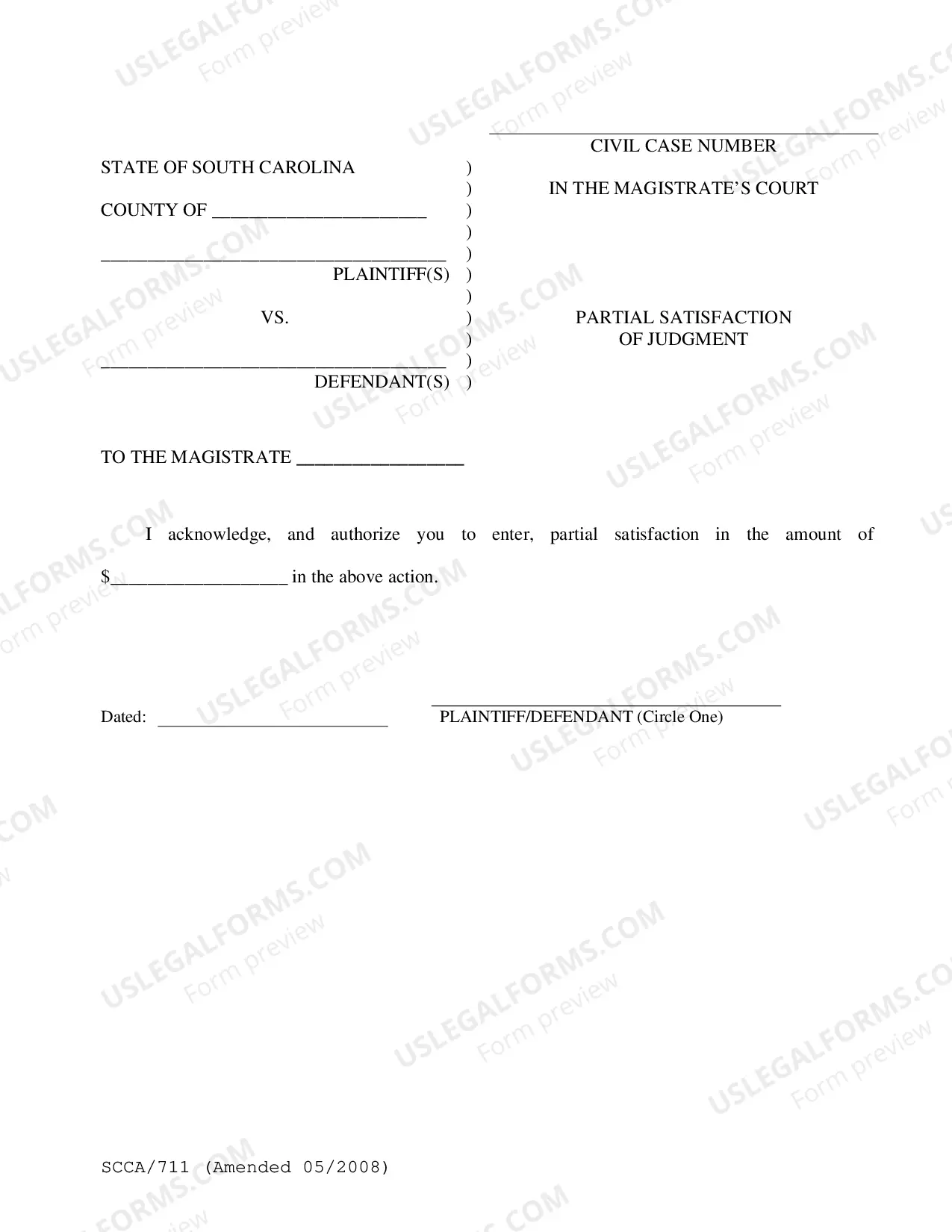
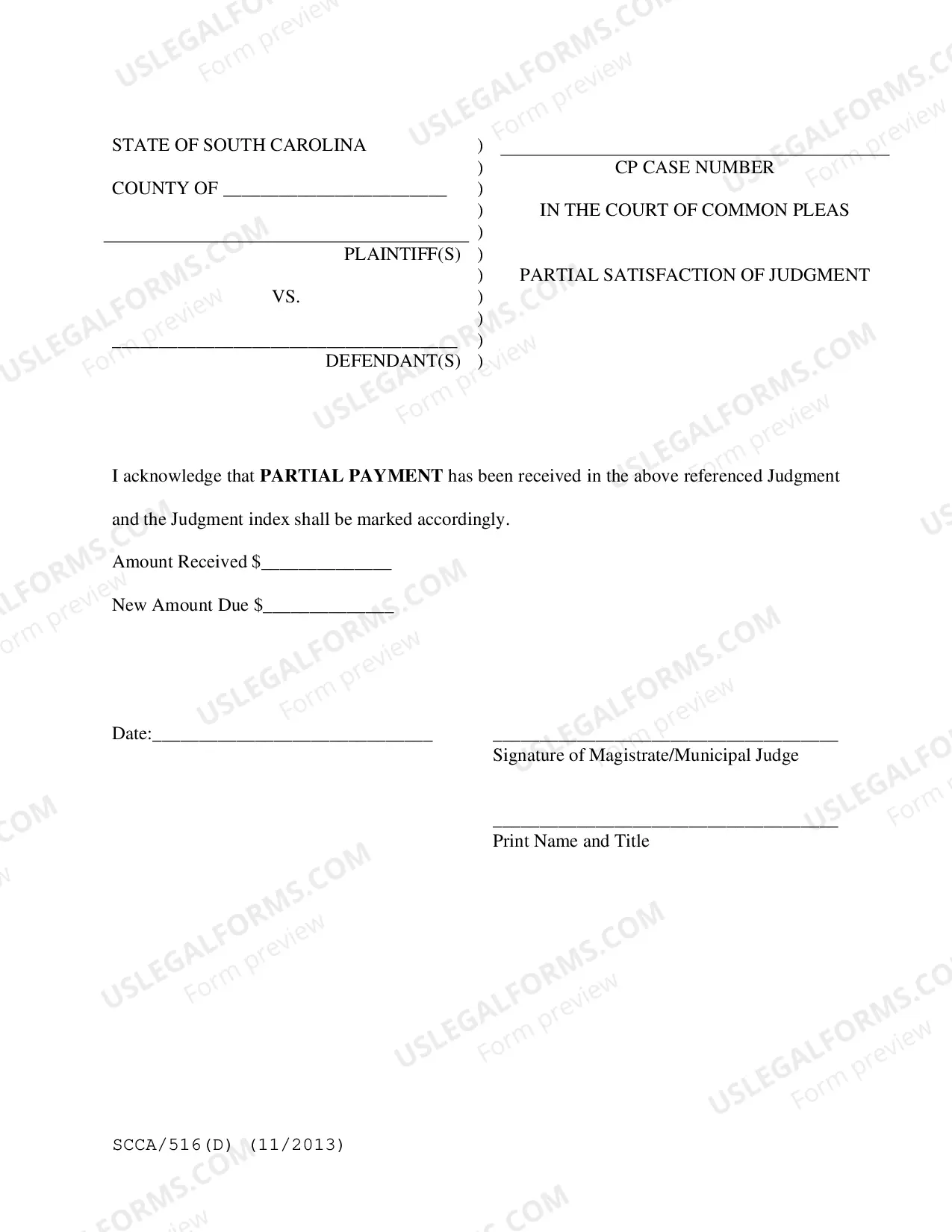
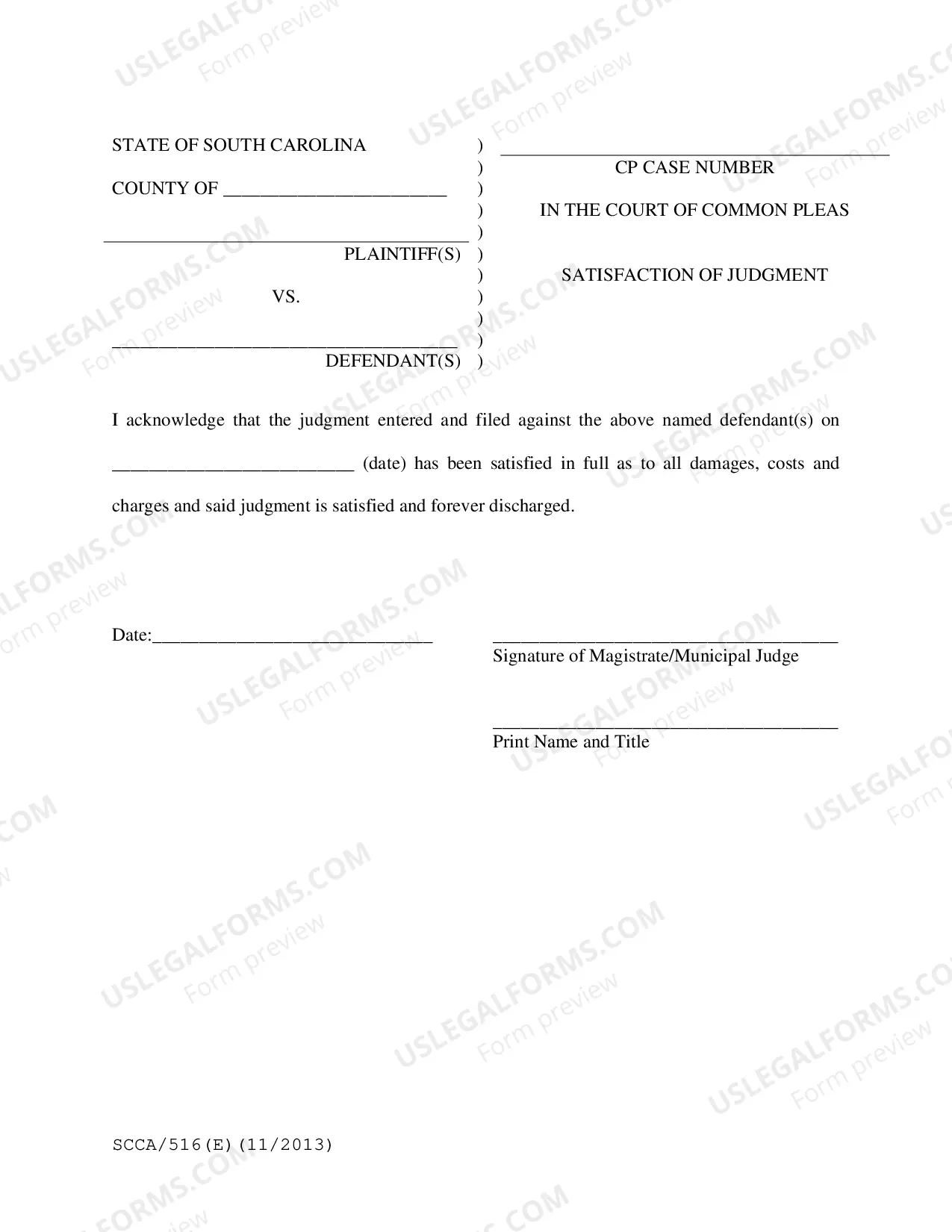
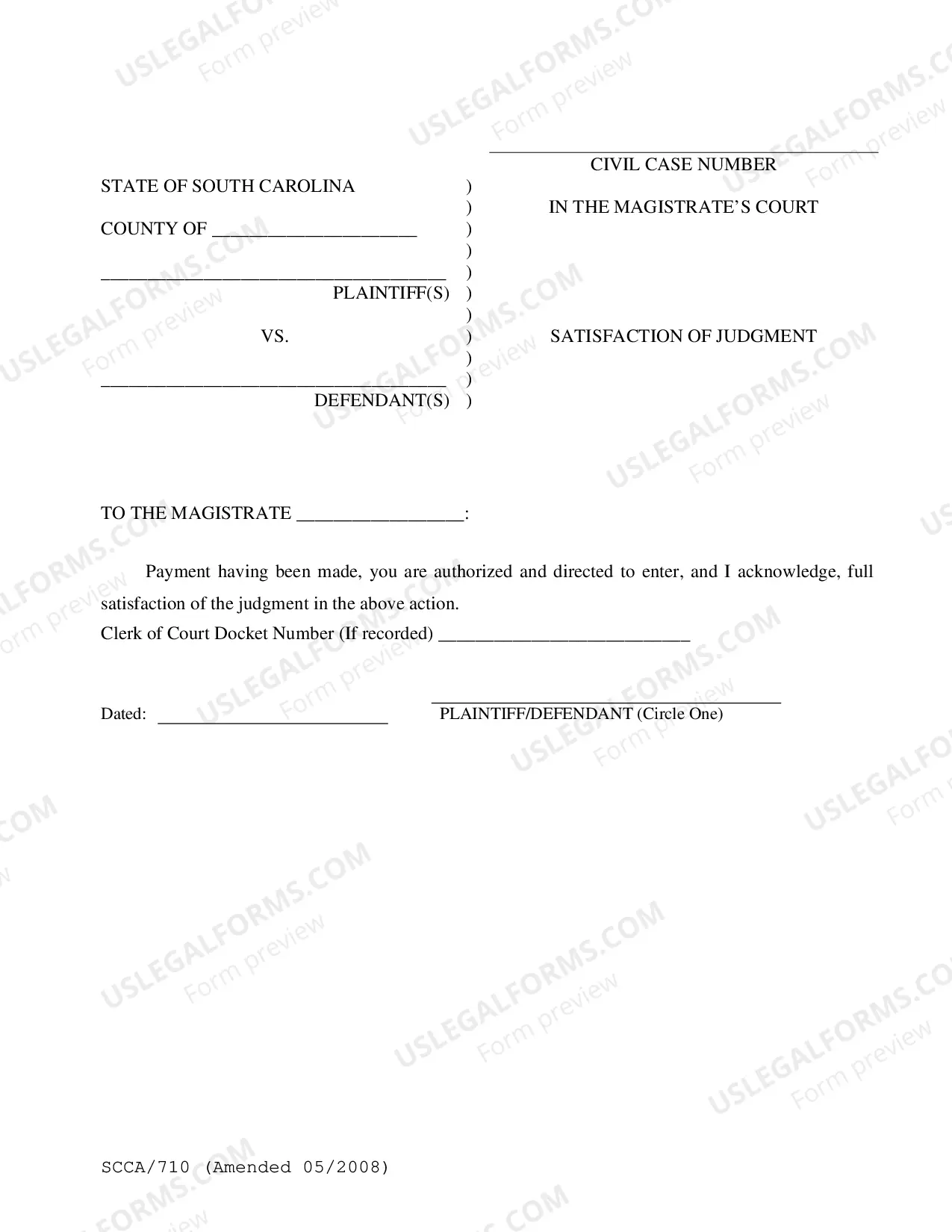
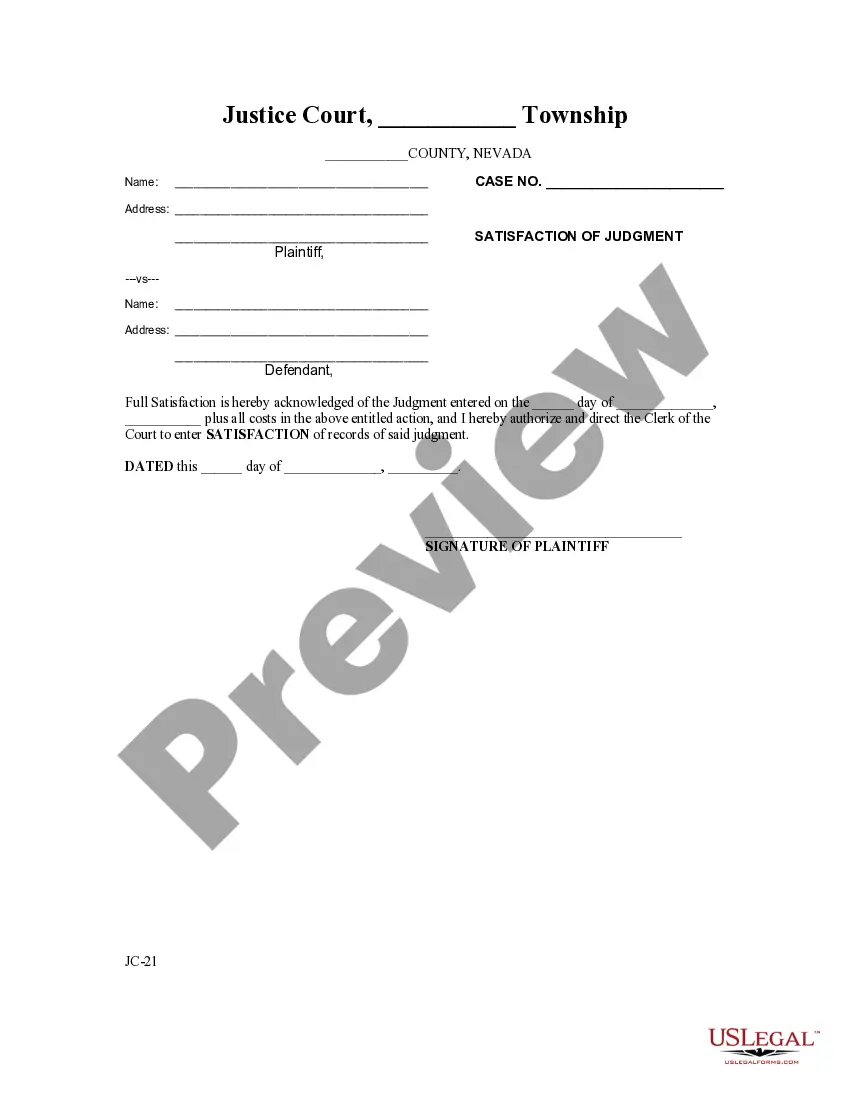
South Carolina Partial Satisfaction of Judgment
Description
Get your form ready online
Our built-in tools help you complete, sign, share, and store your documents in one place.
Make edits, fill in missing information, and update formatting in US Legal Forms—just like you would in MS Word.
Download a copy, print it, send it by email, or mail it via USPS—whatever works best for your next step.
Sign and collect signatures with our SignNow integration. Send to multiple recipients, set reminders, and more. Go Premium to unlock E-Sign.
If this form requires notarization, complete it online through a secure video call—no need to meet a notary in person or wait for an appointment.
We protect your documents and personal data by following strict security and privacy standards.

Make edits, fill in missing information, and update formatting in US Legal Forms—just like you would in MS Word.

Download a copy, print it, send it by email, or mail it via USPS—whatever works best for your next step.

Sign and collect signatures with our SignNow integration. Send to multiple recipients, set reminders, and more. Go Premium to unlock E-Sign.

If this form requires notarization, complete it online through a secure video call—no need to meet a notary in person or wait for an appointment.

We protect your documents and personal data by following strict security and privacy standards.
Looking for another form?

How to fill out South Carolina Partial Satisfaction Of Judgment?
US Legal Forms is the most easy and profitable way to find appropriate legal templates. It’s the most extensive online library of business and personal legal paperwork drafted and verified by legal professionals. Here, you can find printable and fillable blanks that comply with federal and local regulations - just like your South Carolina Partial Satisfaction of Judgment.
Getting your template requires only a few simple steps. Users that already have an account with a valid subscription only need to log in to the website and download the document on their device. Afterwards, they can find it in their profile in the My Forms tab.
And here’s how you can get a professionally drafted South Carolina Partial Satisfaction of Judgment if you are using US Legal Forms for the first time:
- Read the form description or preview the document to make sure you’ve found the one corresponding to your requirements, or find another one using the search tab above.
- Click Buy now when you’re sure of its compatibility with all the requirements, and select the subscription plan you like most.
- Register for an account with our service, log in, and pay for your subscription using PayPal or you credit card.
- Select the preferred file format for your South Carolina Partial Satisfaction of Judgment and save it on your device with the appropriate button.
After you save a template, you can reaccess it whenever you want - just find it in your profile, re-download it for printing and manual completion or upload it to an online editor to fill it out and sign more efficiently.
Take advantage of US Legal Forms, your reliable assistant in obtaining the corresponding official paperwork. Try it out!
Form popularity
FAQ
A person may be held in direct contempt if his/her conduct interferes with judicial proceedings, exhibits disrespect for the Court, or hampers the parties or witnesses.
Order 7 rule 11 Cause of Action Therein, it has been stated that for the purpose of instituting a suit, the cause of action needs to be explicitly mentioned in the plaint. If it has not been mentioned, then the plaint will be rejected by the Court. It is the sole reason why a civil suit exists in the first place.
(a) Signature. Every pleading, motion or other paper of a party represented by an attorney shall be signed in his individual name by at least one attorney of record who is admitted to practice law in South Carolina, and whose address and telephone number shall be stated.
(1) Each averment of a pleading shall be simple, concise, and direct. No technical forms of pleading or motions are required. (2) A party may set forth two or more statements of a cause of action or defense alternatively or hypothetically, either in one count or defense or in separate counts or defenses.
§ 15-39-610 et seq. A judicial sale is used in magistrates' courts to satisfy an adjudicated claim by the sale of personal property taken from a losing party. The sale may be of personal property seized pursuant to a claim and delivery action, a distraint procedure, or as a result of a levy and execution.
If a pleading sets forth a cause of action or defense to which an adverse party is not required to serve a responsive pleading, he may assert at the trial any defense in law or fact to that cause of action or defense.
Unannotated. SECTION 15-39-10. Kinds of execution. There shall be three kinds of executions, (a) against the property of the judgment debtor, (b) against his person and (c) for the delivery of the possession of real or personal property or such delivery with damages for withholding the property.
§ 15-39-420 ?(1) No employer in this State shall withhold any portion of the wages of any employee residing in this State as a result of any garnishment proceedings brought in any court outside of this State unless the creditor first obtains a judgment against such employee growing out of the same indebtedness for