South Carolina DEALING IN COUNTERFEIT OBLIGATIONS OF THE UNITED STATES
Overview of this form
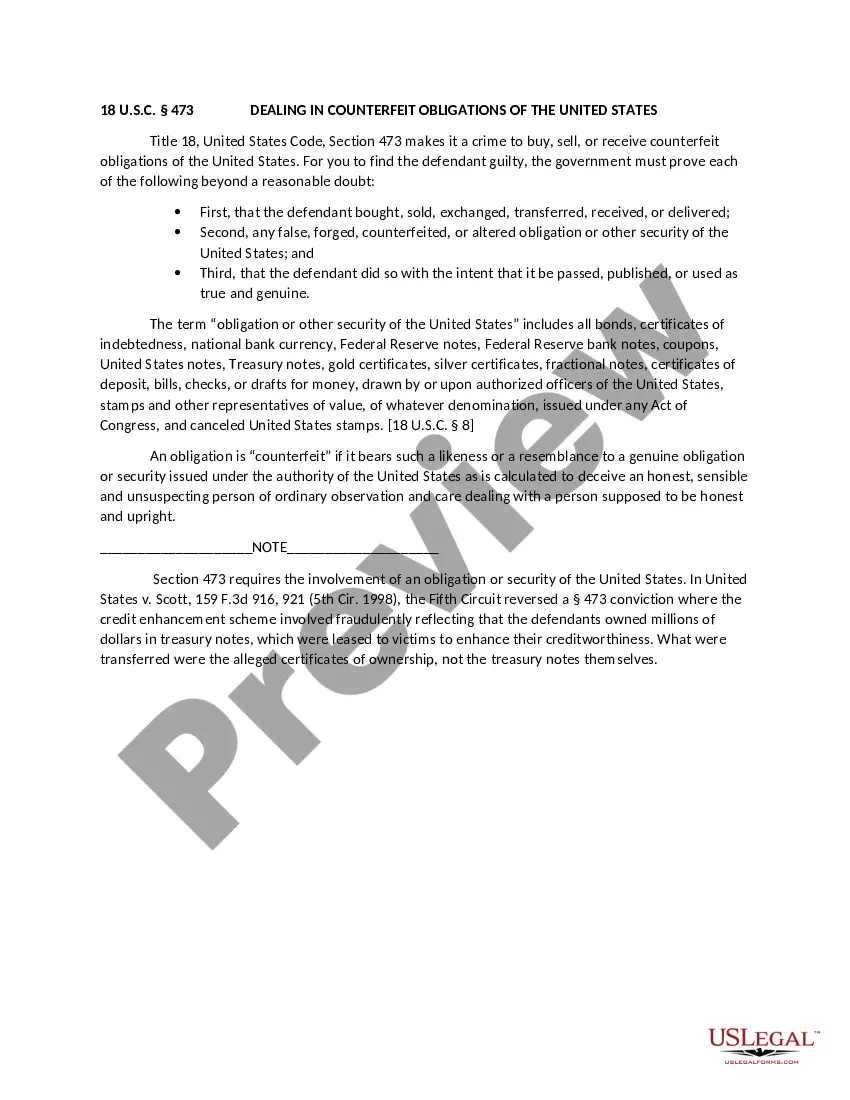
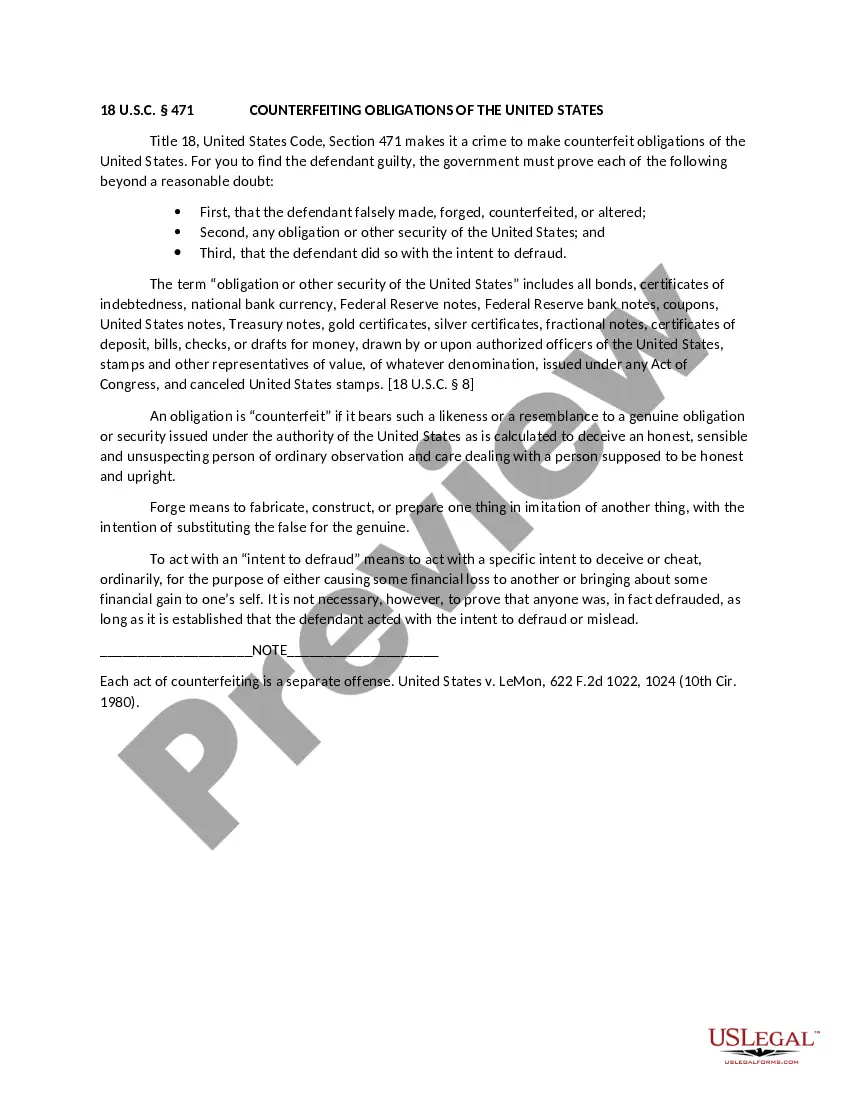
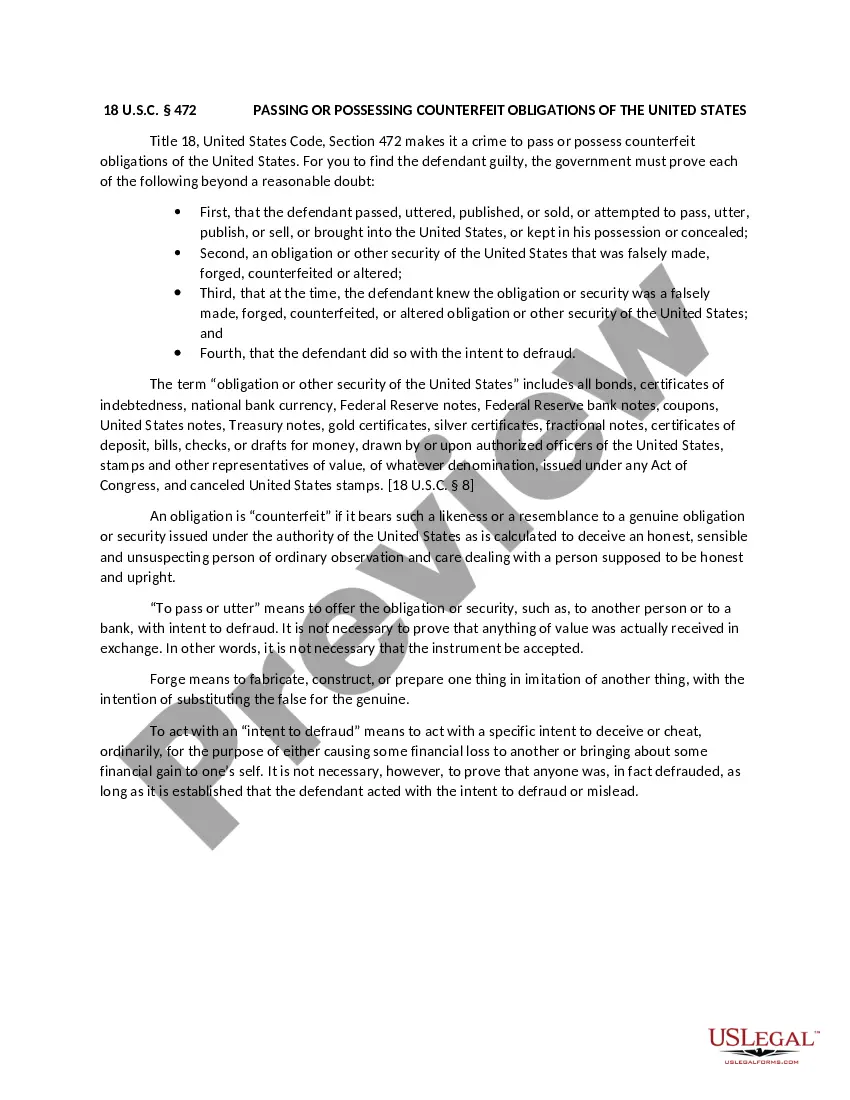
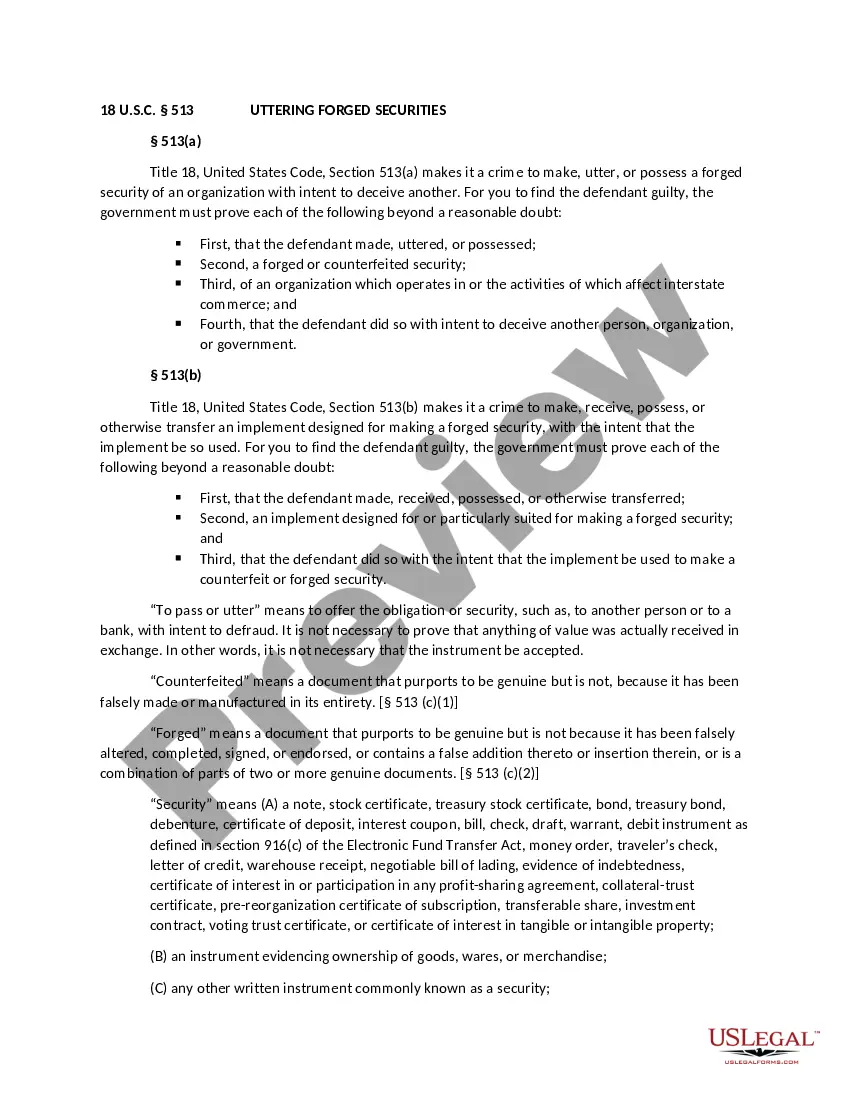
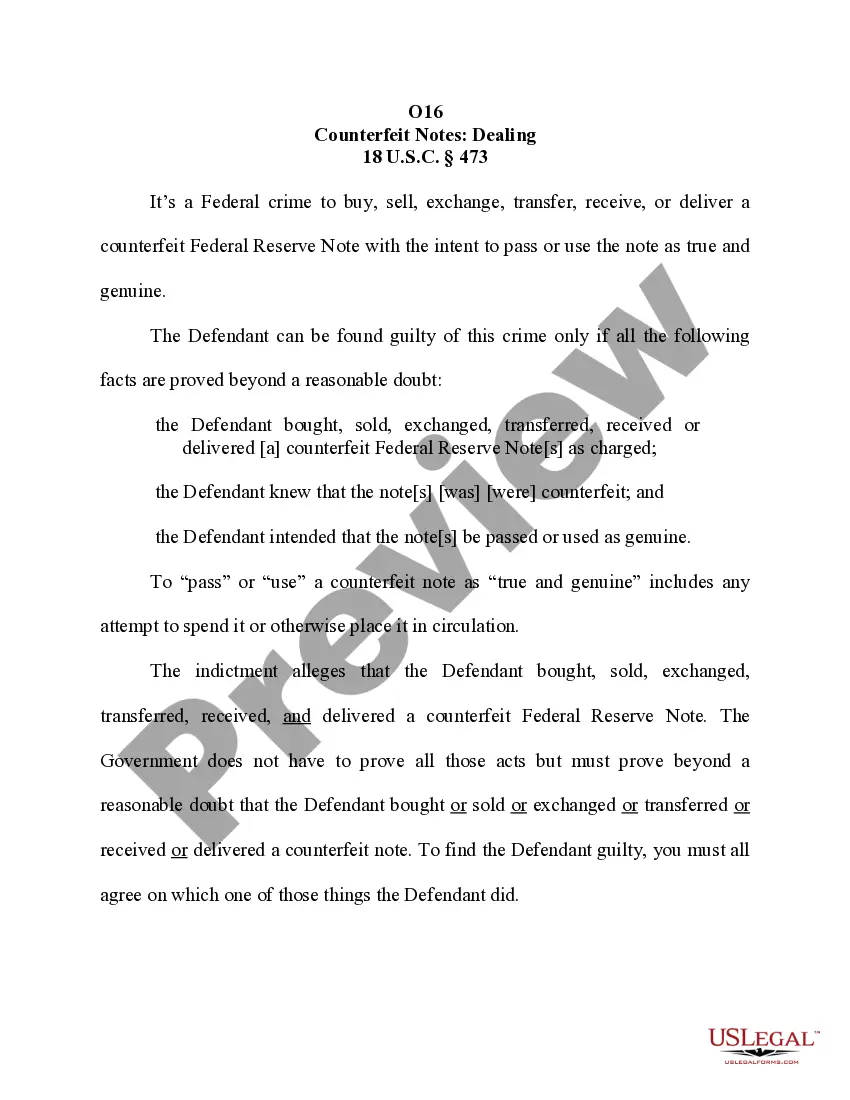
The "Dealing in Counterfeit Obligations of the United States" form outlines the legal instructions necessary for federal criminal cases concerning the buying, selling, or receiving of counterfeit U.S. obligations. This form is based on Title 18, United States Code, Section 473, which defines the crime and the requirements for proving guilt. It is distinct from forms related to other types of fraud or financial crimes, focusing specifically on counterfeit U.S. securities.
Key components of this form
- Definition of counterfeit obligations and what constitutes an obligation of the United States.
- Elements of the crime that the government must prove for a conviction.
- Discussion of relevant cases, such as United States v. Scott, illustrating the application of the law.
When to use this form
This form should be used in scenarios involving allegations of purchasing or distributing counterfeit currency or securities of the United States. It is relevant for federal prosecutors or defense attorneys handling cases involving these serious offenses, as well as for individuals seeking to understand the legal standards applied in such cases.
Who can use this document
- Federal prosecutors aiming to file charges under Title 18, U.S.C. Section 473.
- Defense attorneys representing clients accused of dealing in counterfeit U.S. obligations.
- Law students or legal interns studying federal criminal law applicable in South Carolina.
How to prepare this document
- Identify and state the parties involved in the case.
- Clearly outline the actions that constitute the alleged illegal dealings.
- Present evidence proving the counterfeit nature of the obligations involved.
- Specify the intent behind the actions of the defendant.
- Prepare any additional documentation as required by the court.
Is notarization required?
In most cases, this form does not require notarization. However, some jurisdictions or signing circumstances might. US Legal Forms offers online notarization powered by Notarize, accessible 24/7 for a quick, remote process.
Get your form ready online
Our built-in tools help you complete, sign, share, and store your documents in one place.
Make edits, fill in missing information, and update formatting in US Legal Forms—just like you would in MS Word.
Download a copy, print it, send it by email, or mail it via USPS—whatever works best for your next step.
Sign and collect signatures with our SignNow integration. Send to multiple recipients, set reminders, and more. Go Premium to unlock E-Sign.
If this form requires notarization, complete it online through a secure video call—no need to meet a notary in person or wait for an appointment.
We protect your documents and personal data by following strict security and privacy standards.
Make edits, fill in missing information, and update formatting in US Legal Forms—just like you would in MS Word.
Download a copy, print it, send it by email, or mail it via USPS—whatever works best for your next step.
Sign and collect signatures with our SignNow integration. Send to multiple recipients, set reminders, and more. Go Premium to unlock E-Sign.
If this form requires notarization, complete it online through a secure video call—no need to meet a notary in person or wait for an appointment.
We protect your documents and personal data by following strict security and privacy standards.
Common mistakes
- Failing to provide clear evidence of the counterfeit nature of the obligations.
- Not adequately establishing the defendant's intent in transactions.
- Relying on outdated legal precedents or cases that do not apply.
Advantages of online completion
- Convenient access to legal forms that can be downloaded and completed at any time.
- Forms prepared by licensed attorneys ensure compliance with legal standards.
- Easy editability allows users to customize forms as needed for their specific cases.
Looking for another form?
Form popularity
FAQ
Section 16-13-240 - Obtaining signature or property by false pretenses.
(6) knowingly permit a telephone under his control to be used for any purpose prohibited by this section.
Section 16-13-260 - Obtaining property under false s or letters, S.C.
As laid out in South Carolina General Code Section 16-13-240, it is a crime to obtain a signature, money, or property from someone under false pretenses or misrepresentation of a fact with ?intent to cheat and defraud a person of that property.? Simply put, if you obtain money, property, or the title to property from
(a) It is unlawful for a person, with intent to defraud, in his own name or in any other capacity, to draw, make, utter, issue, or deliver to another a check, draft, or other written order on a bank or depository for the payment of money or its equivalent, whether given to pay rent, make a payment on a lease, obtain
SECTION 16-17-500. Sale or purchase of tobacco products or alternative nicotine products for minors; proof of age; location of vending machines; penalties; smoking cessation programs.
Section 16-15-405 - Second degree sexual exploitation of a minor defined; presumptions; defenses; penalties. (2) distributes, transports, exhibits, receives, sells, purchases, exchanges, or solicits material that contains a visual representation of a minor engaged in sexual activity.
(A) It is unlawful for a person to knowingly make a false complaint to a law enforcement officer concerning the alleged commission of a crime by another, or for a person to knowingly give false information to a rescue squad or fire department concerning the alleged occurrence of a health emergency or fire.