South Carolina PIRACY
What is this form?
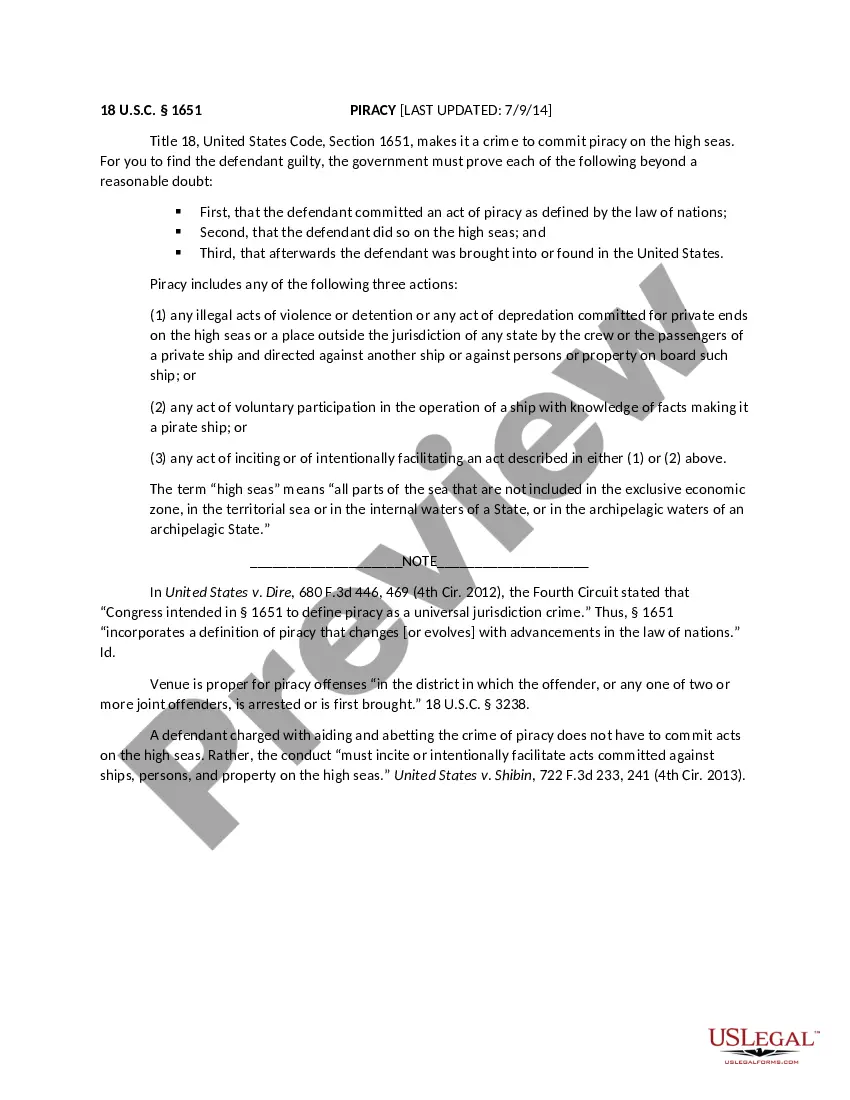
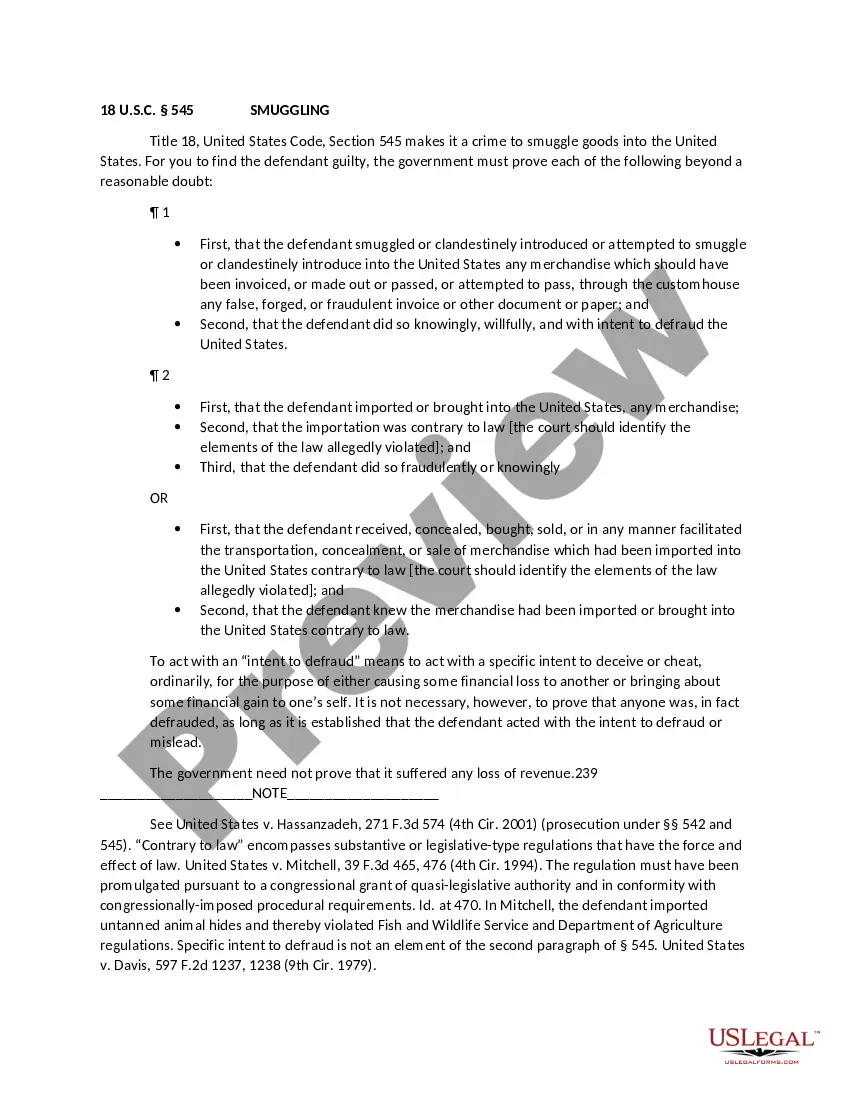
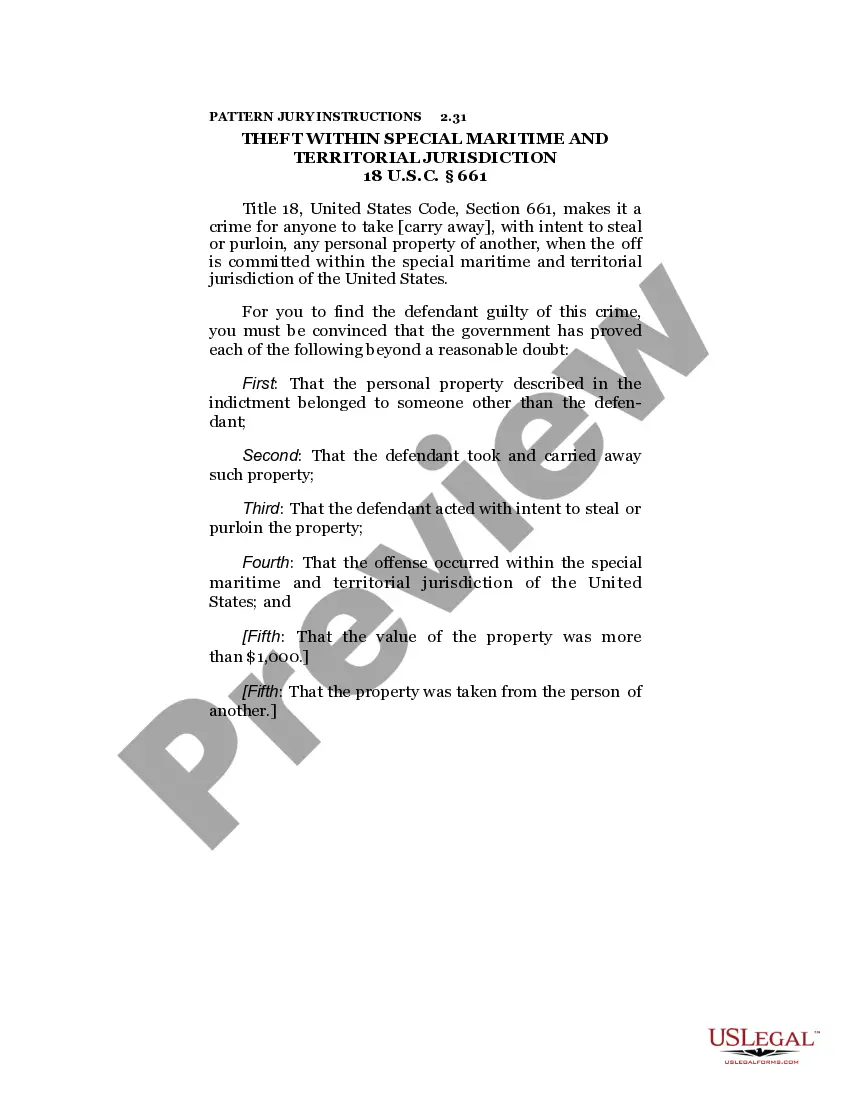
The Piracy form consists of the Official Pattern Jury Instructions for Criminal Cases related to piracy, specifically as defined under Title 18, United States Code, Section 1651. This form serves to guide jurors in understanding the legal definitions, elements of proof, and standards required for a conviction for piracy on the high seas. It differs from other criminal jury instructions by focusing specifically on acts of piracy and their corresponding legal implications in federal jurisdiction.
What’s included in this form
- Description of piracy as defined by U.S. law and international law.
- Elements required for proving an act of piracy: act definition, location, and relation to the United States.
- Legal implications of participation in piracy and aiding and abetting.
- Specifics on what constitutes the high seas.
- Jurisdictional information concerning the prosecution of piracy offenses.

Common use cases
This form should be used in cases arising from alleged acts of piracy that occur on the high seas. It provides legal instruction that is critical during trials involving individuals accused of engaging in, facilitating, or aiding acts of piracy. The instructions help juries assess the accused's conduct against the legal standards for piracy and determine guilt or innocence.
Intended users of this form
- Legal practitioners involved in federal criminal cases.
- Jurors serving on a trial where piracy charges are present.
- Students or scholars studying criminal law related to maritime offenses.
- Members of the legal community interested in understanding the intricacies of piracy law.
Completing this form step by step
- Familiarize yourself with the definitions and elements of piracy as detailed in the form.
- Understand the requirements for proving each element beyond a reasonable doubt.
- For jurors, ensure clarity on the distinction between acts of piracy and other maritime crimes.
- Review relevant case law to provide context for the jury instructions.
- Complete any required jury verdict forms as directed by the presiding judge.
Notarization guidance
This form does not typically require notarization to be legally valid. However, some jurisdictions or document types may still require it. US Legal Forms provides secure online notarization powered by Notarize, available 24/7 for added convenience.
Get your form ready online
Our built-in tools help you complete, sign, share, and store your documents in one place.
Make edits, fill in missing information, and update formatting in US Legal Forms—just like you would in MS Word.
Download a copy, print it, send it by email, or mail it via USPS—whatever works best for your next step.
Sign and collect signatures with our SignNow integration. Send to multiple recipients, set reminders, and more. Go Premium to unlock E-Sign.
If this form requires notarization, complete it online through a secure video call—no need to meet a notary in person or wait for an appointment.
We protect your documents and personal data by following strict security and privacy standards.

Make edits, fill in missing information, and update formatting in US Legal Forms—just like you would in MS Word.

Download a copy, print it, send it by email, or mail it via USPS—whatever works best for your next step.

Sign and collect signatures with our SignNow integration. Send to multiple recipients, set reminders, and more. Go Premium to unlock E-Sign.

If this form requires notarization, complete it online through a secure video call—no need to meet a notary in person or wait for an appointment.

We protect your documents and personal data by following strict security and privacy standards.
Common mistakes
- Confusing piracy with other maritime criminal acts.
- Failing to apply the "beyond a reasonable doubt" standard correctly.
- Not properly understanding the geographical definition of the high seas.
- Neglecting to consider the implications of aiding and abetting piracy.
Benefits of using this form online
- Convenience of downloading and accessing the form from anywhere at any time.
- Editability to adapt the form specifics as needed for individual cases.
- Reliability of instructions drafted by licensed legal professionals.
Legal use & context
- The Piracy form provides a legal framework for understanding jurisdiction in piracy cases.
- It helps ensure that jurors are properly informed on the legal standards and definitions applicable to piracy.
- The evolving nature of piracy law as defined under international law may impact case outcomes.
Looking for another form?
Form popularity
FAQ
The mass execution of forty-nine pirates in Charleston in 1718 is described in historical documents with a frustrating paucity of details. Despite the drama and trauma associated with this event, an air of mystery still hangs over the town regarding the precise location of the pirates' last stand.
While Blackbeard, who arrived in Charleston harbor that same year taking ships and hostages for ransom, may be the best known, it was Stede Bonnet, known as the Gentleman Pirate, who met his fate in the gallows at White Point Garden.
At London's Execution Dock, British privateer William Kidd, popularly known as Captain Kidd, is hanged for piracy and murder. Born in Strathclyde, Scotland, Kidd established himself as a sea captain before settling in New York in 1690, where he bought property and married.
Blackbeard famously blockaded Charles Towne (the old name of Charleston), South Carolina in May 1718. His ship, The Queen Anne's Revenge, and a pirate flotilla of seven additional ships brought all trade to a stop, and the community was in fear of the pirates descending upon their fair city.
Bonnet, more commonly referred to as the ?Gentleman Pirate,? was hanged in Charleston, South Carolina, on this day in 1718 ? less than two years after he bought a ship and abandoned his family in Barbados to join the likes of Blackbeard.
With a flotilla of four sloops, Blackbeard and Bonnet headed for Charleston in May 1718. For a week, the pirates blockade the port of Charleston, seizing hostages and ships.
Some of the most famous pirates known throughout the world, even in modern day, have close ties to South Carolina! In the golden age of piracy (1670-1720) Charleston S.C. was a hub for pirates such as Blackbeard, and Stede Bonnet to sell their stolen goods, and was the adolescent home of Anne Bonney!
Did you know that pirates used to lurk in the marsh waters near Murrells Inlet and Pawleys Island? The inland marshes and creeks were perfect places to hide, instead of staying out in the open sea. There are plenty of pirate-themed adventures for you to explore in the Myrtle Beach Area!