South Carolina Foundation Contract for Contractor
What is this form?
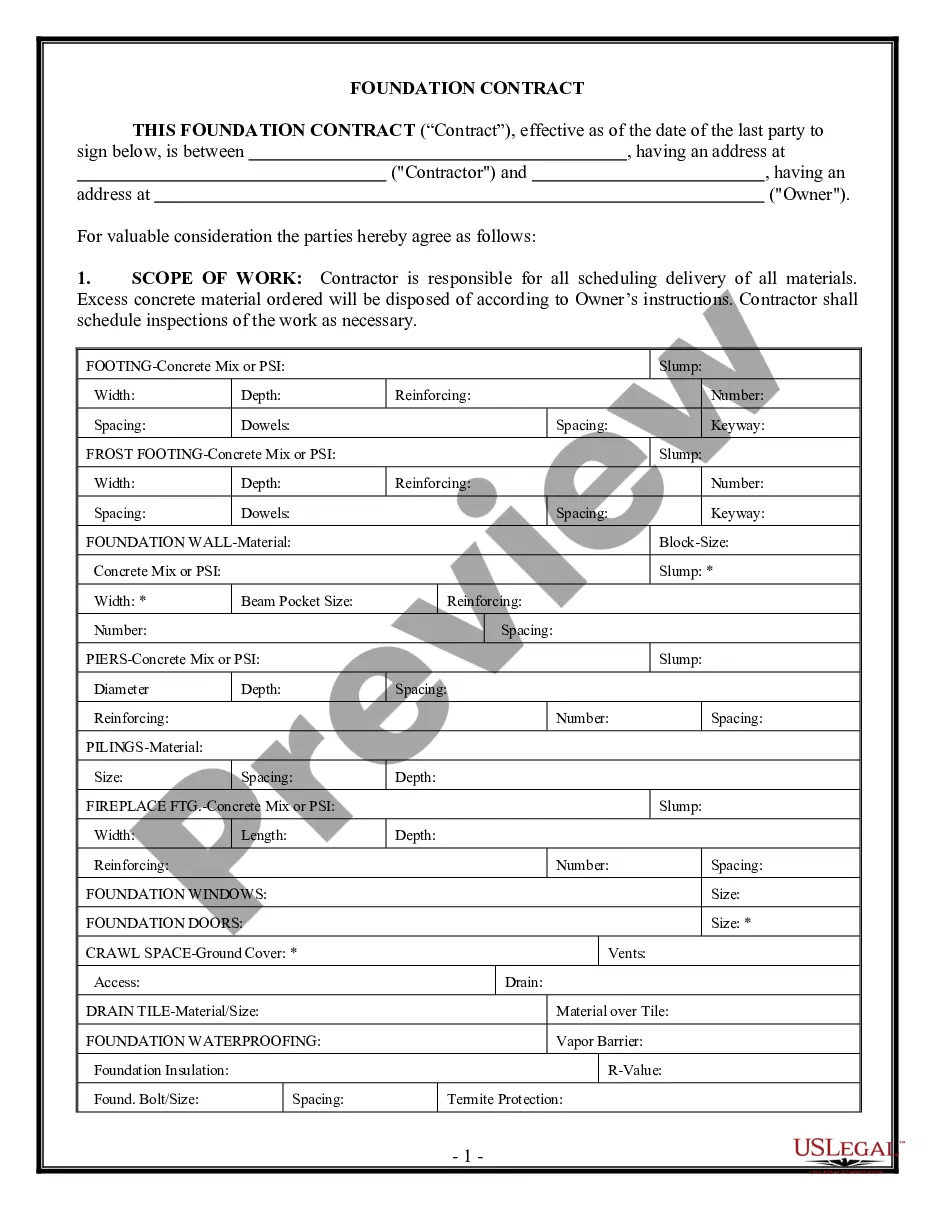
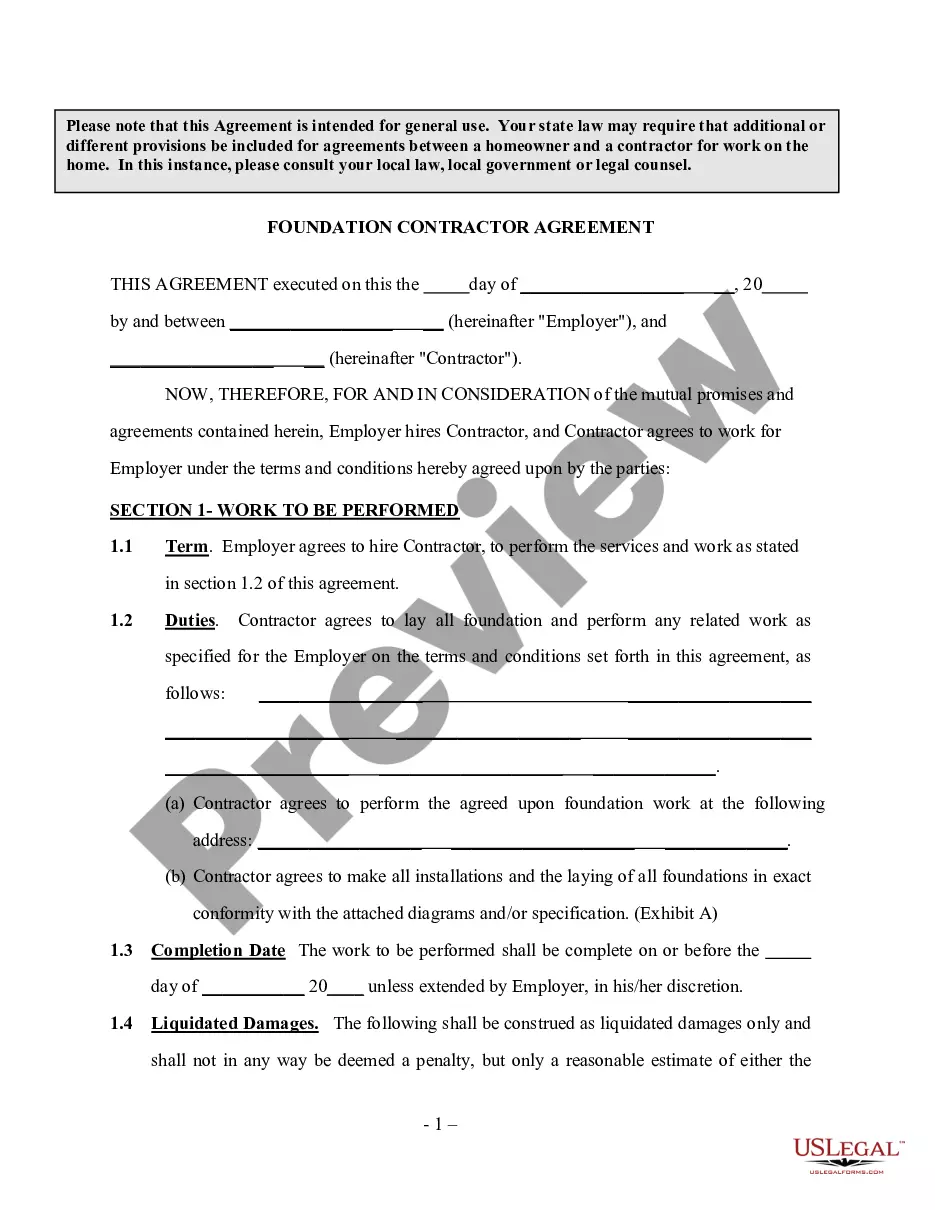
The Foundation Contract for Contractor is a legally binding agreement designed to outline the responsibilities and expectations between foundation contractors and property owners. This contract addresses important aspects such as payment arrangements, insurance, and change orders. It is specifically tailored to comply with the laws of South Carolina, making it a reliable choice for both parties engaging in foundation work.
Form components explained
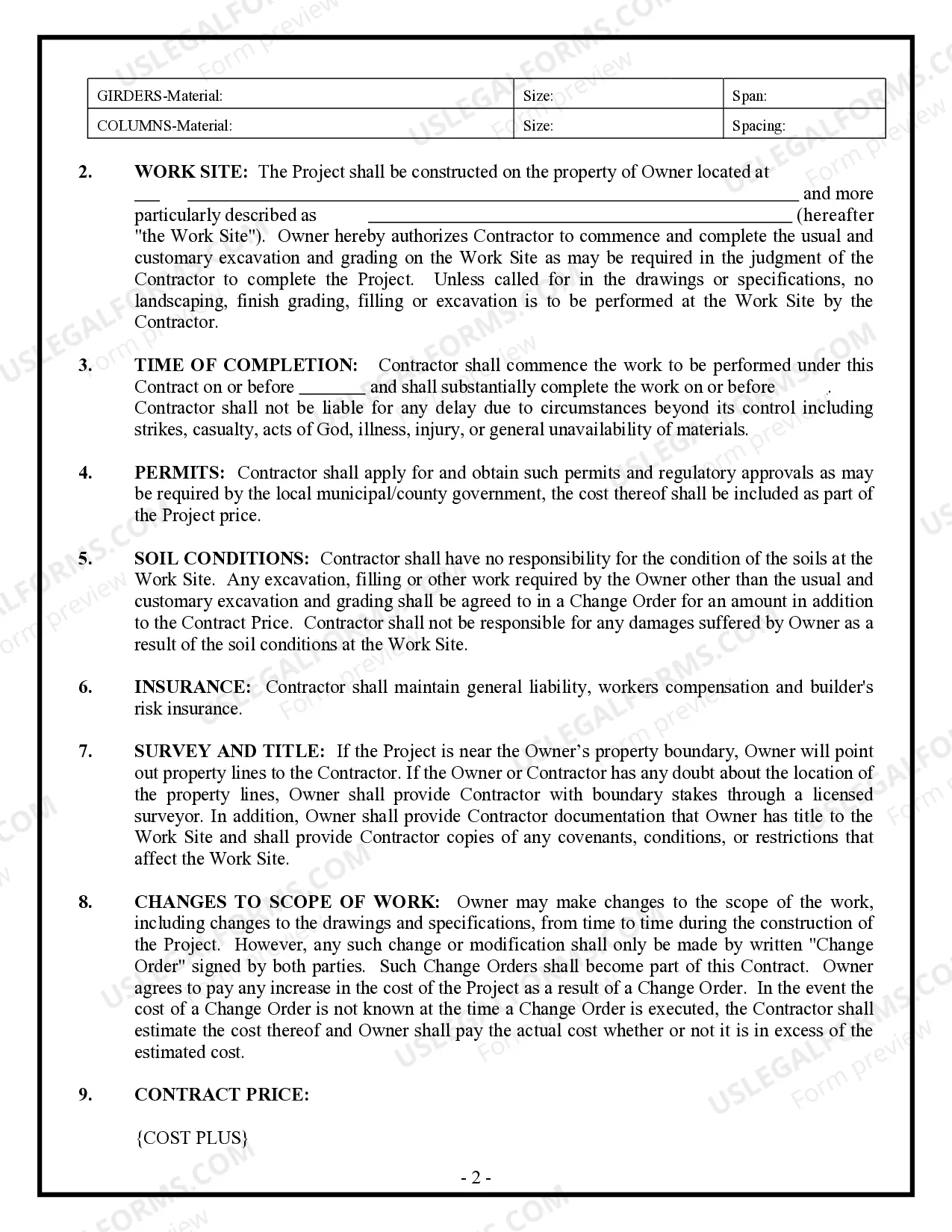
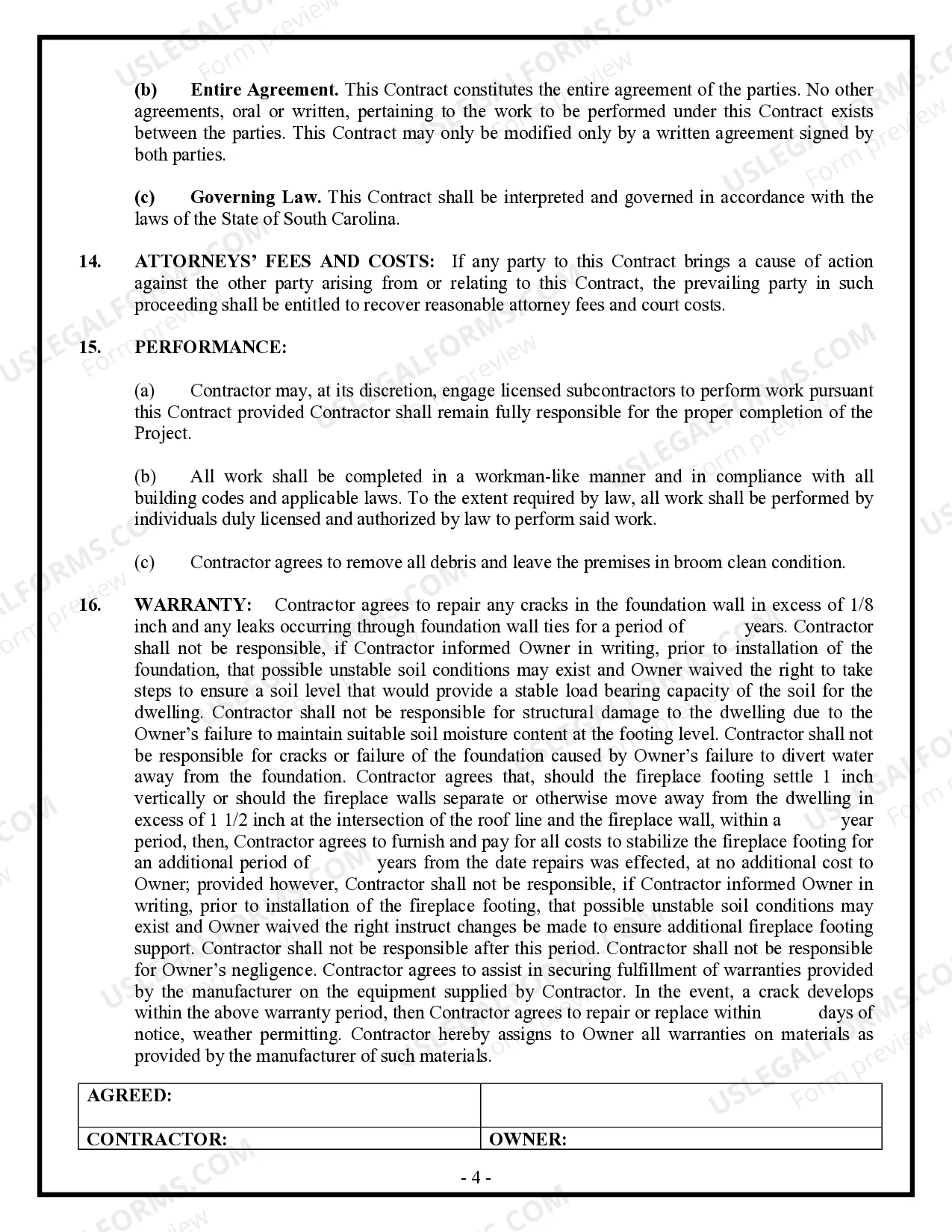
- Permits: Contractor is responsible for obtaining necessary permits and approvals, with associated costs included in the project price.
- Soil Conditions: Clarifies contractor's limitations regarding soil conditions at the work site, and how to address additional work through change orders.
- Insurance Requirements: Contractor must maintain general liability, workers compensation, and builderâs risk insurance during the project.
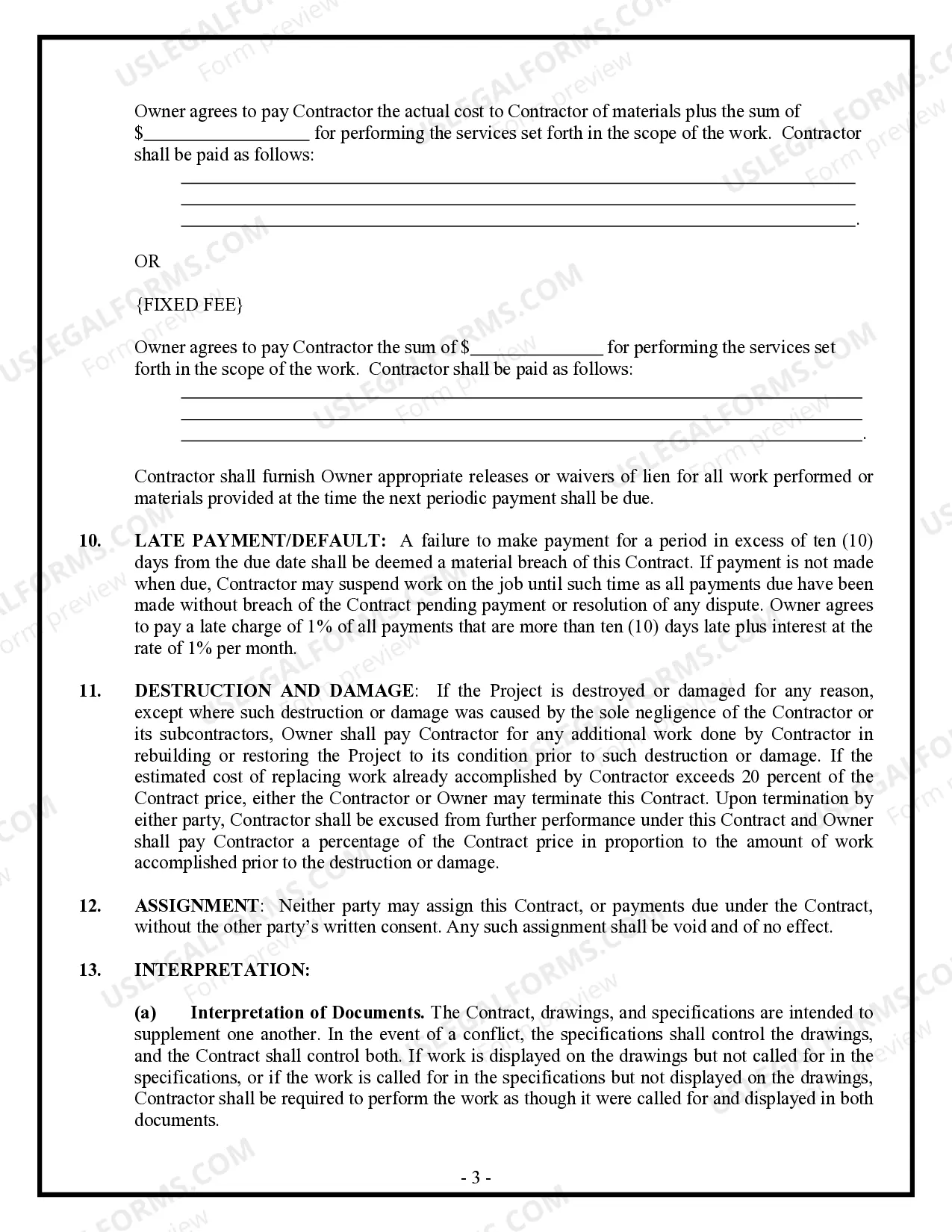
- Change Orders: Outlines how changes to the project scope are to be documented and compensated, including potential cost increases.
- Payment Terms: Defines the consequences of late payments and the conditions under which work may be suspended.

When to use this form
This form should be used when a property owner contracts with a foundation contractor for construction projects involving foundations, such as new home construction or major renovations. It is applicable for both fixed fee and cost-plus arrangements, ensuring that all critical aspects, including insurance and permits, are appropriately addressed to protect both parties during the construction process.
Who should use this form
This form is intended for:
- Foundation contractors working on residential or commercial projects.
- Property owners seeking to define the terms of a construction project involving foundation work.
- Individuals and businesses in South Carolina requiring a clear framework for contractor-owner agreements.
How to complete this form
- Identify the parties involved: Enter the names and contact details of both the contractor and property owner.
- Specify the project details: Clearly outline the scope of work, project location, and any special conditions.
- Determine the payment structure: Choose between a cost-plus or fixed fee arrangement and fill in the agreed contract price.
- Review and include insurance information: Ensure all necessary insurance coverage details are documented within the contract.
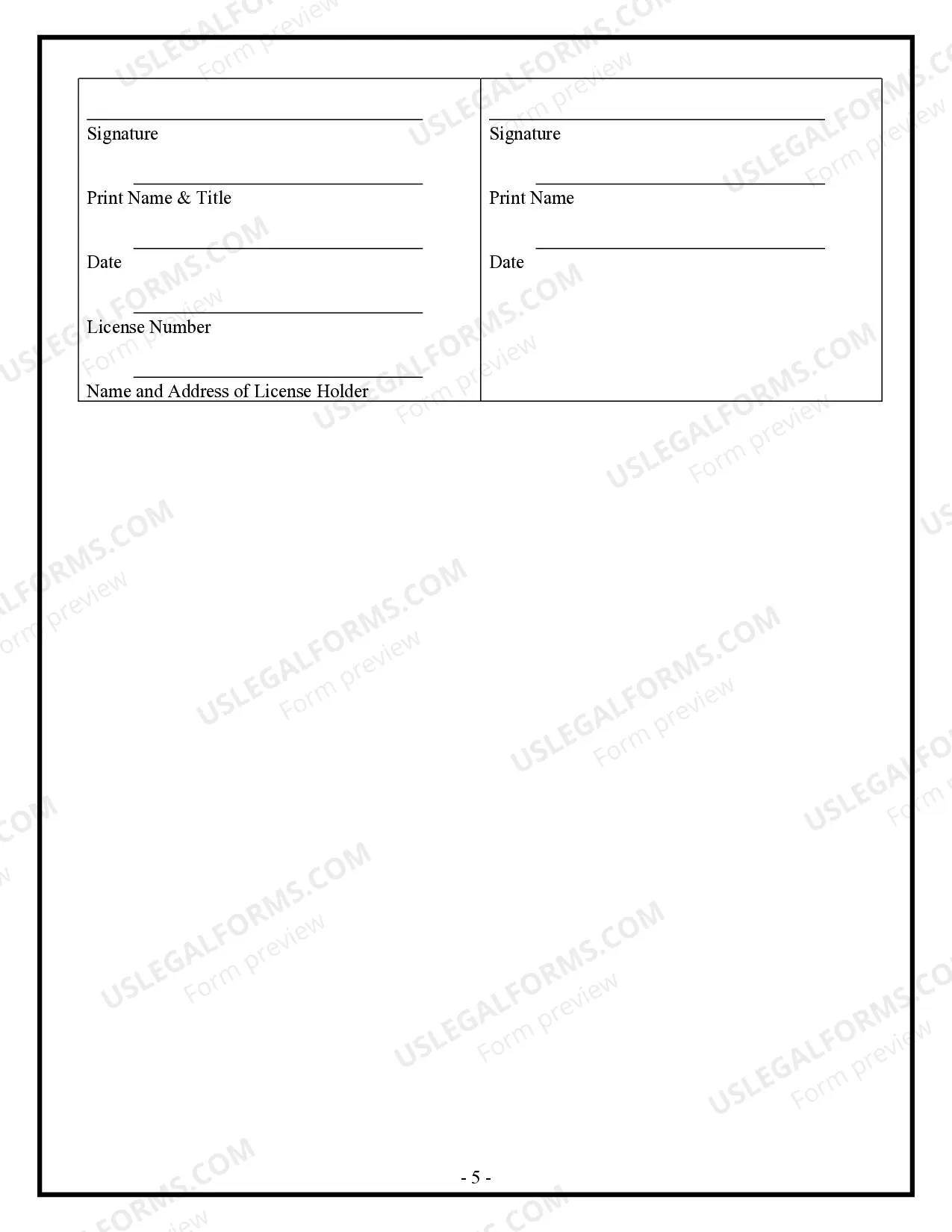
- Sign the contract: Both parties should sign and date the contract to confirm their agreement and understanding of the terms.
Does this document require notarization?
This form does not typically require notarization unless specified by local law. Both parties should ensure they retain copies of the signed contract for their records.
Get your form ready online
Our built-in tools help you complete, sign, share, and store your documents in one place.
Make edits, fill in missing information, and update formatting in US Legal Forms—just like you would in MS Word.
Download a copy, print it, send it by email, or mail it via USPS—whatever works best for your next step.
Sign and collect signatures with our SignNow integration. Send to multiple recipients, set reminders, and more. Go Premium to unlock E-Sign.
If this form requires notarization, complete it online through a secure video call—no need to meet a notary in person or wait for an appointment.
We protect your documents and personal data by following strict security and privacy standards.

Make edits, fill in missing information, and update formatting in US Legal Forms—just like you would in MS Word.

Download a copy, print it, send it by email, or mail it via USPS—whatever works best for your next step.

Sign and collect signatures with our SignNow integration. Send to multiple recipients, set reminders, and more. Go Premium to unlock E-Sign.

If this form requires notarization, complete it online through a secure video call—no need to meet a notary in person or wait for an appointment.

We protect your documents and personal data by following strict security and privacy standards.
Common mistakes to avoid
- Failing to specify the project scope clearly, leading to potential disputes.
- Neglecting to document change orders, resulting in confusion over additional costs.
- Not including required insurance information, which can expose both parties to liability.
Benefits of completing this form online
- Convenience: Download the form instantly, without the need for in-person visits.
- Editability: Customize the template to fit specific project needs and ensure all details are accurate.
- Reliability: Use a legally vetted contract that meets state laws to protect both parties involved.
Looking for another form?


Form popularity
FAQ
In South Carolina, the South Carolina Department of Labor, Licensing and Regulations is responsible for the licensing of all contractors. General, mechanical, specialty and manufactured housing contractors must be licensed in order to work in the state.
A handyman, under the classification of Residential Specialty Contractor, does not need a license to work in South Carolina. However, you will need to register with the South Carolina Department of Labor, Licensing and Regulation.
Per South Carolina state law, a general handyman does not need a license to perform basic repair and maintenance tasks for homeowners. However, one does need to register with the South Carolina Department of Labor, Licensing and Regulation.
FILE A WRITTEN APPLICATION. First things first! SUBMIT A CERTIFIED CHECK. SUBMIT AN AFFIDAVIT. PASS THE EXAM. PAY THE LICENSE FEE.
A handyman, under the classification of Residential Specialty Contractor, does not need a license to work in South Carolina. However, you will need to register with the South Carolina Department of Labor, Licensing and Regulation.
A certified contractor passed the state licensing examination. Certified contractors can work anywhere within the state in which they are licensed. A registered contractor is registered by a local county or municipality and receives a certificate of competency from the Electrical Contractors' Licensing Board.
State law requires residential construction to be done by licensed residential builders and specialty contractors. You have applied for a permit under an exemption to that law. The exemption allows you, as the owner of your property, to act as your own builder even though you do not have a license.
FILE A WRITTEN APPLICATION. SUBMIT A CERTIFIED CHECK. SUBMIT AN AFFIDAVIT. PASS THE EXAM. PAY THE LICENSE FEE.
FILE A WRITTEN APPLICATION. First things first! SUBMIT A CERTIFIED CHECK. SUBMIT AN AFFIDAVIT. PASS THE EXAM. PAY THE LICENSE FEE.