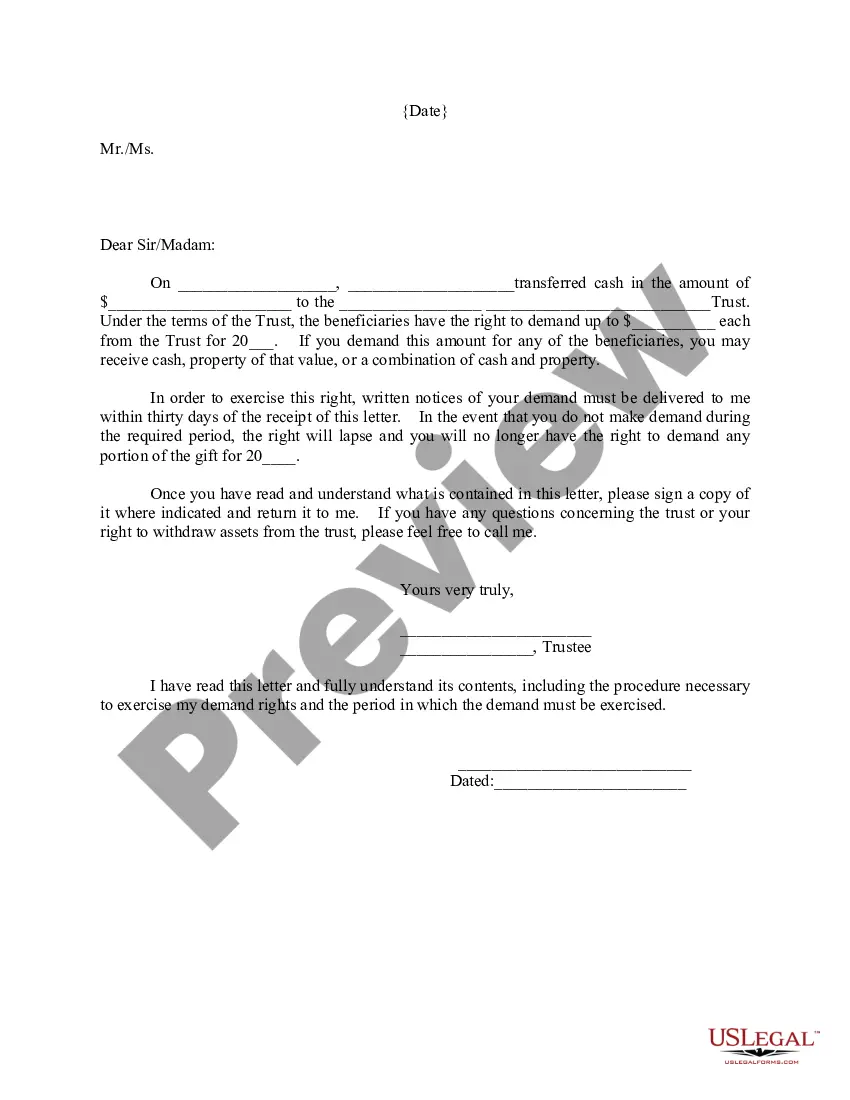
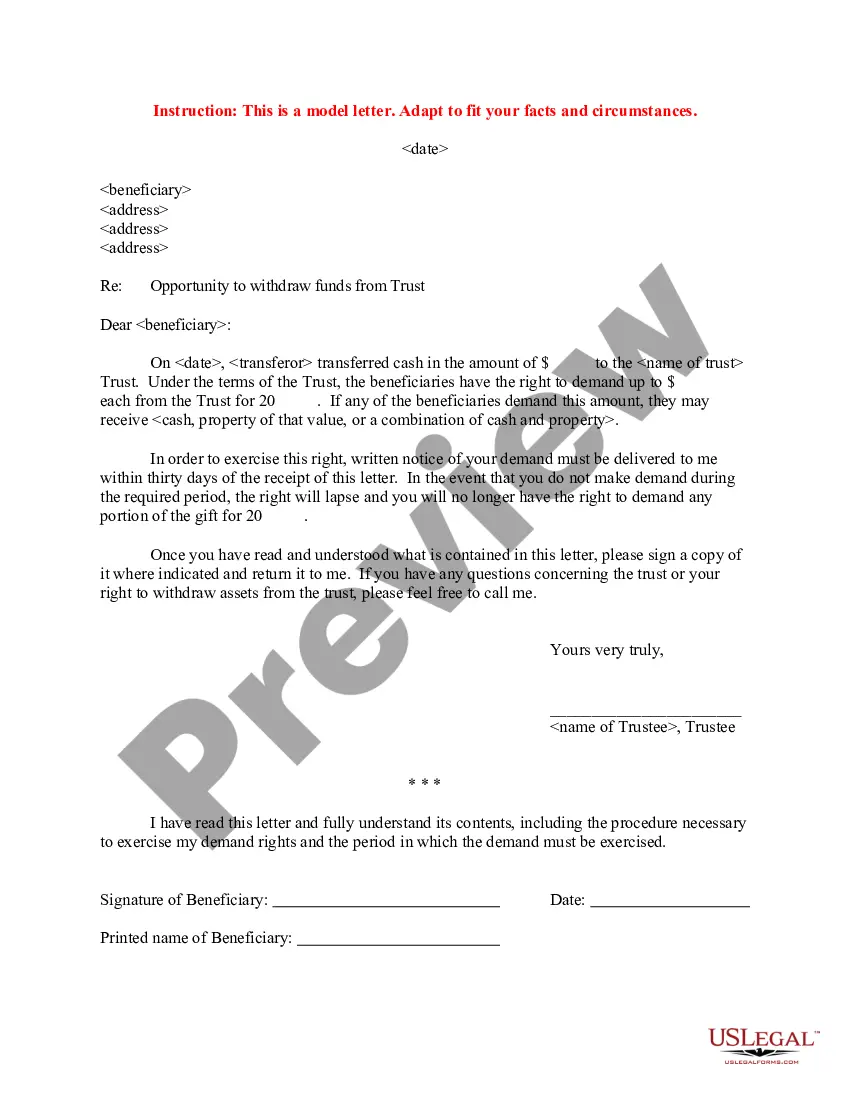
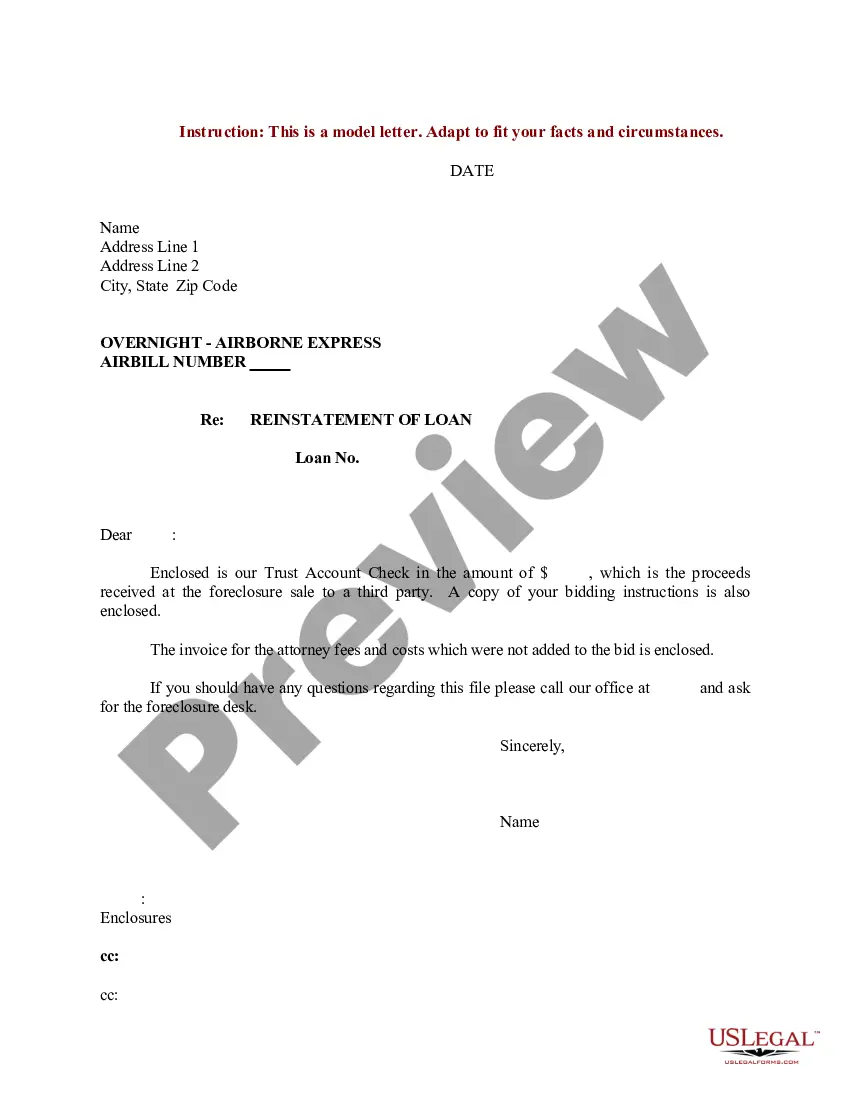
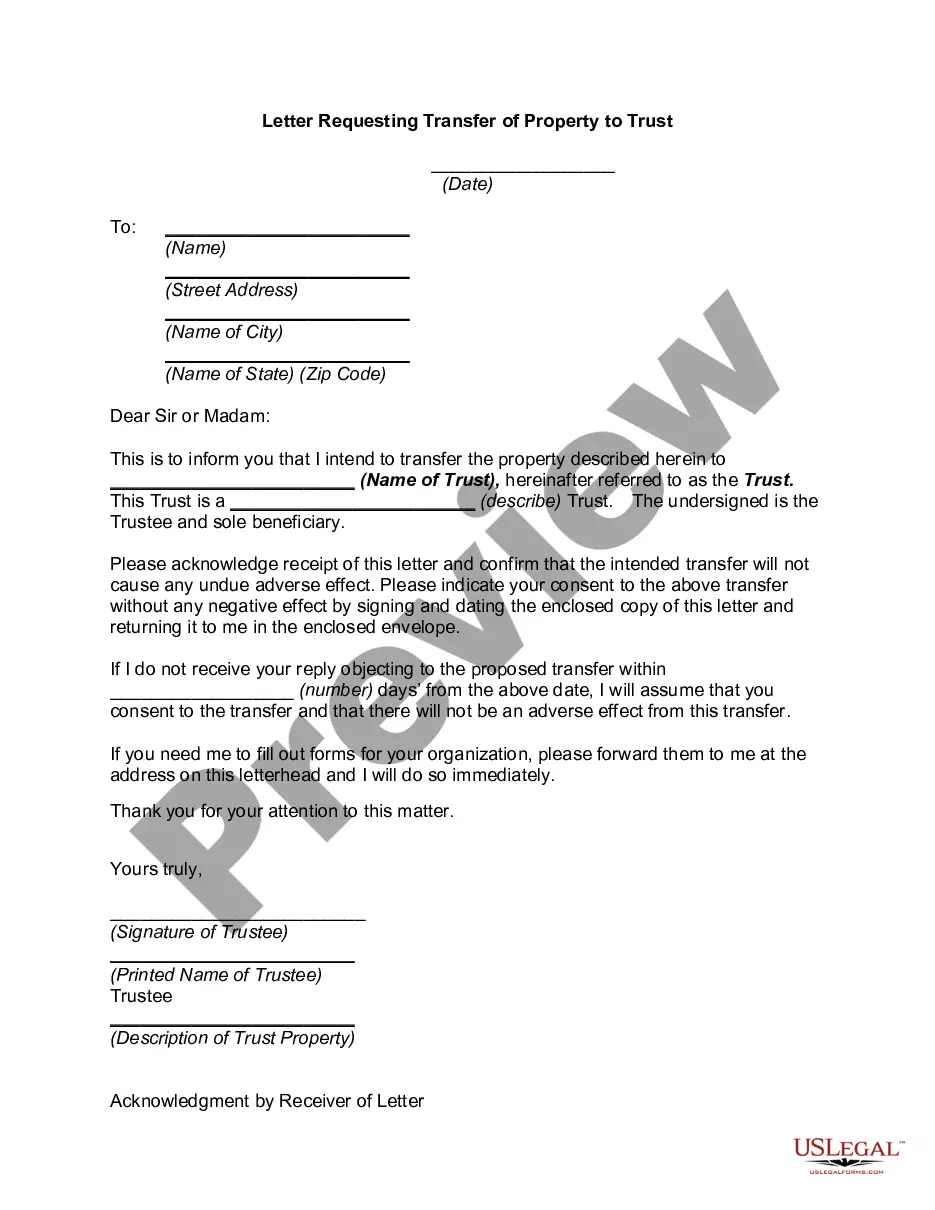
Trustee informs the trustor that he/she has the right to demand a certain amount of funds from the trust during the year. If the trustor demands a withdrawal for any of the beneficiaries, he/she may receive cash, property of that value, or a combination of cash and property.
Rhode Island Letter regarding trust money
Instant download
Description
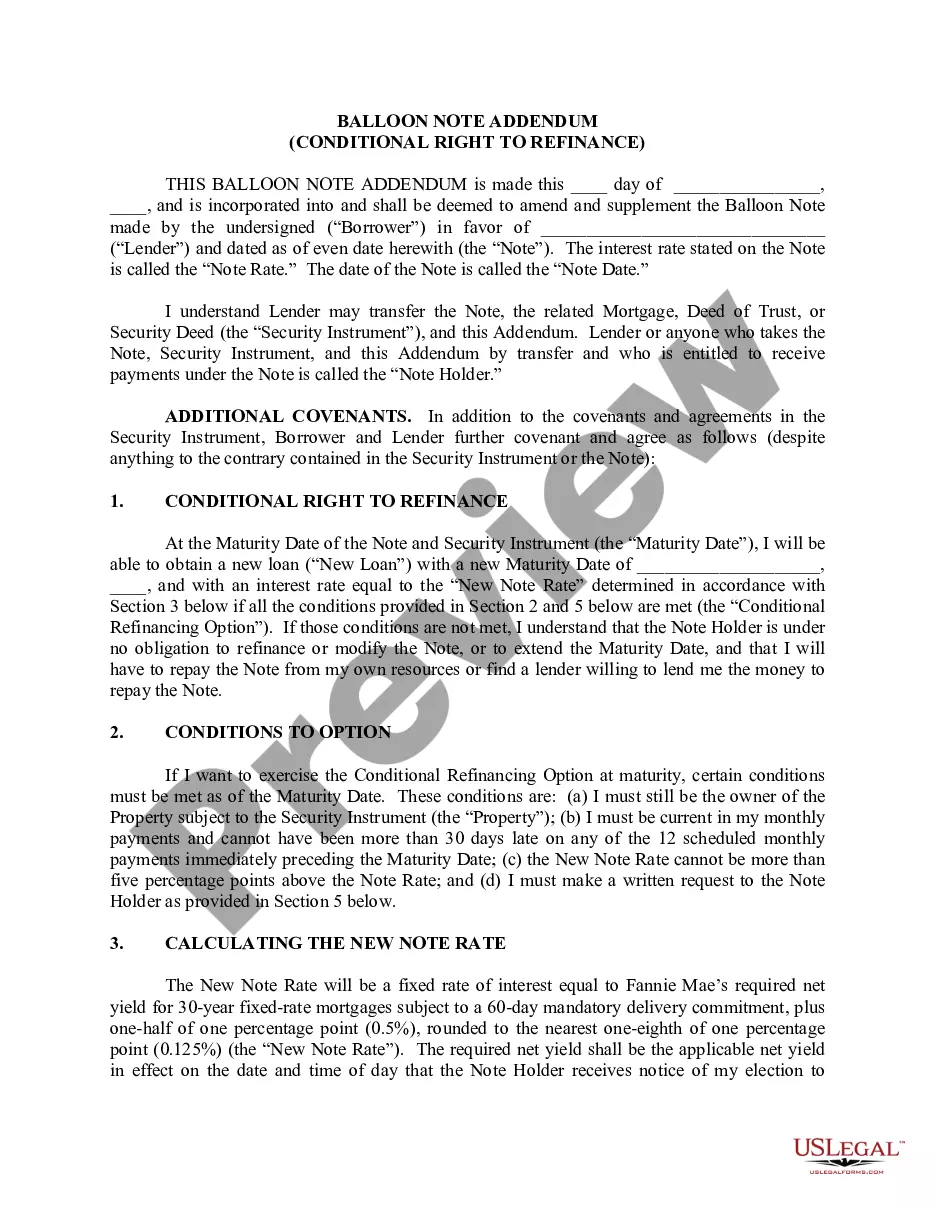
How to fill out Letter Regarding Trust Money?
US Legal Forms - among the largest repositories of legal documents in the country - offers a vast assortment of legal document templates you can obtain or create.
By using the website, you can find thousands of documents for business and personal use, organized by category, state, or keywords. You can access the latest versions of documents such as the Rhode Island Letter concerning trust funds within moments.
If you currently hold a monthly subscription, Log In and obtain the Rhode Island Letter concerning trust funds from the US Legal Forms library. The Download button will appear on every document you view. You can access all previously acquired documents from the My documents section of your account.
Process the transaction. Use your credit card or PayPal account to complete the transaction.
Select the format and download the document to your device. Make modifications. Complete, edit, print, and sign the acquired Rhode Island Letter concerning trust funds. Each template added to your account does not have an expiration date and is yours to keep indefinitely. Therefore, if you wish to obtain or create another copy, simply navigate to the My documents section and click on the document you need. Access the Rhode Island Letter concerning trust funds with US Legal Forms, the most extensive collection of legal document templates. Utilize thousands of professional and state-specific templates that meet your business or personal needs.
- Ensure you have chosen the correct document for your city/region.
- Click the Review button to examine the content of the document.
- Read the description of the document to confirm that you have selected the right one.
- If the document does not suit your requirements, utilize the Search field at the top of the screen to find one that does.
- When you are satisfied with the document, confirm your selection by clicking on the Buy now button.
- Then, choose the pricing plan you prefer and provide your information to register for an account.
Form popularity
FAQ
An irrevocable trust in Rhode Island is a legal arrangement where the trust creator relinquishes all control over the assets placed in the trust. This means the assets cannot be modified, withdrawn, or terminated without the beneficiary's consent. Establishing an irrevocable trust can provide tax benefits and protect assets from creditors. It is essential to consult a professional to ensure the trust aligns with your financial goals.
This can mean a lot of different things, but most often, it means that when the deceased created an estate plan, it was established so that the beneficiaries did not inherit outright, but rather in trust. This means the assets that are inherited are titled in the name of a trust, rather than the beneficiary's name.
The trust allows the trustee to gift from the trust to the current beneficiary's issue up to the annual gift exclusion (currently $15K).
While trust documents may permit beneficiaries to take loans from the trust as a type of distribution, the trustee himself cannot take or borrow money from the trust, as it creates a conflict of interest.
Key Takeaways. Money taken from a trust is subject to different taxation than funds from ordinary investment accounts. Trust beneficiaries must pay taxes on income and other distributions that they receive from the trust. Trust beneficiaries don't have to pay taxes on returned principal from the trust's assets.
The trustee can write the beneficiary a check, give them cash, and transfer real estate by drawing up a new deed or selling the house and giving them the proceeds.
If you have a revocable trust, you can get money out by making a request via the trustee. Should you yourself be listed as the trustee, you'll be able to transfer funds and assets out of the trust as you see fit.
The federal gift tax law provides that every person can give a present interest gift of up to $14,000 each year to any individual they want. This means that each parent can each give each of their children and grandchildren $14,000 (two parents permits a total gift per recipient of $28,000).
Identify yourself as a beneficiary of the irrevocable trust in the body of the letter. State that you are requesting money from the trust, and the reason for the request. Include supporting documentation. For example, if you are requesting money to pay medical bills, enclose copies of the bills.
Trusts can help your heirs avoid a lengthy and expensive probate process after you pass away. You can also arrange gifts of money or property per your instructions to the trustee.