Rhode Island Buy Sell Agreement Package
About this form package
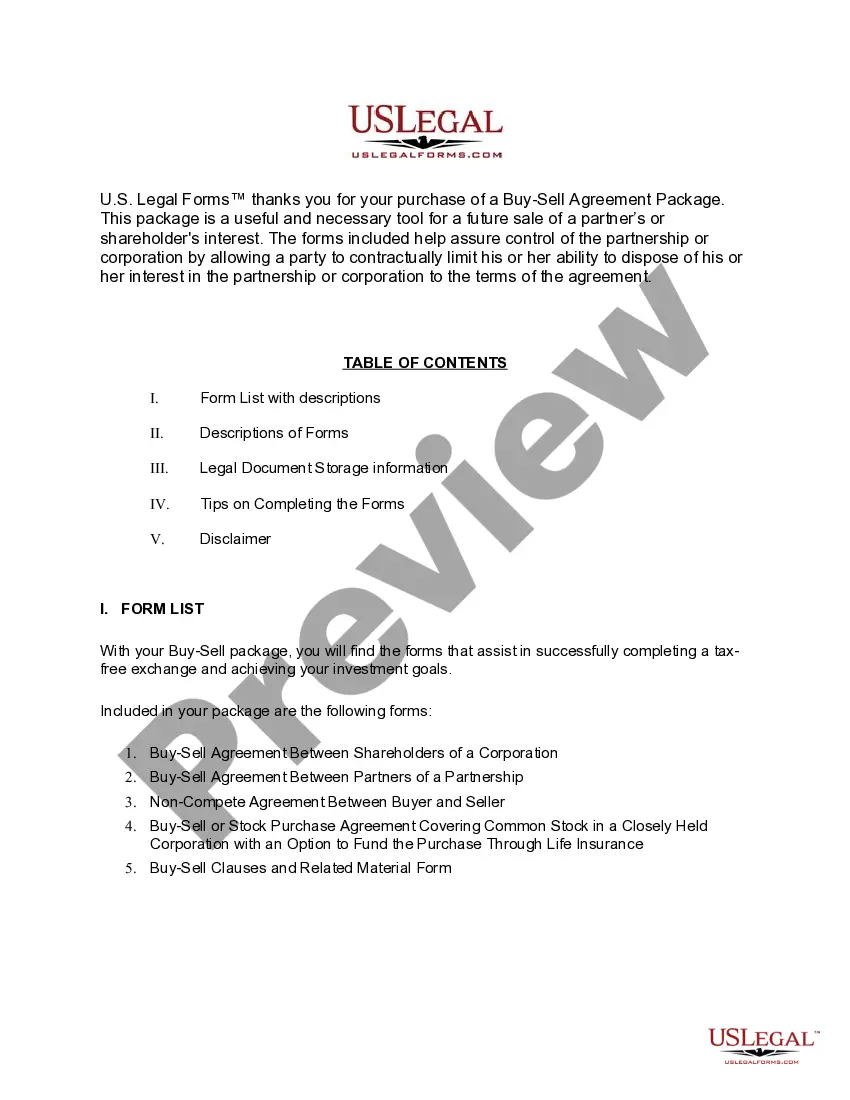
The Rhode Island Buy Sell Agreement Package contains essential legal documents necessary for the sale of a partner's or shareholder's interest in a business. This package ensures that the transaction adheres to predetermined terms, safeguarding control over the partnership or corporation. It includes various forms, each tailored to different types of business arrangements, providing a comprehensive solution that differs from general business contracts.
What’s included in this form package
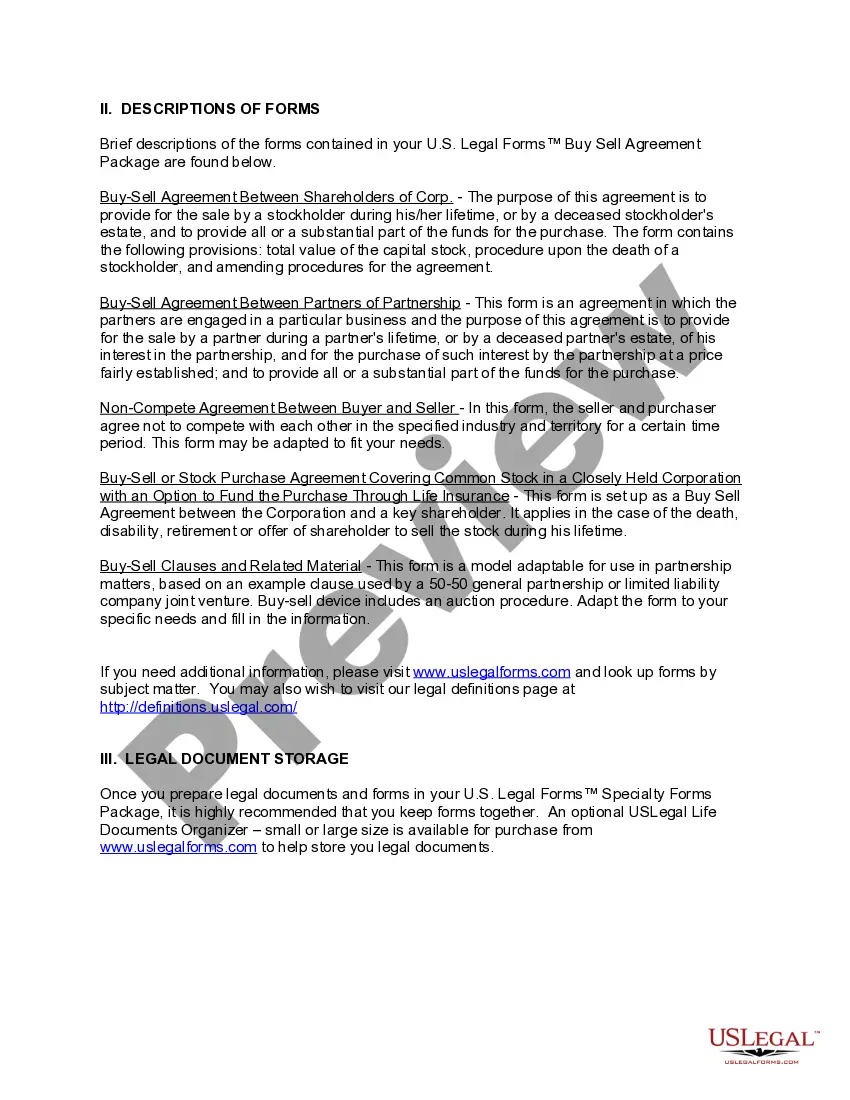
- Buy Sell Agreement Between Shareholders and a Corporation
- Buy Sell Agreement Between Partners of a Partnership
- Buy Sell or Stock Purchase Agreement Covering Common Stock in Closely Held Corporation with Option to Fund Purchase through Life Insurance
- Noncompetition Agreement between Buyer and Seller of Business
- Buy Sell Clauses and Related Material
Common use cases
This package is needed in several scenarios, including:
- When a partner wishes to exit the business or sell their interest.
- When a shareholder wants to transfer their shares, due to retirement or other circumstances.
- When you need to ensure a smooth transaction that limits potential conflicts among remaining partners or shareholders.
- When establishing a non-competition agreement to protect business interests during and after the sale.
Who should use this form package
- Business partners looking to formalize exit strategies.
- Shareholders in closely-held corporations planning to sell their stake.
- Legal professionals advising clients on partnership agreements.
- Business owners seeking to limit competition post-sale.
Steps to complete these forms
- Review all included forms to select the necessary agreements for your situation.
- Identify the parties involved in the transaction and gather their information.
- Fill in the specific details such as names, dates, and terms of the agreements.
- Ensure both parties sign the agreements where required.
- Consult with a legal advisor to confirm that all documents meet state requirements.
Notarization guidance for this package
Forms in this package typically do not require notarization unless specified by local law. However, it is always advisable to confirm whether notarization is necessary for your specific situation to ensure legal validity.
Get your form ready online
Our built-in tools help you complete, sign, share, and store your documents in one place.
Make edits, fill in missing information, and update formatting in US Legal Forms—just like you would in MS Word.
Download a copy, print it, send it by email, or mail it via USPS—whatever works best for your next step.
Sign and collect signatures with our SignNow integration. Send to multiple recipients, set reminders, and more. Go Premium to unlock E-Sign.
If this form requires notarization, complete it online through a secure video call—no need to meet a notary in person or wait for an appointment.
We protect your documents and personal data by following strict security and privacy standards.

Make edits, fill in missing information, and update formatting in US Legal Forms—just like you would in MS Word.

Download a copy, print it, send it by email, or mail it via USPS—whatever works best for your next step.

Sign and collect signatures with our SignNow integration. Send to multiple recipients, set reminders, and more. Go Premium to unlock E-Sign.

If this form requires notarization, complete it online through a secure video call—no need to meet a notary in person or wait for an appointment.

We protect your documents and personal data by following strict security and privacy standards.
Common mistakes to avoid
- Failing to clearly outline terms in the buy-sell agreement.
- Not updating the agreement when business circumstances change.
- Overlooking state-specific legal requirements.
- Neglecting to involve both parties in the agreement creation process.
Why complete this package online
- Convenient access to legal forms from anywhere at any time.
- Editable forms that can be tailored to fit specific business needs.
- Immediate download after purchase, allowing for quick usage.
- All forms drafted by licensed attorneys to ensure legal compliance.
Legal use & context
- Buy-sell agreements are essential for ensuring continuity in business operations.
- Clearly defined terms can help prevent disputes among partners or shareholders.
- These agreements are legally enforceable, provided they comply with state regulations.
What to keep in mind
- The Rhode Island Buy Sell Agreement Package is crucial for business partnerships and shareholder transactions.
- Understanding the components of each form is vital for effective completion and compliance.
- Professional legal advice can enhance the effectiveness and enforceability of these agreements.
Looking for another form?

Form popularity
FAQ
Minority shareholders have limited rights to benefit from the operations of a company, including receiving dividends and being able to sell the company's stock for profit. In practice, these rights can be restricted by a company's officers' decision to not pay dividends or purchase shares from shareholders.
Shareholders are entitled to inspect the company's financial books and records, including, but not limited to, financial statements, shareholder lists, corporate stock ledgers, and meeting minutes.
One power that minority shareholders have is to make a derivative claim against a director or officer within a company who the minority shareholders believe is not acting within their fiduciary responsibility, such as using company funds for personal use or misleading their investors.
Right to vote on major decisions and election of directors; Right to participate in meetings; Right to receive dividends; and. Right to inspect company records that are relevant to the shareholder's interests.
In California, minority shareholders have the right to access crucial information about the corporation in which they hold an interest. They have the right to inspect the record of shareholders as well as the right to inspect the books, accounting records and the minutes of corporate meetings or proceedings.
Common items to include in a shareholder agreement to protect minority shareholders include : Bringing in a third party (mediator) in an attempt to reach an amicable settlement if shareholders are in dispute; Including a right for a minority shareholder to have his shares bought out; or.
Right to appoint Small Shareholder Directors. Right to apply to NCLT for Oppression and Mismanagement: Right to file a Class Action Suit. Right for Reconstruction and Amalgamation of Companies: Adoption of Fair Valuation Mechanism: E-voting Process:
10% or more: can demand a poll vote at a general meeting; 5% or more: a shareholder is able to require circulation of a written resolution and can require a general meeting to be held.
If we can't come to an agreement, there's no simple way to compel the minority shareholder to sell. In general, the majority shareholder will need to address the minority's reasons for refusing to sell, convincing the minority to accept a fair value for their shares.