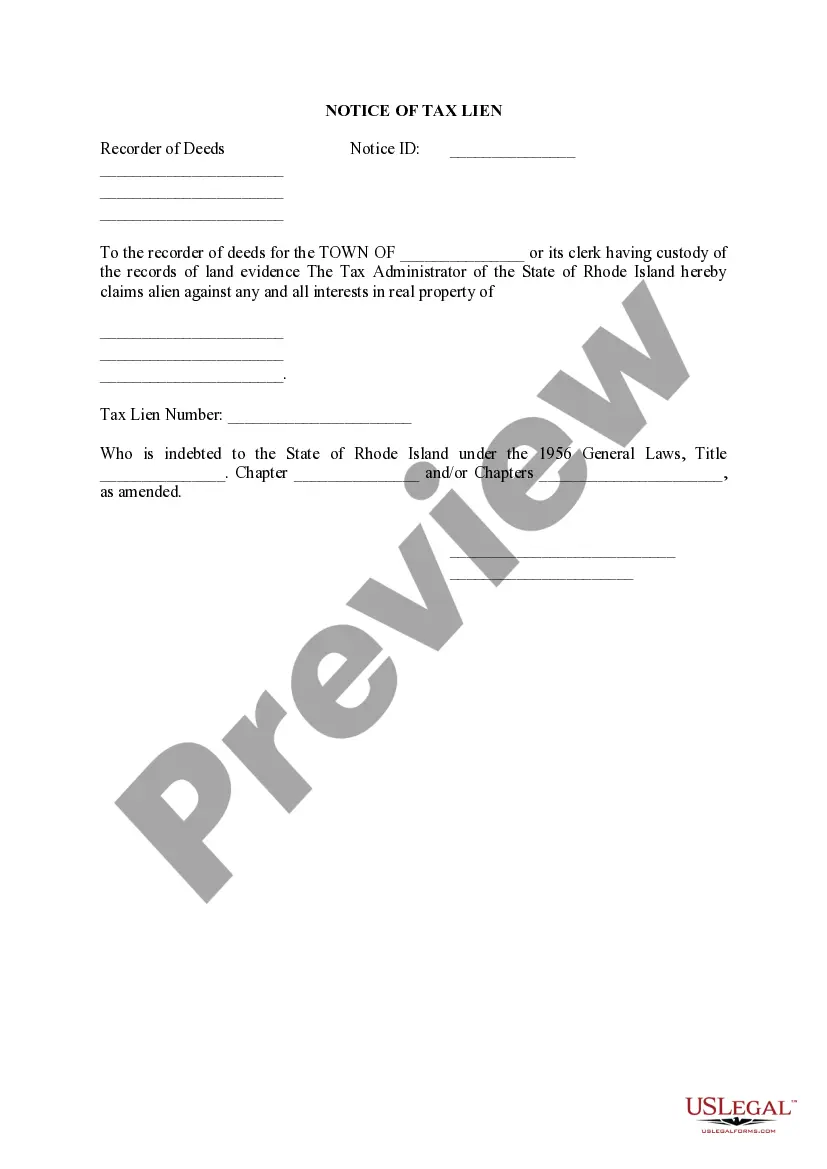
Rhode Island Notice of Tax Lien
Understanding this form
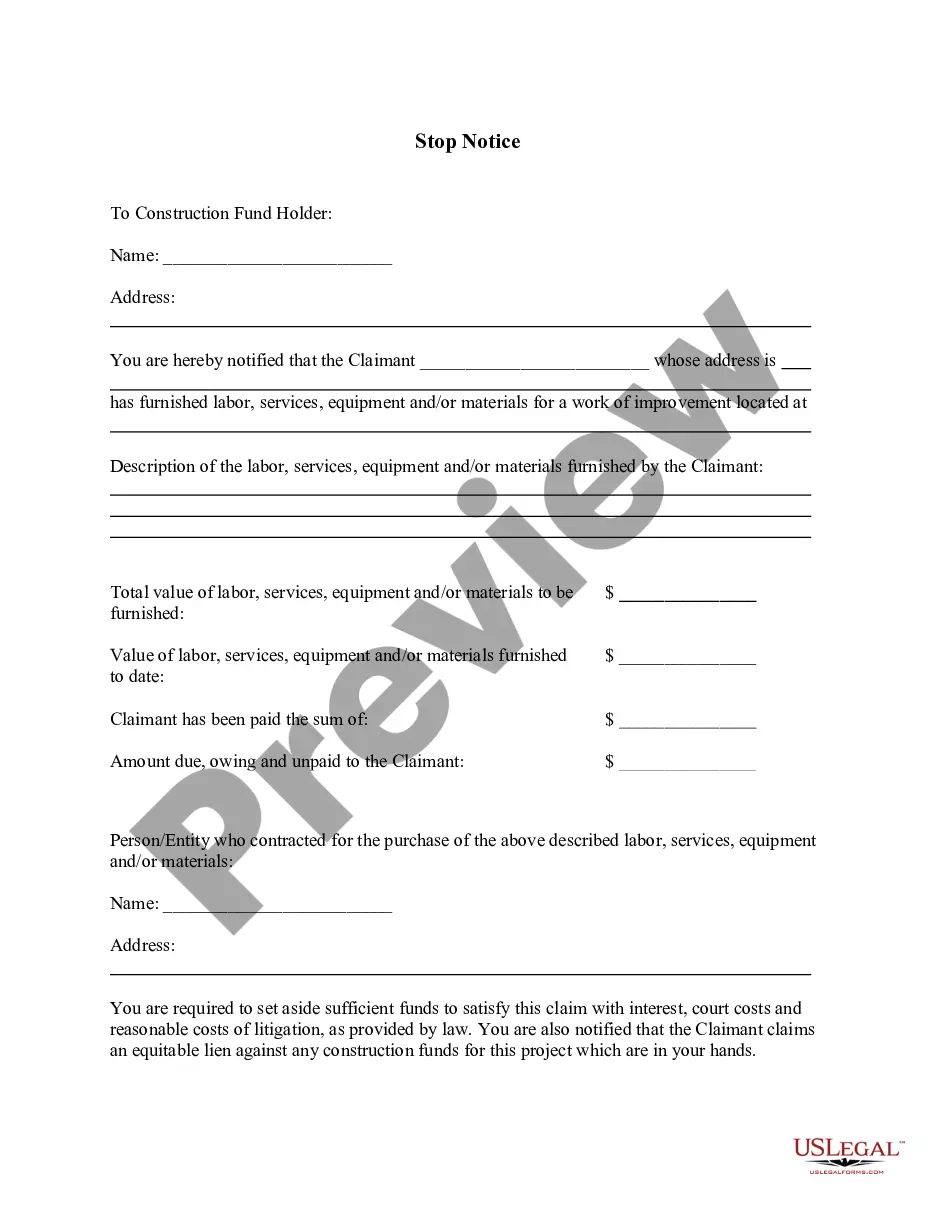
A Notice of Tax Lien is a legal document imposed by the government to secure the payment of taxes owed on real property or personal property. This form is crucial for notifying property owners and other interested parties about outstanding tax obligations, thereby differentiating it from other legal notices that may pertain to different types of liens or debts.
Main sections of this form
- Recorder of Deeds: Specifies the local authority responsible for recording the lien.
- Notice ID: A unique identifier for the tax lien.
- Claimant Information: Includes the name and title of the tax administrator from the state.
- Indebted Party Details: Contains information about the individual or entity that owes taxes.
- Tax Lien Number: A specific number assigned to track the lien.
- Legal Reference: Cites the relevant state laws under which the lien is claimed.
When this form is needed
This form should be used when a state or local government agency needs to impose a tax lien against real or personal property due to unpaid taxes. It serves as a formal notice to indebted individuals or corporations, alerting them to their tax obligations and the potential consequences of failing to pay.
Who needs this form
- Government tax authorities seeking to secure unpaid taxes.
- Individuals or businesses with outstanding tax obligations.
- Real estate professionals needing to inform clients about tax lien issues.
- Legal professionals assisting clients with tax matters.
Instructions for completing this form
- Identify the recorder of deeds or clerk responsible for the local property records.
- Enter the Notice ID in the designated field.
- Fill in the name and contact details of the claiming tax administrator.
- Specify the identity of the individual or organization that is indebted.
- Assign a unique Tax Lien Number to track the case.
- Cite the applicable state law that supports the lien claim.
Does this form need to be notarized?
This form does not typically require notarization unless specified by local law.
Get your form ready online
Our built-in tools help you complete, sign, share, and store your documents in one place.
Make edits, fill in missing information, and update formatting in US Legal Forms—just like you would in MS Word.
Download a copy, print it, send it by email, or mail it via USPS—whatever works best for your next step.
Sign and collect signatures with our SignNow integration. Send to multiple recipients, set reminders, and more. Go Premium to unlock E-Sign.
If this form requires notarization, complete it online through a secure video call—no need to meet a notary in person or wait for an appointment.
We protect your documents and personal data by following strict security and privacy standards.

Make edits, fill in missing information, and update formatting in US Legal Forms—just like you would in MS Word.

Download a copy, print it, send it by email, or mail it via USPS—whatever works best for your next step.

Sign and collect signatures with our SignNow integration. Send to multiple recipients, set reminders, and more. Go Premium to unlock E-Sign.

If this form requires notarization, complete it online through a secure video call—no need to meet a notary in person or wait for an appointment.

We protect your documents and personal data by following strict security and privacy standards.
Common mistakes to avoid
- Failing to provide accurate details about the indebted party.
- Omitting the appropriate legal references, which may lead to challenges.
- Not including the Tax Lien Number, which is essential for tracking purposes.
- Submitting the form to the wrong recording office.
Why complete this form online
- Convenient downloading allows for immediate access and use.
- Editable templates enable users to fill in specific information easily.
- Reliable content drafted by licensed attorneys ensures legal compliance.
Legal use & context
- The Notice of Tax Lien provides a formal record of a taxpayer's obligations.
- It may affect the ability to sell or refinance the property.
- Failure to respond or resolve the lien could lead to further legal action, including the sale of property to satisfy the debt.
Summary of main points
- A Notice of Tax Lien secures unpaid tax debts against property.
- The form requires specific information about both the creditor and debtor.
- It's essential to file this document accurately and with the correct authority to ensure enforceability.
Looking for another form?

Form popularity
FAQ
When you pay off your full tax balance or when the IRS runs out of time to collect the balance, the IRS will automatically release your tax lien. This removes the lien from your property. If the lien isn't automatically released, you can write to the IRS to request the release certificate.
Contrary to popular belief, the IRS does not have to record an NFTL before it can levy bank accounts or receivables. Once the Final Notice has been issued and 30 days have passed, the IRS can levy bank accounts and/or accounts receivable. The IRS does not perform a lien search prior to issuing a levy.
We may file a Notice of Federal Tax Lien in the public record to notify your creditors of your tax debt.The federal tax lien arises automatically when the IRS sends the first notice demanding payment of the tax debt assessed against you and you fail to pay the amount in full.
If you do happen to find a paid tax lien on your report, and it's been more than seven years since satisfied the debt, you just need to dispute the item with the credit bureaus. Once they verify the date and status, they will typically remove it within 30 days.
A lien secures the government's interest in your property when you don't pay your tax debt. A levy actually takes the property to pay the tax debt. If you don't pay or make arrangements to settle your tax debt, the IRS can levy, seize and sell any type of real or personal property that you own or have an interest in.
A lien release is used to cancel a lien that has already been filed. Lien releases are also referred to as a release of lien, cancellation of lien, or a lien cancellation. These are typically used to cancel the filed claim from public records.
A lien is a legal claim against your property to secure payment of your tax debt, while a levy actually takes the property to satisfy the tax debt.When filed, the Notice of Federal Tax Lien is a public document that alerts other creditors that the IRS is asserting a secured claim against your assets.
Tax liens put your assets at risk. To remove them you'll need to work with the IRS to pay your back taxes. Many or all of the products featured here are from our partners who compensate us. This may influence which products we write about and where and how the product appears on a page.
A tax lien operates as any other lien. It is a legal claim against your property that will remain in place until you either pay the outstanding debt or the property is sold, with sale proceeds going first to pay off any outstanding mortgage, then to pay off the tax debt.