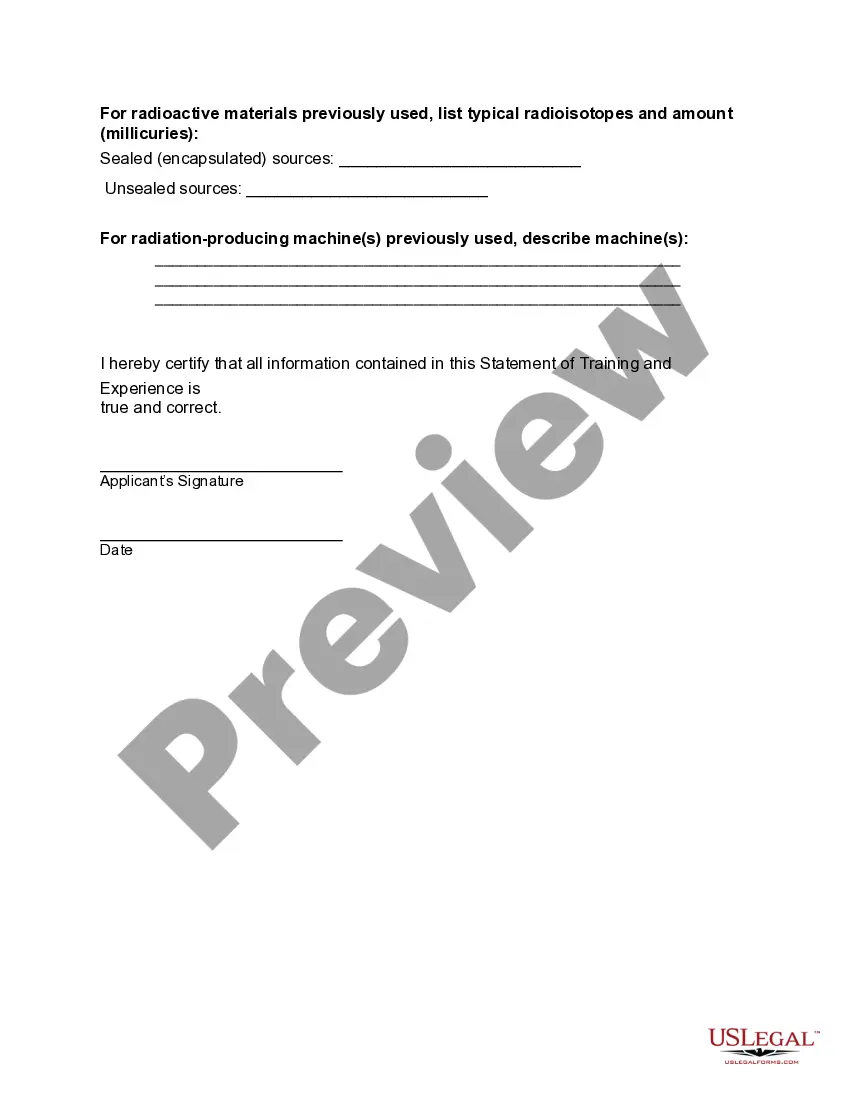
Puerto Rico Permit Holder's Statement of Training and Experience Using Radiation
Description
Get your form ready online
Our built-in tools help you complete, sign, share, and store your documents in one place.
Make edits, fill in missing information, and update formatting in US Legal Forms—just like you would in MS Word.
Download a copy, print it, send it by email, or mail it via USPS—whatever works best for your next step.
Sign and collect signatures with our SignNow integration. Send to multiple recipients, set reminders, and more. Go Premium to unlock E-Sign.
If this form requires notarization, complete it online through a secure video call—no need to meet a notary in person or wait for an appointment.
We protect your documents and personal data by following strict security and privacy standards.

Make edits, fill in missing information, and update formatting in US Legal Forms—just like you would in MS Word.

Download a copy, print it, send it by email, or mail it via USPS—whatever works best for your next step.

Sign and collect signatures with our SignNow integration. Send to multiple recipients, set reminders, and more. Go Premium to unlock E-Sign.

If this form requires notarization, complete it online through a secure video call—no need to meet a notary in person or wait for an appointment.

We protect your documents and personal data by following strict security and privacy standards.
Looking for another form?


How to fill out Permit Holder's Statement Of Training And Experience Using Radiation?
Selecting the appropriate legal document template can be a challenge.
Clearly, there is a wide range of templates available online, but how can you find the legal document you need.
Utilize the US Legal Forms website. The service offers thousands of templates, including the Puerto Rico Permit Holder's Statement of Training and Experience Using Radiation, which can be utilized for both professional and personal purposes.
Firstly, ensure that you have selected the correct form for your city/county. You can view the form by clicking the Review button and reading the form description to confirm it is the right one for you.
- All forms are reviewed by experts and meet state and federal regulations.
- If you are already registered, Log In to your account and click on the Acquire button to download the Puerto Rico Permit Holder's Statement of Training and Experience Using Radiation.
- Use your account to view the legal forms you have previously acquired.
- Access the My documents tab in your account to obtain another copy of the document you need.
- If you are a new user of US Legal Forms, follow these simple steps.
Form popularity
FAQ
Some countries require, especially for food products, a certificate proving that they do not contain radioactive substances, before accepting the import and selling of such products in its territory.
The aim of radiation protection is to prevent reliably the deterministic effects of radiation and to reduce the risk of stochastic effects to a reasonably achievable level.
The U.S. Nuclear Regulatory Commission and Agreement States regulate the use of radioactive material in order to protect people and the environment. Material licensees have the primary responsibility to maintain the security and accountability of the radioactive material in their possession.
The Nuclear Regulatory Commission (NRC) regulates the manufacture and use of radioactive materials in nuclear medicine, radiation therapy and research.
State Governments Under certain conditions (as allowed by the Atomic Energy Act), the NRC enters into agreements with State governors. Those agreements authorize individual States to regulate the use of specific radioactive materials within their borders. This includes radioisotopes used in medicine and industry.
The Nuclear Regulatory Commission (NRC) regulates the manufacture and use of radioactive materials in nuclear medicine, radiation therapy and research.
People who are internally contaminated can expose people near them to radiation from the radioactive material inside their bodies. The body fluids (blood, sweat, urine) of an internally contaminated person can contain radioactive materials.
Radiation protection aims to reduce unnecessary radiation exposure with a goal to minimize the harmful effects of ionizing radiation. 2 In the medical field, ionizing radiation has become an inescapable tool used for the diagnosis and treatment of a variety of medical conditions.
Some countries require, especially for food products, a certificate proving that they do not contain radioactive substances, before accepting the import and selling of such products in its territory.
The principal federal agencies with responsibilities for radiation protection of the public are the Environmental Protection Agency (EPA), the Nuclear Regulatory Commission, and the Department of Energy (DOE). Of these, only EPA and DOE may develop guidances or regulations for TENORM.