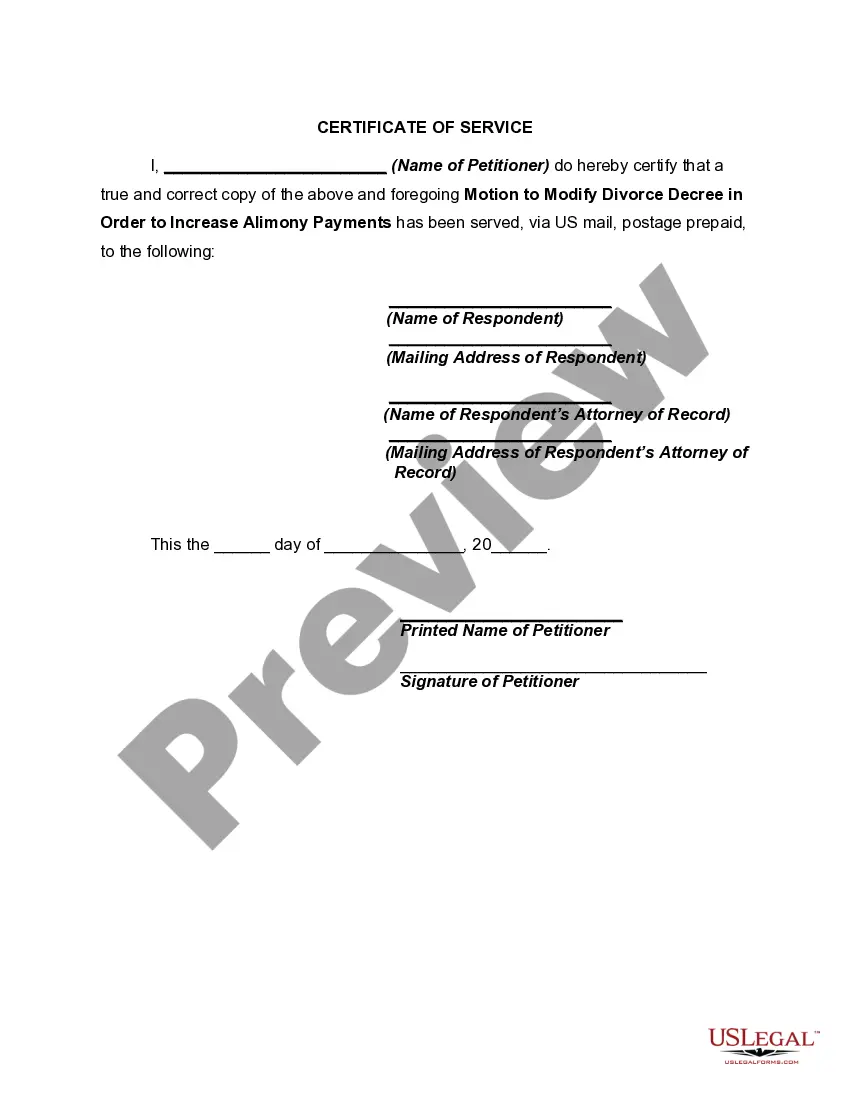
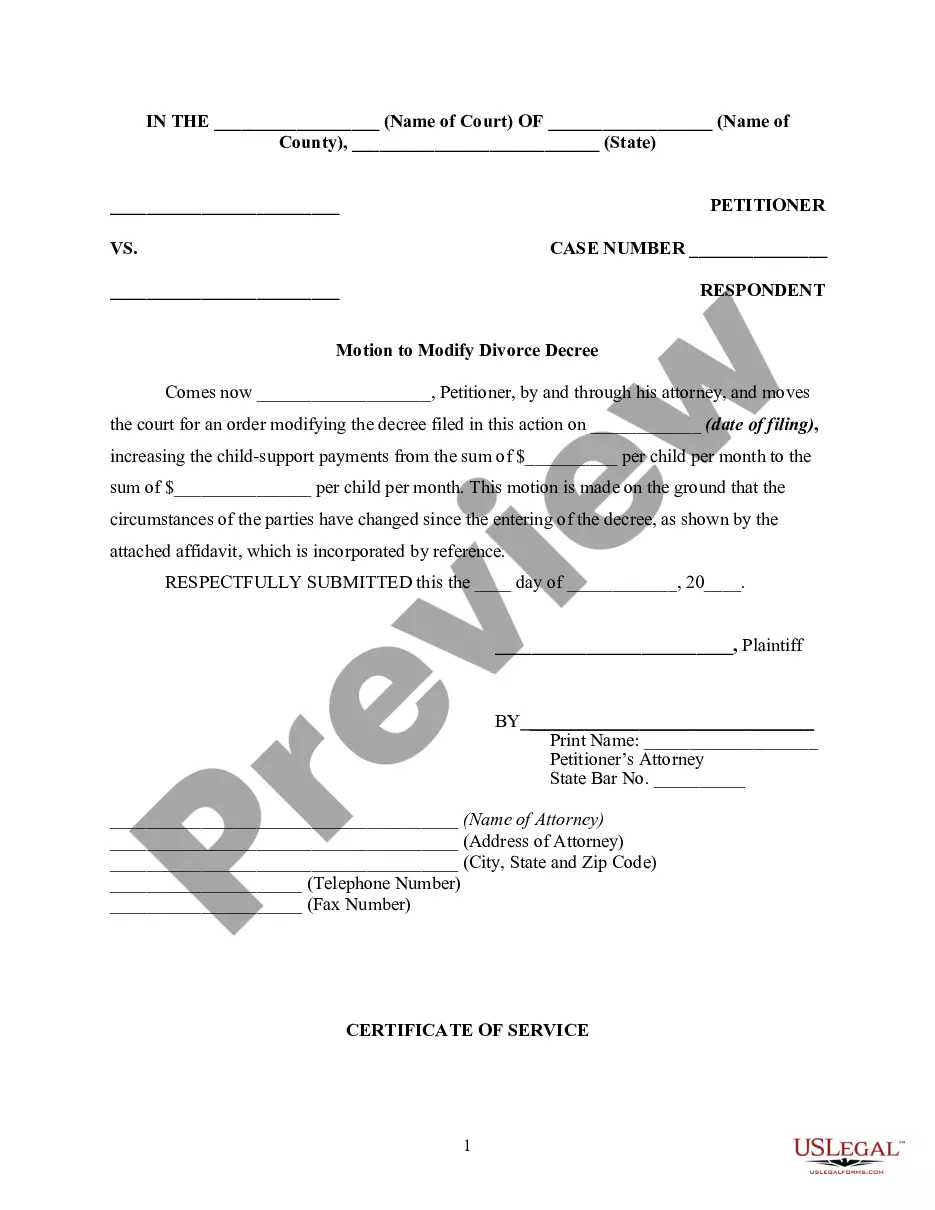
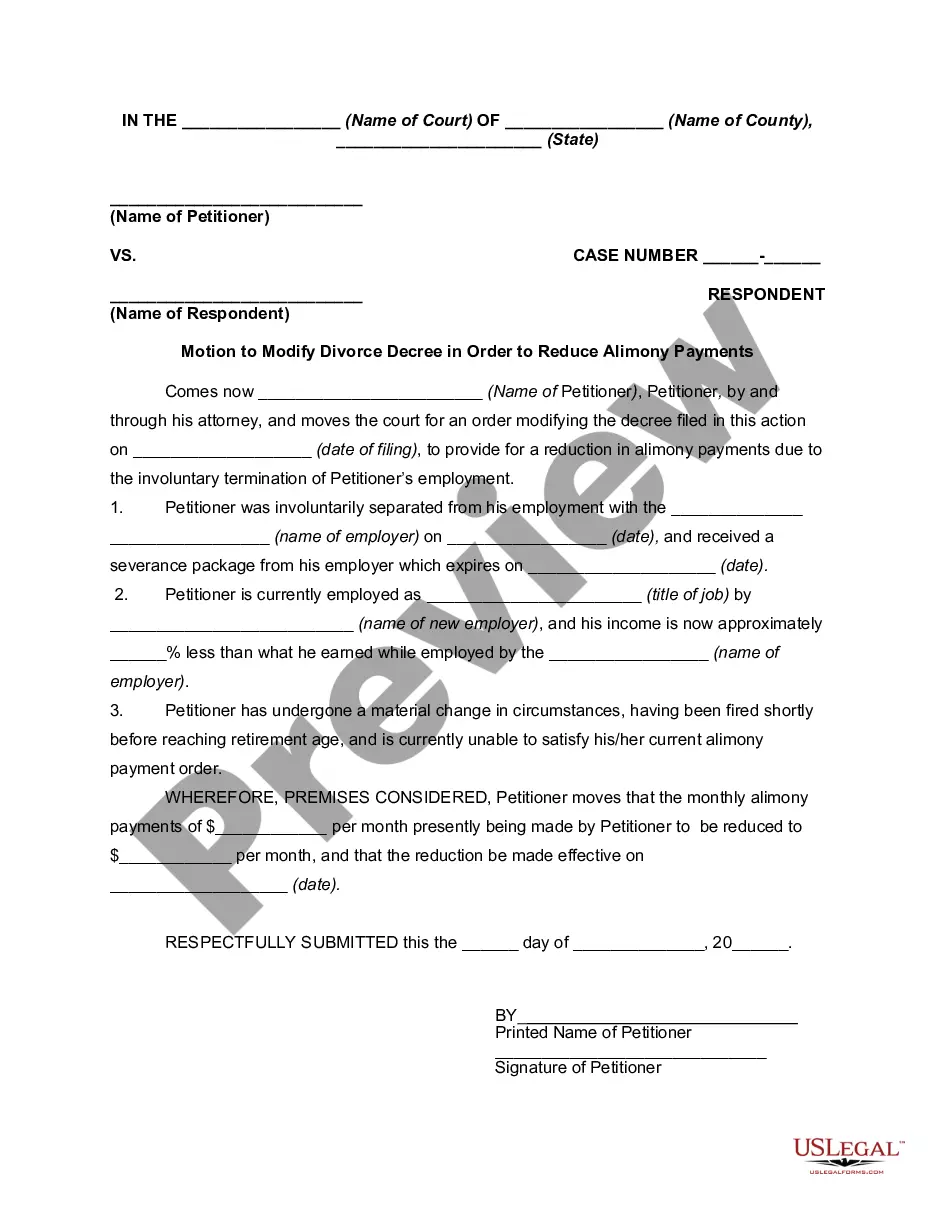
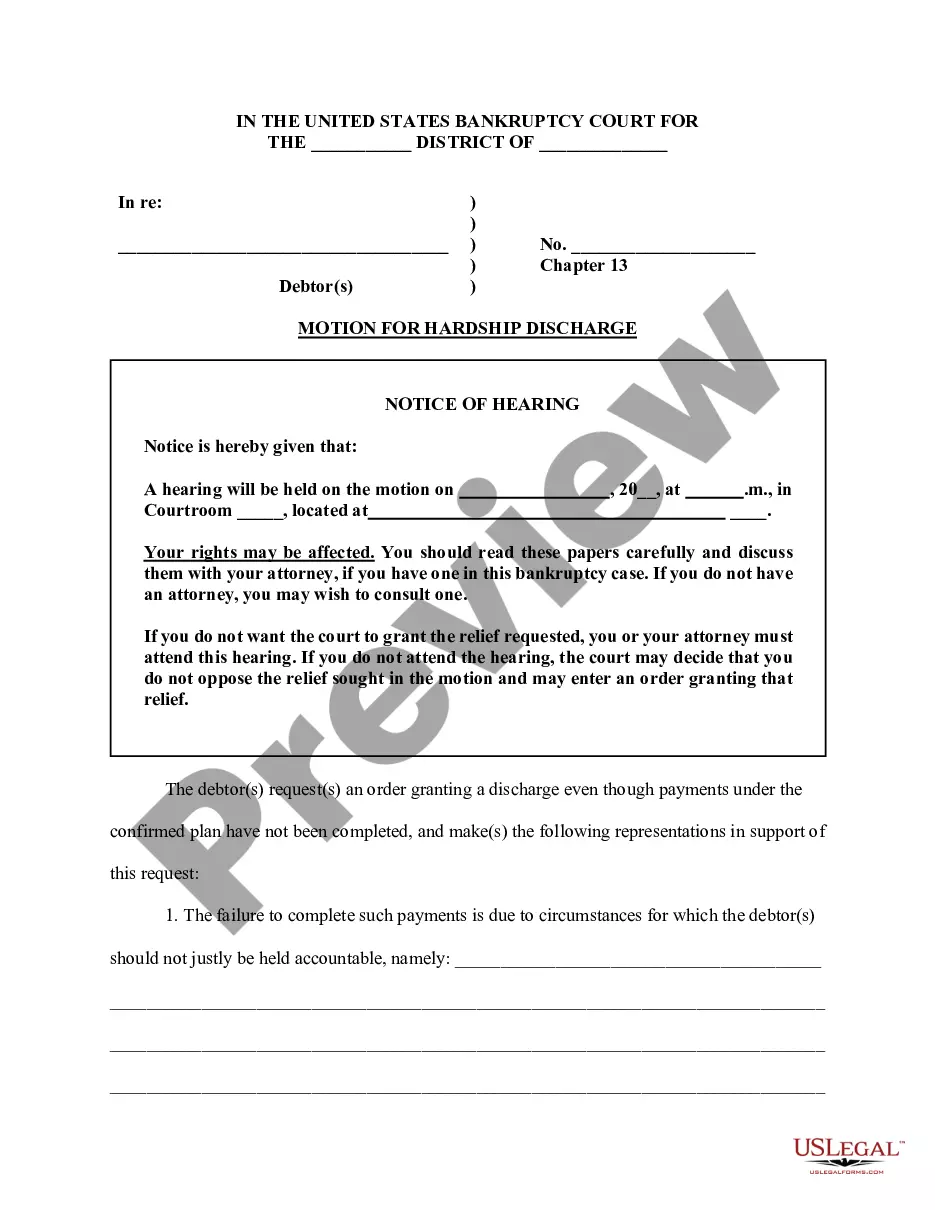
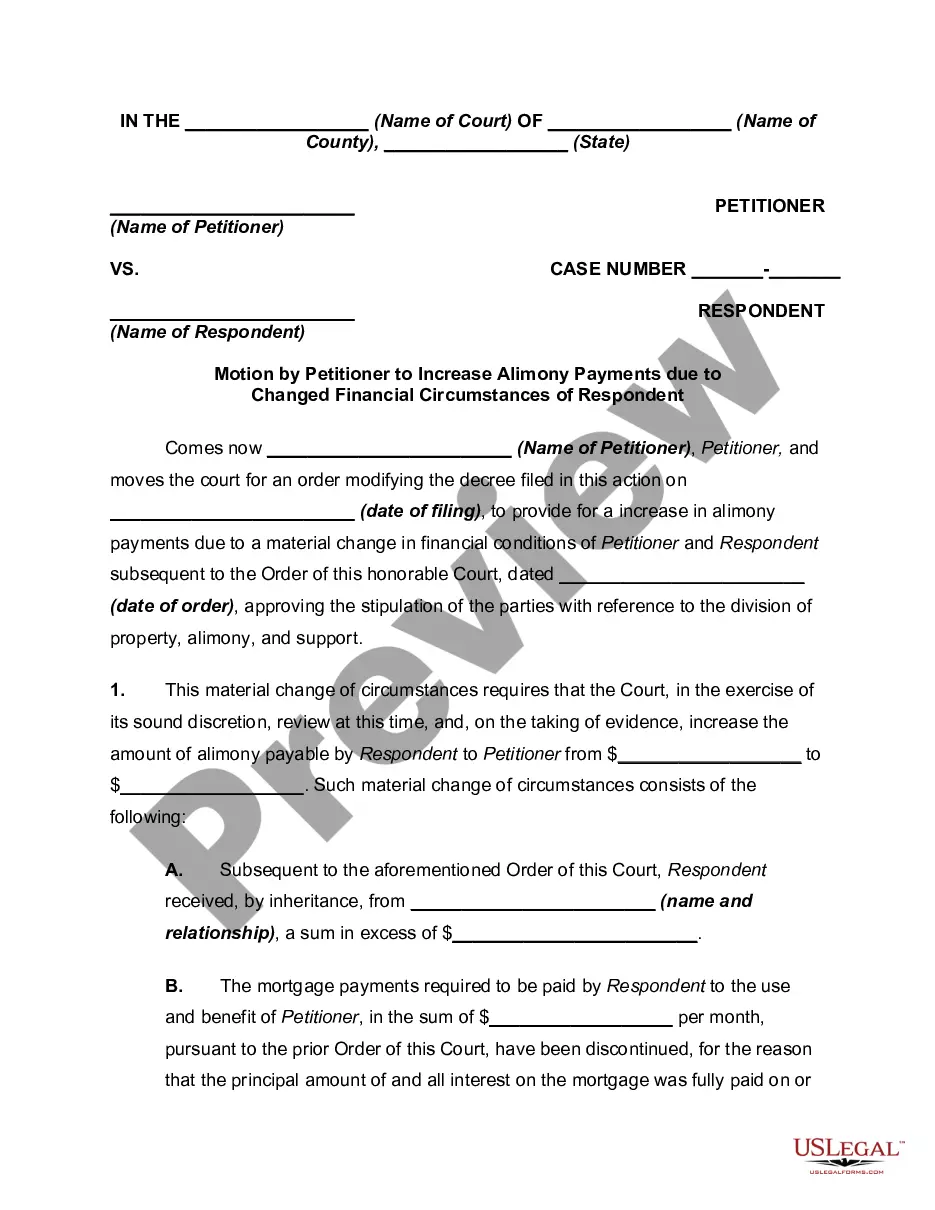
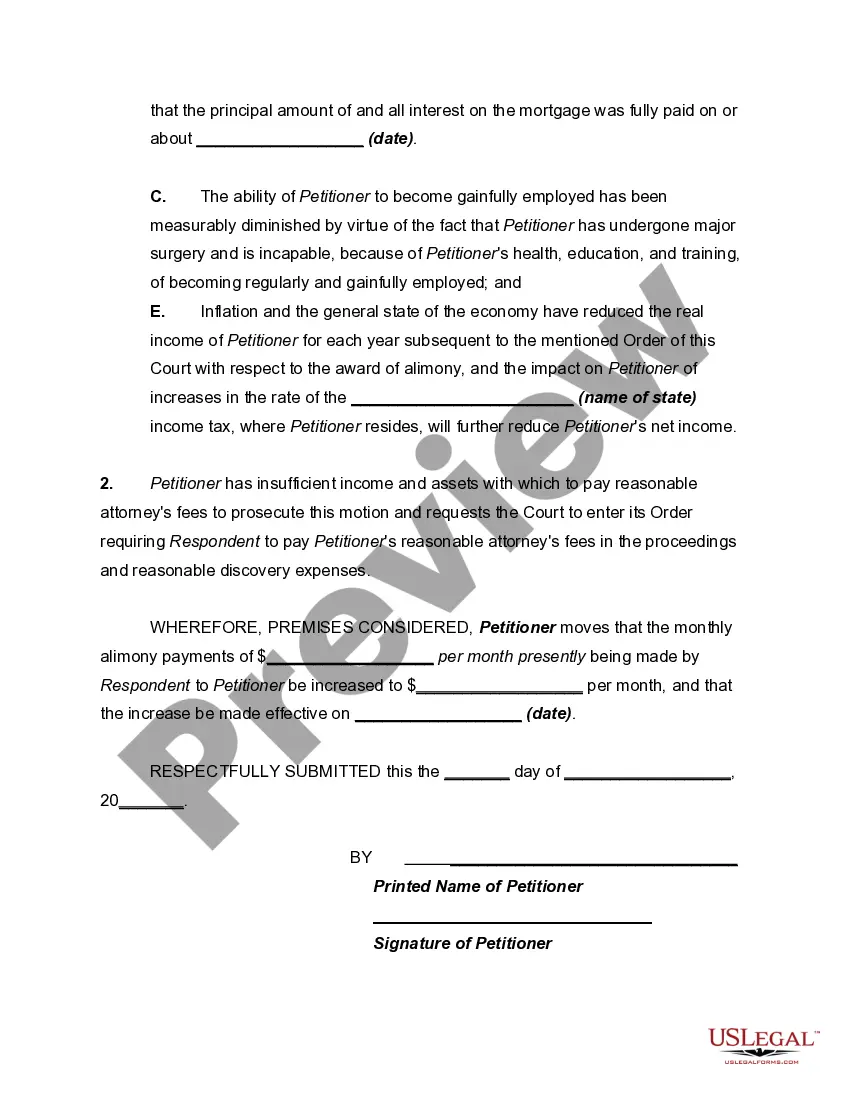
Puerto Rico Motion By Petitioner Spouse to Increase Alimony Payments due to Changed Financial Circumstances of Respondent Spouse

State:
Multi-State
Control #:
US-01899BG
Format:
Word; 
Rich Text
Instant download

Description

A decree for alimony is res judicata only as long as the circumstances remain the same as when the court rendered the decree. The doctrine of res judicata is based on the concept that parties should not call upon a court to adjudicate twice the same set of facts. Therefore, a party generally cannot base a motion to modify an order for alimony on the same set of facts that existed when the original order was made.


To justify a modification of an alimony order, a court must find that there has been a change in the material circumstances of the parties since the time of the original order. The burden of proving a change of circumstances is on the party seeking the modification.


This form is a generic example that may be referred to when preparing such a form for your particular state. It is for illustrative purposes only. Local laws should be consulted to determine any specific requirements for such a form in a particular jurisdiction.
Free preview
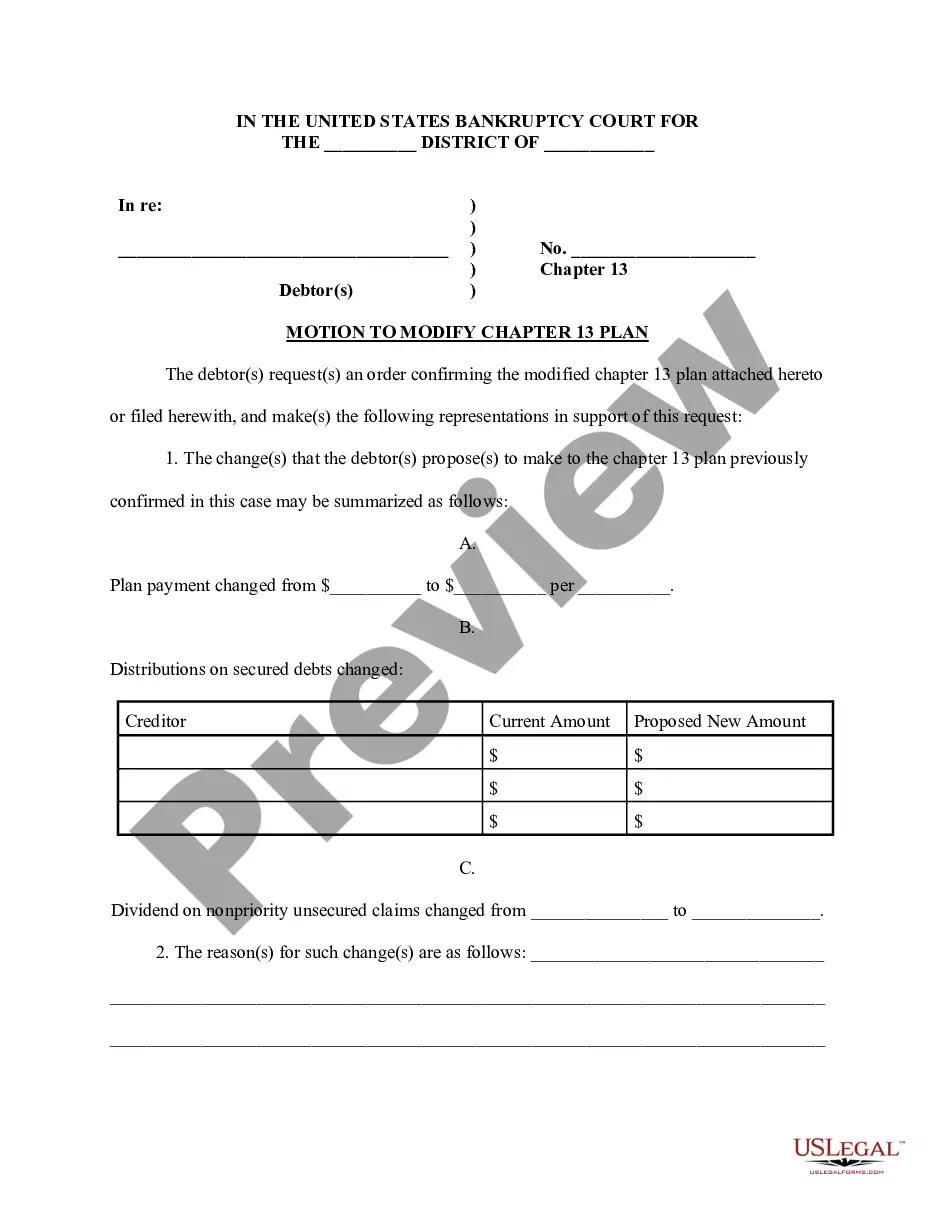
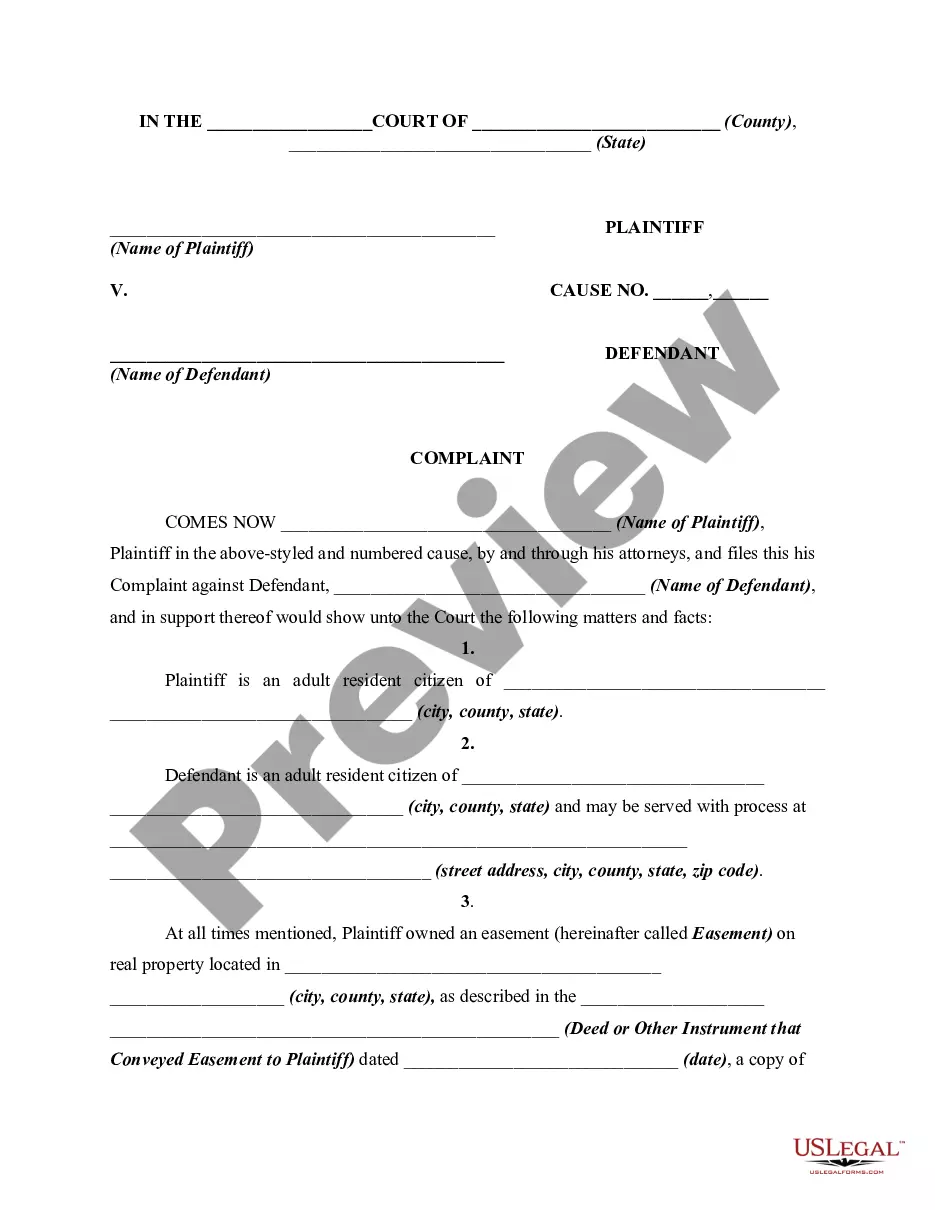
  • Preview Motion By Petitioner Spouse to Increase Alimony Payments due to Changed Financial Circumstances of Respondent Spouse
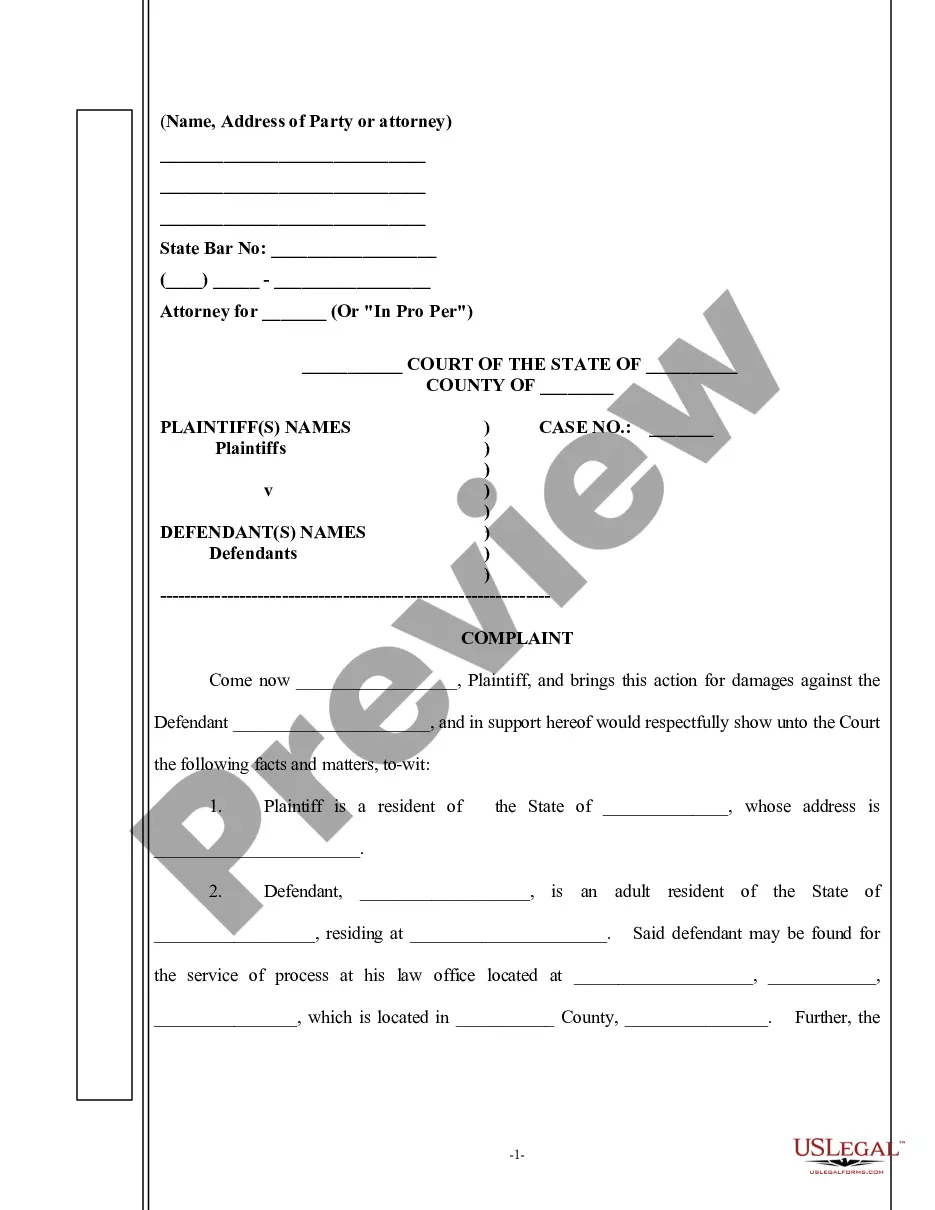
  • Preview Motion By Petitioner Spouse to Increase Alimony Payments due to Changed Financial Circumstances of Respondent Spouse
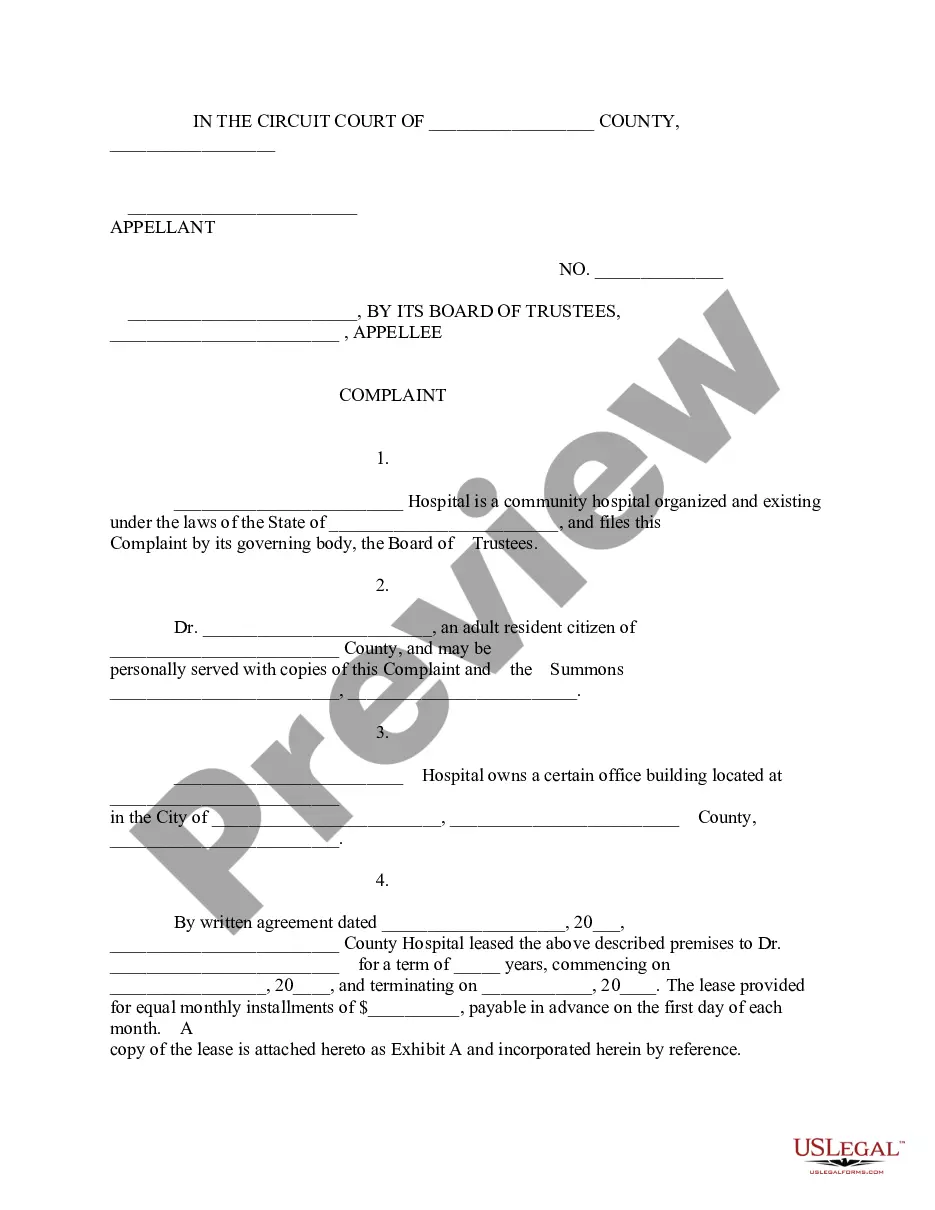
  • Preview Motion By Petitioner Spouse to Increase Alimony Payments due to Changed Financial Circumstances of Respondent Spouse

How to fill out Motion By Petitioner Spouse To Increase Alimony Payments Due To Changed Financial Circumstances Of Respondent Spouse?

Locating the appropriate authorized document template can be a challenge. It goes without saying that there are numerous web templates accessible online, but how can you secure the authorized form you require? Utilize the US Legal Forms platform. The service offers a vast array of templates, including the Puerto Rico Motion By Petitioner Spouse to Increase Alimony Payments due to Changed Financial Circumstances of Respondent Spouse, suitable for both business and personal needs. All forms are reviewed by professionals and meet state and federal requirements.

If you are currently registered, Log In to your account and click on the Obtain button to access the Puerto Rico Motion By Petitioner Spouse to Increase Alimony Payments due to Changed Financial Circumstances of Respondent Spouse. Use your account to search through the authorized forms you have previously purchased. Navigate to the My documents section of your account to retrieve another copy of the document you need.

If you are a new user of US Legal Forms, here are simple steps for you to follow: First, ensure you have chosen the correct form for your locality/state. You can browse the form using the Review button and examine the form details to confirm this is the right one for you. If the form does not meet your needs, use the Search field to find the appropriate form. Once you are confident that the form is suitable, click on the Purchase now button to acquire the form. Select the payment plan you prefer and enter the necessary information. Create your account and complete your order using your PayPal account or credit card. Choose the document format and download the authorized document template to your device. Finally, complete, edit, print, and sign the obtained Puerto Rico Motion By Petitioner Spouse to Increase Alimony Payments due to Changed Financial Circumstances of Respondent Spouse. US Legal Forms is the largest collection of authorized forms where you can find numerous document templates. Take advantage of the service to download correctly-prepared papers that comply with state requirements.

Form popularity

FAQ

In New York State a married person may be legally responsible to provide for the support of his or her spouse during their marriage, if that spouse lacks sufficient income or assets to provide for his or her own reasonable needs.

Reasons Alimony May Be Terminated Cohabitation. Should the supported spouse begin cohabitating with another person, alimony payments may be terminated. ... Remarriage. In the State of Florida, alimony payments will automatically terminate in the event the supported spouse remarries. ... Self-Sufficiency & Agreement. ... Petition.

Common ways include signing a pre- or postnuptial agreement, negotiating assets with your spouse instead of payments, proving there is not a need for spousal support, or filing for a fault-based divorce.

The judge will decide how much alimony will be paid, how long it will last, and from where the alimony will be paid, such as from the spouse's salary, other income, property, etc. In Puerto Rico, a judge can order ?pendente lite? spousal support.

Alimony or spousal support is similar to child support, however, it's designed to provide financial aid to lesser earning spouses leaving the marriage. Unlike child support, you can waive your right to seek alimony from your ex if you so choose.

The easiest way to get out of paying alimony is to have a frank discussion with your spouse about your situation. You may be able to reach an agreement between yourselves (even if it requires a little negotiating). You can also show the court that your spouse is perfectly capable of supporting him- or herself.

The key factors analyzed in an alimony decision are each spouse's income, ability to earn and standards of living established during the marriage. If there is a history of violence, abuse or certain criminal convictions, however, this could bar a spouse from receiving alimony payments under California law.

Generally, spousal support ends under the following circumstances: Divorce decree or marital settlement agreement. Generally, in marriages lasting less than 15 years, the court will award support for a period lasting between 15% to 30% of the marriage's length.

Trusted and secure by over 3 million people of the world’s leading companies

Puerto Rico Motion By Petitioner Spouse to Increase Alimony Payments due to Changed Financial Circumstances of Respondent Spouse