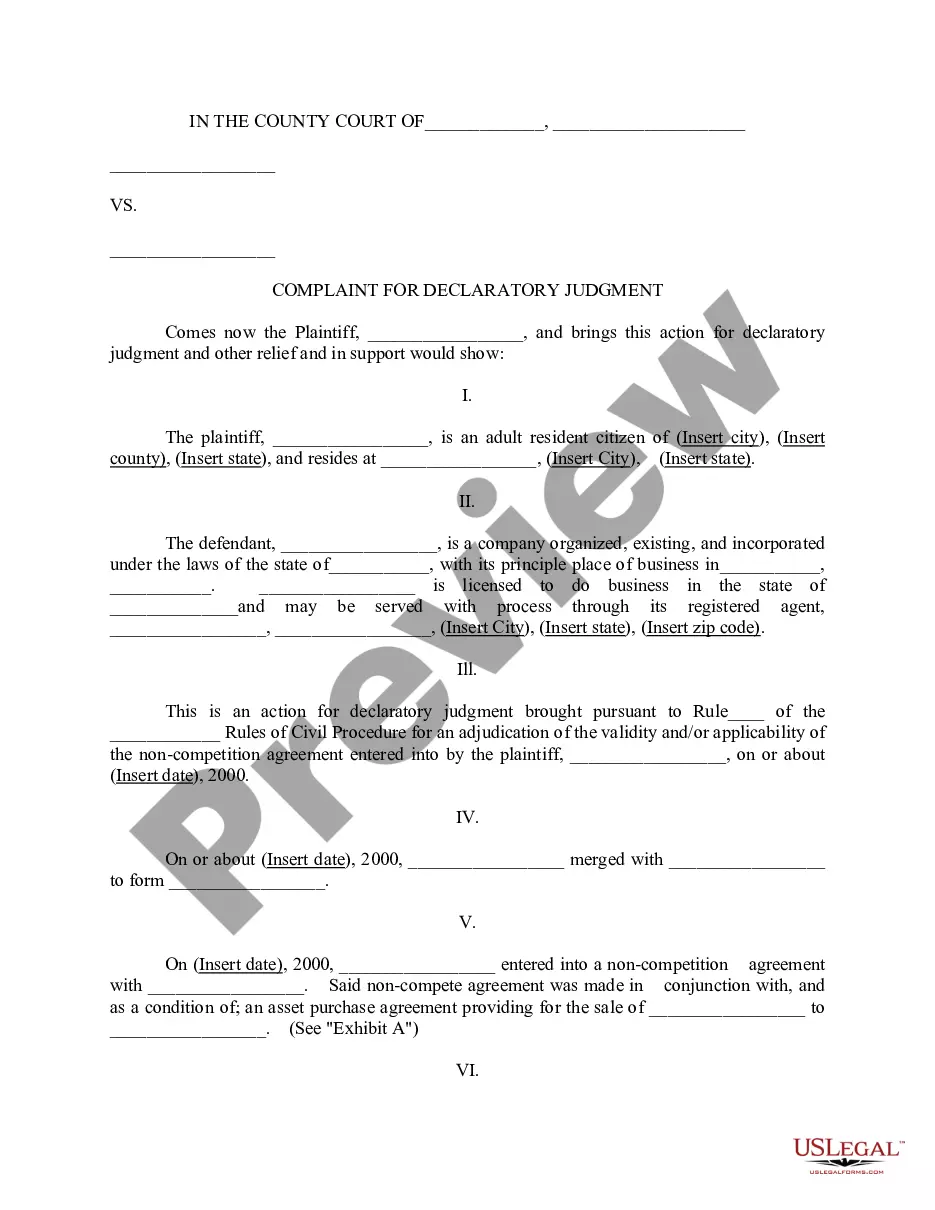
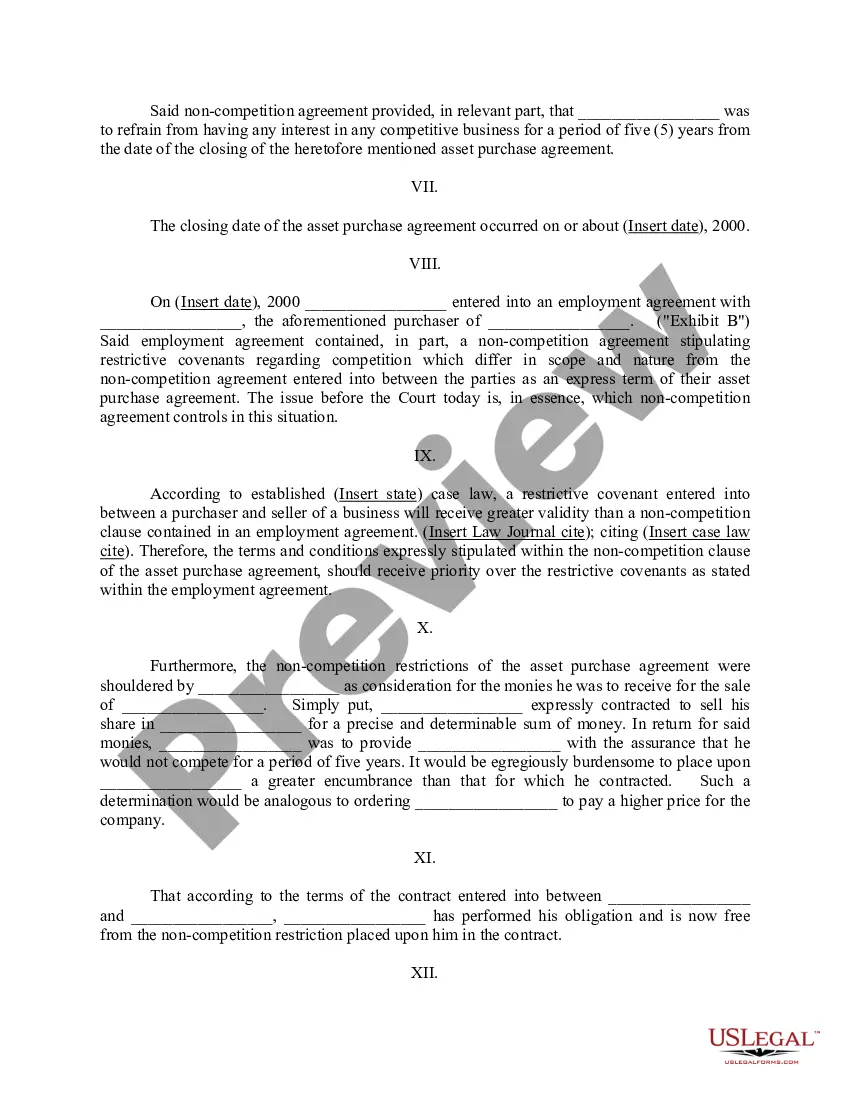
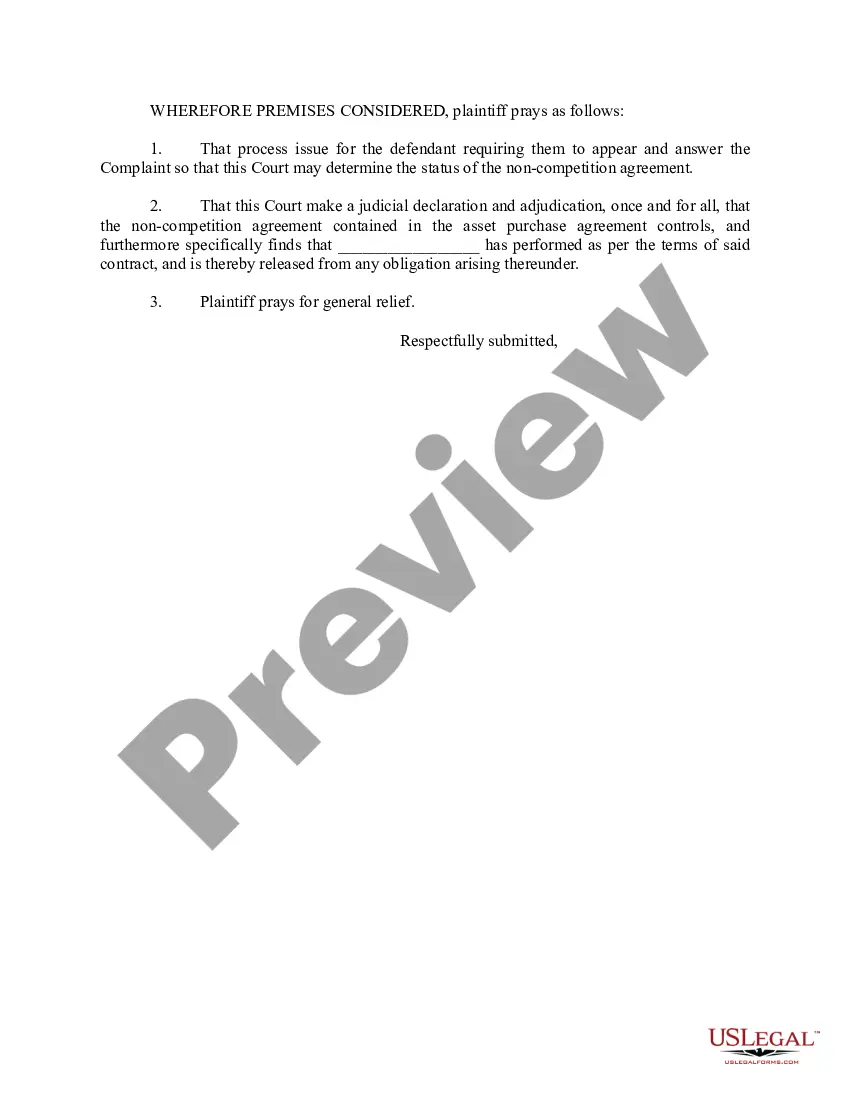
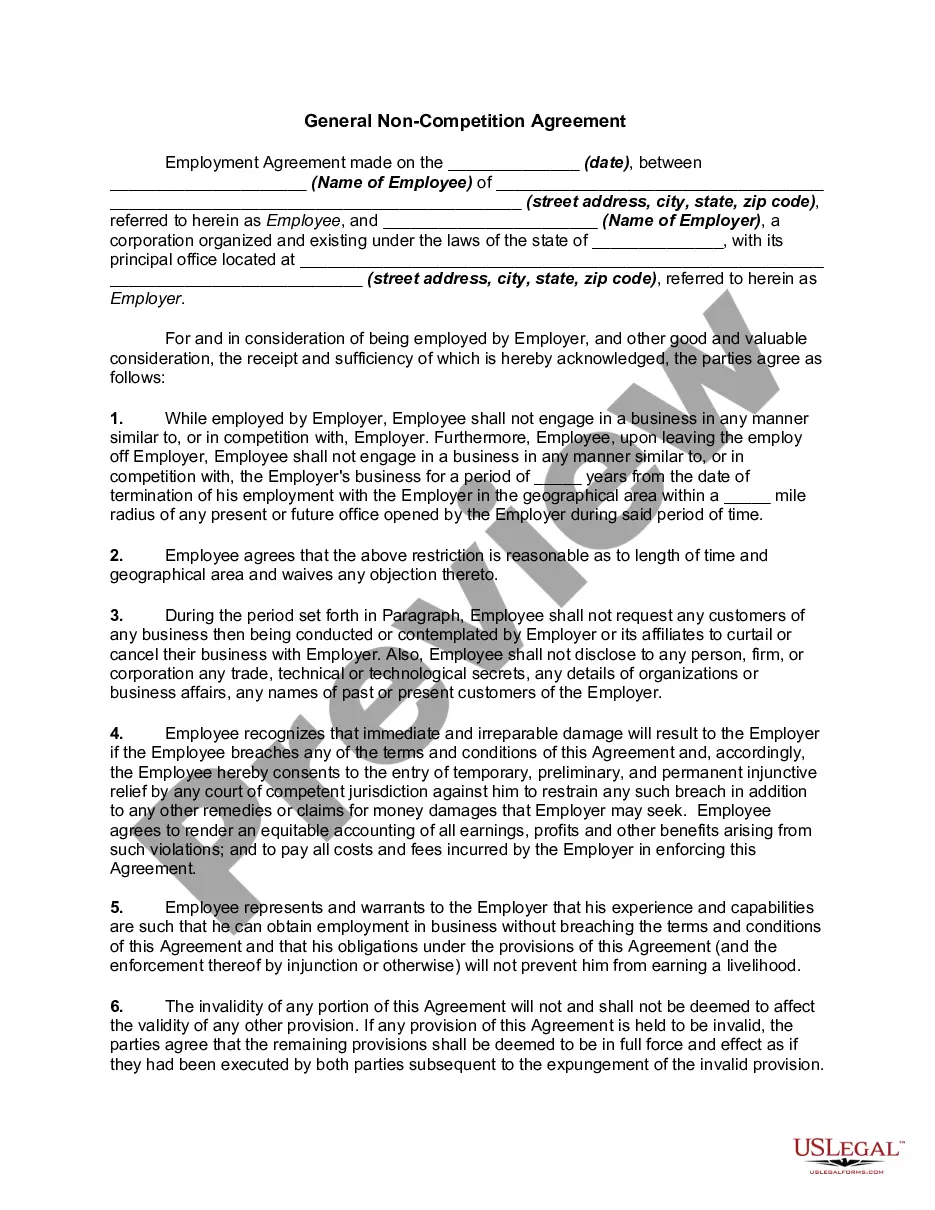
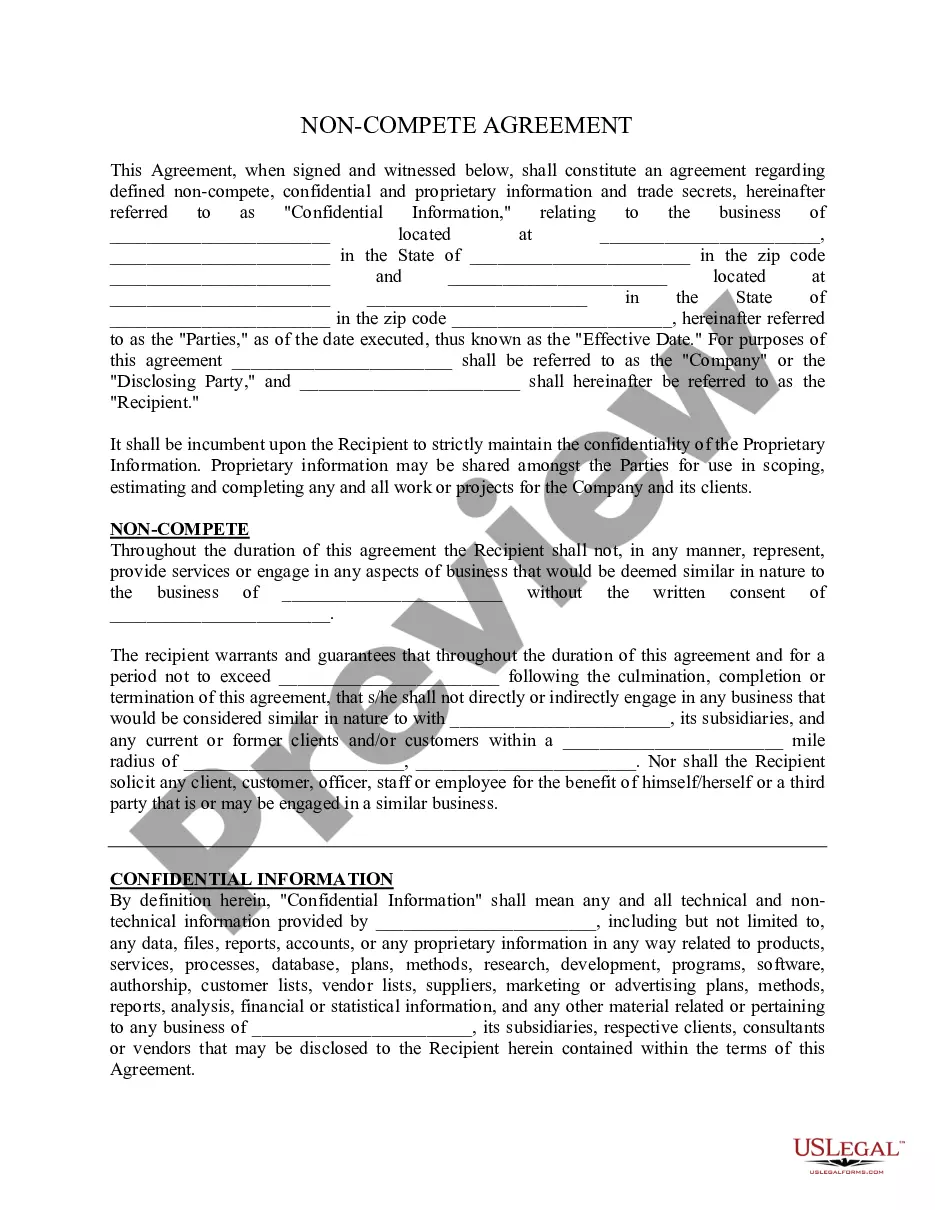
Plaintiff brings an action for a declaratory judgment arguing that he/she has fulfilled certain contractual duties and is now free from a non-competition restriction placed upon him/her in the contract.
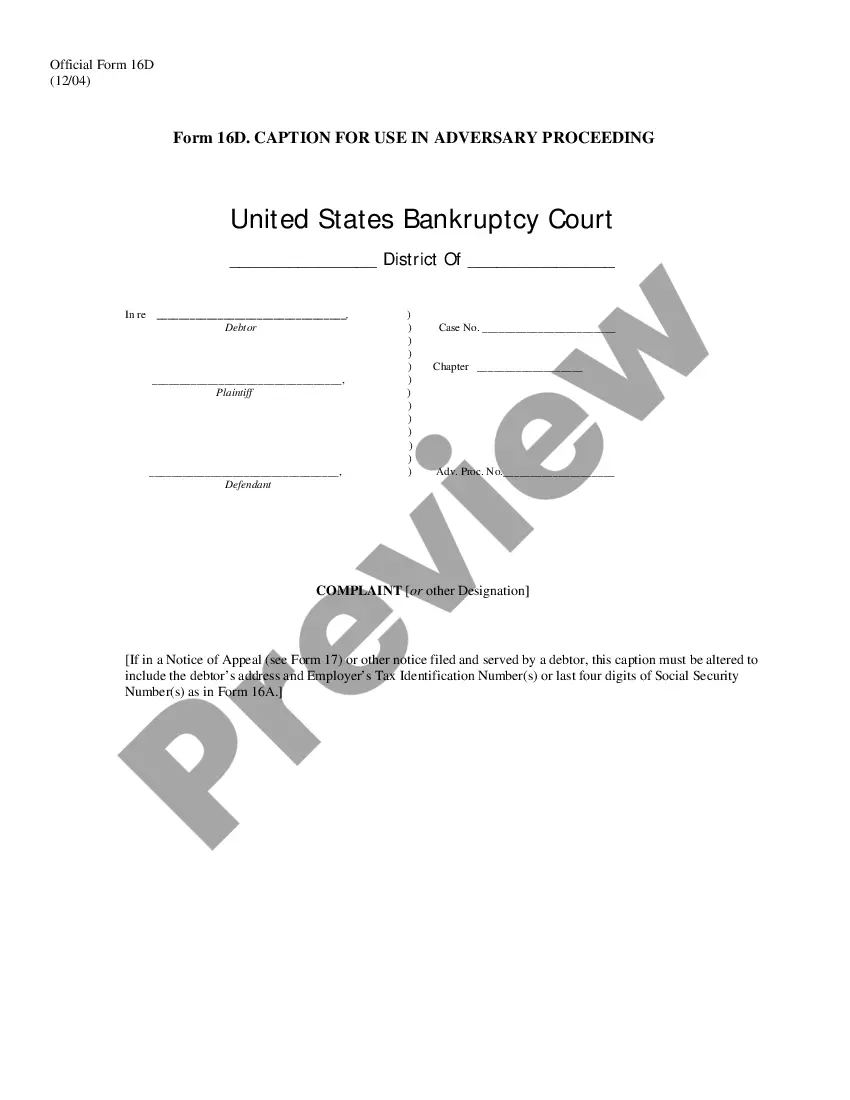
Puerto Rico Complaint For Declaratory Judgment Of Validity of Separate Noncompetition Agreements
Category:
State:
Multi-State
Control #:
US-000288
Format:
Word;
Rich Text
Instant download
Description
Free preview





How to fill out Complaint For Declaratory Judgment Of Validity Of Separate Noncompetition Agreements?
It is feasible to dedicate time online looking for the valid document template that satisfies the federal and state requirements you need. US Legal Forms offers numerous valid forms that are reviewed by experts.
You can download or print the Puerto Rico Complaint For Declaratory Judgment Of Validity of Separate Noncompetition Agreements from our service.
If you possess a US Legal Forms account, you may Log In and click on the Download button. After that, you may complete, modify, print, or sign the Puerto Rico Complaint For Declaratory Judgment Of Validity of Separate Noncompetition Agreements. Each valid document template you obtain is yours indefinitely. To retrieve another copy of any acquired form, navigate to the My documents section and click on the corresponding button.
Select the format of the document and download it to your device. Make modifications to your document if possible. You can complete, edit, sign, and print the Puerto Rico Complaint For Declaratory Judgment Of Validity of Separate Noncompetition Agreements. Download and print thousands of document templates using the US Legal Forms website, which provides the largest selection of valid forms. Utilize professional and state-specific templates to address your business or personal needs.
- If you are utilizing the US Legal Forms website for the first time, follow the straightforward instructions below.
- First, ensure that you have selected the correct document template for the region/city of your choice. Review the form description to confirm you have chosen the appropriate form.
- If available, utilize the Review button to browse through the document template as well.
- If you wish to find another version of the form, use the Search field to discover the template that fits your needs and requirements.
- Once you have found the template you desire, click Acquire now to proceed.
- Select the pricing plan you want, enter your details, and register for an account on US Legal Forms.
- Complete the purchase. You can use your credit card or PayPal account to pay for the valid form.
Form popularity
FAQ
Law 75 in Puerto Rico protects commercial distributors from arbitrary termination by suppliers. This law emphasizes the need for just cause and fair treatment in distributor relationships. Understanding Law 75 is crucial, especially if your business involves non-compete agreements. A Puerto Rico Complaint For Declaratory Judgment Of Validity of Separate Noncompetition Agreements can help clarify any disputes arising from this law.
Non-compete agreements can be enforceable in Puerto Rico, but they must meet certain criteria set by local laws. These agreements should not overly restrict an individual's right to work or compete. To confirm the enforceability of your agreement, consider filing a Puerto Rico Complaint For Declaratory Judgment Of Validity of Separate Noncompetition Agreements to resolve any doubts.
Yes, many U.S. employment laws apply in Puerto Rico, but there are unique local regulations as well. It’s important to understand the interplay of federal and local laws when dealing with employment issues. For clarity on specific situations, like non-compete agreements, a Puerto Rico Complaint For Declaratory Judgment Of Validity of Separate Noncompetition Agreements can be helpful.
Law 80 in Puerto Rico governs employee dismissal and outlines the rights of employees regarding termination. It requires employers to provide just cause for dismissals, offering job security to employees. Understanding this law is essential, especially when navigating non-compete agreements. Consider utilizing a Puerto Rico Complaint For Declaratory Judgment Of Validity of Separate Noncompetition Agreements to address potential conflicts.
Yes, non-compete agreements are generally legal in Puerto Rico. However, they must adhere to specific regulations to be enforceable. To ensure compliance, it’s vital to consult a legal expert when drafting such agreements. A Puerto Rico Complaint For Declaratory Judgment Of Validity of Separate Noncompetition Agreements can provide clarity on their validity.
A plaintiff seeking declaratory relief must show that there is an actual controversy even though declaratory relief will not order enforceable action against the defendant. An actual controversy means there is a connection between the challenged conduct and injury, and redressability that the court could order.
Some types of disputes cannot be decided by a jury. These include claims for injunctive relief or declaratory relief, or questions of law instead of questions of fact. If you have a type of case that a jury can decide, you still may want to have a judge decide the case instead of a jury.
For example, a policyholder believes that their denied claim is unjust. As a result, they inform the insurer that they are considering a lawsuit to recover losses. The insurer seeks a declaratory judgment to clarify its rights and obligations with hopes of preventing the lawsuit.
For example, one party may claim that it performed under a commission agreement and is entitled to payment of his or her commission. The other party may file a declaratory judgment action seeking a declaration that there has not been performance under the agreement and that no commission is owed.
The declaratory judgment would clarify the parties' rights and obligations under the insurance policy. It could guide future actions related to the claim.