Pennsylvania Wrongful Death And Survival Actions Checklist
About this form
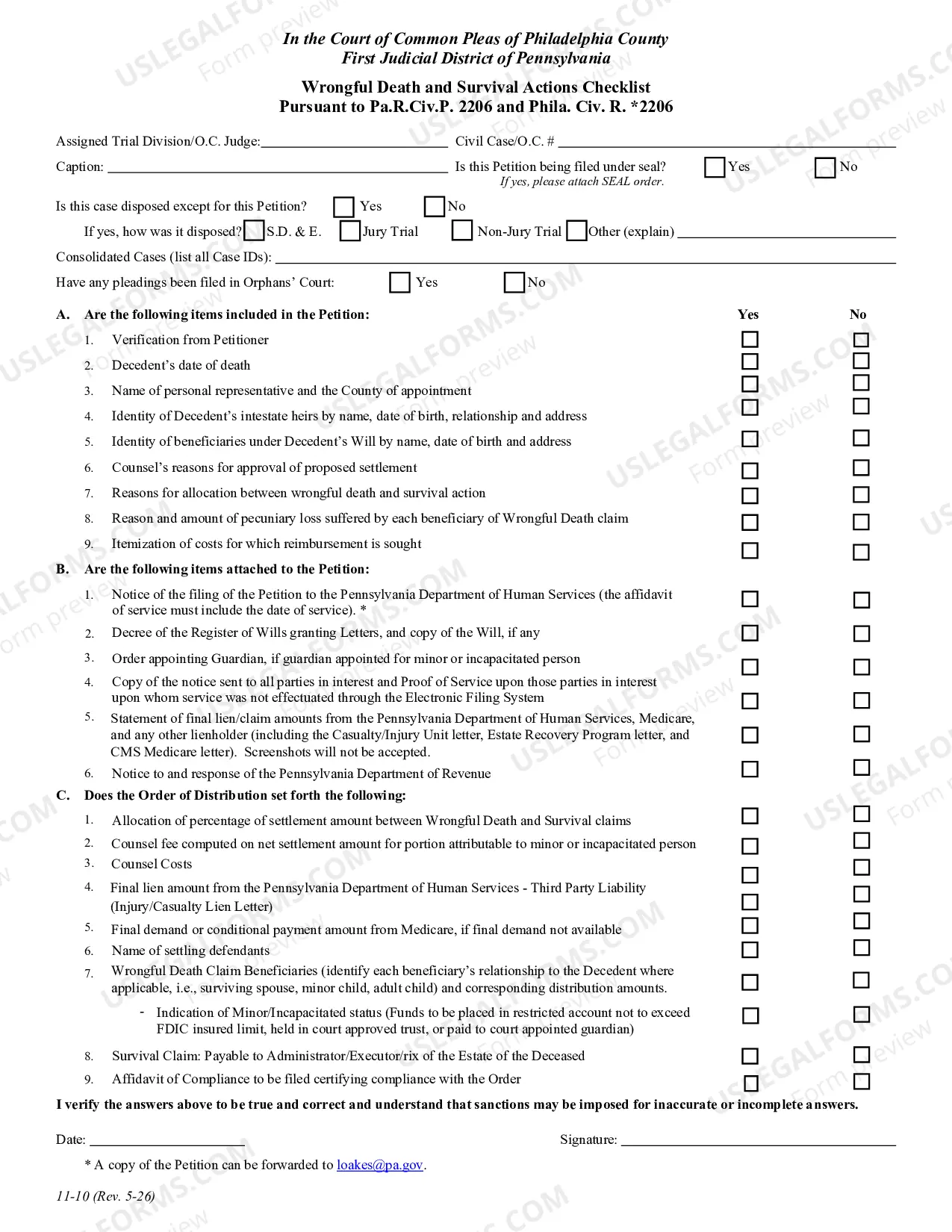
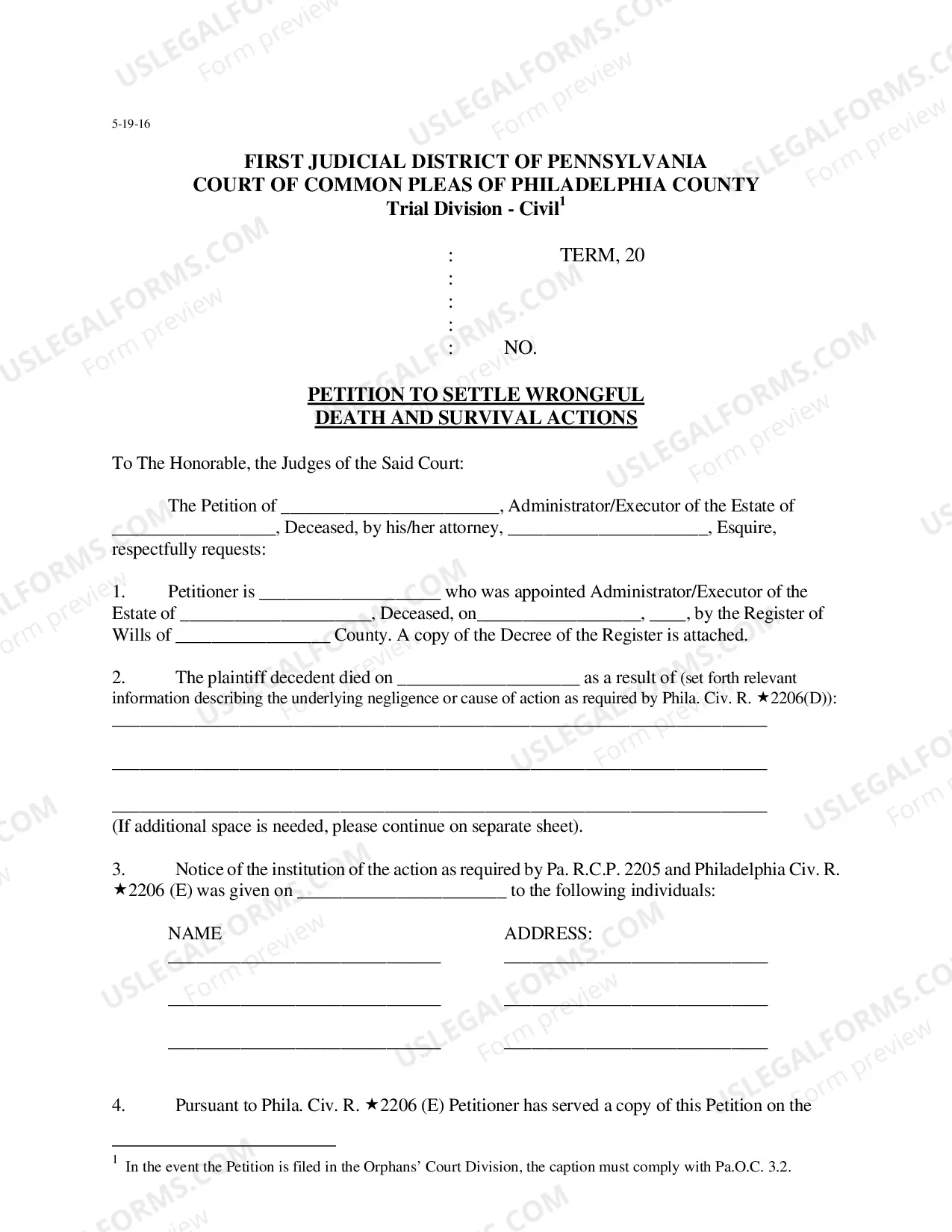
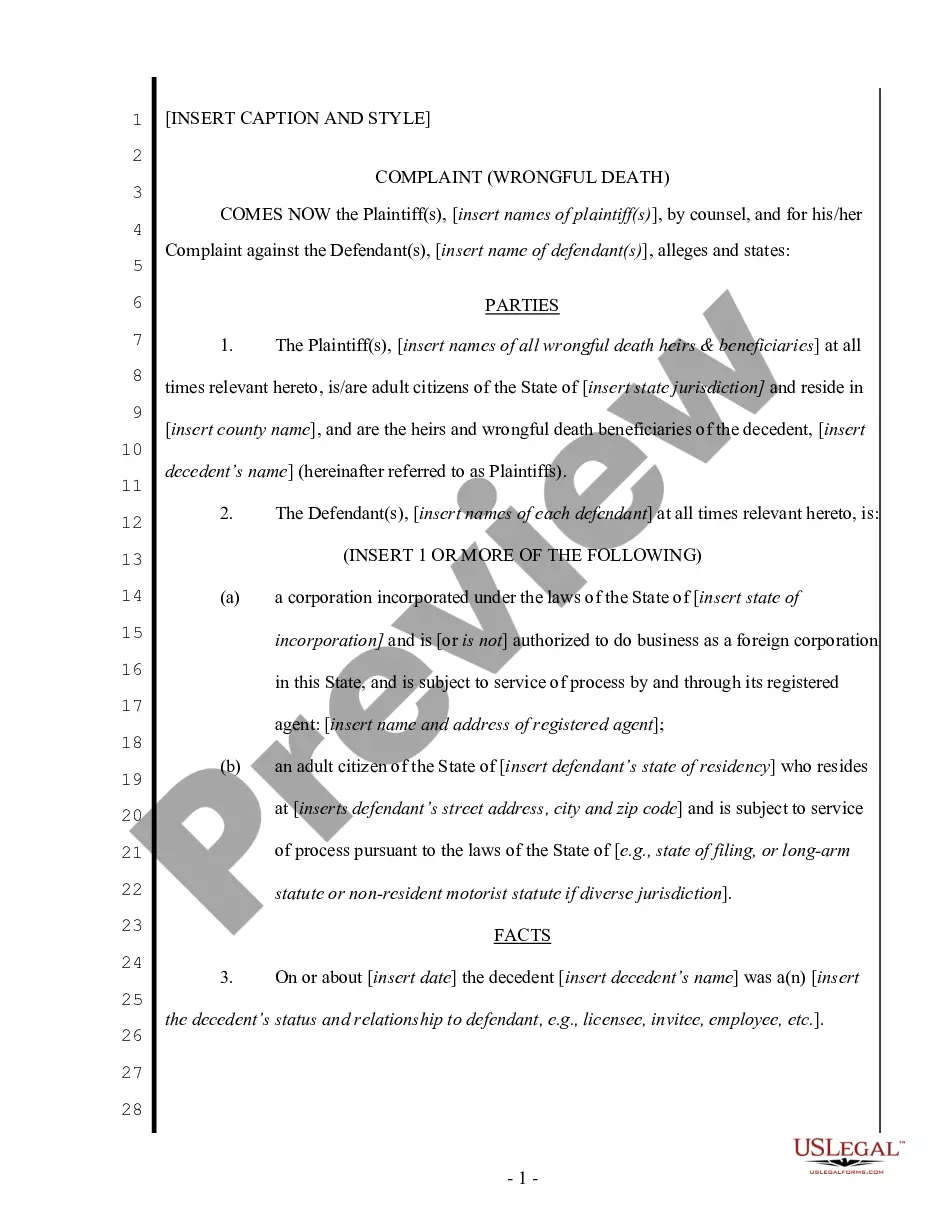
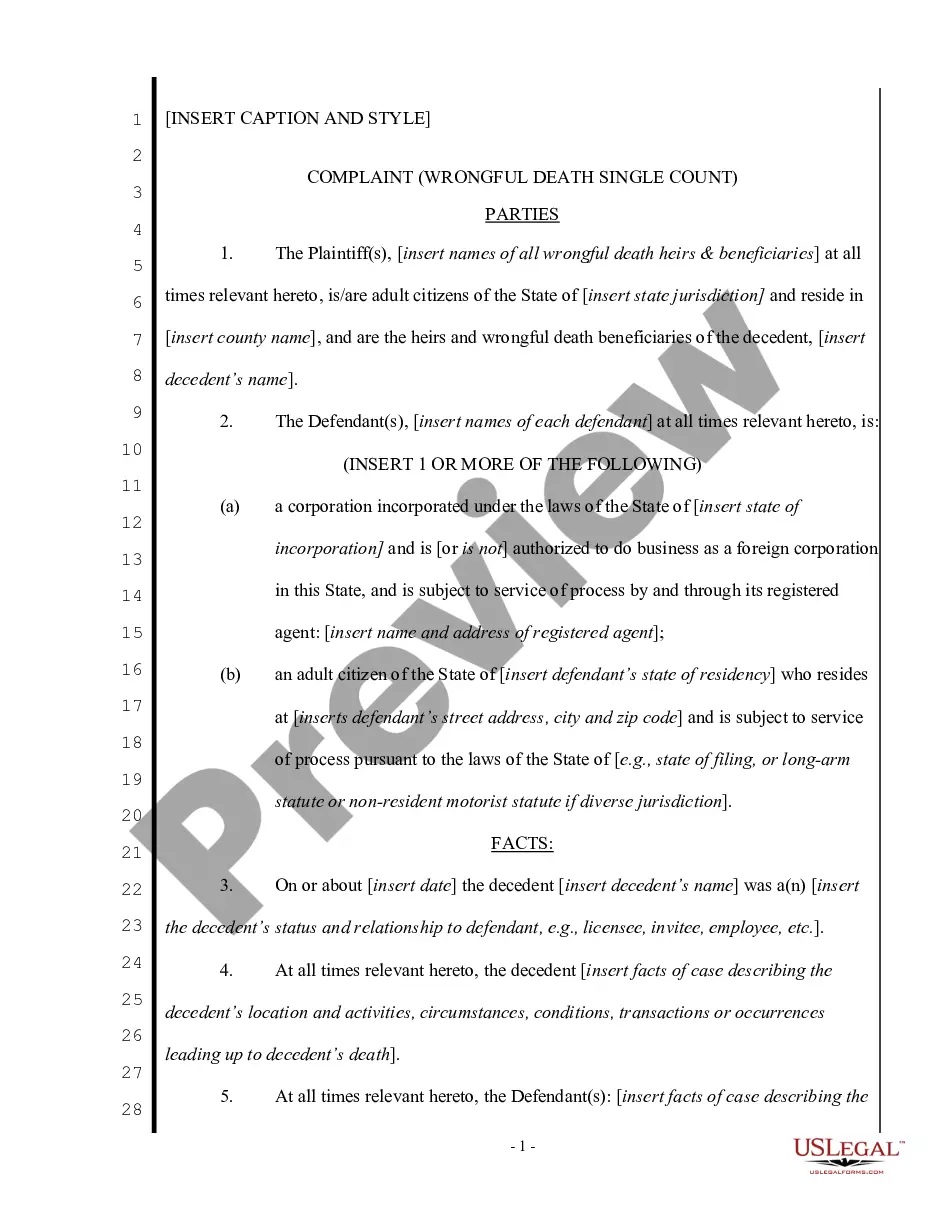
The Wrongful Death and Survival Actions Checklist is a legal document designed to aid individuals pursuing claims in the case of a wrongful death. This form outlines the necessary components and requirements to ensure that all pertinent information is included when filing such actions in accordance with local court rules. It differs from other legal forms as it specifically addresses the critical elements needed to file claims for wrongful death and any related survival actions, ensuring compliance with Pennsylvania law.
Main sections of this form
- Verification from the petitioner
- Details regarding the decedentâs date of death and supporting death certificate
- Information on the personal representative and the county of appointment
- Identification of the decedent's heirs and beneficiaries, including names, dates of birth, relationships, and addresses
- A comprehensive breakdown of costs and pecuniary loss for each beneficiary
- Documentation supporting the proposed settlement allocation between wrongful death and survival claims
When this form is needed
This checklist is used when filing a petition related to wrongful death and survival actions in a civil court. It provides a comprehensive list of items that must be included in the petition to ensure that all legal requirements are met. This form is essential for ensuring that the petition is complete and compliant with Pennsylvania rules, making it crucial during legal proceedings following the death of an individual due to wrongful conduct.
Who should use this form
- Personal representatives of a deceased person seeking to file wrongful death claims
- Attorneys representing clients in wrongful death and survival actions
- Heirs and beneficiaries needing to understand the requirements for pursuing compensation
- Individuals who are unsure of what documentation is required when dealing with wrongful death cases
Instructions for completing this form
- Gather all required documentation, including death certificates and information about heirs and beneficiaries.
- Complete the checklist sections, ensuring that all items are either marked as included or noted if not applicable.
- Attach necessary supporting documents to the petition, such as the notice of filing and any decrees or orders.
- Ensure that all parties in interest are notified and that proof of service is included.
- Review the completed form for accuracy before submission.
Notarization requirements for this form
This form does not typically require notarization unless specified by local law. However, always verify the specific requirements in your jurisdiction, as some cases may have unique needs for notarization.
Get your form ready online
Our built-in tools help you complete, sign, share, and store your documents in one place.
Make edits, fill in missing information, and update formatting in US Legal Forms—just like you would in MS Word.
Download a copy, print it, send it by email, or mail it via USPS—whatever works best for your next step.
Sign and collect signatures with our SignNow integration. Send to multiple recipients, set reminders, and more. Go Premium to unlock E-Sign.
If this form requires notarization, complete it online through a secure video call—no need to meet a notary in person or wait for an appointment.
We protect your documents and personal data by following strict security and privacy standards.

Make edits, fill in missing information, and update formatting in US Legal Forms—just like you would in MS Word.

Download a copy, print it, send it by email, or mail it via USPS—whatever works best for your next step.

Sign and collect signatures with our SignNow integration. Send to multiple recipients, set reminders, and more. Go Premium to unlock E-Sign.

If this form requires notarization, complete it online through a secure video call—no need to meet a notary in person or wait for an appointment.

We protect your documents and personal data by following strict security and privacy standards.
Typical mistakes to avoid
- Failing to include a death certificate or omitting key dates.
- Not providing adequate information about heirs and beneficiaries.
- Overlooking the requirement for proof of service to interested parties.
- Not verifying that all required documents are attached before submission.
Benefits of using this form online
- Convenience of completing the form from any location with internet access.
- Immediate download options that save time compared to traditional methods.
- Editable fields that allow users to customize the checklist as needed.
- Access to up-to-date legal templates drafted by licensed attorneys.
Looking for another form?
Form popularity
FAQ
A survival action is the lawsuit that the deceased person would have been able to bring had he or she lived, while a wrongful death action is a claim for compensation for the harms that the family of the deceased has suffered.
The survival statute, 42 Pa. C.S. § 8302, provides: ?All causes of action or proceedings, real or personal, shall survive the death of the plaintiff or the defendant, or the death of one or more joint plaintiffs or defendants.?
Damages recoverable under a survival action may include things like the decedent's pain and suffering, medical bills, and past and future wage loss.
A survival action is the lawsuit that the deceased person would have been able to bring had he or she lived, while a wrongful death action is a claim for compensation for the harms that the family of the deceased has suffered.
A wrongful death lawsuit is brought on behalf of the spouse, parents or children. In contrast, a survival action is brought on behalf of the deceased person by the personal representative of the estate. The second difference is between the two types of claims is the type of damages that are recoverable.
The statute provides that an action may be brought to recover damages for the death of an individual caused by the wrongful act or negligence of another so long as no claims were obtained by the injured individual during his or her lifetime.
Pennsylvania survival statute states in its entirety: All causes of action or proceedings, real or personal, shall survive the death of the plaintiff or of the defendant, or the death of one or more joint plaintiffs or defendants.
Damages in survival actions are paid directly to the deceased individual's estate, which is then paid out to his or her beneficiaries through an executor when the estate is settled.