Pennsylvania Affidavit of Personal Service
Understanding this form
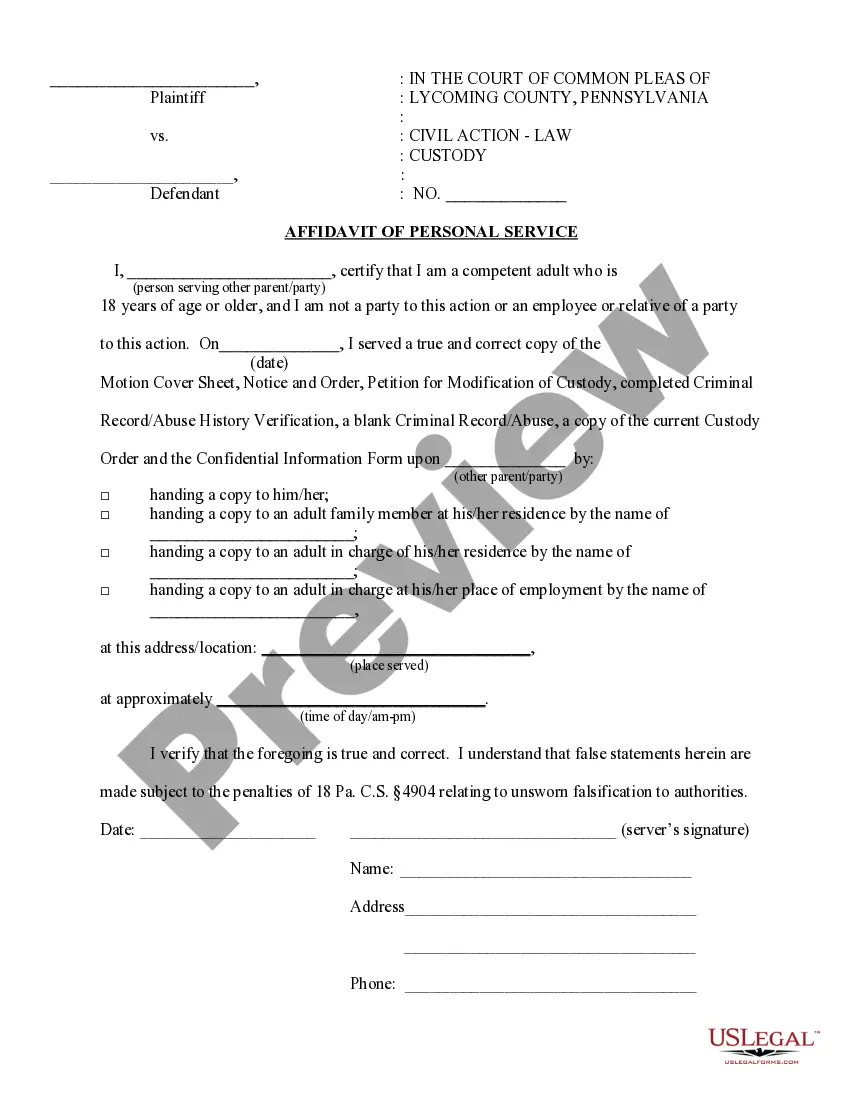
The Affidavit of Personal Service is a legal document that provides a sworn statement by the person who has delivered court documents to another party. This affidavit details key information such as the time, date, and manner of service, alongside the identity of the person served. It differs from other service forms by specifically certifying that legal documents have been handed to the intended individual or a responsible adult at their residence or workplace.
Main sections of this form
- Identification of the server as a competent adult, not involved in the case.
- Date of service and details regarding the documents served.
- Options for how service was executed, including delivery to the individual or an adult at their residence or workplace.
- Confirmation of the location where service took place.
- Time of day when the documents were served.
- Signature and contact details of the person serving the documents.
When to use this document
This form is needed whenever legal documents, such as custody modifications or notices, must be personally delivered to another party. It serves as proof that proper service has been carried out, which is critical in court proceedings, ensuring both parties are informed and able to respond appropriately.
Intended users of this form
- Individuals serving court documents to another party in a custody case.
- Professionals involved in legal proceedings who need to document the service of legal papers.
- Anyone acting on behalf of a party in a civil action who is not a related party or employee of the involved parties.
Steps to complete this form
- Identify the individual serving the documents and confirm they are a competent adult.
- Enter the date on which the service was performed.
- Specify the name of the person who was served or the adult at their residence or workplace.
- Indicate the method of service (e.g., direct delivery or delivery to an adult).
- Provide the address where the service was conducted.
- Document the time of service and ensure the server signs and includes their contact information.
Notarization requirements for this form
This form does not typically require notarization unless specified by local law. However, it is important to check any additional requirements in your jurisdiction to ensure it meets all legal standards.
Get your form ready online
Our built-in tools help you complete, sign, share, and store your documents in one place.
Make edits, fill in missing information, and update formatting in US Legal Forms—just like you would in MS Word.
Download a copy, print it, send it by email, or mail it via USPS—whatever works best for your next step.
Sign and collect signatures with our SignNow integration. Send to multiple recipients, set reminders, and more. Go Premium to unlock E-Sign.
If this form requires notarization, complete it online through a secure video call—no need to meet a notary in person or wait for an appointment.
We protect your documents and personal data by following strict security and privacy standards.

Make edits, fill in missing information, and update formatting in US Legal Forms—just like you would in MS Word.

Download a copy, print it, send it by email, or mail it via USPS—whatever works best for your next step.

Sign and collect signatures with our SignNow integration. Send to multiple recipients, set reminders, and more. Go Premium to unlock E-Sign.

If this form requires notarization, complete it online through a secure video call—no need to meet a notary in person or wait for an appointment.

We protect your documents and personal data by following strict security and privacy standards.
Typical mistakes to avoid
- Failing to complete all required fields, which may invalidate the affidavit.
- Not having the server sign the affidavit, which is crucial for its validity.
- Providing incorrect or incomplete information about the person served or the service location.
- Using a party to the case as the server, which is not allowed.
Benefits of using this form online
- Convenience of accessing and downloading the form anytime and anywhere.
- Editability to tailor the document to specific case needs before printing.
- Reliability given that the forms are drafted by licensed attorneys.
- Time-saving in preparing the necessary paperwork for court proceedings.
Quick recap
- The Affidavit of Personal Service is essential for documenting the delivery of legal documents.
- It must be completed accurately to avoid legal complications.
- This form is specific to Pennsylvania and should comply with local court rules.
Looking for another form?
Form popularity
FAQ
Example: I, Jane Smith, swear that the information in my sworn statement is truthful to the best of my knowledge and understanding. Your statement of truth must be in the first person and you need to identify yourself in it. Keep it short and sweet.
Becoming a Process Server in Pennsylvania You do not have to be licensed to become process server in Pennsylvania. In addition to service of original process by the sheriff, process can also be served by a competent adult if they are in Philadelphia County per PARCP Rule 400.1.
In Pennsylvania, process servers do not have to be licensed. In general, only a sheriff ? usually hired through the county the case is in ? may serve an original process. In some cases, a competent adult can act as a process server.
Done name of the recipient of the service. Address where it is served and the county. And state forMoreDone name of the recipient of the service. Address where it is served and the county. And state for item 7 enter the required. Information indicated below for item 8 mark the appropriate.
(A) The summons shall be served upon the defendant by both first class mail and certified mail, return receipt requested.
For Pennsylvania Process Service to be served via mail, the defendant or an authorized agent must get a signed receipt for a copy of the original process. The required receipt must be signed by the defendant or an authorized representative before Pennsylvania Process Service on the defendant may be performed.
Service of process ranges from $75 to $145. Remote locations are more expensive. Cities and urban areas are less. ABC Legal charges per address, entity, and the number of cases being served.
Verification means a signed written statement of fact supported by oath or affirmation or made subject to the penalties of 18 Pa. C.S. § 4904 (relating to unsworn falsification to authorities). If verification is required, notarization is not necessary.