Pennsylvania Acknowledgment for Defendant (for Marital Property Settlement Agreement)
What is this form?
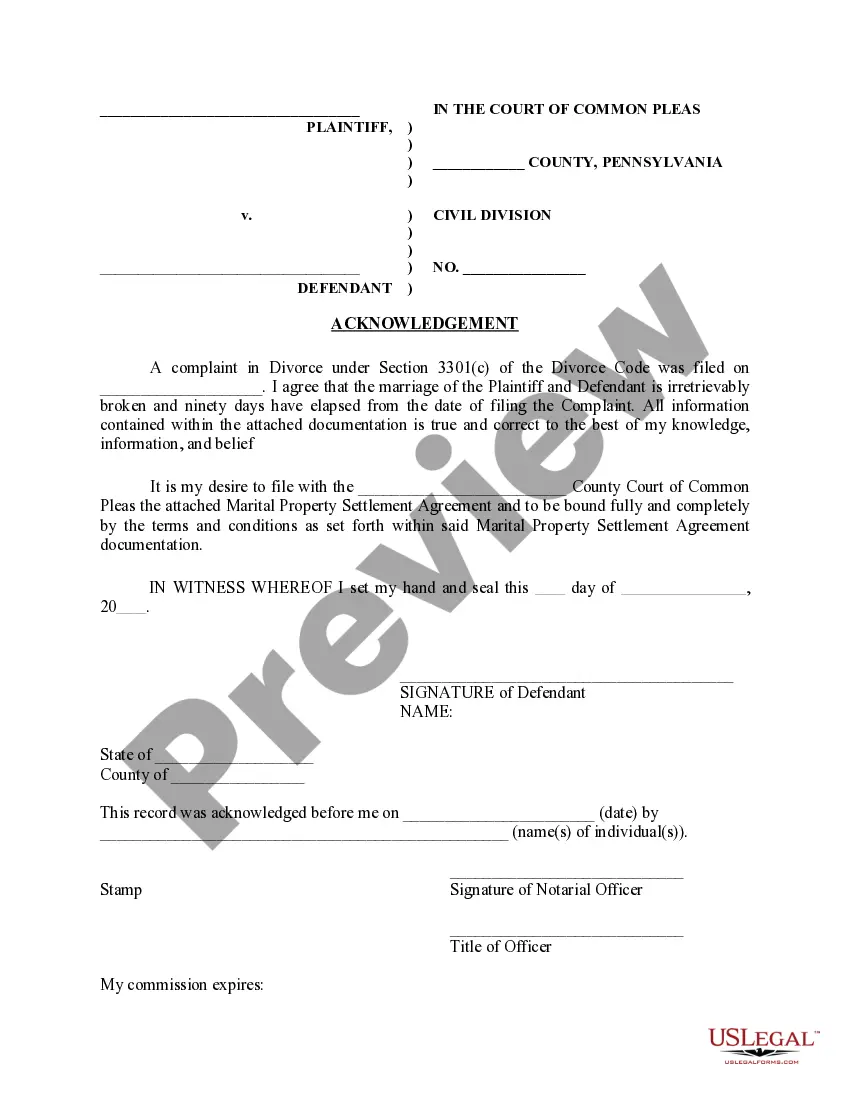
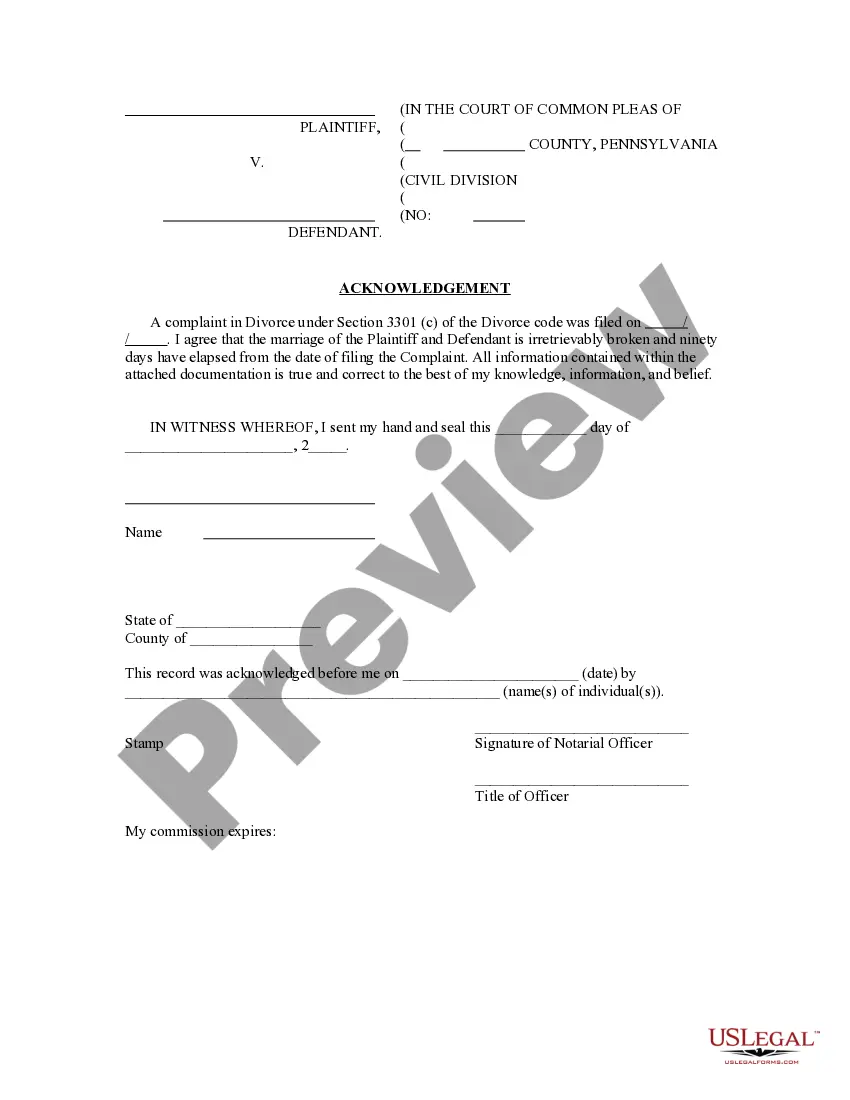
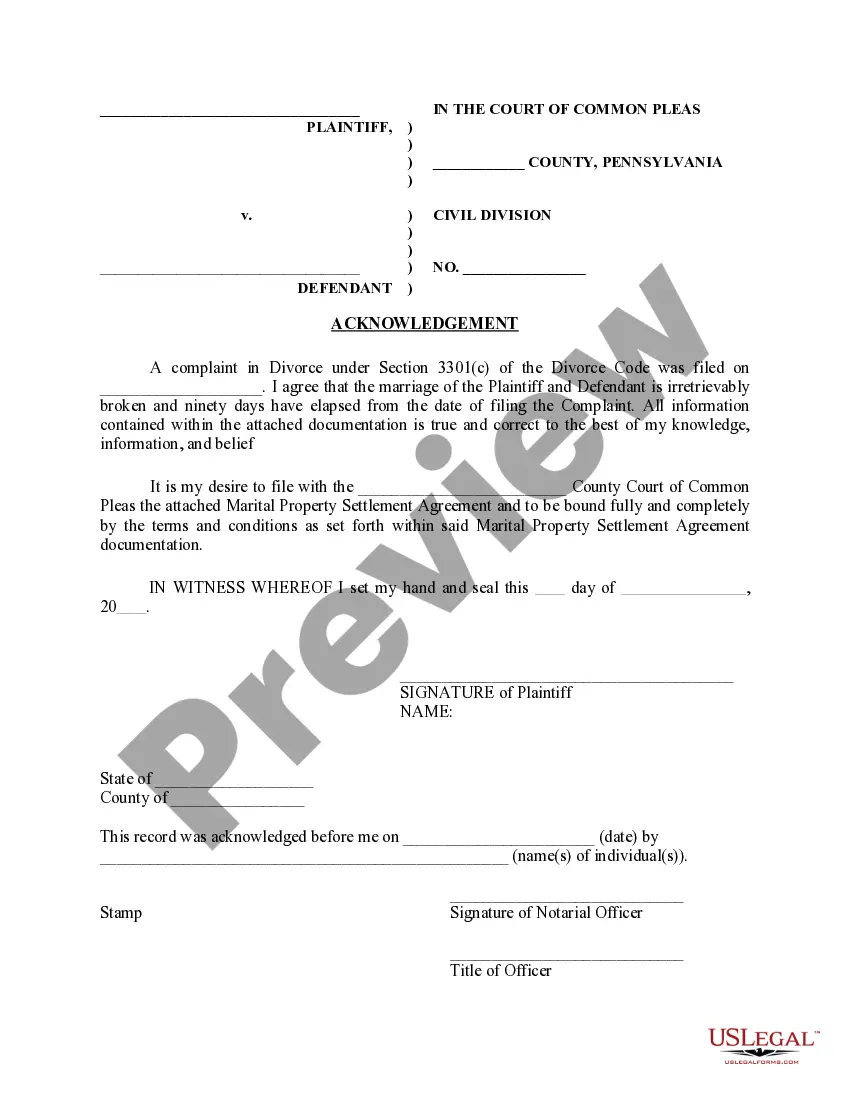
The Acknowledgment for Defendant for Marital Property Settlement Agreement is a legal document through which the defendant formally acknowledges and agrees to the terms specified in a Marital Property Settlement Agreement. This form is essential in divorce proceedings as it clarifies the defendant's agreement to the proposed settlement of marital property, ensuring both parties are on the same page during the divorce process.
What’s included in this form
- Date of the divorce complaint filing.
- Statement acknowledging the irretrievable breakdown of the marriage.
- Affirmation of the truthfulness of the attached documentation.
- Intent to file the attached Marital Property Settlement Agreement.
- Signature space for the defendant and a notary public.

Common use cases
This form should be used when a marital property settlement agreement has been proposed during divorce proceedings. It serves as an acknowledgment that the defendant understands and agrees to the terms of the settlement, which can help expedite the divorce process and address any property division issues.
Who needs this form
- Defendants in divorce proceedings.
- Individuals involved in a marital property settlement negotiation.
- Parties seeking to formalize their agreement regarding property division during a divorce.
Completing this form step by step
- Fill in the date of the complaint filing.
- Clearly state your acknowledgment of the marriage's irretrievable breakdown.
- Confirm the truthfulness of all attached documents.
- Indicate your intent to file the Marital Property Settlement Agreement with the court.
- Sign and date the form in the presence of a notary public.
Is notarization required?
This form needs to be notarized to ensure legal validity. US Legal Forms provides secure online notarization powered by Notarize, allowing you to complete the process through a verified video call, available anytime.
Get your form ready online
Our built-in tools help you complete, sign, share, and store your documents in one place.
Make edits, fill in missing information, and update formatting in US Legal Forms—just like you would in MS Word.
Download a copy, print it, send it by email, or mail it via USPS—whatever works best for your next step.
Sign and collect signatures with our SignNow integration. Send to multiple recipients, set reminders, and more. Go Premium to unlock E-Sign.
If this form requires notarization, complete it online through a secure video call—no need to meet a notary in person or wait for an appointment.
We protect your documents and personal data by following strict security and privacy standards.

Make edits, fill in missing information, and update formatting in US Legal Forms—just like you would in MS Word.

Download a copy, print it, send it by email, or mail it via USPS—whatever works best for your next step.

Sign and collect signatures with our SignNow integration. Send to multiple recipients, set reminders, and more. Go Premium to unlock E-Sign.

If this form requires notarization, complete it online through a secure video call—no need to meet a notary in person or wait for an appointment.

We protect your documents and personal data by following strict security and privacy standards.
Typical mistakes to avoid
- Failing to include the accurate date of the divorce complaint filing.
- Not signing the form in front of a notary public.
- Neglecting to review all attached documents for accuracy before acknowledgment.
Benefits of completing this form online
- Convenient access to legal resources 24/7.
- Editable templates that allow for easy customization.
- Reliable content drafted by licensed attorneys.
Looking for another form?
Form popularity
FAQ
A detailed parenting-time scheduleincluding holidays! Specifics about support. Life insurance. Retirement accounts and how they will be divided. A plan for the sale of the house.
Things You Cannot Change in a Divorce Settlement Agreement In particular, California courts will not reconsider the original property or debt division. However, the parties can agree between themselves to change the terms of the property or debt division by stipulation and order to modify an earlier judgment.
2. At what stage in our divorce do we need to agree a financial settlement? At any time before or after you divorce, although it is advisable to do so before either partner remarries. It is usually best if you can negotiate a settlement prior to the divorce.
The Settlement Agreement is filed with the court, and becomes a part of the final divorce decree. The Settlement Agreement can contain the same terms and govern the issues between you as the Separation Agreement, or it can have different terms.
You need to have your written agreement notarized. Make sure, when you sign the agreement, that you understand everything you are agreeing to. This type of agreement is often called a marital settlement agreement or MSA.
You can resolve a divorce without a settlement by going to trial. Simply do what is required -- exchange declarations of disclosure, attend status conferences, request a trial date, advise the Court of the other parties' noncompliance, file an OSC...
Once an agreement has been reached, both parties will sign the settlement, and it will be forwarded to a judge who will incorporate the agreement into the final divorce decree.Usually, an attorney will need to file a motion immediately, and present an argument to the court about why the agreement should be rescinded.
Marital Settlement Agreements, reached between the parties in writing and signed by the parties, become legally binding when approved by the court at the time of the final court hearing.Once approved by the court, such post judgment stipulations do become legally binding and enforceable between the parties.