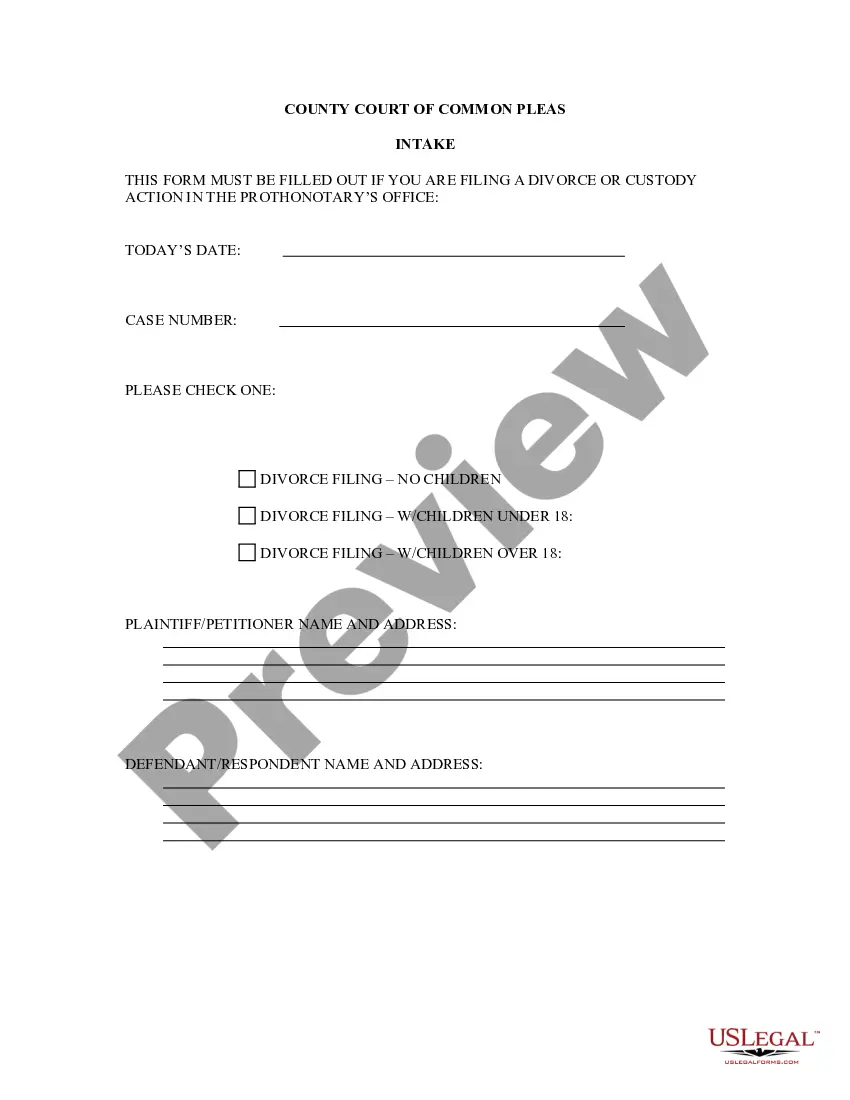
Pennsylvania Court of Common Pleas Intake
Understanding this form
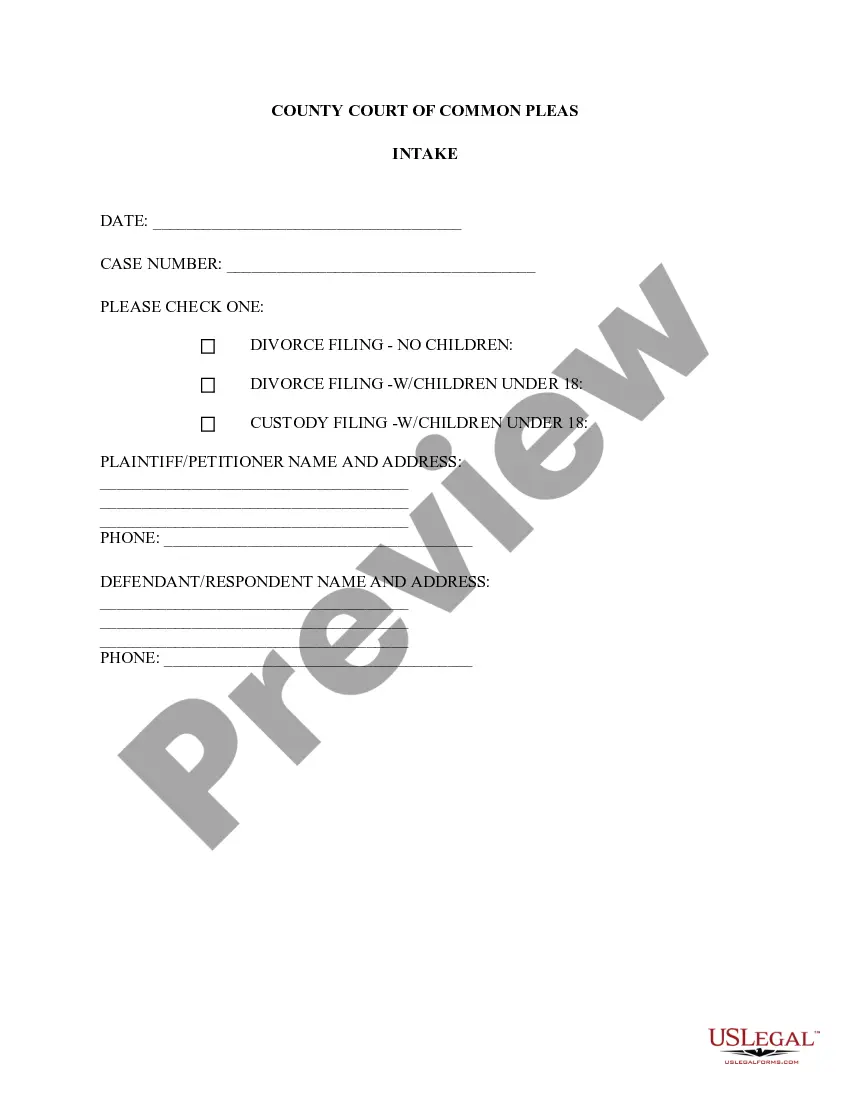
The Court of Common Pleas Intake form is designed for cases involving children during divorce proceedings. This form serves to notify the court of the filing type and collects contact information for both parties, distinguishing it from other divorce-related forms that may not involve children.
Key parts of this document
- Case caption for identifying the divorce action.
- Contact information for each party involved.
- Section indicating the type of divorce filing.
- Details regarding child custody and visitation if applicable.
Common use cases
You should use the Court of Common Pleas Intake form in cases where a divorce involves minor children. This is typically necessary when initiating divorce proceedings to ensure the court is informed about the circumstances and parties involved.
Who needs this form
- Individuals filing for divorce in a court of common pleas.
- Parents seeking to formalize custody arrangements during divorce.
- Parties who need to communicate essential information to the court about their divorce.
Completing this form step by step
- Identify and list the names of both parties at the top of the form.
- Indicate the type of divorce that is being filed.
- Fill in the required contact information for each party.
- Provide information about any minor children, including custody and visitation details.
- Sign and date the form as required.
Is notarization required?
Notarization is generally not required for this form. However, certain states or situations might demand it. You can complete notarization online through US Legal Forms, powered by Notarize, using a verified video call available anytime.
Get your form ready online
Our built-in tools help you complete, sign, share, and store your documents in one place.
Make edits, fill in missing information, and update formatting in US Legal Forms—just like you would in MS Word.
Download a copy, print it, send it by email, or mail it via USPS—whatever works best for your next step.
Sign and collect signatures with our SignNow integration. Send to multiple recipients, set reminders, and more. Go Premium to unlock E-Sign.
If this form requires notarization, complete it online through a secure video call—no need to meet a notary in person or wait for an appointment.
We protect your documents and personal data by following strict security and privacy standards.

Make edits, fill in missing information, and update formatting in US Legal Forms—just like you would in MS Word.

Download a copy, print it, send it by email, or mail it via USPS—whatever works best for your next step.

Sign and collect signatures with our SignNow integration. Send to multiple recipients, set reminders, and more. Go Premium to unlock E-Sign.

If this form requires notarization, complete it online through a secure video call—no need to meet a notary in person or wait for an appointment.

We protect your documents and personal data by following strict security and privacy standards.
Common mistakes
- Failing to include correct contact information for both parties.
- Not specifying the type of divorce clearly.
- Overlooking the required information about children involved.
Benefits of using this form online
- Convenient access to forms that can be downloaded and filled out at any time.
- Editability allows users to make necessary changes before submitting.
- Reliable templates drafted by licensed attorneys for accuracy.
Looking for another form?
Form popularity
FAQ
To obtain access to those records, researchers must contact the appropriate federal court. Online access to case and docket information is provided for a fee by the Administrative Office of the U.S. Courts through PACER. The court may refer you to a Federal Records Center to obtain copies.
A common pleas court hears cases involving such matters as real estate, personal injury, breach of contract, marital conflicts, probating of estates, guardianship of minors, and business relationships. This court has jurisdiction to hear all criminal felony cases.
The Pennsylvania Court of Common Pleas refers to the trial level courts in Pennsylvania.This is where most misdemeanor and all felony criminal cases are disposed of, where Orphan's Court matters are addressed, and where larger civil cases are originated.
The Courts of Common Pleas hear trials of civil matters; Family Court cases (adoption, divorce, child custody, child support, abuse and neglect); Orphans' Court matters including trusts and estates; criminal matters; appeals from government agencies (like zoning and other municipal appeals); and appeals from District
Search and view individual court case information (including docket sheets)for freeplease go to the UJS web portal. Search, view and print Unified Judicial System (UJS) contract summaries, detailed expenditure data, monthly salary and annual compensation reports.
Superior Court Case Processing In superior court, the two major types of court cases are criminal and civil. Trials in criminal and civil cases are generally conducted the same way.
There the Court of Common Pleas, also called Common Bench, heard all real actions and common pleasactions between subjects that did not involve royal interests. It had no authority to hear criminal matters which were the special prerogative of the King's Bench.
Search and view individual court case information (including docket sheets)for freeplease go to the UJS web portal. Search, view and print Unified Judicial System (UJS) contract summaries, detailed expenditure data, monthly salary and annual compensation reports.
The courts of common pleas have original jurisdiction in all criminal felony cases and original jurisdiction in all civil cases in which the amount in controversy is generally more than $15,000. Courts of common pleas have appellate jurisdiction over the decisions of some state administrative agencies.
The Superior Court of California. Documents maintained in court case files are public records and subject to public inspection. California Rules of Court, Rule 2.400(a) states that all papers in the court files may be inspected by the public in the office of the clerk.all court records are presumed open.