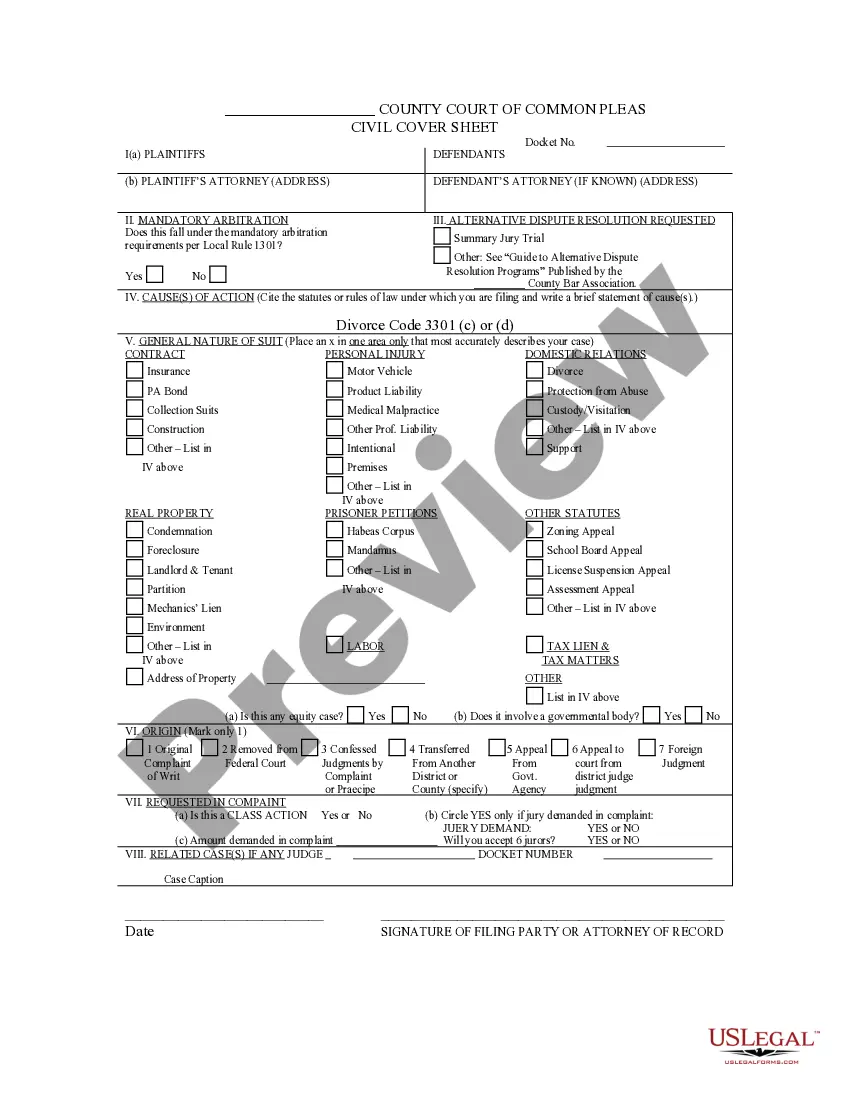
Pennsylvania Civil Cover Sheet
Overview of this form
The Civil Cover Sheet is a vital document used in divorce proceedings involving children in Pennsylvania. Its primary purpose is to inform the court about the nature of the legal action and provide essential information about the involved parties. Unlike other legal forms, this cover sheet specifically highlights domestic relations matters, helping streamline the judicial process by presenting key case details upfront.
Key components of this form
- General nature of the suit: Indicate the type of case by marking the appropriate category.
- Case caption: Include the titles and names of the parties involved in the divorce.
- Filing party or attorney signature: Confirm document authenticity with a signature.
- Date of signature: Record the date on which the form is completed and signed.
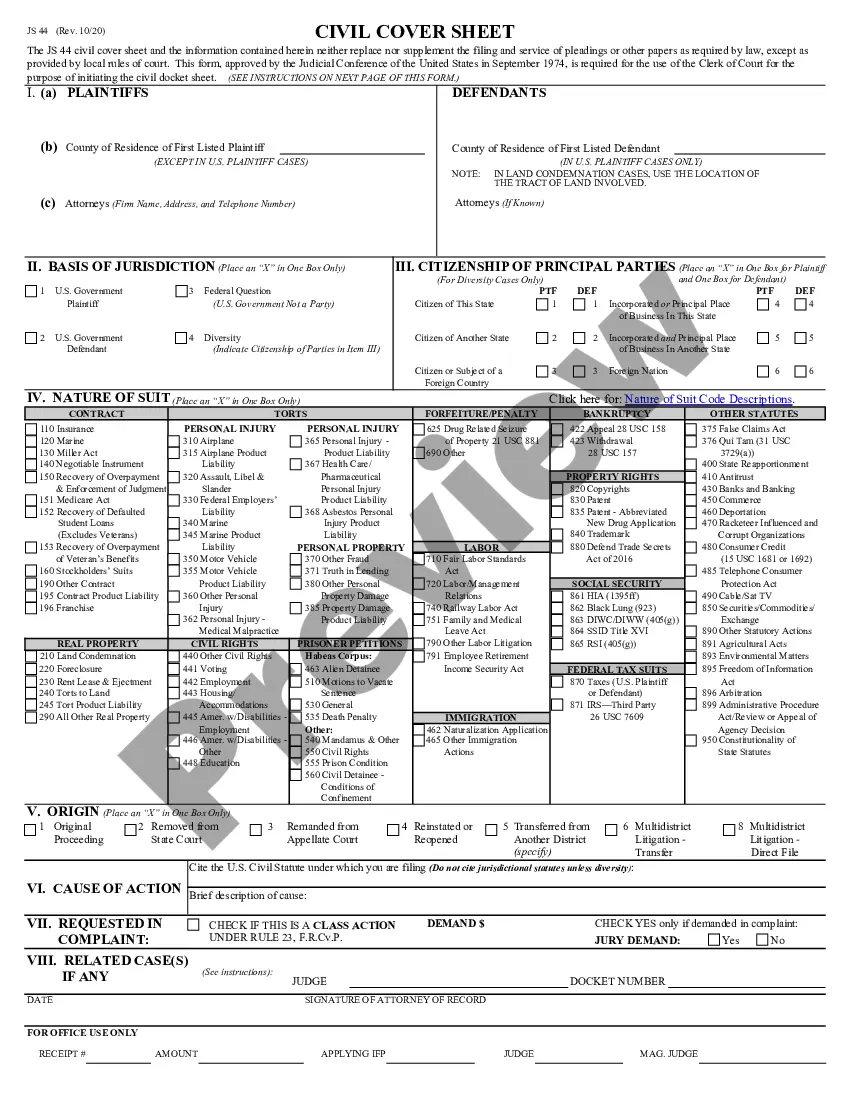
When this form is needed
This form is required when filing a divorce case that involves children in Pennsylvania. It is crucial for ensuring that the court has an accurate understanding of the nature of the case and the parties involved, thus facilitating the legal process. Use it at the beginning of your filing to comply with court requirements.
Who can use this document
- Individuals filing for divorce in Pennsylvania where children are involved.
- Attorneys representing clients in domestic relations cases.
- Any party interested in ensuring that their case is accurately presented to the court.
How to prepare this document
- Identify the nature of the suit by checking one box that best describes your case.
- Enter the case caption with the names of both parties in the divorce.
- Record the date of completion at the designated spot on the form.
- Sign the document as the filing party or ensure your attorney signs it.
Is notarization required?
In most cases, this form does not require notarization. However, some jurisdictions or signing circumstances might. US Legal Forms offers online notarization powered by Notarize, accessible 24/7 for a quick, remote process.
Get your form ready online
Our built-in tools help you complete, sign, share, and store your documents in one place.
Make edits, fill in missing information, and update formatting in US Legal Forms—just like you would in MS Word.
Download a copy, print it, send it by email, or mail it via USPS—whatever works best for your next step.
Sign and collect signatures with our SignNow integration. Send to multiple recipients, set reminders, and more. Go Premium to unlock E-Sign.
If this form requires notarization, complete it online through a secure video call—no need to meet a notary in person or wait for an appointment.
We protect your documents and personal data by following strict security and privacy standards.

Make edits, fill in missing information, and update formatting in US Legal Forms—just like you would in MS Word.

Download a copy, print it, send it by email, or mail it via USPS—whatever works best for your next step.

Sign and collect signatures with our SignNow integration. Send to multiple recipients, set reminders, and more. Go Premium to unlock E-Sign.

If this form requires notarization, complete it online through a secure video call—no need to meet a notary in person or wait for an appointment.

We protect your documents and personal data by following strict security and privacy standards.
Common mistakes to avoid
- Failing to check the correct nature of the suit, which can lead to delays.
- Omitting the case caption or incorrectly spelling names of the parties.
- Not signing the form, which renders it incomplete and invalid.
Benefits of using this form online
- Convenient access to the form allows for easy completion from anywhere.
- Editable format helps you fill in your details accurately without handwritten errors.
- Reliable resources ensure that the form complies with the latest legal standards.
Looking for another form?




Form popularity
FAQ
Examples are murder, assault, theft,and drunken driving. Civil law deals with behavior that constitutes an injury to an individual or other private party, such as a corporation. Examples are defamation (including libel and slander), breach of contract, negligence resulting in injury or death, and property damage.
Go to your county clerk's office and let them know you'd like to file a small claim. The clerk's office will give you paperwork to fill out with basic information for your case: your name (the plaintiff), the name of the person or business you're suing (the defendant) and the amount you're asking for.
Form SC-100 is officially called Plaintiff's Claim and Order to Go to Small Claim Courts. The form is created for the court cases that involve more than $10,000. Form SC-100 must be filled out by the plaintiff, a person who is suing another individual.
A civil case is a lawsuit that usually deals with contracts and/or torts. Torts, generally speaking, are wrongful (negligent) acts that result in damage or injury. Civil cases can occur by way of action or application.
Defendant's name. Plaintiff's name. Name and address of the court. Case number. Date. Clerk of the court. Notice to person served that they are being served as: An individual defendant. As the person sued under the fictitious name of. On behalf of.
A court of law that deals with disagreements between individual people or private companies, rather than with criminal activity:What is the pronunciation of civil court?
Tort claims. Breach of contract claims. Equitable claims. Landlord/tenant issues.
While a criminal case is filed by the state against the offender, a civil case is filed by a person or entity against another person or entity.