Pennsylvania Individual Credit Application
What is this form?
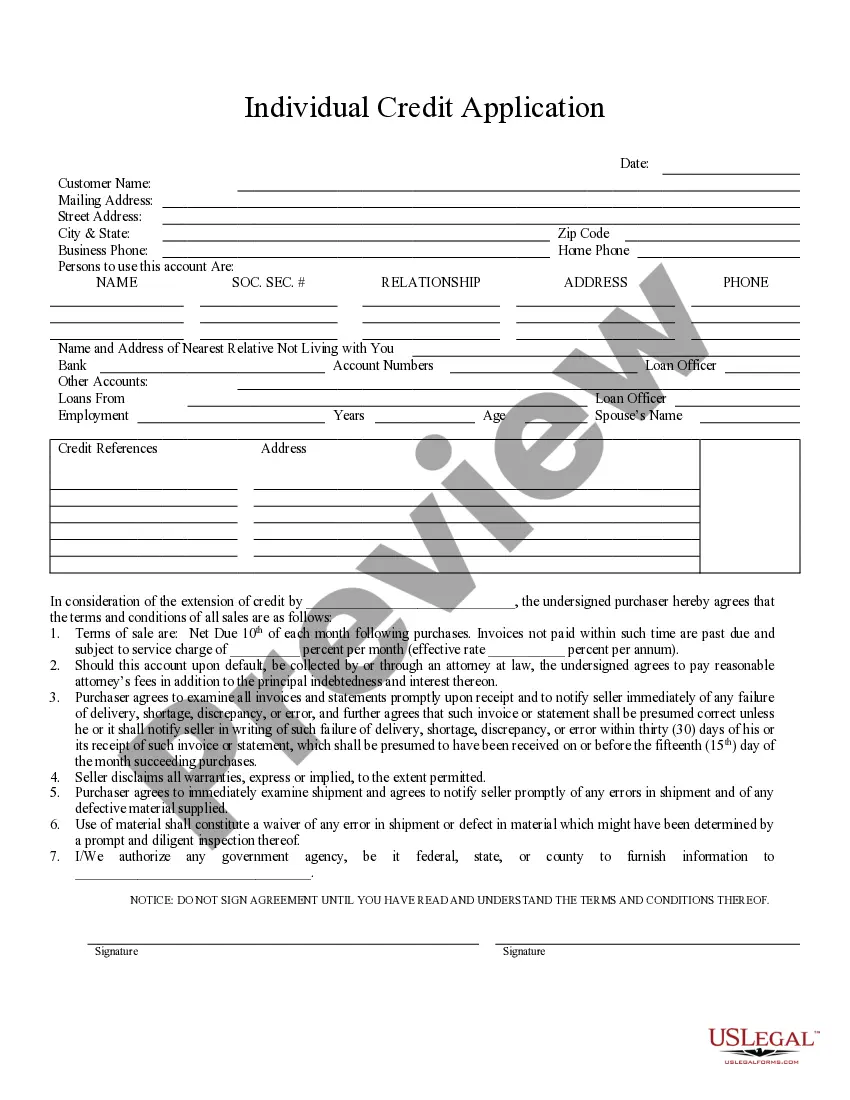
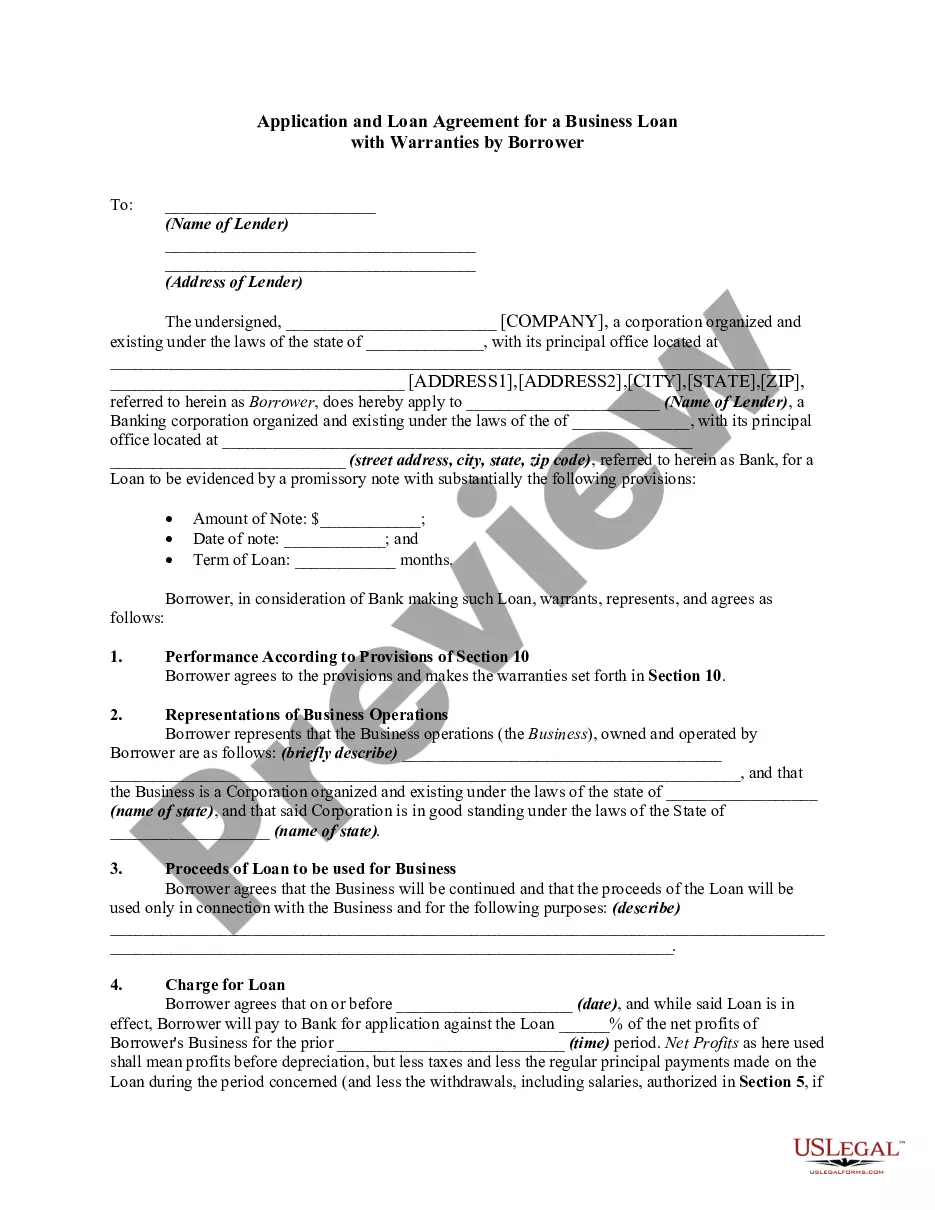
The Individual Credit Application is a legal document used by individuals seeking to obtain credit for a purchase. It outlines the terms of sale, repayment arrangements, and conditions in case of default, differentiating it from other credit applications by including specific provisions for personal information disclosure and warranty disclaimers. This form is essential for formalizing the credit agreement between a buyer and a seller.
Main sections of this form
- Identification of the seller and purchaser.
- Terms of sale, detailing repayment schedule and interest rates.
- Default provisions for unpaid invoices and attorney's fees.
- Disclaimer of warranties by the seller.
- Authorization for the seller to acquire personal information from government agencies.
- Procedures for disputing invoices and shipment errors.
Common use cases
This Individual Credit Application should be used when an individual intends to borrow money or receive credit for purchasing goods or services. It is particularly useful in situations where the seller requires formal acknowledgment of the terms of sale and repayment before extending credit. Common scenarios include purchasing high-ticket items like appliances or vehicles where financing is necessary.
Who needs this form
This form is appropriate for:
- Individuals seeking to purchase goods or services on credit.
- Businesses extending credit to individual consumers.
- Buyers who want a clear understanding of their repayment obligations.
Steps to complete this form
- Begin by identifying the parties involved, including the seller's and the purchaser's names.
- Clearly state the terms of sale, including the payment schedule and interest rates.
- Fill in the percentage for the service charge on late payments.
- Document any disclaimers regarding warranties related to the purchased goods.
- Sign and date the form to acknowledge understanding and acceptance of the terms.
Does this document require notarization?
Notarization is not commonly needed for this form. However, certain documents or local rules may make it necessary. Our notarization service, powered by Notarize, allows you to finalize it securely online anytime, day or night.
Get your form ready online
Our built-in tools help you complete, sign, share, and store your documents in one place.
Make edits, fill in missing information, and update formatting in US Legal Forms—just like you would in MS Word.
Download a copy, print it, send it by email, or mail it via USPS—whatever works best for your next step.
Sign and collect signatures with our SignNow integration. Send to multiple recipients, set reminders, and more. Go Premium to unlock E-Sign.
If this form requires notarization, complete it online through a secure video call—no need to meet a notary in person or wait for an appointment.
We protect your documents and personal data by following strict security and privacy standards.

Make edits, fill in missing information, and update formatting in US Legal Forms—just like you would in MS Word.

Download a copy, print it, send it by email, or mail it via USPS—whatever works best for your next step.

Sign and collect signatures with our SignNow integration. Send to multiple recipients, set reminders, and more. Go Premium to unlock E-Sign.

If this form requires notarization, complete it online through a secure video call—no need to meet a notary in person or wait for an appointment.

We protect your documents and personal data by following strict security and privacy standards.
Common mistakes to avoid
- Failing to read and understand the terms before signing.
- Not providing correct contact information for credit verification.
- Neglecting to return the application within the specified timeframe.
- Omitting signatures or dates, which may render the application invalid.
Benefits of completing this form online
- Convenient access to download and print the form anytime.
- Editable fields allow for easy entry of personal and transaction details.
- Reliable format that meets legal standards.
- Reduced need for in-person appointments or consultations.
Looking for another form?


Form popularity
FAQ
Listing these deductions separately is called itemizing. For 2020, the standard deduction is $12,400 for single filers and $24,800 for married couples filing jointly. For 2021, it is $12,550 for singles and $25,100 for married couples.
If a taxpayer claims a credit for taxes paid to other states, the taxpayer must complete PA-40 Schedule G-L.The credit is limited to the lesser of the tax paid to the state with the highest tax rate or 3.07% of the income subject to tax in Pennsylvania and the state with the highest tax rate.
The California Standard Deduction As of the 2020 tax yearthe return you'd file in 2021the state-level standard deductions are: $4,601 for single taxpayers, as well as married and registered domestic partner (RDP) taxpayers who file separate returns.
Claim the standard deduction. Certain retirement contributions. Medical expenses that exceed 10 percent of your income. Interest paid on a portion of your mortgage loans. Up to $2,500 of student loan interest. Donations to charity. A portion of state, local and property taxes.
A 90% Pennsylvania EITC tax credit is available to offset the donation given.This check creates the credit for all the individual members when the CPSF thank you letter is delivered to DCED. Each donor on their joinder form can select a tuition based preschool or K-12 school to offer scholarships from their donation.
Disallowed deductions include the federal standard deduction and itemized deductions (with the limited exception for unreimbursed employee business expenses deducted from gross compensation). Additionally, Pennsylvania does not allow a deduction for the personal exemption.
The PA EITC program, established in 2001, offers businesses and individuals a credit to lower their tax liability through donations to K-12 private schools, scholarship organizations, pre-K programs, and other educational enrichment initiatives. When it launched in 2001, it had an original budget of $30 million.
Resident credit is available on interest and dividend income for taxes paid. to another state only if it is classified as business income in Pennsylvania. to another country only if it is classified as interest and/or dividend income in PA and is also subject to tax in other countries from foreign sources.
The Pennsylvania personal income tax does not provide for a standard deduction or personal exemption. However, individuals may reduce tax liabilities through certain deductions, credits and exclusions.