Pennsylvania Quitclaim Deed - Trust to an Individual
About this form
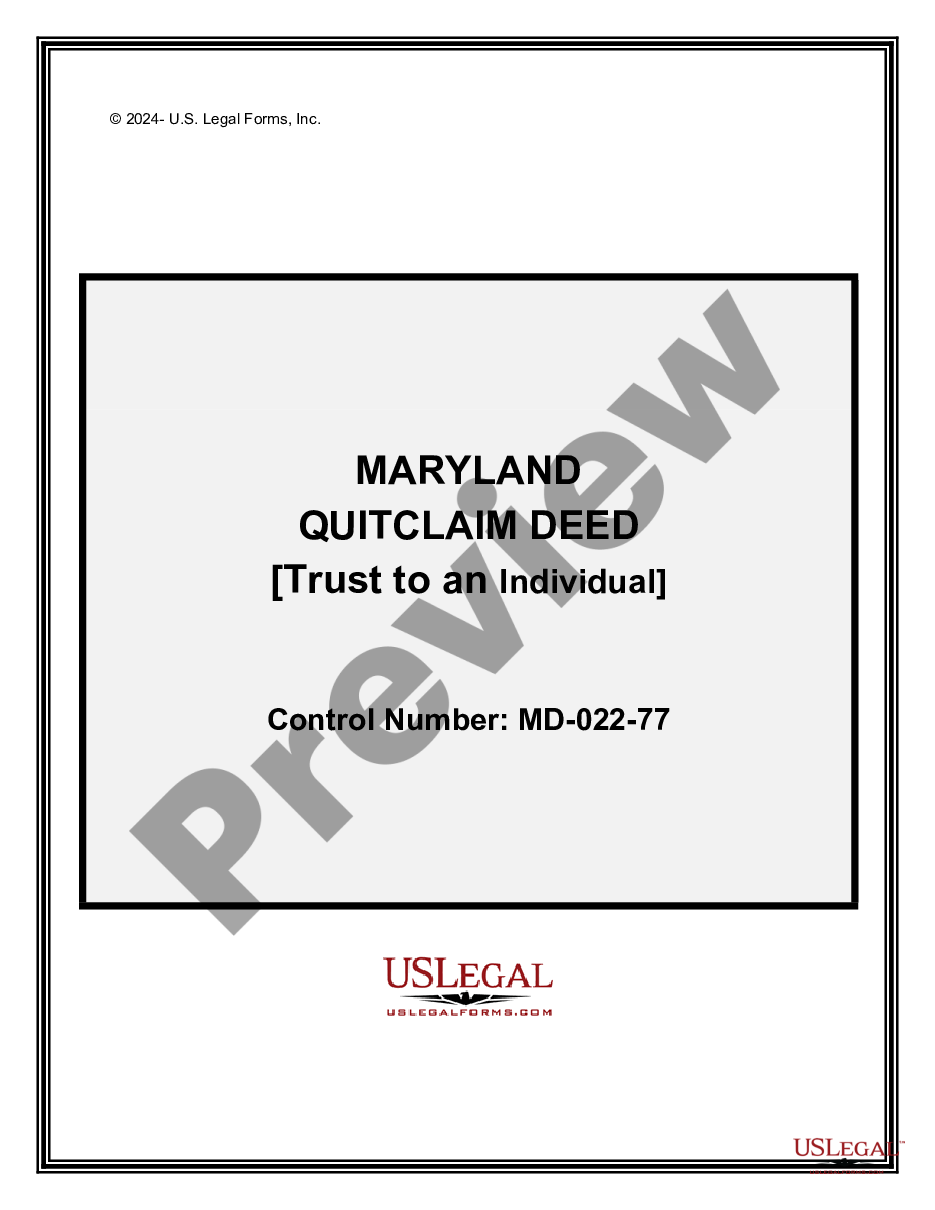
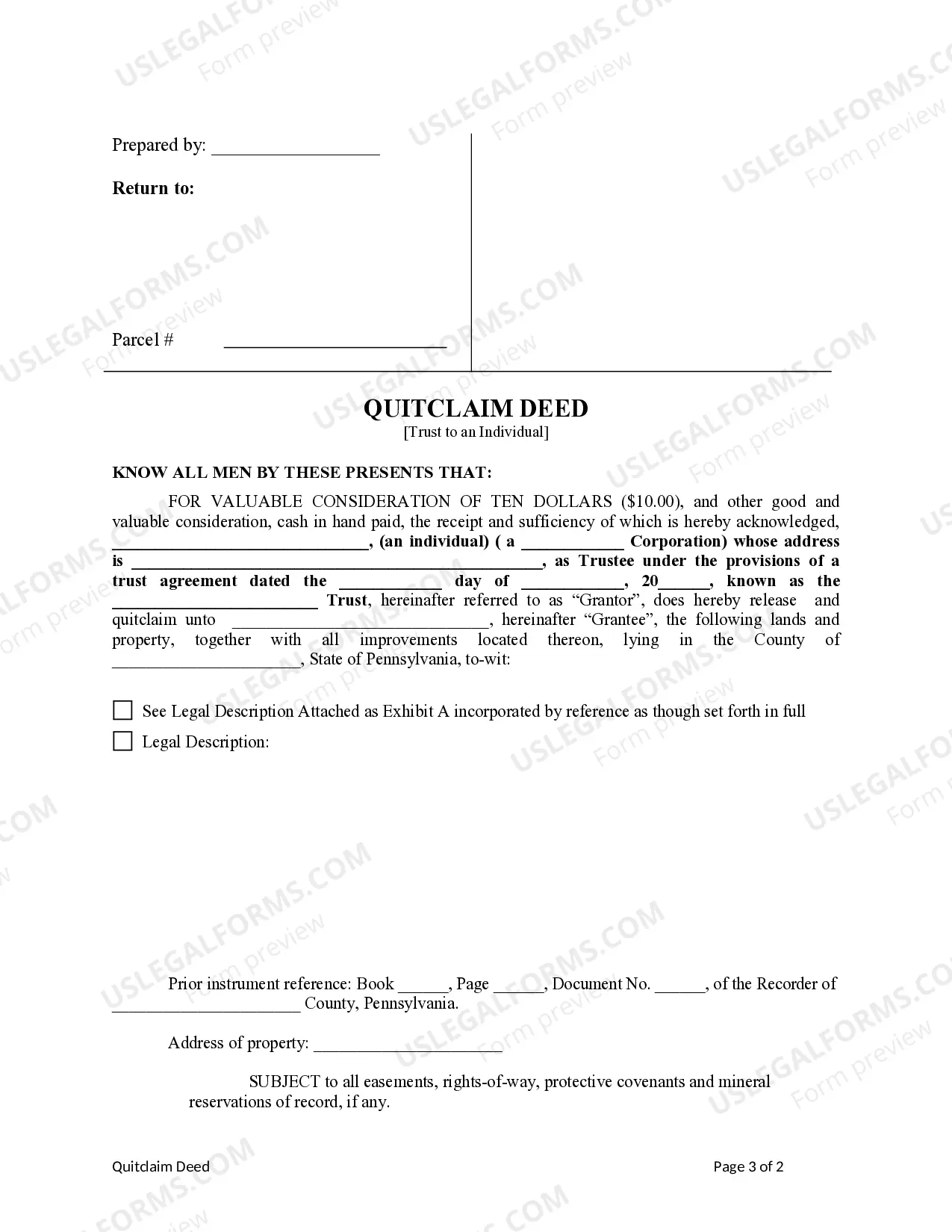
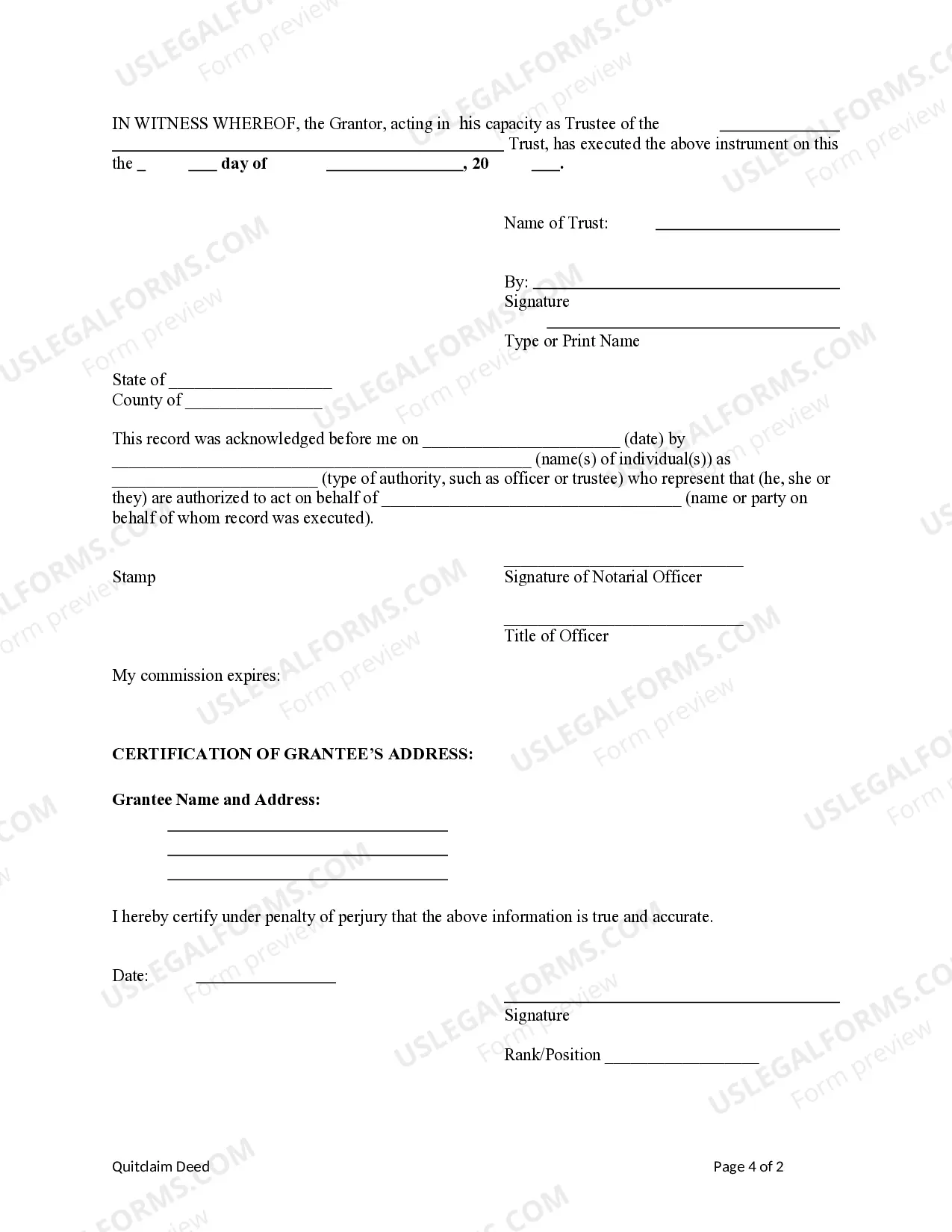
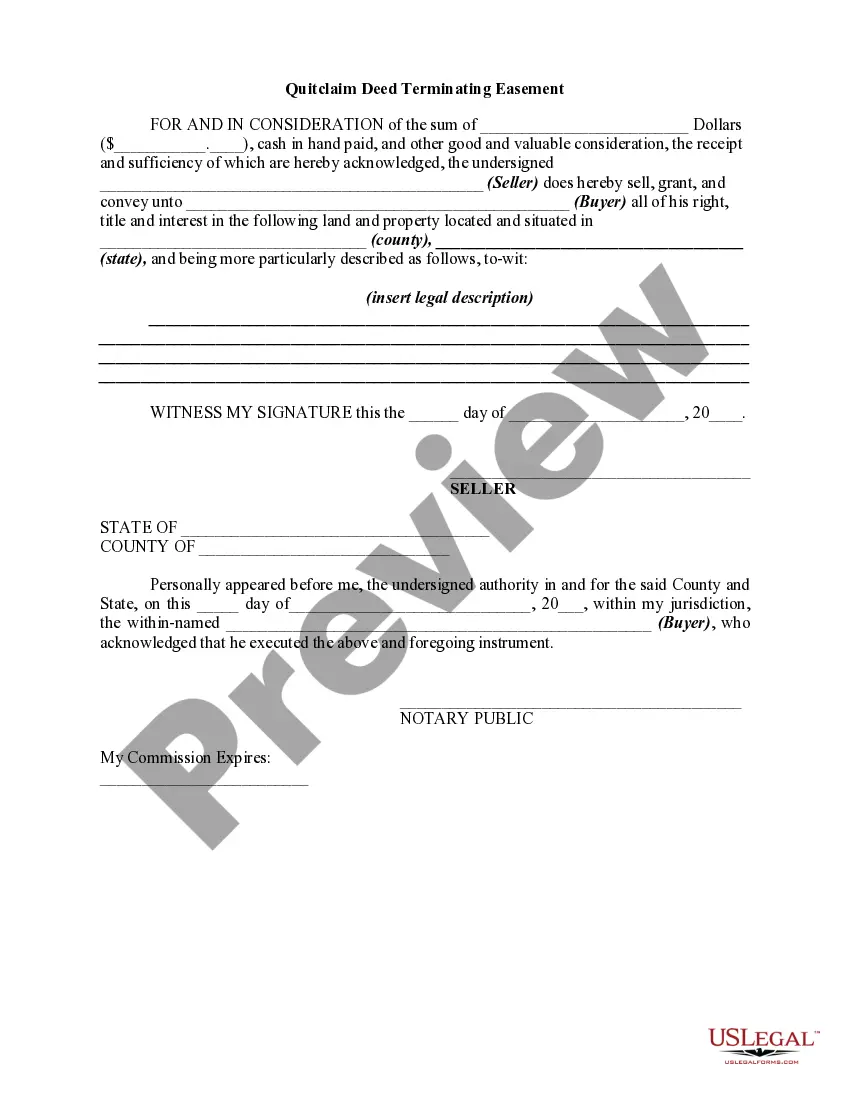
This form is a Quitclaim Deed used when a Trust (the Grantor) transfers property ownership to an individual (the Grantee). Unlike other deeds, a quitclaim deed does not guarantee that the Grantor has clear title to the property. It simply conveys whatever interest the Grantor has in the property, making it essential in situations where the exact nature of ownership is uncertain.
Form components explained
- Grantor and Grantee information: Details identifying the Trust and the individual receiving the property.
- Property description: A precise legal description of the property being transferred.
- Conditions and limitations: Any easements, rights-of-way, or limitations on the property that may affect use.
- Signatures and dates: Required signatures and the date of the transfer to validate the document.
- Exhibit A: An attachment that provides further details about the property.





When to use this document
This Quitclaim Deed is typically used in situations where a Trust is transferring property to a beneficiary or individual. Common scenarios include estate planning, dissolution of trusts, or when family members decide to transfer property ownership informally. It is also useful in situations where the property is being transferred without any warranties as to its title.
Intended users of this form
This form is intended for:
- Trustees of a Trust looking to transfer property to an individual.
- Beneficiaries or individuals who will receive property from a Trust.
- Anyone involved in an estate planning process that includes asset transfers from a Trust.
Instructions for completing this form
- Identify the parties: Clearly state the name of the Trust (Grantor) and the individual (Grantee).
- Specify the property: Enter the full legal description of the property being transferred.
- Enter any conditions: Include details about easements or rights that may affect the property.
- Sign the document: Ensure that the Grantor signs the deed in the presence of a notary if required.
- Attach Exhibit A: Include any additional documentation that clarifies the property description or conditions.
Is notarization required?
This document requires notarization to meet legal standards. US Legal Forms provides secure online notarization powered by Notarize, allowing you to complete the process through a verified video call, available 24/7.
Get your form ready online
Our built-in tools help you complete, sign, share, and store your documents in one place.
Make edits, fill in missing information, and update formatting in US Legal Forms—just like you would in MS Word.
Download a copy, print it, send it by email, or mail it via USPS—whatever works best for your next step.
Sign and collect signatures with our SignNow integration. Send to multiple recipients, set reminders, and more. Go Premium to unlock E-Sign.
If this form requires notarization, complete it online through a secure video call—no need to meet a notary in person or wait for an appointment.
We protect your documents and personal data by following strict security and privacy standards.

Make edits, fill in missing information, and update formatting in US Legal Forms—just like you would in MS Word.

Download a copy, print it, send it by email, or mail it via USPS—whatever works best for your next step.

Sign and collect signatures with our SignNow integration. Send to multiple recipients, set reminders, and more. Go Premium to unlock E-Sign.

If this form requires notarization, complete it online through a secure video call—no need to meet a notary in person or wait for an appointment.

We protect your documents and personal data by following strict security and privacy standards.
Mistakes to watch out for
- Failing to provide a complete legal description of the property.
- Not including signatures from both the Grantor and a notary if necessary.
- Overlooking specific state requirements that may affect the validity of the deed.
Why complete this form online
- Convenience of filling out the form from home or office at your own pace.
- Editable fields that allow for easy completion and corrections as needed.
- Access to professionally drafted templates that comply with legal standards.
Quick recap
- A Quitclaim Deed is used for transferring property from a Trust to an individual without guaranteeing title.
- It includes essential elements such as property description, Grantor and Grantee information, and necessary signatures.
- This form is specifically compliant with Pennsylvania laws; users in other states should verify local regulations.
Looking for another form?
Form popularity
FAQ
To use a Quitclaim Deed to add someone to a property deed or title, you would need to create a Quitclaim Deed and list all of the current owners in the grantor section. In the grantee section, you would list all of the current owners as well as the person you would like to add.
Fill in the deed form. Print it out. Have the grantor(s) and grantee(s) sign and get the signature(s) notarized. Fill out a Statement of Value form, if necessary. Get the Uniform Parcel Number (UPI) on the deed certified, if required by your county.
If you own your own home, you are free to gift or sell an interest in the real property to someone else.You'll need to transfer an interest by writing up another deed with the person's name on it. In California, you can use either a grant deed, a quitclaim deed or an interspousal deed, depending on your circumstances.
You'll need to pay a fee, which varies from county to county. For example, in Montgomery County, near Philadelphia, the fee for recording a deed is $86.75 for up to four pages and up to four names, and $1 per additional name and $4 per additional page.
But you might be wondering if an owner can transfer a deed to another person without a real estate lawyer. The answer is yes. Parties to a transaction are always free to prepare their own deeds.A quitclaim deed, for example, is far simpler than a warranty deed.
A person who signs a quitclaim deed to transfer property they do not own results in no title at all being transferred since there is no actual ownership interest. The quitclaim deed only transfers the type of title you own.
Yes, you can use a Quitclaim Deed to transfer a gift of property to someone. You must still include consideration when filing your Quitclaim Deed with the County Recorder's Office to show that title has been transferred, so you would use $10.00 as the consideration for the property.