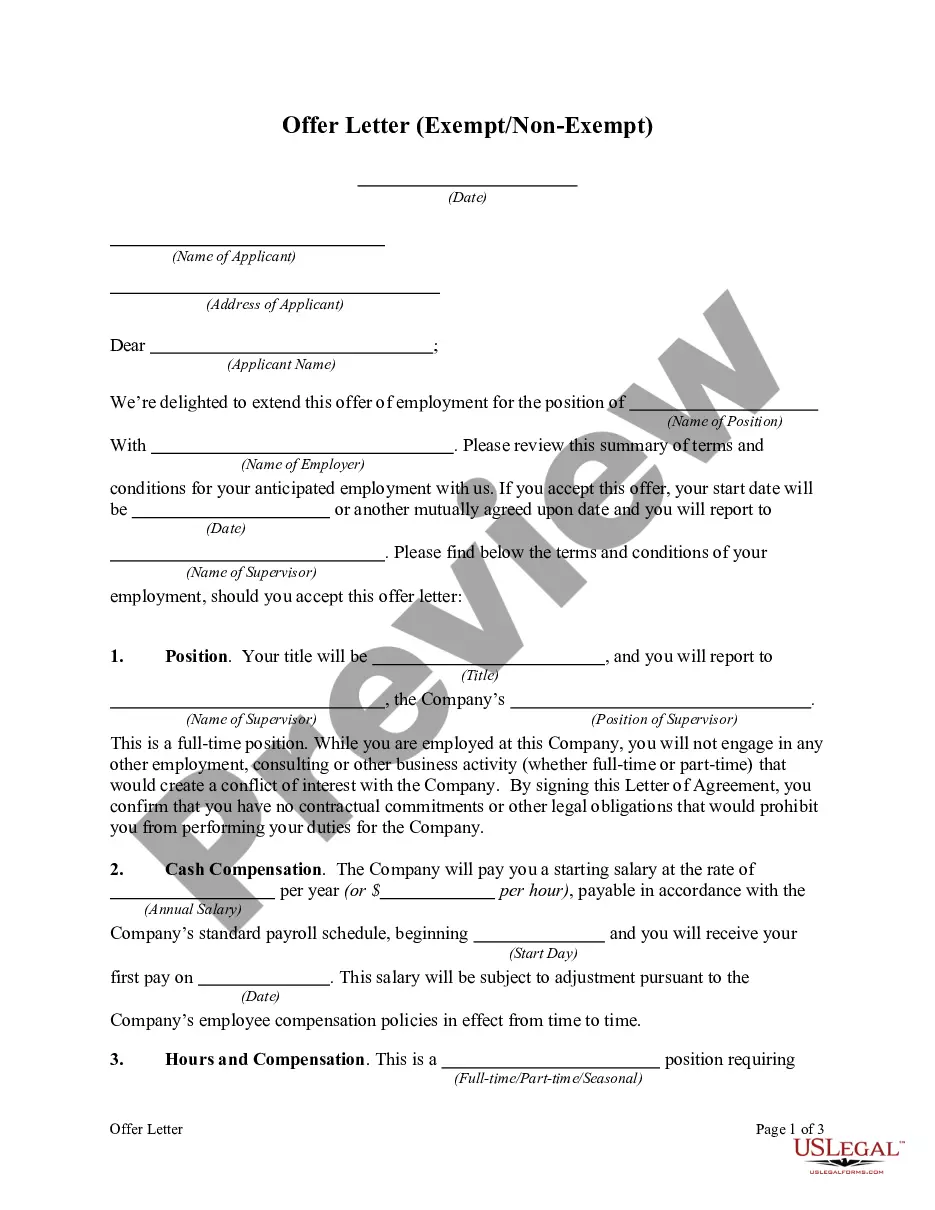
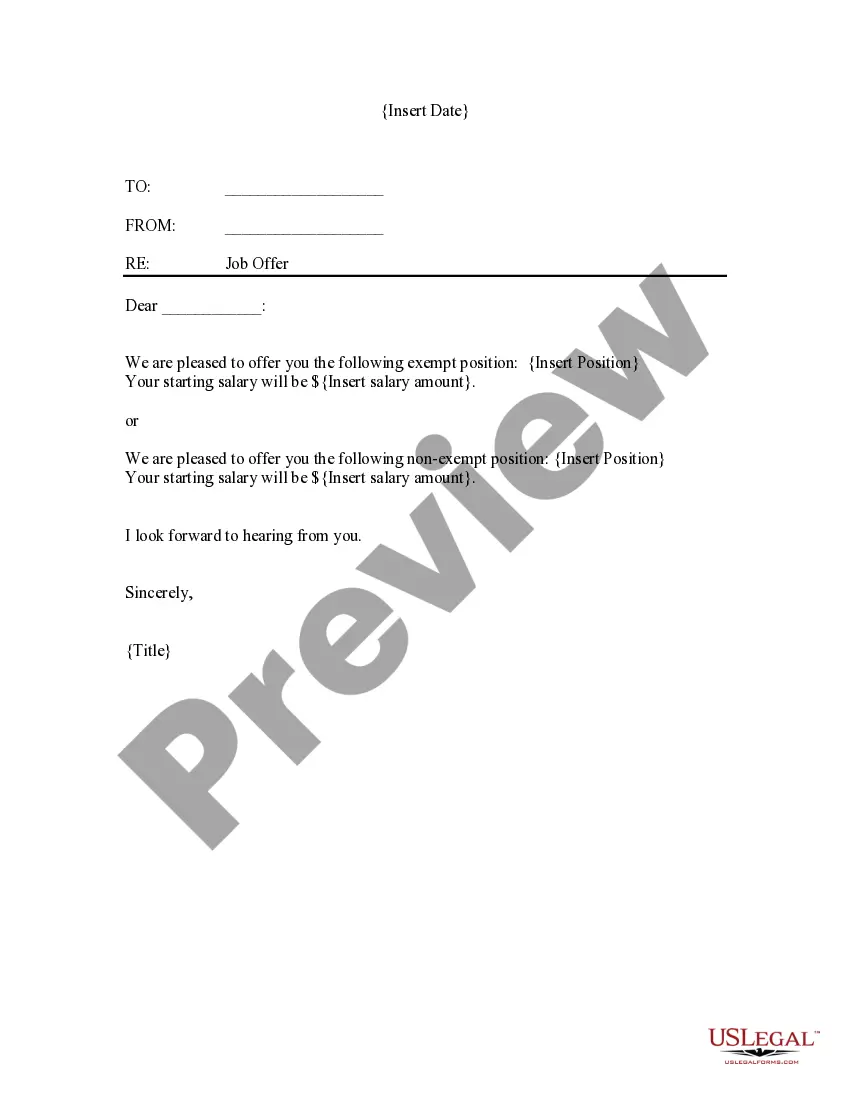
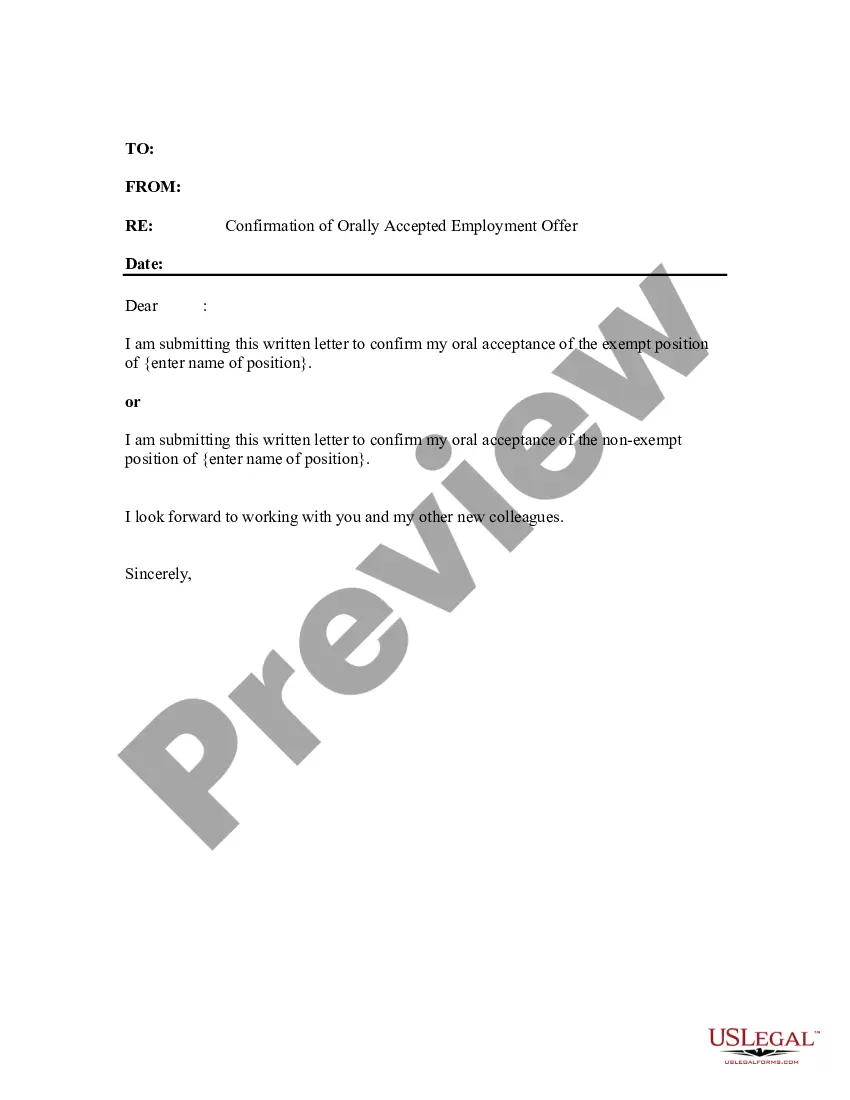
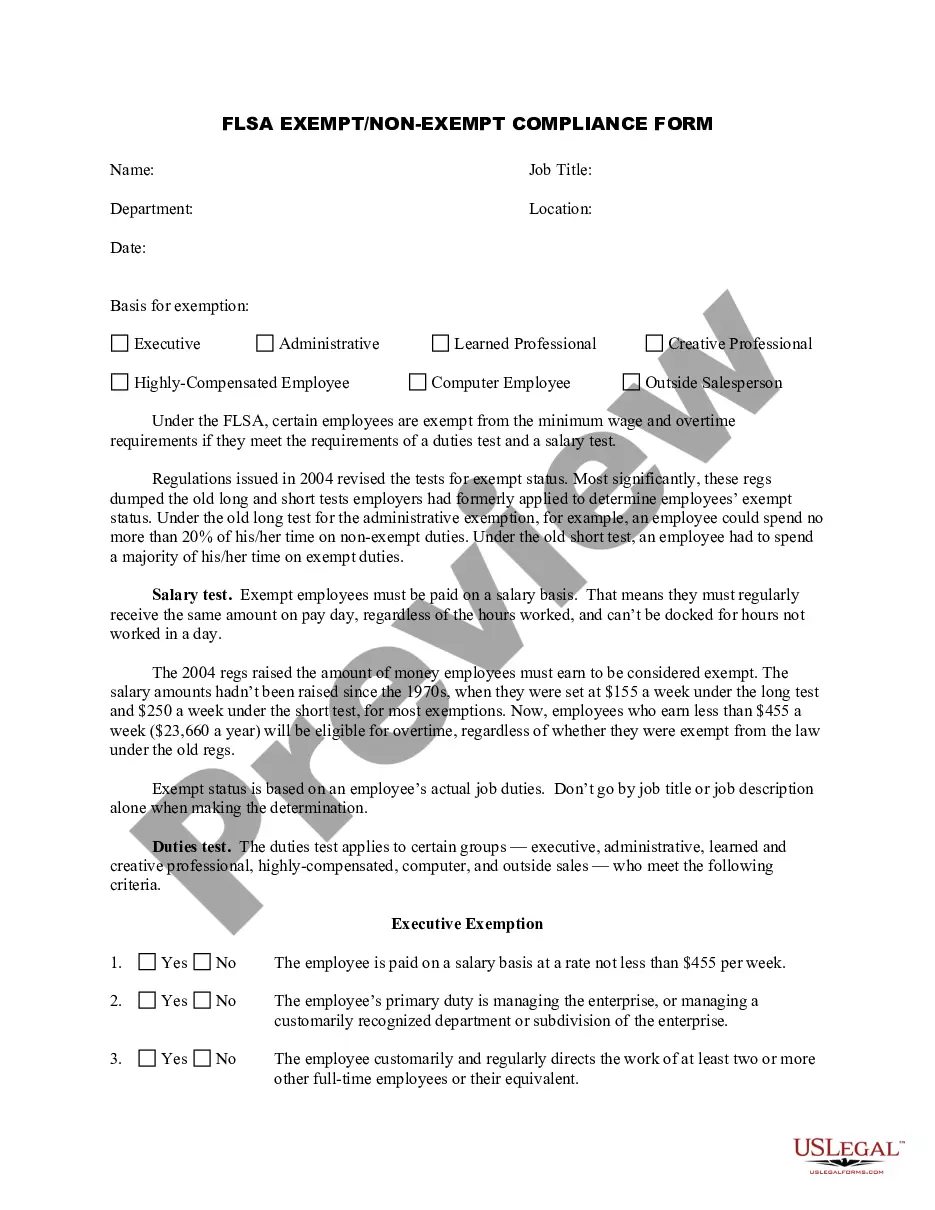
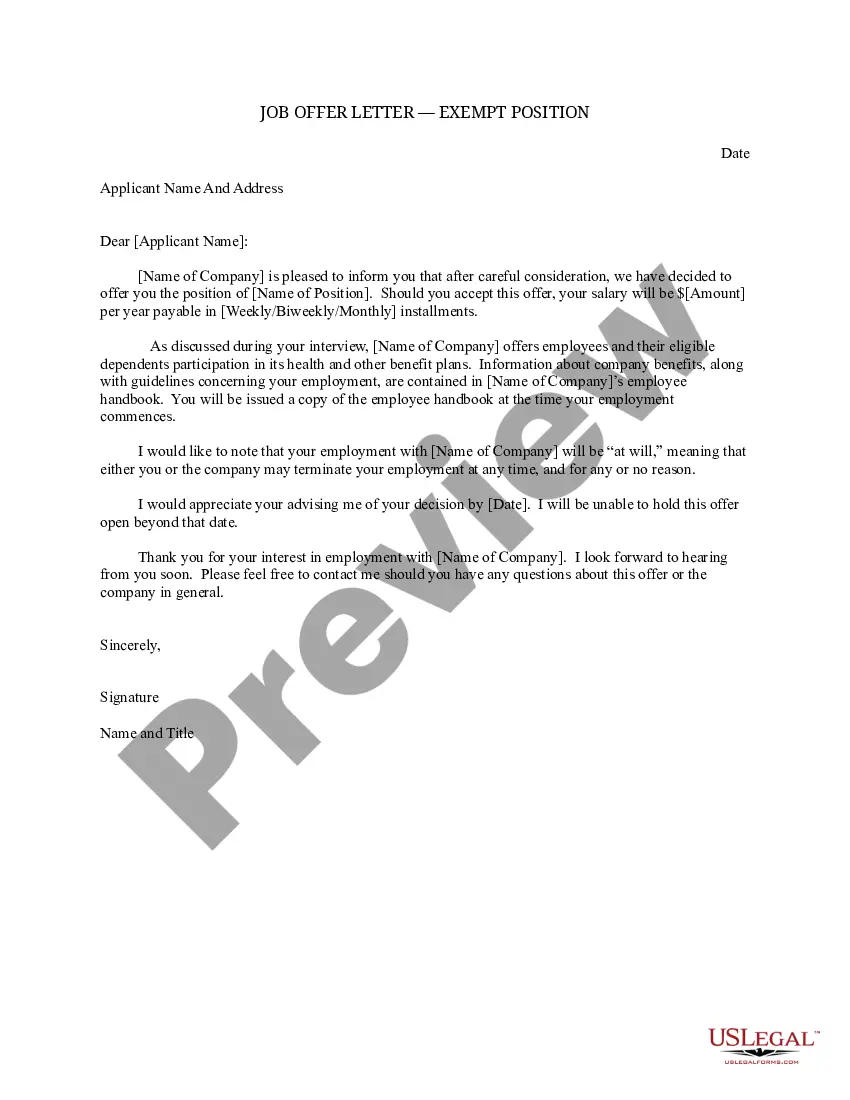
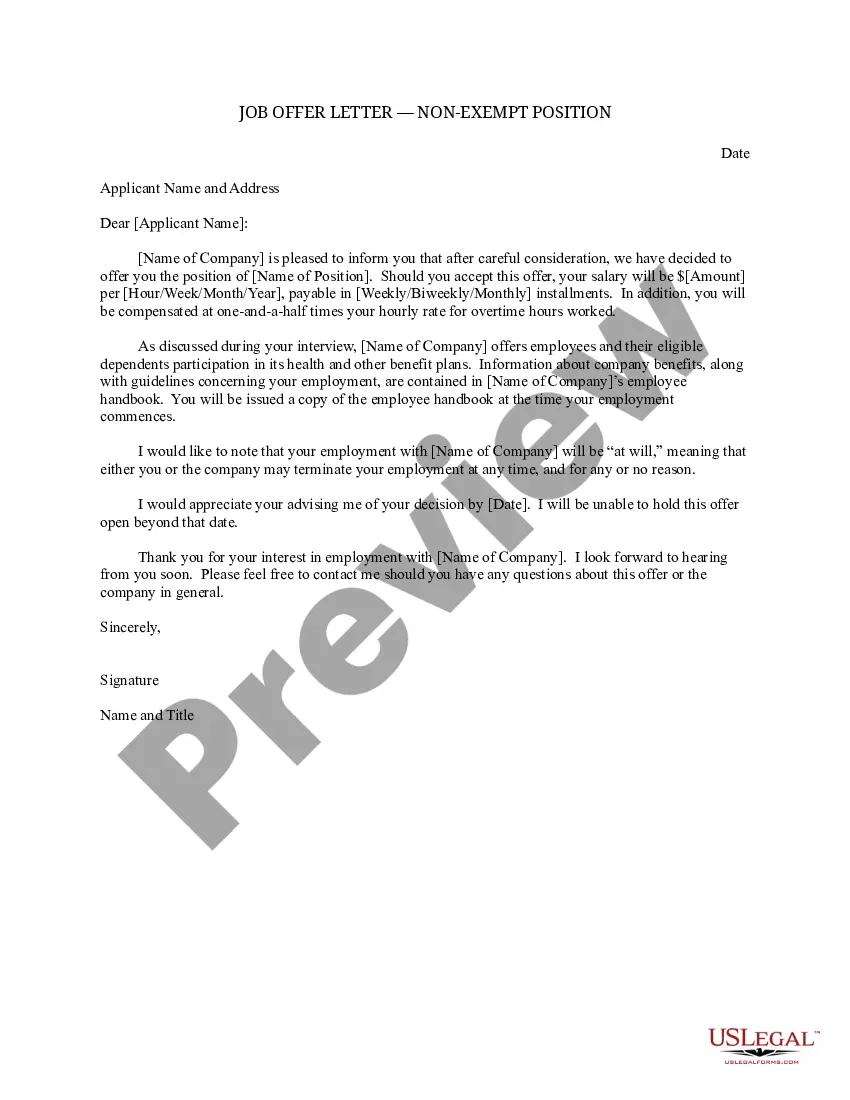
Oregon Employment Offer Letter Exempt or Non-Exempt
Description


Get your form ready online
Our built-in tools help you complete, sign, share, and store your documents in one place.
Make edits, fill in missing information, and update formatting in US Legal Forms—just like you would in MS Word.
Download a copy, print it, send it by email, or mail it via USPS—whatever works best for your next step.
Sign and collect signatures with our SignNow integration. Send to multiple recipients, set reminders, and more. Go Premium to unlock E-Sign.
If this form requires notarization, complete it online through a secure video call—no need to meet a notary in person or wait for an appointment.
We protect your documents and personal data by following strict security and privacy standards.

Make edits, fill in missing information, and update formatting in US Legal Forms—just like you would in MS Word.

Download a copy, print it, send it by email, or mail it via USPS—whatever works best for your next step.

Sign and collect signatures with our SignNow integration. Send to multiple recipients, set reminders, and more. Go Premium to unlock E-Sign.

If this form requires notarization, complete it online through a secure video call—no need to meet a notary in person or wait for an appointment.

We protect your documents and personal data by following strict security and privacy standards.
Looking for another form?
How to fill out Employment Offer Letter Exempt Or Non-Exempt?
US Legal Forms - one of the largest collections of legal documents in the United States - offers a wide range of legal form templates that you can either purchase or create.
Using the website, you can discover thousands of forms for both business and personal purposes, organized by categories, states, or keywords.
You can access the latest versions of forms like the Oregon Employment Offer Letter Exempt or Non-Exempt in a matter of minutes.
Check the form summary to ensure you have selected the appropriate document.
If the form does not meet your requirements, use the Search box at the top of the page to find the one that does.
- If you have an existing subscription, Log In and obtain the Oregon Employment Offer Letter Exempt or Non-Exempt from your US Legal Forms library.
- The Download button will appear on each form you review.
- You can find all previously downloaded forms in the My documents section of your account.
- If you are using US Legal Forms for the first time, here are straightforward instructions to get started.
- Ensure you have selected the correct form for your city/county.
- Click the Preview button to review the form's content.
Form popularity
FAQ
As of now, Oregon legislature indicates that the non-exempt salary threshold will increase significantly in 2025. It's essential to check current updates, as this threshold impacts how you classify employees in your Oregon Employment Offer Letter. Ensure to stay informed, since accurate classification helps you comply with wage and hour laws.
Pros of hiring exempt employeesYou don't have to pay overtime. When you hire exempt employees, you won't pay overtime no matter how many hours these employees work per week.You can assume they're more experienced.You can give them more responsibility.
Exempt positions are excluded from minimum wage, overtime regulations, and other rights and protections afforded nonexempt workers. Employers must pay a salary rather than an hourly wage for a position for it to be exempt.
Exempt employees are paid a salary rather than by the hour, and their work is executive or professional in nature. Exempt employees stand in contrast to nonexempt employees, who must be paid at least the minimum wage, and overtime when they work more than the standard 40-hour workweek.
Non-exempt Offer means, any publicly solicited or private offer, sale or contract to sell any New Securities by the Company to any bona fide third party other than B.
All salaried employees must be paid overtime unless they meet the test for exempt status as defined by federal and state laws. CAUTION: Misclassification of salaried employees as exempt creates liability for unpaid overtime. It is the employer´s burden to prove exempt status of employees.
The FLSA includes these job categories as exempt: professional, administrative, executive, outside sales, and computer-related. The details vary by state, but if an employee falls in the above categories, is salaried, and earns a minimum of $684 per week or $35,568 annually, then they are considered exempt.
In any workplace, there are two types of employees: exempt and nonexempt. Exempt employees are those who are exempt from minimum wage and overtime pay requirements. This is because exempt employees are paid a salary rather than an hourly wage, and they work in what are considered executive or professional jobs.
An exempt employee is not entitled to overtime pay according to the Fair Labor Standards Act (FLSA). To be exempt, you must earn a minimum of $684 per week in the form of a salary. Non-exempt employees must be paid overtime and are protected by FLSA regulations.
Almost all Oregon employers are subject to the Fair Labor Standards Act (FLSA), and the minimum salary to qualify for exemption under that law is $684 per week or $35,568 annually (allowing up to 10% of the salary basis threshold to be met with nondiscretionary bonuses/incentives, including commissions, paid at least