Oregon Affidavit of Noncompliance in a Forcible Entry and Unlawful Detainer / Eviction Action
What this document covers
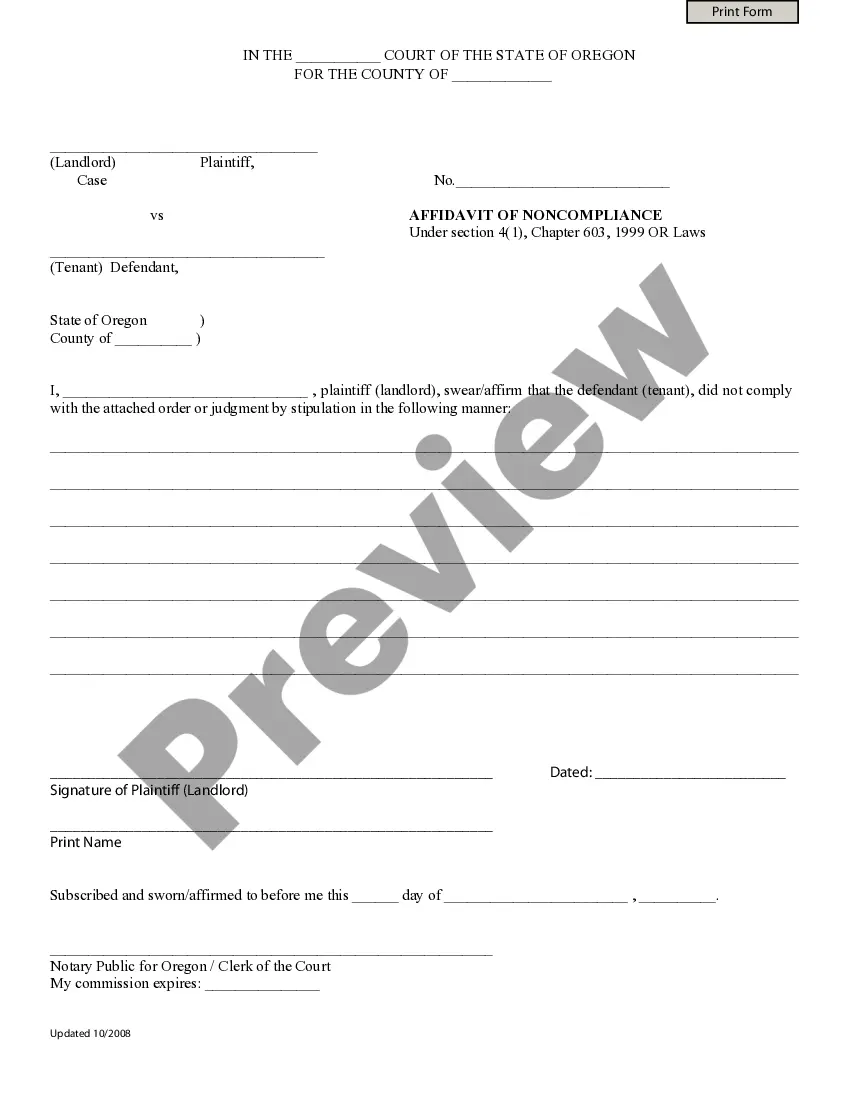
The Affidavit of Noncompliance in a Forcible Entry and Unlawful Detainer/Eviction Action is a legal document that landlords use to formally declare that a tenant has failed to comply with a court order related to eviction proceedings. This sworn statement is a critical component of landlord-tenant law, ensuring that the eviction process is conducted legally and appropriately. Unlike other eviction forms, this affidavit specifically addresses noncompliance with a judgment or stipulation made in an eviction lawsuit.
What’s included in this form
- Identifies the court and county where the eviction case is filed.
- Includes the names of the plaintiff (landlord) and defendant (tenant).
- States the case number for reference.
- Details the specific manner in which the tenant has failed to comply.
- Requires the landlord's signature and printed name for validity.
- Notarization section for the public notary's affirmation.
When to use this document
This form is used after a landlord has obtained a court judgment or stipulation against a tenant in an eviction action. If the tenant does not adhere to the court's orderâfor example, failing to pay rent or vacate the propertyâthis affidavit serves as a formal notification to the court that the tenant is noncompliant. It is essential for a landlord to document this noncompliance to proceed with the next steps in the eviction process.
Who needs this form
This affidavit should be used by:
- Landlords who have initiated an eviction lawsuit against a tenant.
- Property owners who have a valid court order they wish to enforce.
- Legal representatives of landlords involved in eviction proceedings.
How to prepare this document
- Identify the court in which the eviction case is filed and fill in the pertinent county.
- Enter the names of the parties involved: the landlord (plaintiff) and tenant (defendant).
- Fill in the case number given by the court for the eviction action.
- Clearly describe how the tenant has not complied with the court order.
- Sign the affidavit to affirm the statements made within the document.
- Have the affidavit notarized by a certified notary public to validate it.
Is notarization required?
Yes, this form must be notarized to be legally valid. The notarization process helps confirm the authenticity of the signatures and statements made by the landlord. US Legal Forms offers integrated online notarization with 24/7 availability, ensuring a secure video call without the need to travel.
Get your form ready online
Our built-in tools help you complete, sign, share, and store your documents in one place.
Make edits, fill in missing information, and update formatting in US Legal Forms—just like you would in MS Word.
Download a copy, print it, send it by email, or mail it via USPS—whatever works best for your next step.
Sign and collect signatures with our SignNow integration. Send to multiple recipients, set reminders, and more. Go Premium to unlock E-Sign.
If this form requires notarization, complete it online through a secure video call—no need to meet a notary in person or wait for an appointment.
We protect your documents and personal data by following strict security and privacy standards.

Make edits, fill in missing information, and update formatting in US Legal Forms—just like you would in MS Word.

Download a copy, print it, send it by email, or mail it via USPS—whatever works best for your next step.

Sign and collect signatures with our SignNow integration. Send to multiple recipients, set reminders, and more. Go Premium to unlock E-Sign.

If this form requires notarization, complete it online through a secure video call—no need to meet a notary in person or wait for an appointment.

We protect your documents and personal data by following strict security and privacy standards.
Avoid these common issues
- Failing to provide complete and specific details about the tenant's noncompliance.
- Not including the correct case number or court information.
- Neglecting to sign the affidavit before submitting it to the court.
- Forgetting to have the affidavit notarized, when necessary.
Benefits of using this form online
- Convenient access from any location, eliminating the need for in-person visits.
- Immediate download and fillable formats enhance efficiency and ease of use.
- Reliable templates drafted by licensed attorneys ensure compliance with legal standards.
Looking for another form?

Form popularity
FAQ
If you file an eviction (unlawful detainer) case and you decide you do not want to move forward, you can ask the court to dismiss the case.You included more than one tenant in your eviction case but have decided you only want to evict one or some of them, so you dismiss the case as to the others.
Addresses. Date. Tenant names. Status and date of the lease. Why the eviction notice is served (clear and concise explanation) Date tenant must vacate the property. Proof of service or delivery of notice.
You can remove your eviction from your public record by petitioning the court, winning your case or disputing an inaccurately reported eviction. While the process is more difficult, it's not impossible.
Courts commonly refer to eviction actions as "forcible entry and detainer" or "unlawful detainer" actions. The legal theory is that the landlord alleges the tenant unlawfully continues to have use and possession of the rental property, and the landlord seeks the assistance of the court to have the tenant removed.
Approach The Court Of Law You will have to send a legal notice to your tenant asking him/her to pay the arrears of rent or else to vacate within a month. The tenant has to pay rent in the court once it is assessed by the court and in case he/she fails, it invites immediate eviction.
If you do not vacate by the day in the notice, the landlord can then apply to the NSW Civil and Administrative Tribunal (NCAT) for a termination order. A termination order ends the tenancy and specifies the day by which you must give vacant possession.
Know Your Rights. It goes without saying, but take some time to know your rights as a tenant. Keep Good Records. Make Sure Notice is Proper. Service of the Unlawful Detainer. Talking to an Attorney. Managing Partner Lipton Legal Group, A PC Beverly Hills, CA.
After the Landlord and Tenant Board makes an order to evict a tenant, a court official called the Sheriff is in charge of enforcing or carrying out the order. If you have not moved out by the date the eviction order says you must move, the Sheriff can make you leave and let your landlord change the locks.
A bill passed during the Oregon legislature's third special session extends a moratorium on evictions, but it also requires action from renters in order to gain continued protections. House Bill 4401 extends the statewide pause on evictions for non-payment until June 30 of 2021.