Oregon Co-Petitioner Stipulated General Judgment of Dissolution of Marriage and Money Award
About this form
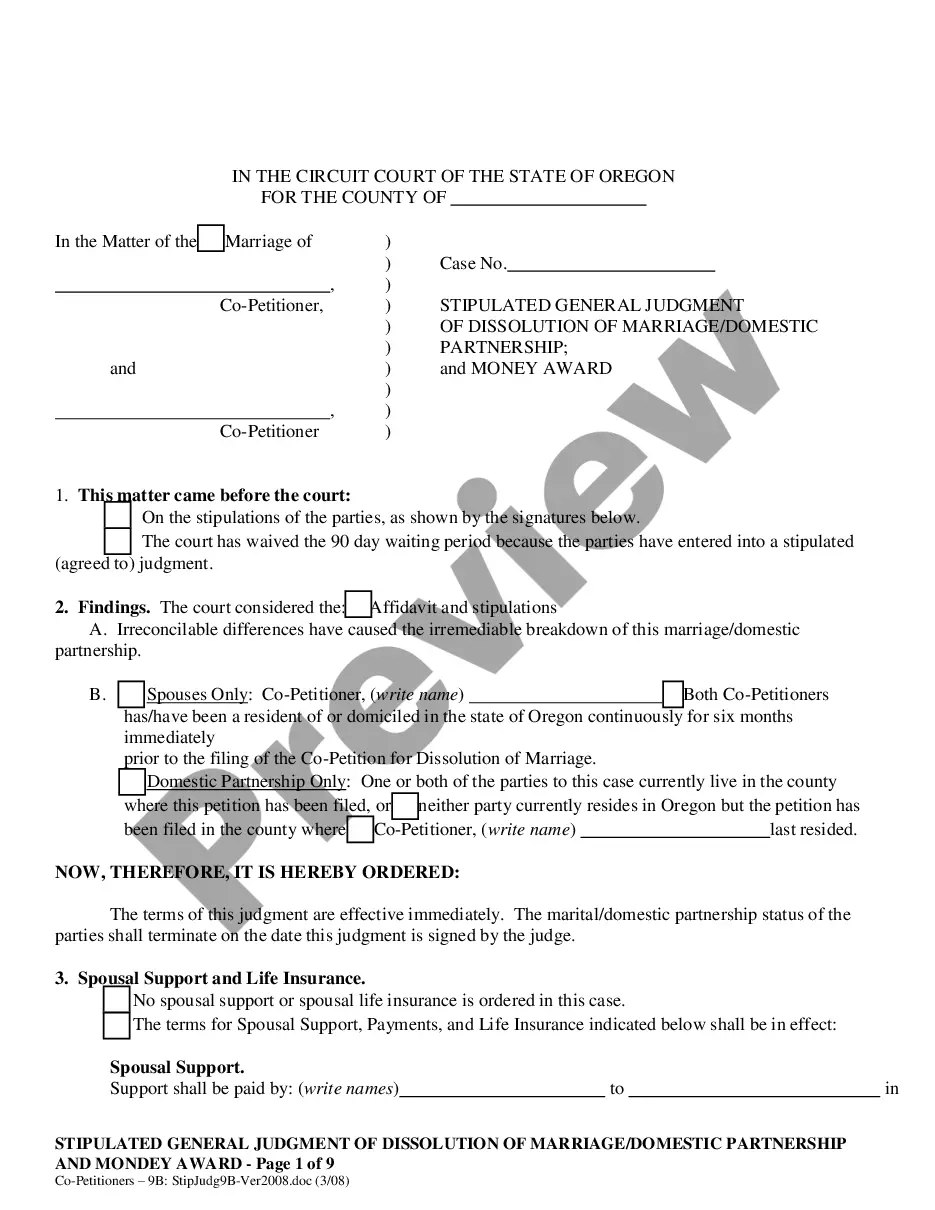
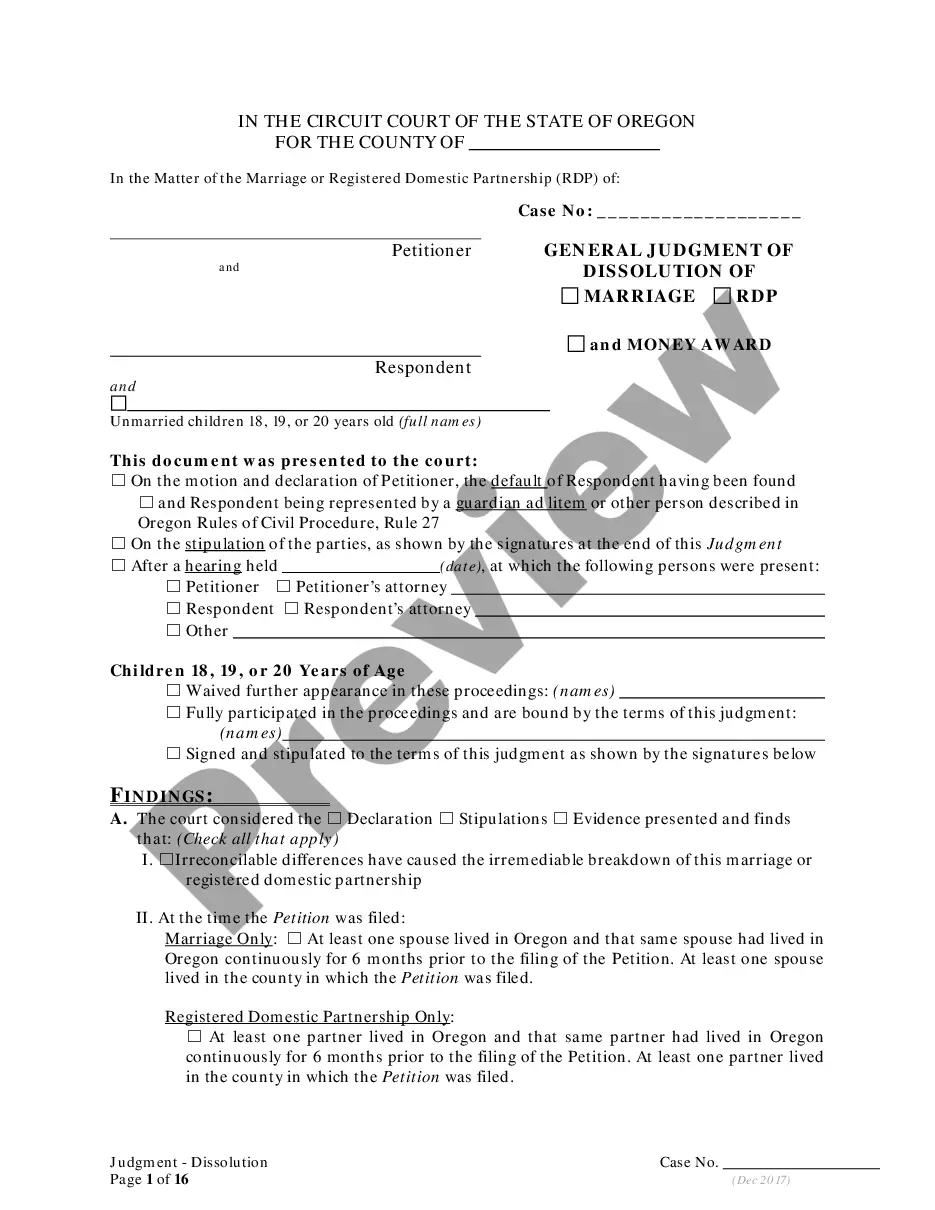
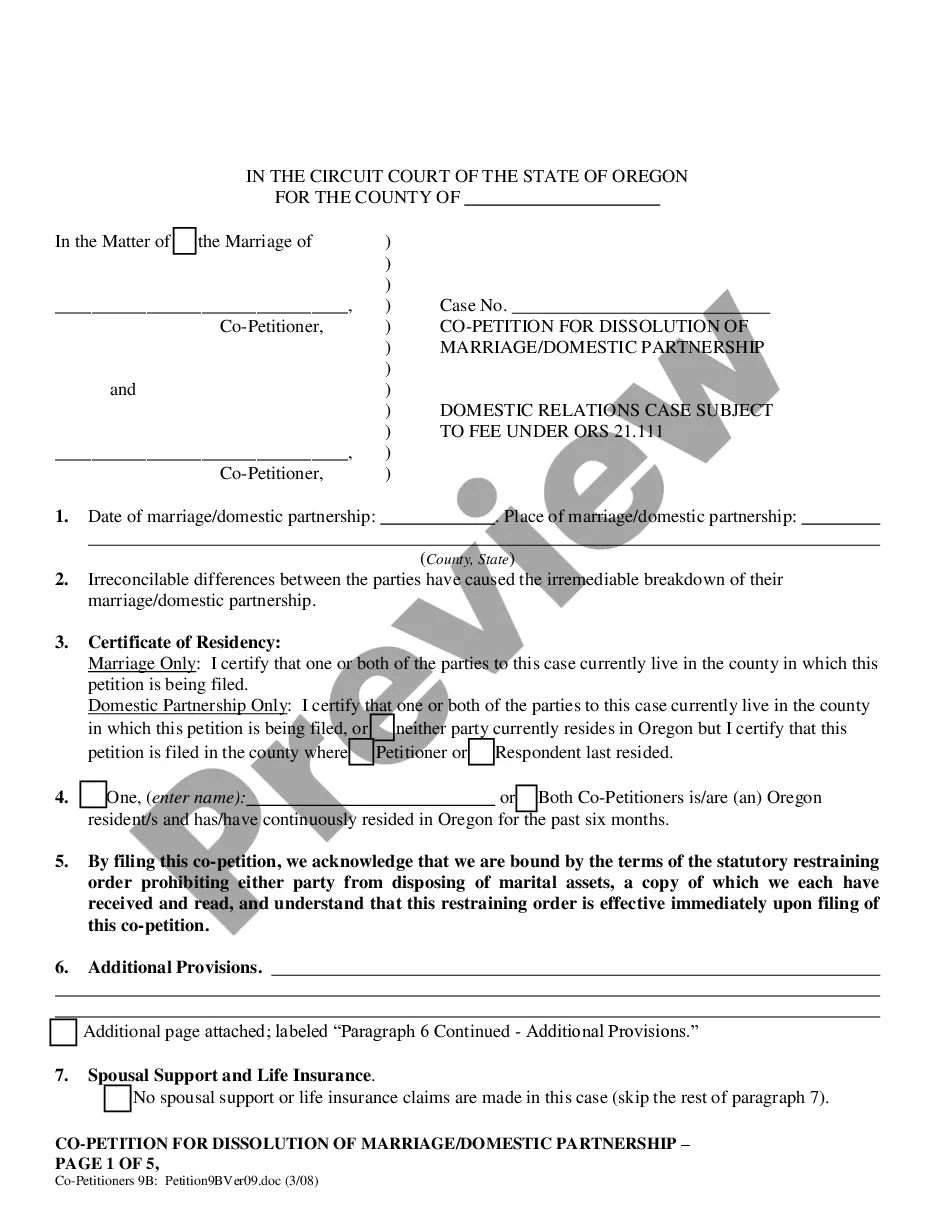
The Co-Petitioner Stipulated General Judgment of Dissolution of Marriage and Money Award is a legal document used in Oregon to finalize the dissolution of a marriage or domestic partnership where minor children are not involved. This form facilitates an agreed judgment between both parties, allowing for the division of assets and liabilities, the determination of spousal support, and the official termination of marital status, all without the need for a trial.
Key parts of this document
- Identification of the co-petitioners and the case number.
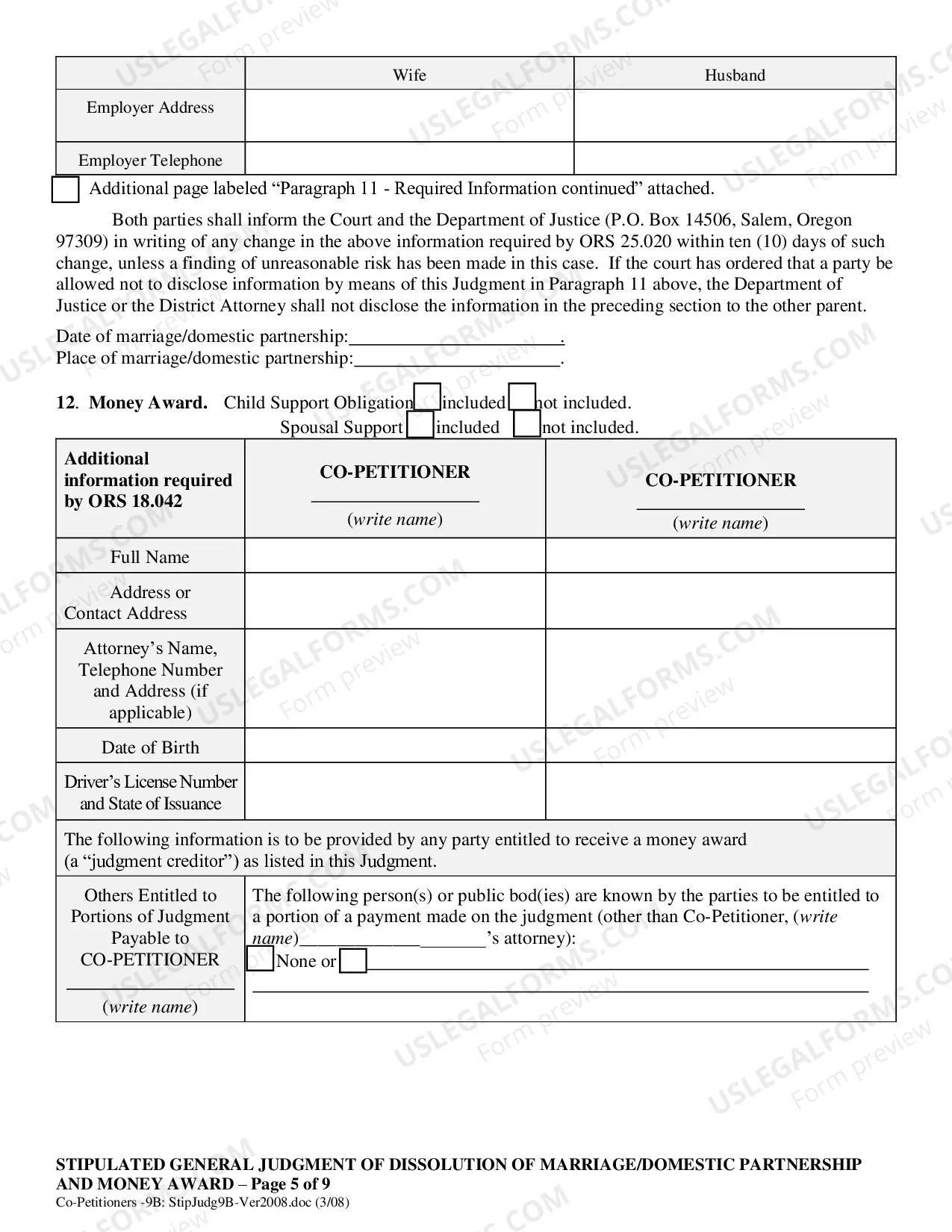
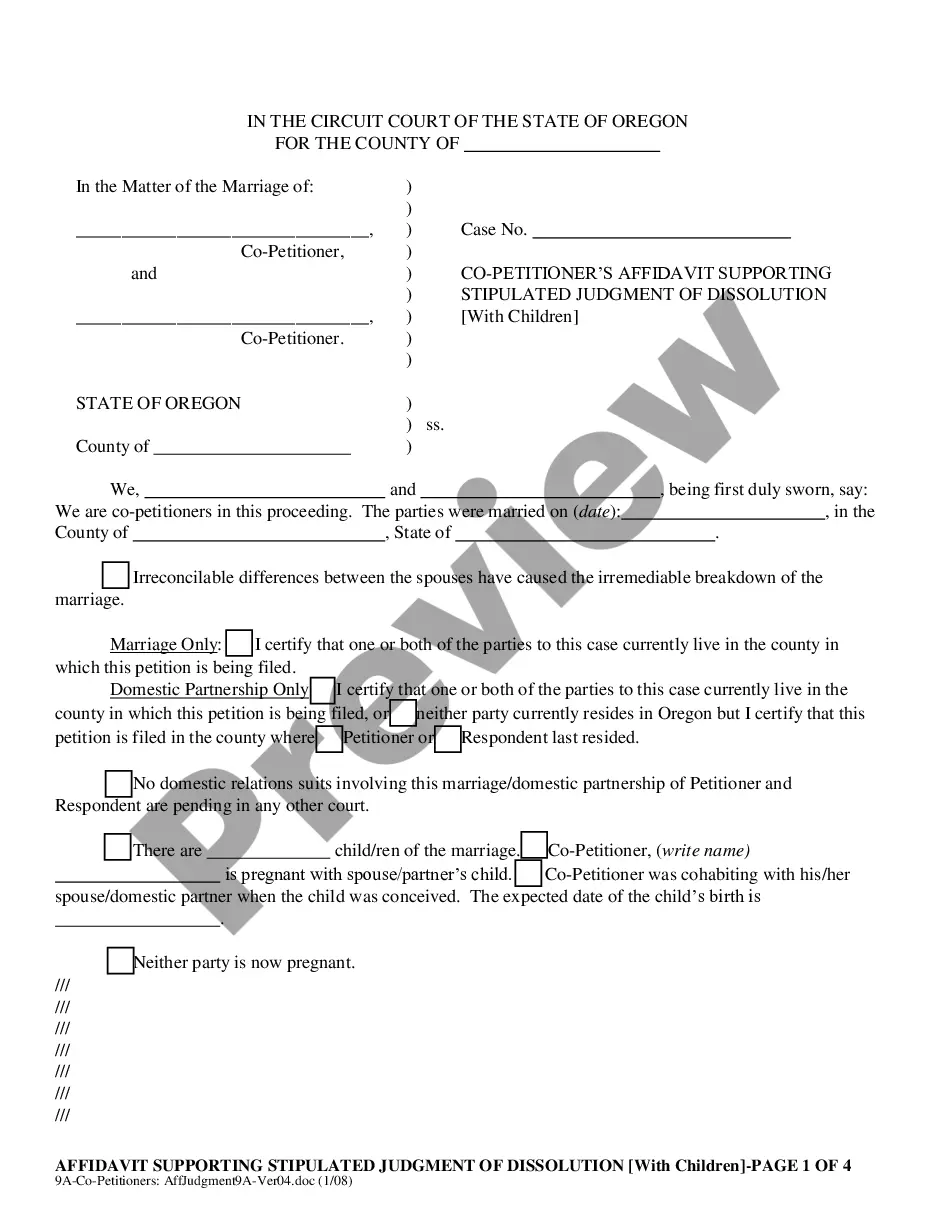
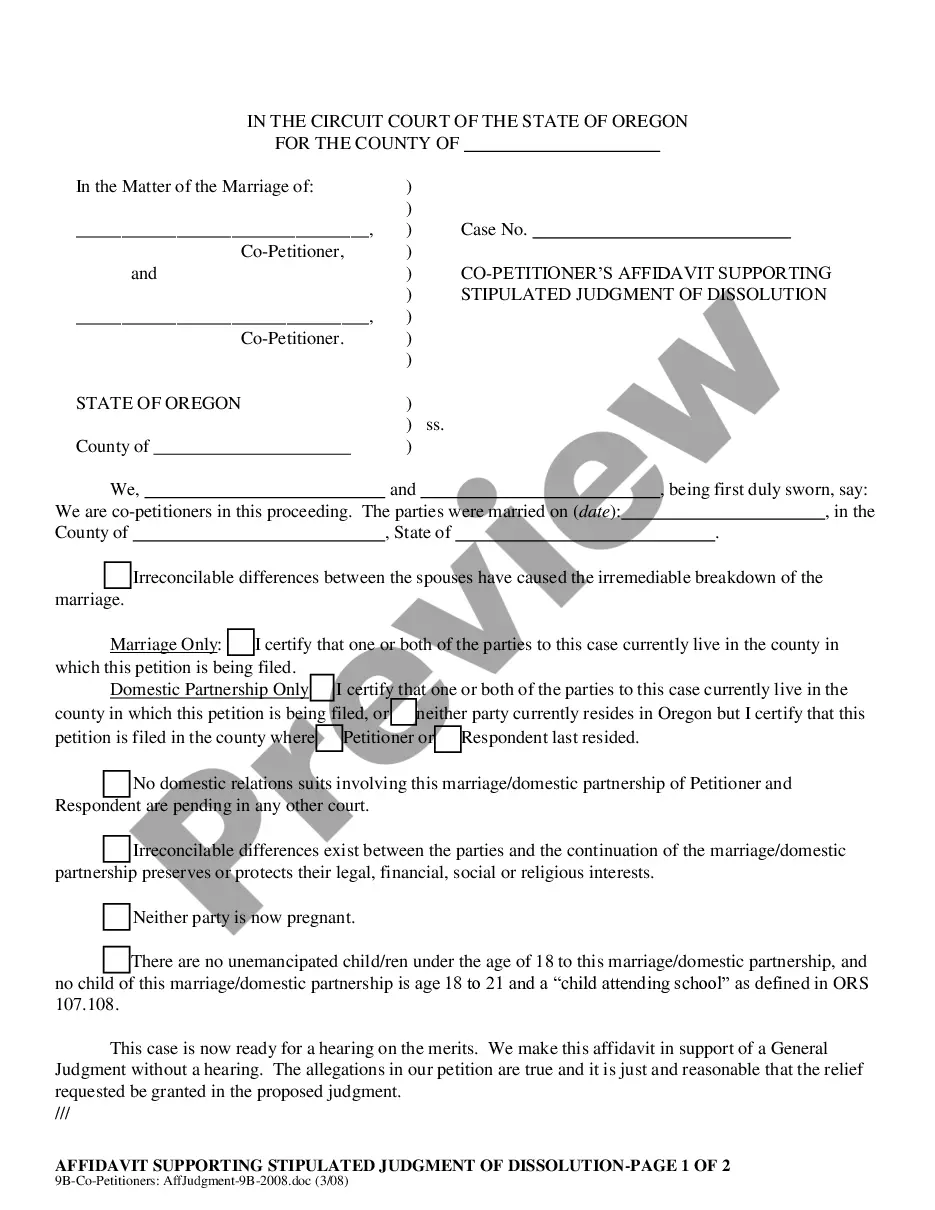
- Confirmation of residency requirements for filing.
- Acknowledgment of irreconcilable differences as grounds for dissolution.
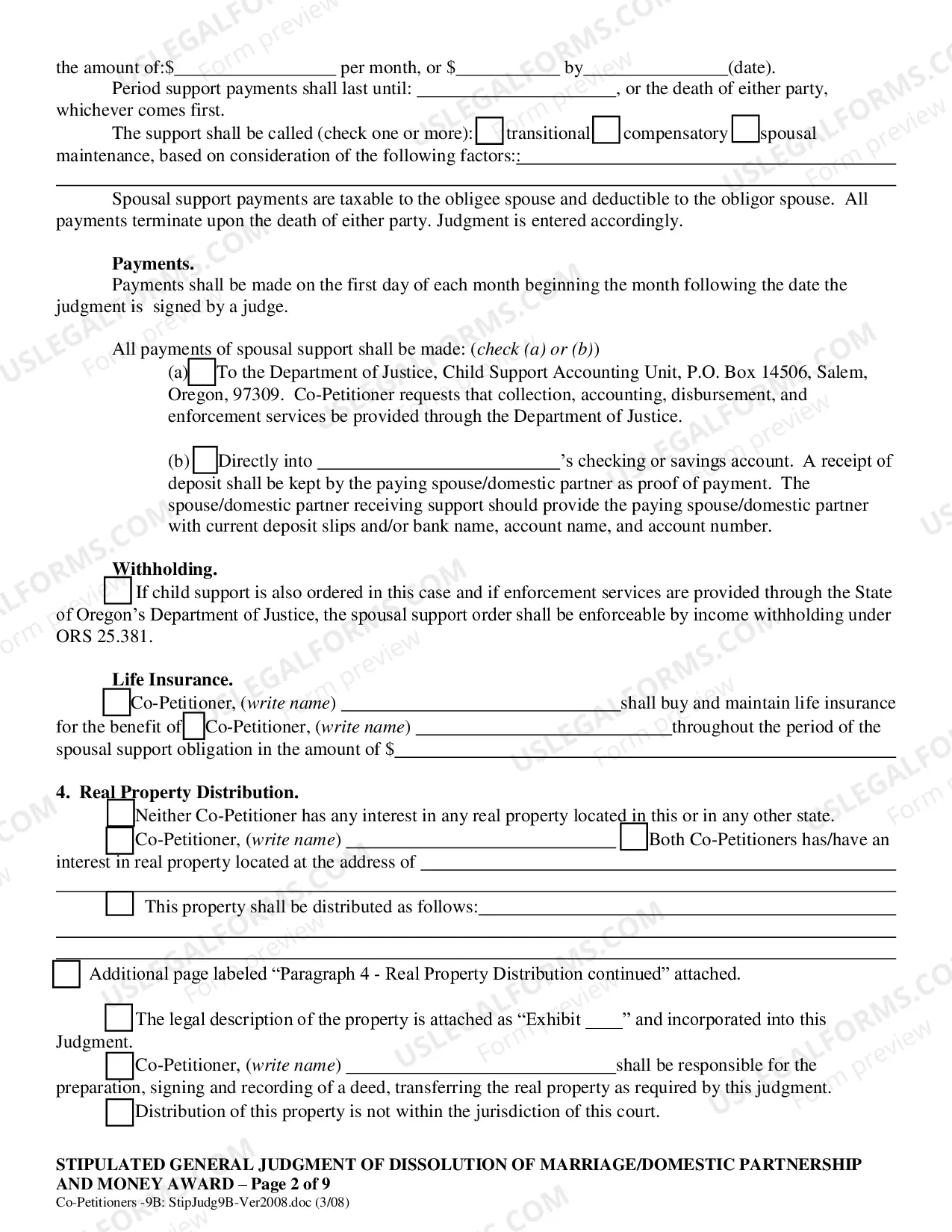
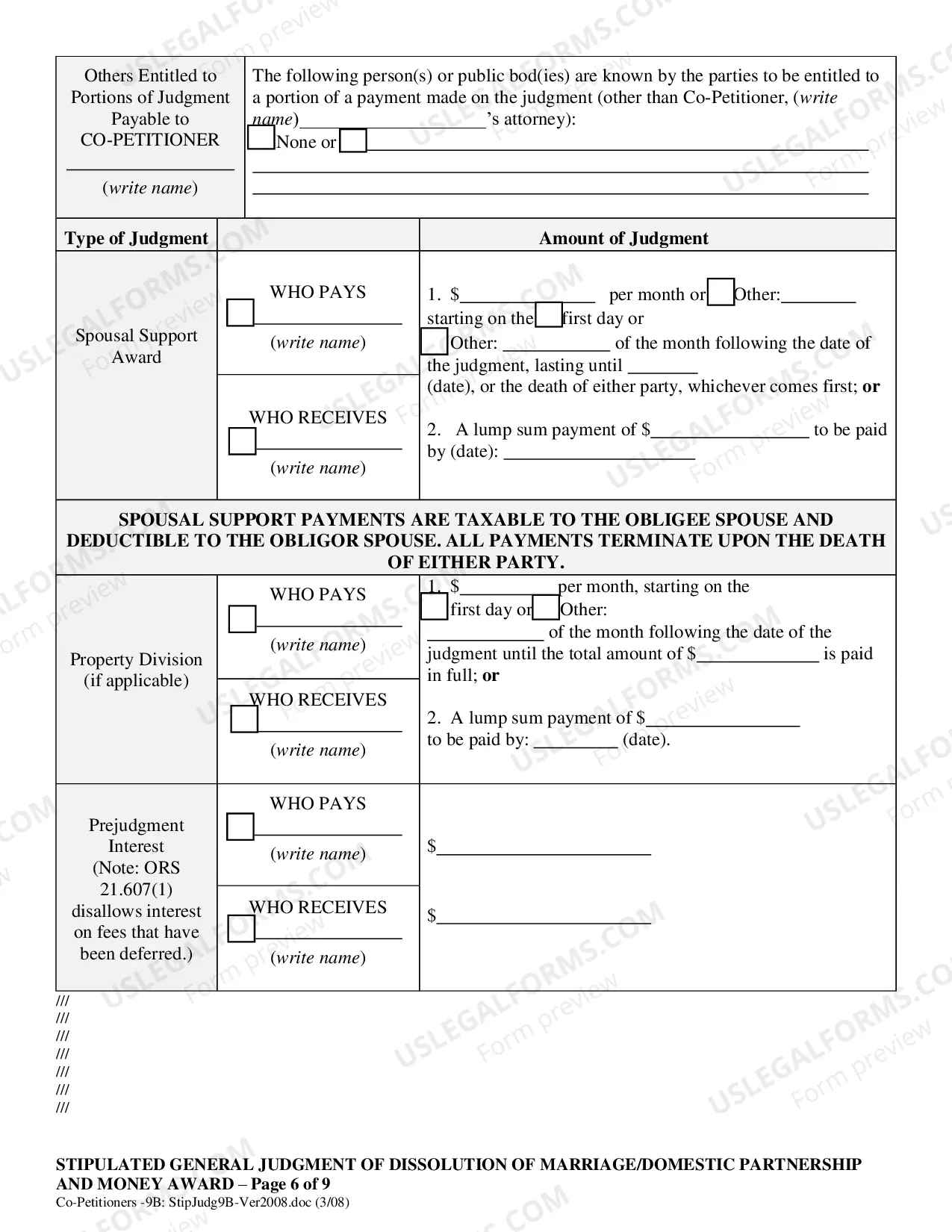
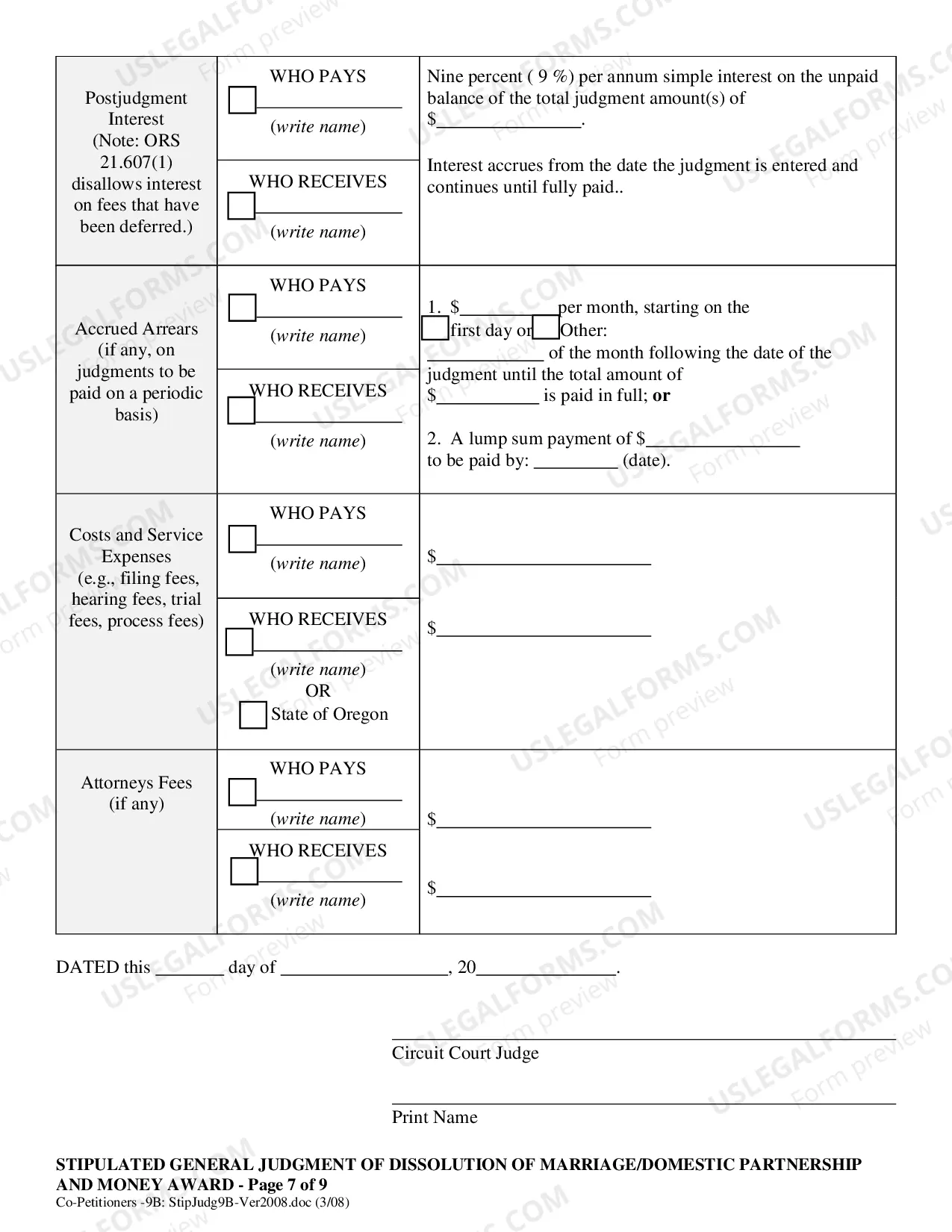
- Provisions for spousal support, including amount and duration.
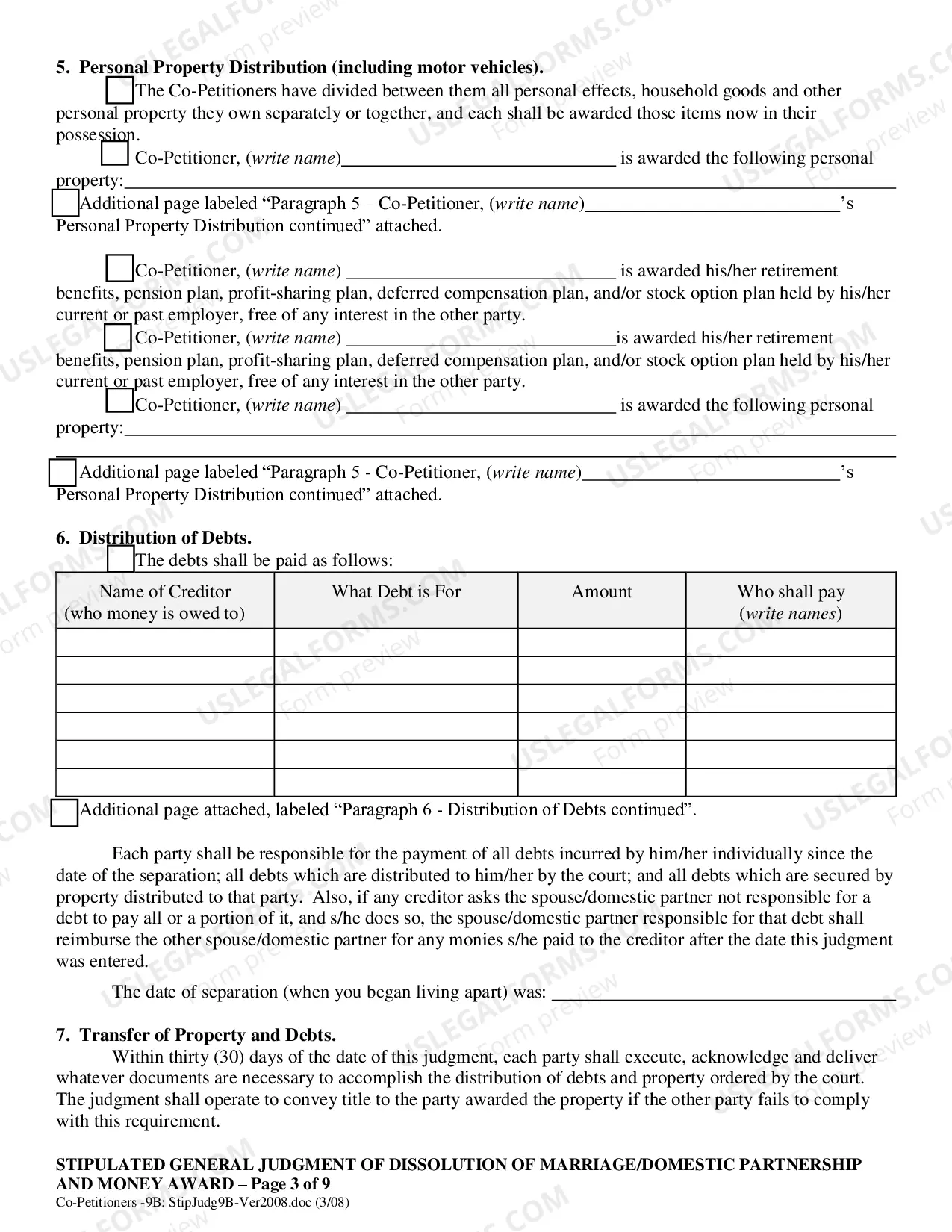
- Specifications regarding the distribution of marital property and debts.
- Restoration of former names, if applicable.


Common use cases
This form should be used when both parties in a marriage or domestic partnership agree to the terms of their separation and wish to formalize their divorce without going to court. It is suitable for situations where there are no minor children involved and both parties have reached an agreement regarding support and distribution of assets and debts.
Who needs this form
- Couples seeking a mutual agreement on the terms of their divorce.
- Individuals filing for dissolution where no minor children are present.
- Parties who have mutually agreed on the division of assets and liabilities.
- Those who require a formal and legally binding judgment for their separation.
Steps to complete this form
- Identify the names and case number of both co-petitioners at the top of the form.
- Check the appropriate boxes to confirm residency and grounds for dissolution.
- Fill in details regarding spousal support, including payment amounts and duration.
- Clearly specify the division of any marital property and debts.
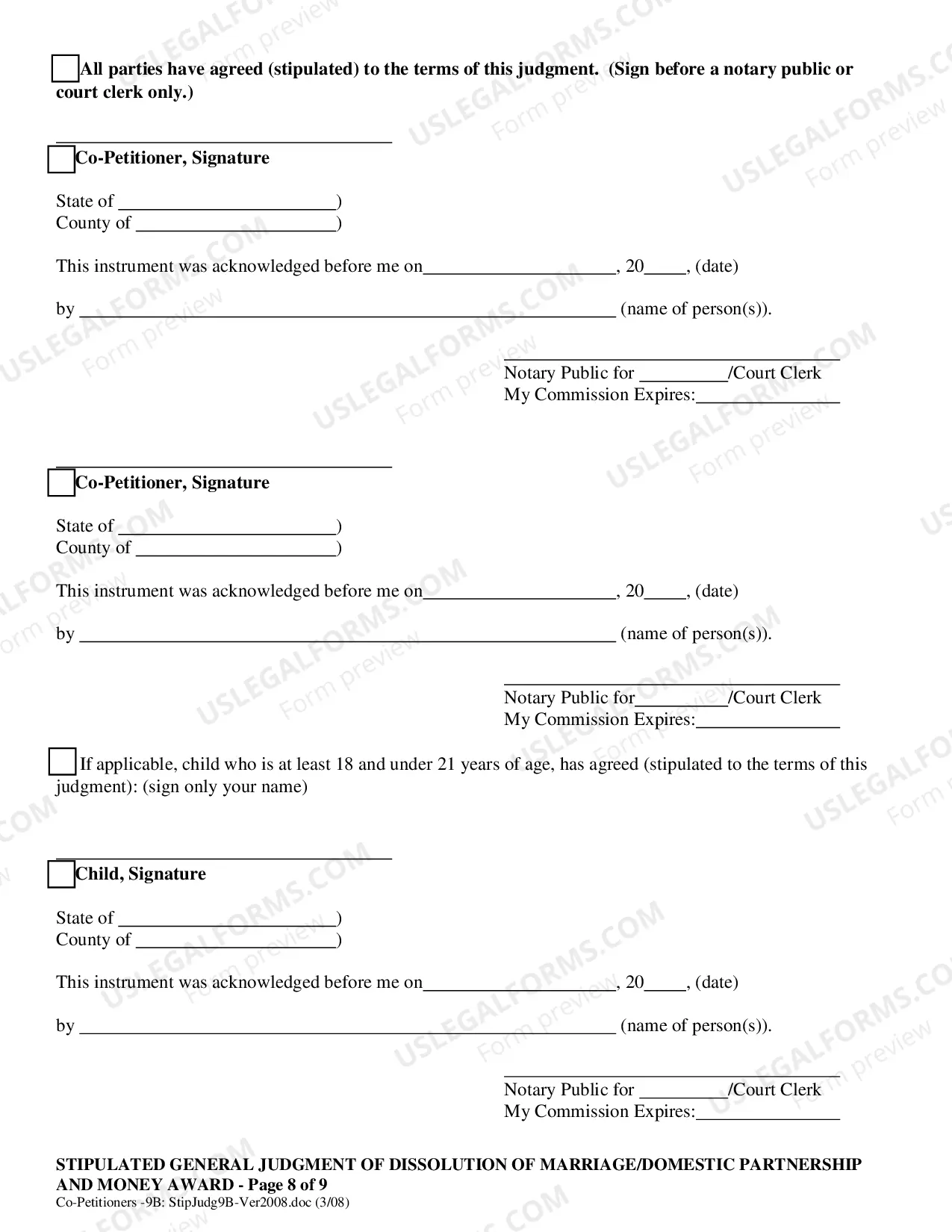
- Sign the document in front of a notary public or court clerk as needed.
Is notarization required?
Yes, this form must be notarized to be legally valid. Using US Legal Forms, you can take advantage of integrated online notarization services, available 24/7 via secure video call. This eliminates the need for travel while ensuring that your document meets all legal requirements.
Get your form ready online
Our built-in tools help you complete, sign, share, and store your documents in one place.
Make edits, fill in missing information, and update formatting in US Legal Forms—just like you would in MS Word.
Download a copy, print it, send it by email, or mail it via USPS—whatever works best for your next step.
Sign and collect signatures with our SignNow integration. Send to multiple recipients, set reminders, and more. Go Premium to unlock E-Sign.
If this form requires notarization, complete it online through a secure video call—no need to meet a notary in person or wait for an appointment.
We protect your documents and personal data by following strict security and privacy standards.

Make edits, fill in missing information, and update formatting in US Legal Forms—just like you would in MS Word.

Download a copy, print it, send it by email, or mail it via USPS—whatever works best for your next step.

Sign and collect signatures with our SignNow integration. Send to multiple recipients, set reminders, and more. Go Premium to unlock E-Sign.

If this form requires notarization, complete it online through a secure video call—no need to meet a notary in person or wait for an appointment.

We protect your documents and personal data by following strict security and privacy standards.
Common mistakes
- Failing to check residency and grounds for dissolution boxes correctly.
- Neglecting to provide complete information for property and debt distribution.
- Forgetting to sign the document or have it properly notarized.
- Not clearly specifying the terms of spousal support or their duration.
Benefits of completing this form online
- Convenience of completing the form at your own pace.
- Easy access to downloadable templates designed by licensed attorneys.
- Secure and reliable format for legal documentation.
- Ability to revisit and edit your responses as needed before submission.
Looking for another form?

Form popularity
FAQ
By Default If you do not respond to the Petition in writing within 30 days of receiving it, the petitioner can get an Order of Default. This means that all of the requests in the Petition will be ordered as part of a Judgment without input from you.
After you have gone through all the steps in a divorce, you will get a "General Judgment of Dissolution of Marriage," which is a court order that ends your marriage. The divorce judgment will usually state: The date your marriage ends (this is the date the judge signs the judgment);
In a contested divorce the petitioner (plaintiff) petitions the court for a divorce and respondent (defendant) has to respond. When the petition is jointly filed, the spouses are called Co-Petitioners. The husband and wife petition the court together with paperwork that is signed by both parties.
Will it take me long to get a divorce? An uncontested divorce (where you and your spouse agree about the terms of the divorce) can be final about three months after the divorce petition is filed and delivered to your spouse. You may be able to reduce this time if the judge thinks you have a very good reason.
The term "entry of judgment" refers to a court order being entered after the judge rules on a case. In a divorce case, the judge orders a dissolution of the marriage, property division, child custody and support, visitation schedules, spousal support, attorney's fees and any other pertinent issues.
Divorce Terms When a Case is in Default Because the other spouse has chosen not to participate, no one is there to challenge the petitioner's demands. Property division, child custody, spousal maintenance, and other divorce issues will be decided solely by the petitioner. Default judgments are considered final.
A summary dissolution is an uncontested divorce which allows couples to end their marriage without ever appearing in court. Summary dissolution is a streamlined option, but is available only to couples who satisfy the following requirements: one or both spouses have lived in Oregon for the past six months.
A Notice of Entry of Judgment & Decree of Divorce (Default) is a document that notifies the other party that the Judge has signed a Judgment & Decree of Divorce (Default). This document must be sent to the other party and the Affidavit of Service filed with the Clerk of Courts.