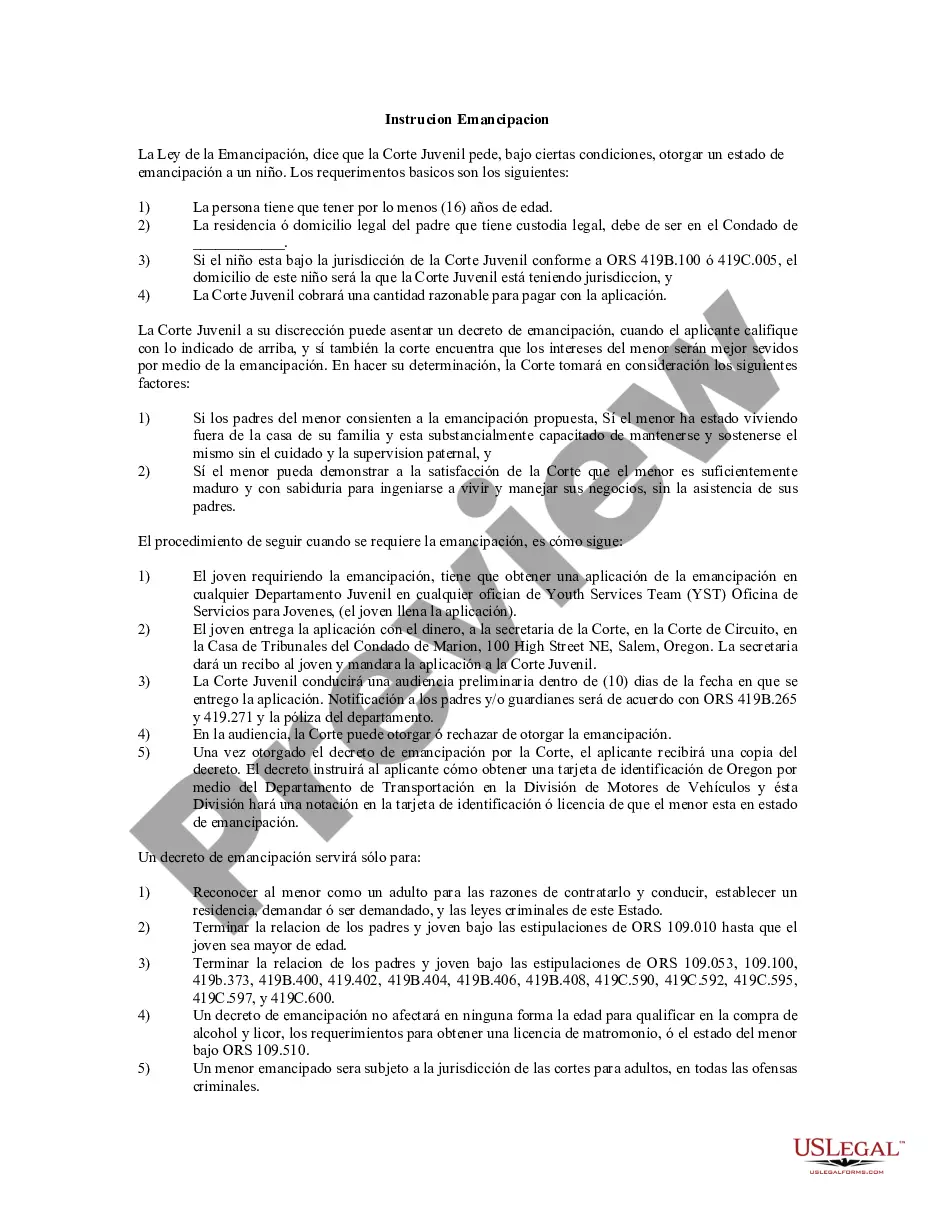
Oregon Emancipation Information - Espanol
Overview of this form
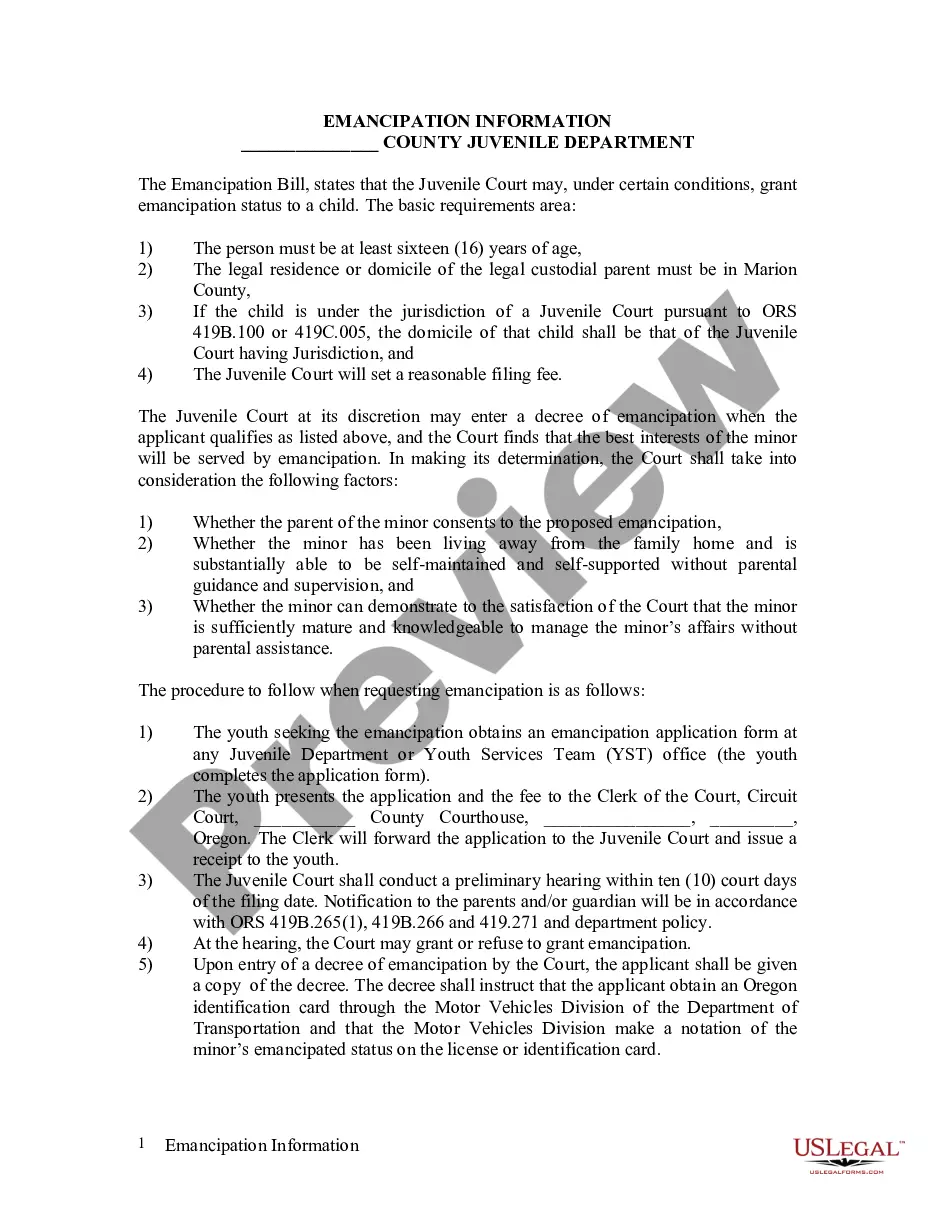
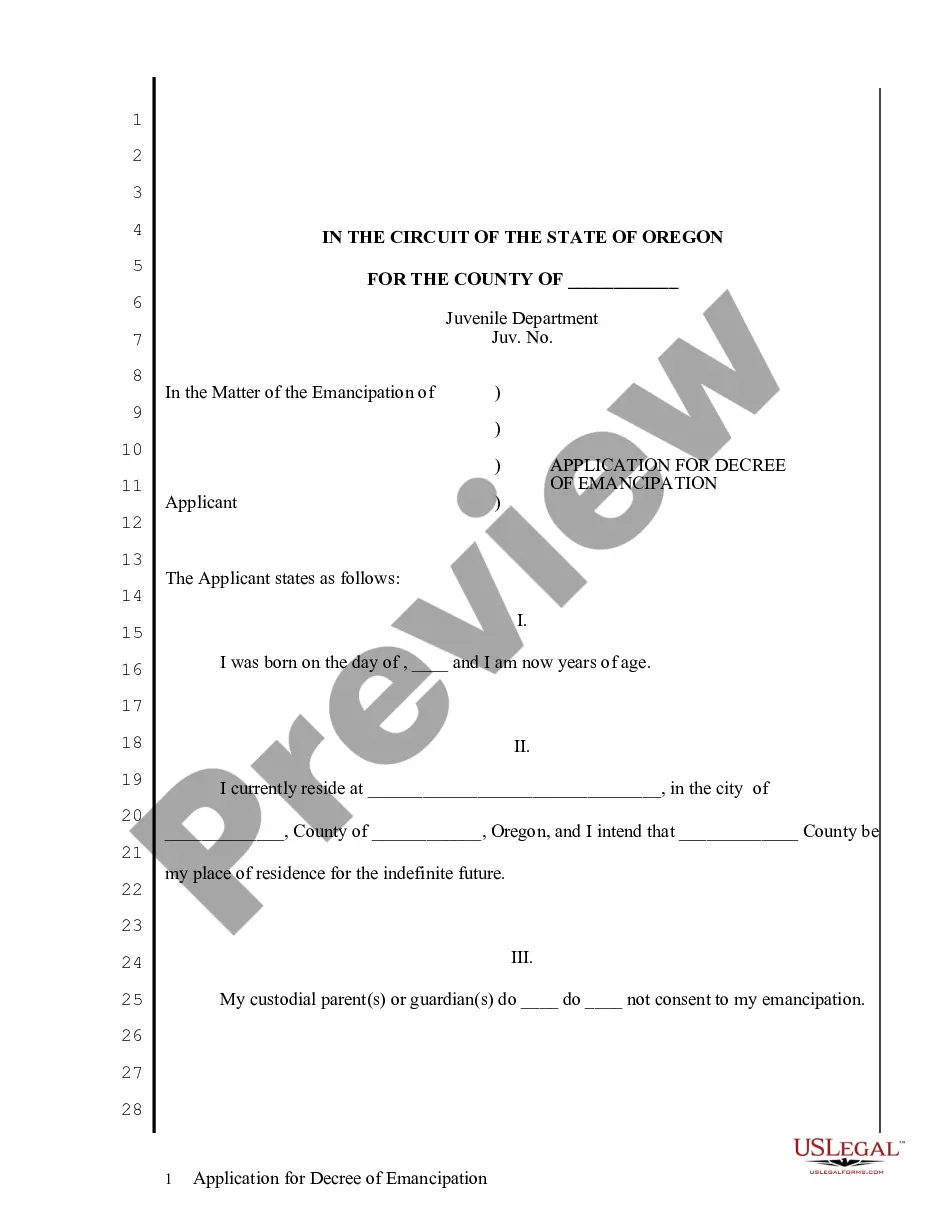
The Emancipation Information - Espanol form is a legal document designed for use in Oregon, specifically for minors seeking emancipation. This form outlines the criteria and process for a minor, aged 16 or older, to attain legal independence from parental control. It differentiates from other legal forms as it is specifically tailored for juveniles and outlines the necessary steps to apply for emancipation in Oregonâs juvenile court system.
What’s included in this form
- Age requirement: The applicant must be at least 16 years old.
- Residency: The legal residence of the custodial parent must be in the specified Oregon county.
- Jurisdiction: Considerations for minors currently under juvenile court jurisdiction.
- Application fee: A reasonable fee may be required to submit the application.
- Court hearing: Details concerning the preliminary hearing and possible outcomes.


When to use this document
This form should be used when a minor in Oregon wishes to become emancipated from parental control. This legal transition allows the minor to manage their affairs independently, which may be necessary in situations where the minor is ready to live independently, has been living apart from their family, or requires the ability to make legal contracts, such as renting accommodations or signing employment agreements.
Who can use this document
Eligibility criteria include:
- Minors aged 16 years or older wishing for emancipation.
- Minors not currently residing under the direct supervision of their parents.
- Individuals who believe they can financially support themselves without parental guidance.
Steps to complete this form
- Obtain the Emancipation Information - Espanol application from a local Youth Services Team office.
- Complete the application with accurate personal details and ensure all required fields are filled.
- Submit the completed application along with any applicable fees to the clerk at the Circuit Court in Marion County.
- Receive a receipt from the court clerk and confirmation that your application has been forwarded to the juvenile court.
- Prepare for the preliminary hearing, where your emancipation request will be reviewed.
Notarization guidance
In most cases, this form does not require notarization. However, some jurisdictions or signing circumstances might. US Legal Forms offers online notarization powered by Notarize, accessible 24/7 for a quick, remote process.
Get your form ready online
Our built-in tools help you complete, sign, share, and store your documents in one place.
Make edits, fill in missing information, and update formatting in US Legal Forms—just like you would in MS Word.
Download a copy, print it, send it by email, or mail it via USPS—whatever works best for your next step.
Sign and collect signatures with our SignNow integration. Send to multiple recipients, set reminders, and more. Go Premium to unlock E-Sign.
If this form requires notarization, complete it online through a secure video call—no need to meet a notary in person or wait for an appointment.
We protect your documents and personal data by following strict security and privacy standards.

Make edits, fill in missing information, and update formatting in US Legal Forms—just like you would in MS Word.

Download a copy, print it, send it by email, or mail it via USPS—whatever works best for your next step.

Sign and collect signatures with our SignNow integration. Send to multiple recipients, set reminders, and more. Go Premium to unlock E-Sign.

If this form requires notarization, complete it online through a secure video call—no need to meet a notary in person or wait for an appointment.

We protect your documents and personal data by following strict security and privacy standards.
Mistakes to watch out for
- Forgetting to check the age requirementâapplicants must be at least 16 years old.
- Not confirming residency of the custodial parent in the correct Oregon county.
- Failing to submit the application with the required fee.
- Neglecting to inform parents or guardians as required by law.
- Not preparing adequately for the court hearing.
Advantages of online completion
- Convenience of accessing and completing the form at any time.
- Editability allows for easy corrections before submission.
- Access to templates drafted by licensed attorneys ensuring compliance with legal standards.
Legal use & context
- The form serves to legally recognize a minor as an adult in certain situations, like employment, residency, and contract engagements.
- It establishes an independent legal status, terminating the typical parent-child legal relationship as defined under Oregon statutes.
- Consultation with a lawyer is recommended to navigate the process effectively.
What to keep in mind
- The Emancipation Information - Español form is essential for minors in Oregon seeking independence.
- Understanding eligibility, application procedures, and legal implications is crucial before filing.
- Engagement in the process requires attentiveness to deadlines and requirements set by the juvenile court.
Looking for another form?

Form popularity
FAQ
There is a Court filing fee of $252.00 (non-refundable if emancipation is denied) payable to the State of Oregon Circuit Court. Circuit Court conducts a preliminary hearing that must be scheduled within 15 days of the minor's application.
Oregon law provides that the Juvenile Court may, under certain conditions, grant emancipation status to a child. The basic requirements are: 1. The person must be sixteen (16) or seventeen (17) years of age, 2.
As long as a child is under eighteen years of age, parents cannot legally abandon their responsibilities to them by forcing them out of the home. What rights do emancipated minors have? Emancipated minors do not have to obey their parents. They also do not have to obey curfew laws.
Emancipation in Oregon is allowed by ORS 419B. 552 and ORS 419B. 558. Emancipation is a legal mechanism to have a child 16 years of age or older declared an adult for most purposes.
According to State law, in order to be eligible to apply for emancipation, you need to meet the following requirements: You must be 16 years of age or older. The legal residence of the custodial parent must be in Polk County.
According to State law, in order to be eligible to apply for emancipation, you need to meet the following requirements: You must be 16 years of age or older. The legal residence of the custodial parent must be in Polk County.
An applicant must be at least 16 years of age and domiciled in this county. An applicant must pay a $281 filing fee at the time the completed application is submitted for consideration. You must pay the filing fee whether or not the Judge grants a Decree of Emancipation.
1 attorney answer If your parents agree, you can live wherever you like. But if they do not, you must continue to live with them. If you leave home without their consent, they can report you missing and you could be returned home by law enforcement, or...