Oregon Request for Hearing regarding Statutory Restraining Order
Understanding this form
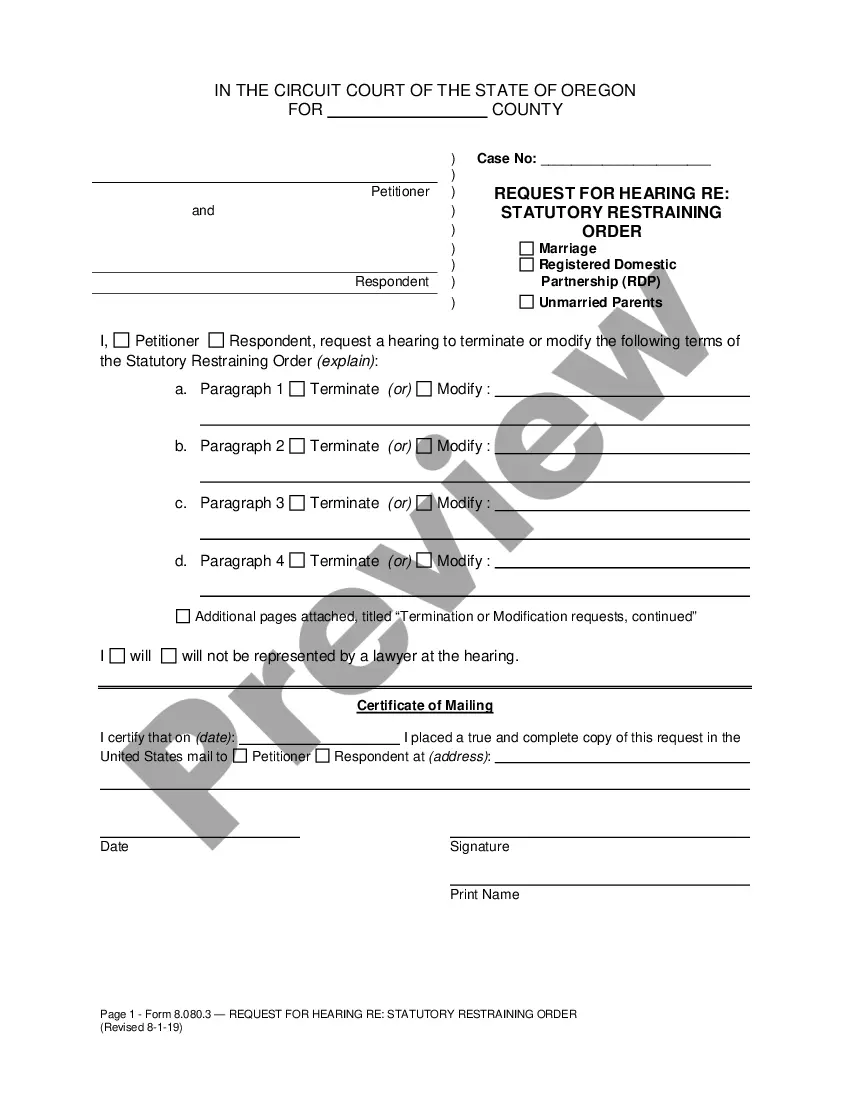
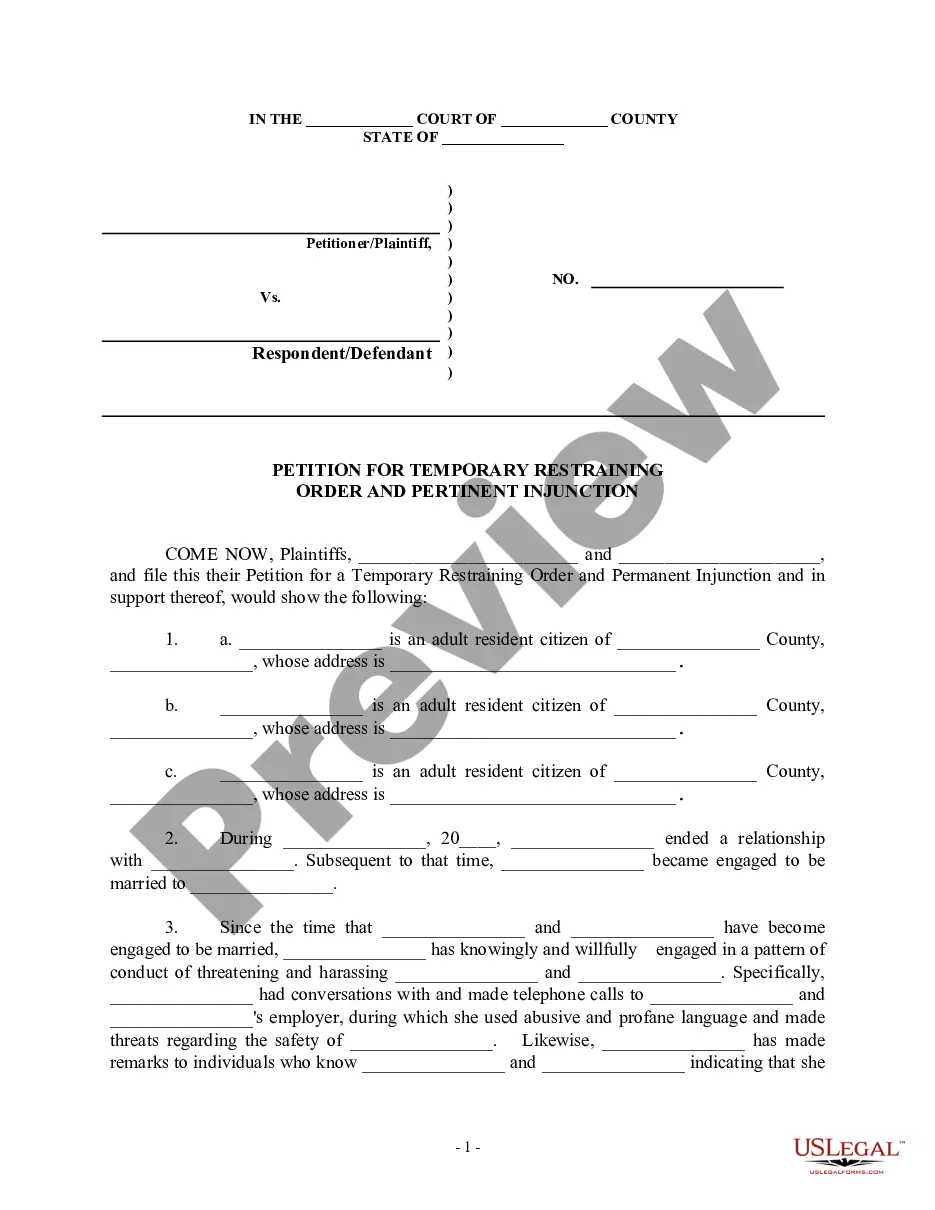
The Request for Hearing regarding Statutory Restraining Order is a legal document used to ask the court for a hearing to either modify or terminate an existing statutory restraining order. This form is specifically designed for cases where individuals seek to make changes to the terms of an order already in place, ensuring that their legal rights and circumstances are appropriately addressed in court.
Form components explained
- Identification of parties involved: Clearly states the petitioner and respondent.
- Case number: Space to enter the relevant court case number.
- Request details: Sections to specify which paragraph(s) of the restraining order you wish to terminate or modify.
- Representation: Indicates whether the petitioner will be represented by an attorney during the hearing.
- Certificate of mailing: Confirms that a copy of the request has been sent to the other party.
When this form is needed
This form should be used when you need to make changes to a statutory restraining order. Common scenarios include when the situation has changed significantly, necessitating modification of the existing order, or if you believe grounds exist for completely terminating the order. It is essential to initiate this process if you wish to protect your rights or respond to any changes in circumstances.
Who this form is for
- Individuals who are parties to a statutory restraining order.
- Petitioners seeking to modify or terminate the terms of an existing order.
- Respondents who wish to contest or adjust the stipulations of a restraining order.
Steps to complete this form
- Identify the parties involved by entering the names of the petitioner and respondent.
- Fill in the case number as assigned by the court.
- Specify which paragraphs of the restraining order you want to modify or terminate along with the reasons.
- Indicate whether you will be represented by a lawyer at the hearing.
- Complete the certificate of mailing by entering the date and the respondent's address.
Notarization requirements for this form
This form does not typically require notarization unless specified by local law.
Get your form ready online
Our built-in tools help you complete, sign, share, and store your documents in one place.
Make edits, fill in missing information, and update formatting in US Legal Forms—just like you would in MS Word.
Download a copy, print it, send it by email, or mail it via USPS—whatever works best for your next step.
Sign and collect signatures with our SignNow integration. Send to multiple recipients, set reminders, and more. Go Premium to unlock E-Sign.
If this form requires notarization, complete it online through a secure video call—no need to meet a notary in person or wait for an appointment.
We protect your documents and personal data by following strict security and privacy standards.

Make edits, fill in missing information, and update formatting in US Legal Forms—just like you would in MS Word.

Download a copy, print it, send it by email, or mail it via USPS—whatever works best for your next step.

Sign and collect signatures with our SignNow integration. Send to multiple recipients, set reminders, and more. Go Premium to unlock E-Sign.

If this form requires notarization, complete it online through a secure video call—no need to meet a notary in person or wait for an appointment.

We protect your documents and personal data by following strict security and privacy standards.
Avoid these common issues
- Failing to specify the exact paragraphs being modified or terminated.
- Not providing complete information about the parties involved.
- Missing the certificate of mailing or not following proper mailing procedures.
Advantages of online completion
- Convenient access to legal forms anytime and anywhere.
- Edit and customize your form easily before download.
- Forms are drafted to meet legal requirements, ensuring reliability.
Key takeaways
- The Request for Hearing regarding Statutory Restraining Order is critical for seeking modification or annulment of a restraining order.
- Ensure all information is accurate to avoid delays in the hearing process.
- Understand the legal implications of your requests and consider seeking legal advice if necessary.
Looking for another form?
Form popularity
FAQ
The court is looking for a description of your relationship to the respondent, when, where, what happened, and who did what to whom. Using the facts of the incident only, keep your statement brief and to the point. Briefly describe the most recent incident of abuse and/or threats of abuse or other behaviors.
You cannot drop the charges, but as long as the judge believes that you are not being forced or coerced into dropping the No Contact order, he/she should drop it. Just go to the court that put the order in effect and ask the Clerk's office to pull the case and tell them what it is that you are seeking.
In situations where a court issued a restraining order that lack jurisdiction, that order is also invalidated. If this is proven during the trial, you are not bound by such an order. Falsely accused. In case you are falsely accused of violating a restraining order, a defense attorney can clear you of all the charges.
There are typically two reasons for a denied restraining order petition: Petitioner did not establish a claim for relief. Petitioner did not appear at the time set for the ex parte hearing on the petition.
You can fill out and file a Response to Request for Civil Harassment Restraining Orders (Form CH-120. ) where you tell the judge your side of the story about what happened. Even if you do not file a Response, GO TO YOUR HEARING!
If a Judge hears from an individual about past cases of physical or emotional abuse without a good explanation from the other side, a restraining order can be granted.If the connection between the parties is something else, like neighbors, then the restraining order is a civil one, not domestic violence.