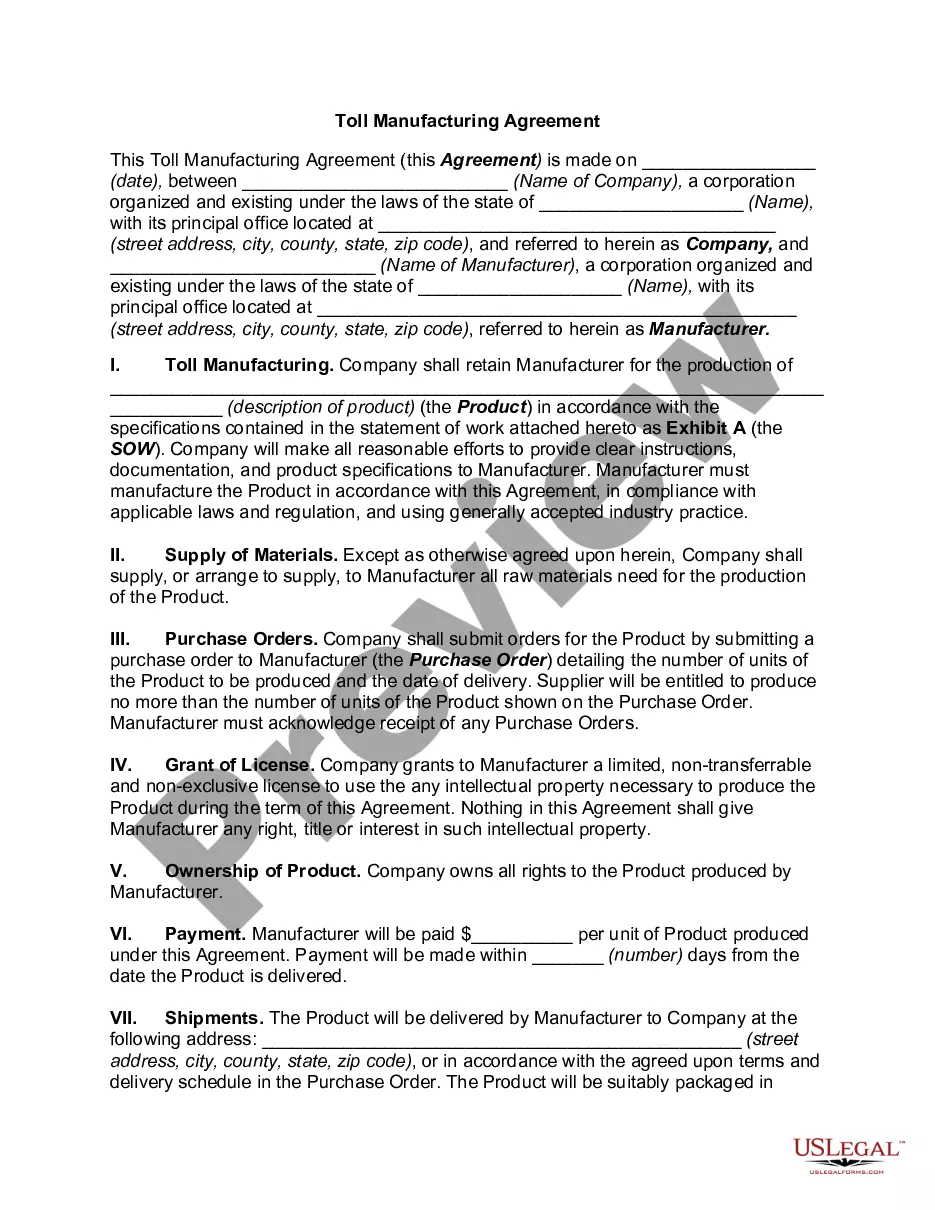
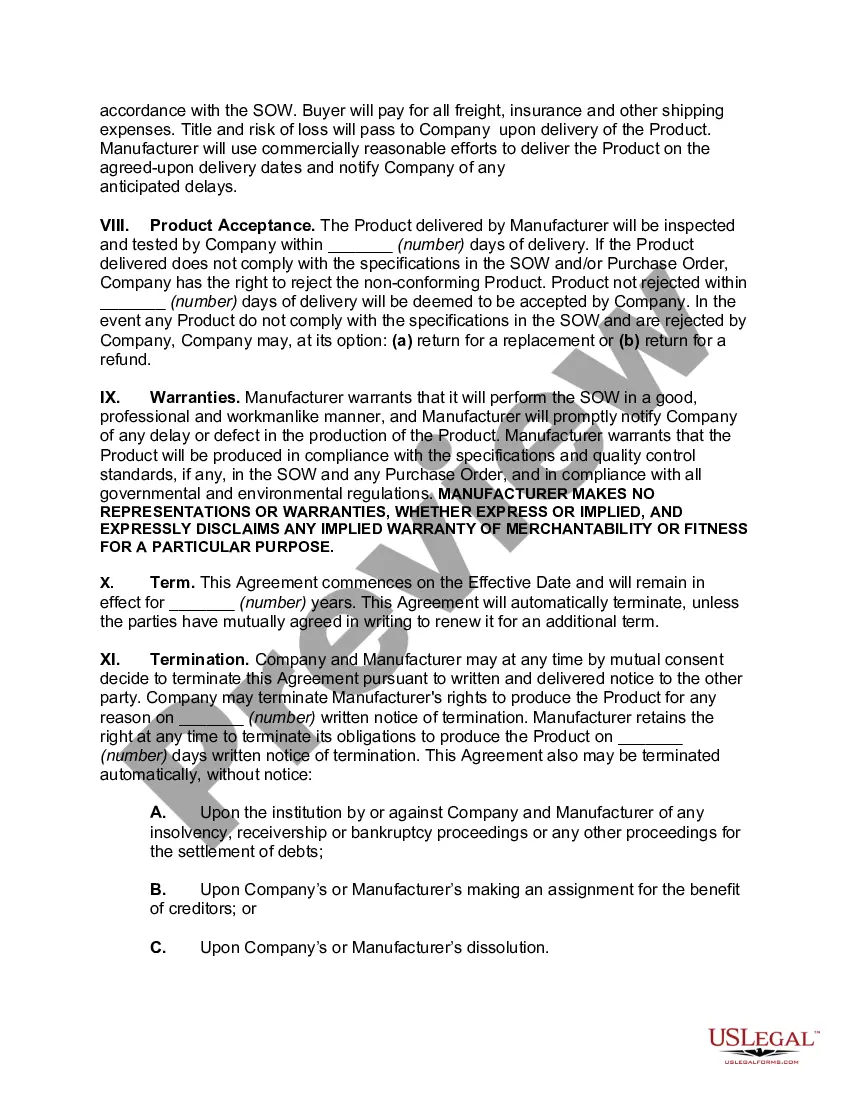
Oklahoma Toll Manufacturing Agreement
Description
Get your form ready online
Our built-in tools help you complete, sign, share, and store your documents in one place.
Make edits, fill in missing information, and update formatting in US Legal Forms—just like you would in MS Word.
Download a copy, print it, send it by email, or mail it via USPS—whatever works best for your next step.
Sign and collect signatures with our SignNow integration. Send to multiple recipients, set reminders, and more. Go Premium to unlock E-Sign.
If this form requires notarization, complete it online through a secure video call—no need to meet a notary in person or wait for an appointment.
We protect your documents and personal data by following strict security and privacy standards.

Make edits, fill in missing information, and update formatting in US Legal Forms—just like you would in MS Word.

Download a copy, print it, send it by email, or mail it via USPS—whatever works best for your next step.

Sign and collect signatures with our SignNow integration. Send to multiple recipients, set reminders, and more. Go Premium to unlock E-Sign.

If this form requires notarization, complete it online through a secure video call—no need to meet a notary in person or wait for an appointment.

We protect your documents and personal data by following strict security and privacy standards.
Looking for another form?








How to fill out Toll Manufacturing Agreement?
US Legal Forms - one of the largest collections of legal documents in the United States - offers a vast selection of legal form templates that you can download or print.
By using the site, you can access thousands of forms for both business and personal use, categorized by type, state, or keywords. You can obtain the latest versions of forms like the Oklahoma Toll Manufacturing Agreement within minutes.
If you already have a monthly subscription, Log In and download the Oklahoma Toll Manufacturing Agreement from the US Legal Forms library. The Download button will appear on every form you view. You can find all previously downloaded forms in the My documents section of your account.
Complete the transaction. Use your credit card or PayPal account to finalize the payment.
Select the format and download the form to your device. Make edits. Fill out, modify, print, and sign the downloaded Oklahoma Toll Manufacturing Agreement. Every template you add to your account has no expiration date and is yours permanently. So, if you wish to download or print another copy, simply go to the My documents section and click on the form you need.
- Make sure you have selected the correct form for your city/state.
- Click the Preview button to review the form's content.
- Check the form details to ensure you have chosen the right one.
- If the form does not match your requirements, use the Search box at the top of the screen to locate the appropriate one.
- If you are satisfied with the form, confirm your selection by clicking the Get now button.
- Then, choose the payment plan you prefer and provide your credentials to register for an account.
Form popularity
FAQ
The main difference between contract and toll manufacturing lies in ownership of the materials. In a contract manufacturing scenario, the manufacturer often purchases the raw materials and owns the final product, transferring that ownership to the hiring company upon completion. In contrast, an Oklahoma Toll Manufacturing Agreement ensures that the client supplies the raw materials, maintaining ownership throughout the production process. Understanding these distinctions can help you make informed decisions about your manufacturing needs.
The toll manufacturing process involves a business that hires another company to produce goods on its behalf, using its own materials and specifications. This agreement allows you to leverage the expertise and facilities of the manufacturer while retaining control over the product quality and ingredients. When engaging in an Oklahoma Toll Manufacturing Agreement, both parties benefit from reduced costs and increased efficiency without the need for large capital investments. This arrangement fosters collaboration and can result in quicker time-to-market for your products.
Tolling fees in manufacturing refer to the costs charged by a manufacturer who processes materials or components on behalf of another company. These fees typically cover production services, labor, and operational expenses incurred during manufacturing. When engaging in an Oklahoma Toll Manufacturing Agreement, parties should clearly define tolling fees to avoid any misunderstandings. This clarity contributes to a smoother partnership and effective resource allocation.
An example of toll manufacturing involves a business that needs a specific product but lacks the facilities to produce it. In this scenario, the business contracts another company, often with accessible manufacturing equipment, to create the product. This arrangement allows the original business to save on operating costs while ensuring quality production. Utilizing an Oklahoma Toll Manufacturing Agreement streamlines this process, ensuring clarity and efficiency.
Toll manufacturing refers to a process where a company provides its production services to another business. In this relationship, the client supplies the raw materials, and the manufacturer processes them to create finished goods. An Oklahoma Toll Manufacturing Agreement formalizes this partnership, ensuring that all parties understand their roles, responsibilities, and the quality standards expected in the production.
Subcontractors and manufacturers play distinct roles in the production process. Manufacturers produce goods from raw materials, while subcontractors often handle specific tasks or components within the production line. Understanding this difference is crucial for establishing clear agreements, such as the Oklahoma Toll Manufacturing Agreement, where responsibilities and expectations are outlined.
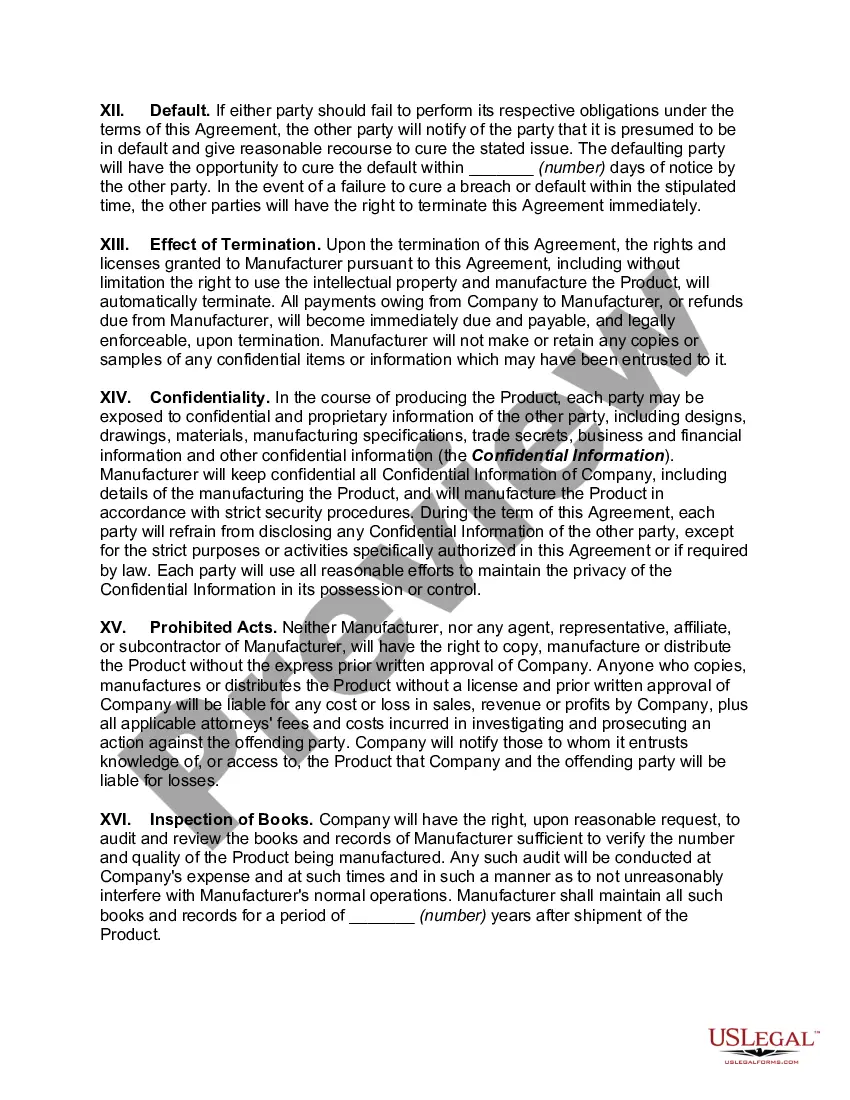
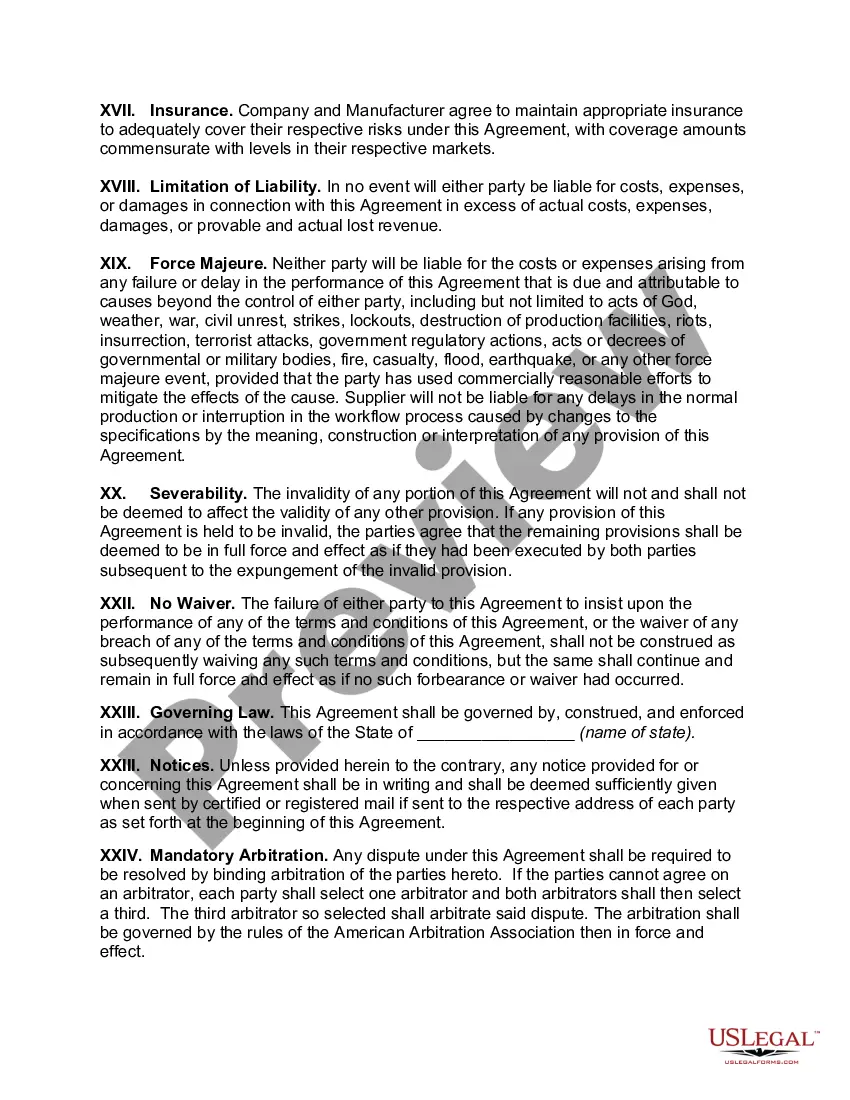
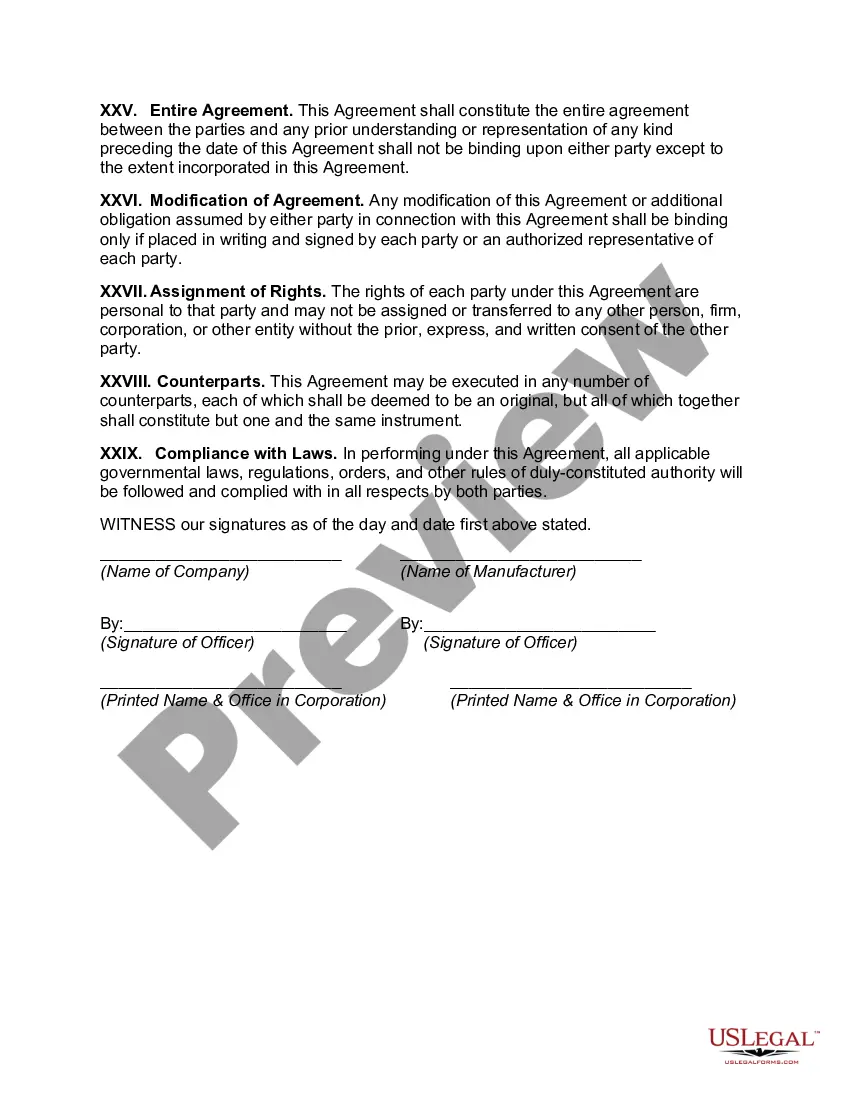
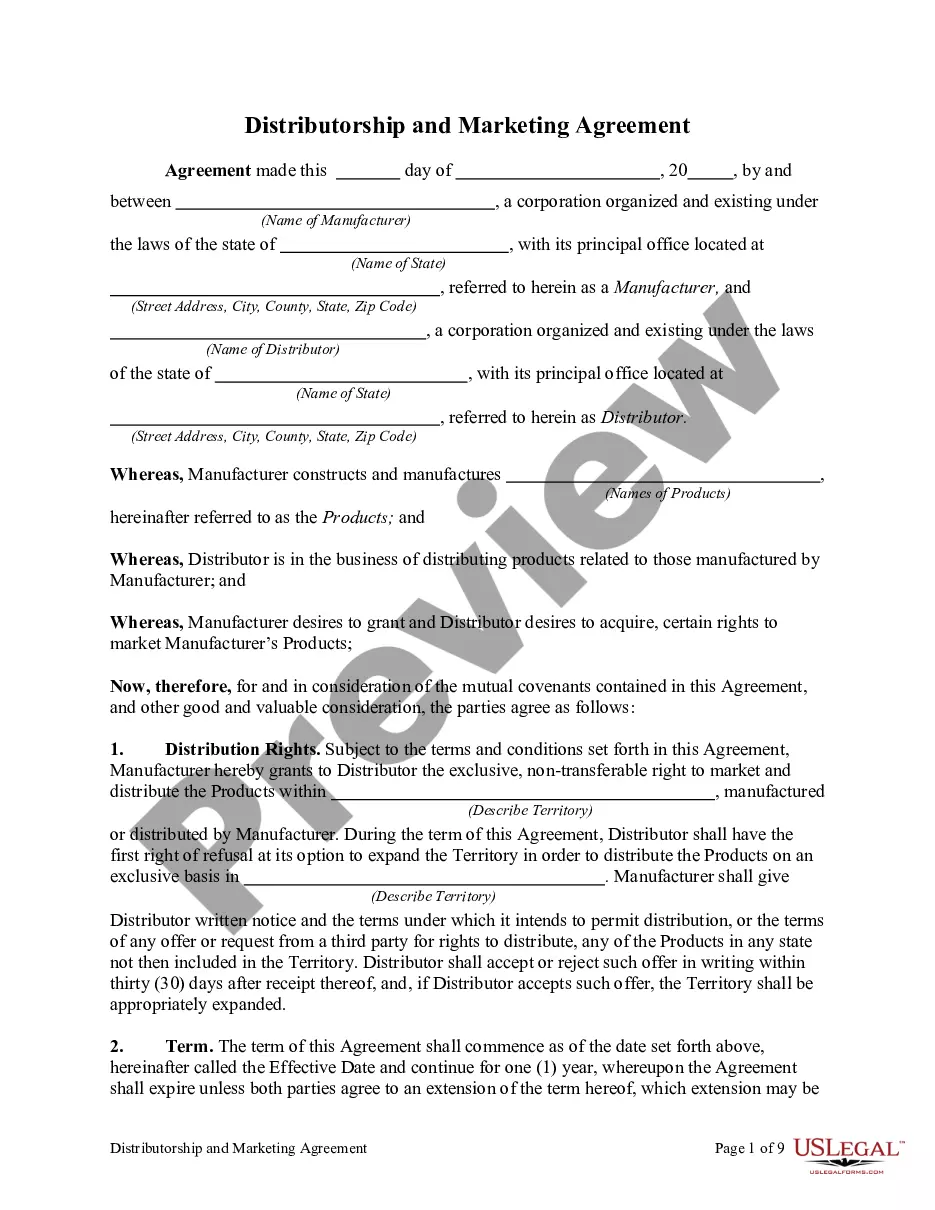
An Oklahoma Toll Manufacturing Agreement is a legal document that outlines the terms under which a manufacturer will process raw materials for a client. This agreement specifies the responsibilities, costs, and quality control measures to be followed. By establishing clear terms, businesses can ensure their materials are handled properly, while leveraging the manufacturer’s expertise for efficient production.
A manufacturer is a company that produces goods, often under its brand, while a contract manufacturer produces products based on another company's designs and specifications. With an Oklahoma Toll Manufacturing Agreement, you can further specify production processes without losing control of your brand. This arrangement provides a collaborative approach, helping businesses meet their production needs effectively.
A tolling manufacturer provides production services for other companies, processing their raw materials according to specific guidelines. This service is defined by an Oklahoma Toll Manufacturing Agreement, which outlines the terms and conditions of the production. Companies choose tolling manufacturers for their expertise and capacity, allowing them to focus on other aspects of their business.
A toll manufacturer processes raw materials for clients without taking ownership of the products, whereas a contract manufacturer typically owns the products it builds and may handle everything from design to delivery. By using an Oklahoma Toll Manufacturing Agreement, companies can maintain tighter control over their supply chain while benefiting from the expertise of the manufacturer. This distinction is vital for businesses looking to optimize production and efficiency.