Oklahoma Instructional Design ADDIE
Description
Get your form ready online
Our built-in tools help you complete, sign, share, and store your documents in one place.
Make edits, fill in missing information, and update formatting in US Legal Forms—just like you would in MS Word.
Download a copy, print it, send it by email, or mail it via USPS—whatever works best for your next step.
Sign and collect signatures with our SignNow integration. Send to multiple recipients, set reminders, and more. Go Premium to unlock E-Sign.
If this form requires notarization, complete it online through a secure video call—no need to meet a notary in person or wait for an appointment.
We protect your documents and personal data by following strict security and privacy standards.

Make edits, fill in missing information, and update formatting in US Legal Forms—just like you would in MS Word.

Download a copy, print it, send it by email, or mail it via USPS—whatever works best for your next step.

Sign and collect signatures with our SignNow integration. Send to multiple recipients, set reminders, and more. Go Premium to unlock E-Sign.

If this form requires notarization, complete it online through a secure video call—no need to meet a notary in person or wait for an appointment.

We protect your documents and personal data by following strict security and privacy standards.
Looking for another form?

How to fill out Instructional Design ADDIE?
You can invest numerous hours online attempting to locate the legal document template that complies with the federal and state standards you require.
US Legal Forms provides thousands of legal forms that are reviewed by experts.
You can conveniently obtain or print the Oklahoma Instructional Design ADDIE with my help.
If available, use the Preview option to review the document template as well.
- If you already possess a US Legal Forms account, you can Log In and then click the Download option.
- Subsequently, you can fill out, modify, print, or sign the Oklahoma Instructional Design ADDIE.
- Every legal document template you purchase is yours permanently.
- To obtain another copy of a purchased form, navigate to the My documents tab and then select the relevant option.
- If you are visiting the US Legal Forms website for the first time, follow the simple instructions below.
- First, ensure you have selected the correct document template for the county/town of your choice.
- Review the form description to confirm that you have selected the right form.
Form popularity
FAQ
The ADDIE model of instructional design includes five essential steps: Analyze, Design, Develop, Implement, and Evaluate. Each step plays a crucial role in creating effective educational experiences. By following these steps, you can ensure that your instructional materials meet the needs of learners, such as those looking for Oklahoma Instructional Design ADDIE resources.
The acronym "ADDIE" stands for Analyze, Design, Develop, Implement, and Evaluate. It is an Instructional Design model that has withstood the test of time and use. It is simply a "device" to help us think through a course's design.
Addie's model consists of Analysis, Design, Development, Implementation and Evaluation. In this research, the researcher develop pocket book for vocabulary using Addie's model as guide. There are 5 stages of Addie's model consists of Analysis, Design, Development, Implementation and Evaluation.
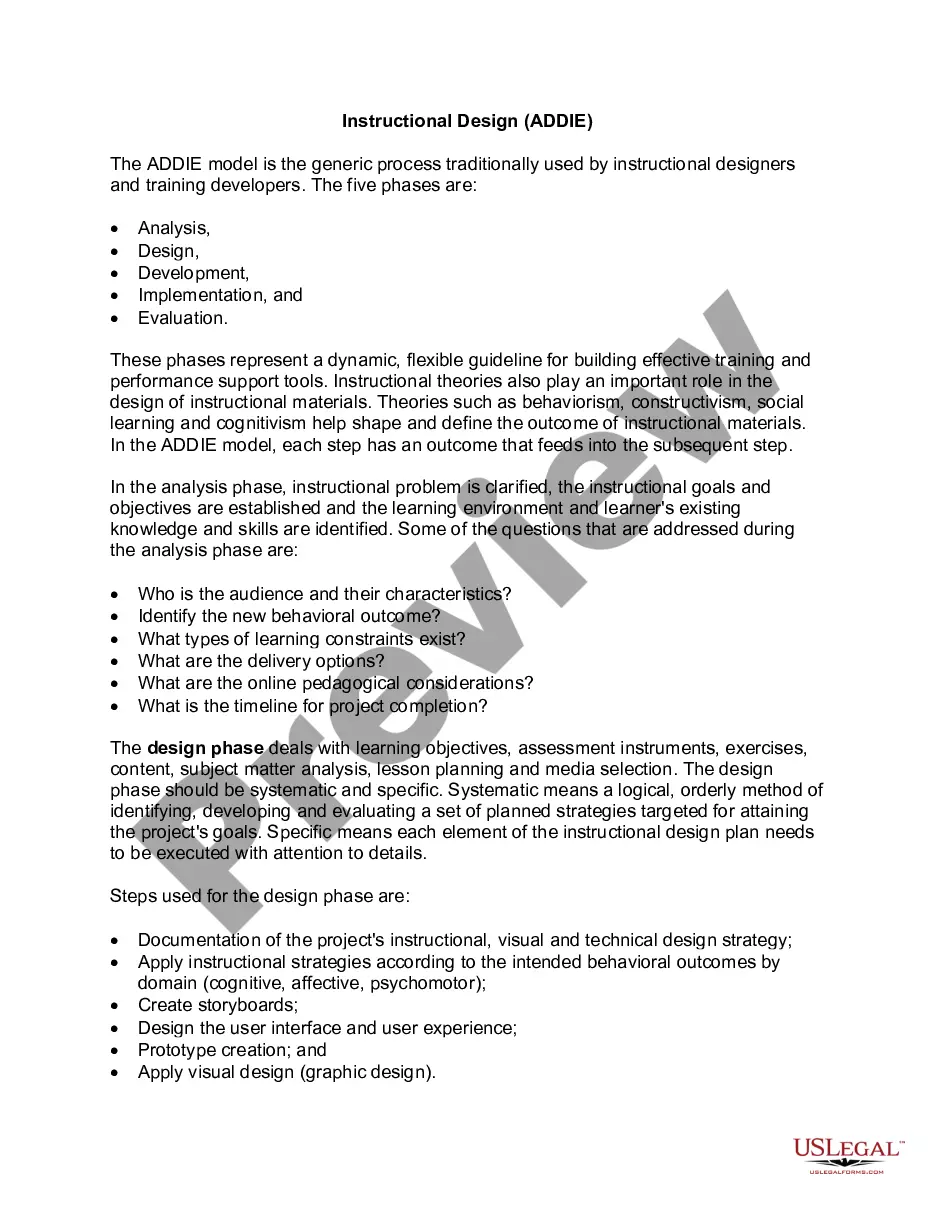
The ADDIE model is the generic process traditionally used by instructional designers and training developers. The five phasesAnalysis, Design, Development, Implementation, and Evaluationrepresent a dynamic, flexible guideline for building effective training and performance support tools.
The term, ADDIE, is an acronym for a five-step process: Analysis, Design, Development, Implementation, and Evaluation. How does the ADDIE model work? An instructional designer follows the five-step ADDIE process to create a training program, eLearning course, or learning materials.
A Quick Guide to Four Instructional Design ModelsADDIE Model.Merrill's Principles of Instruction.Gagne's Nine Events of Instructions.Bloom's Taxonomy.
Instructional design, also known as instructional system design (ISD), is the creation of learning experiences and materials in a manner that results in the acquisition and application of knowledge and skills.
Addie is an acronym for the five stages of a development process: Analysis, Design, Development, Implementation, and Evaluation. The ADDIE model relies on each stage being done in the given order but with a focus on reflection and iteration.
In this post we'll explore the five stages of the ADDIE model of instructional designanalysis, design, development, implementation, and evaluationand how this process can help or hurt your learning evaluation methods.
Stages of the Training Process. Effective training begins well before a trainer delivers an individual training session and continues after that training session is complete. Training can be viewed as a process comprised of five related stages or activities: assessment, motivation, design, delivery, and evaluation.