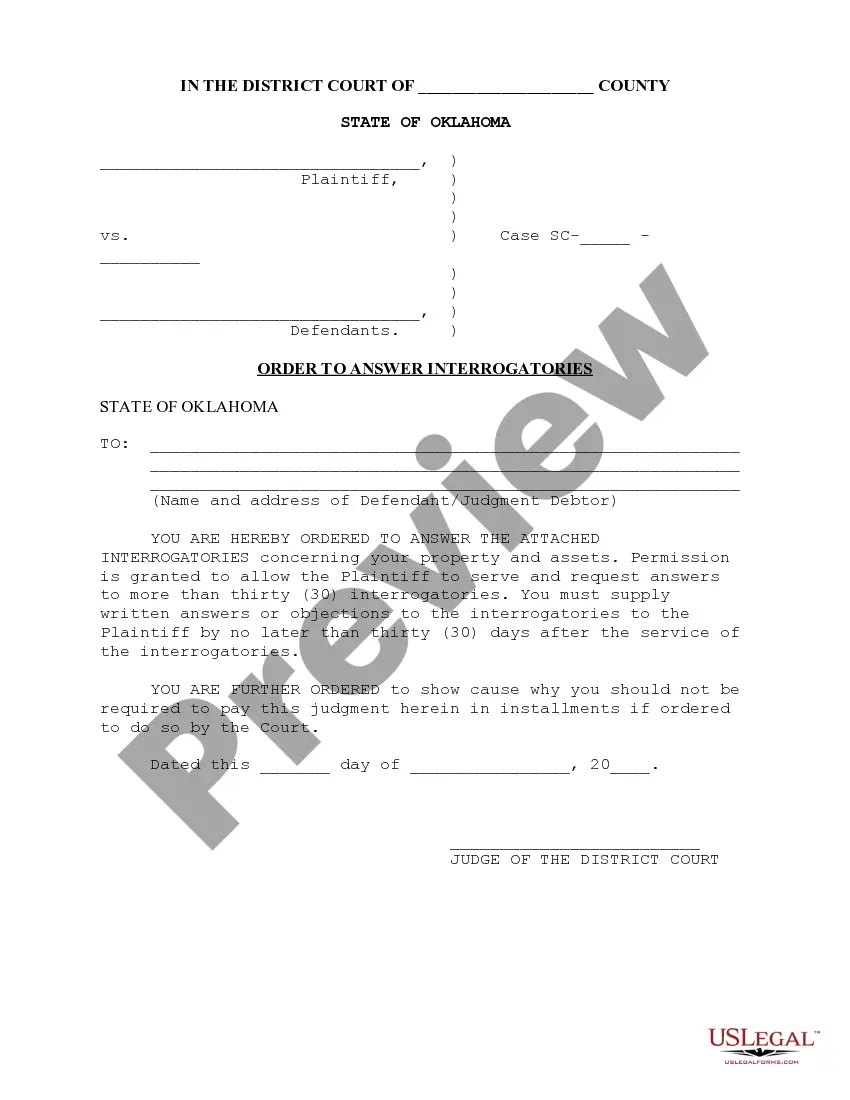
Oklahoma Order to Answer Interrogatories
Understanding this form
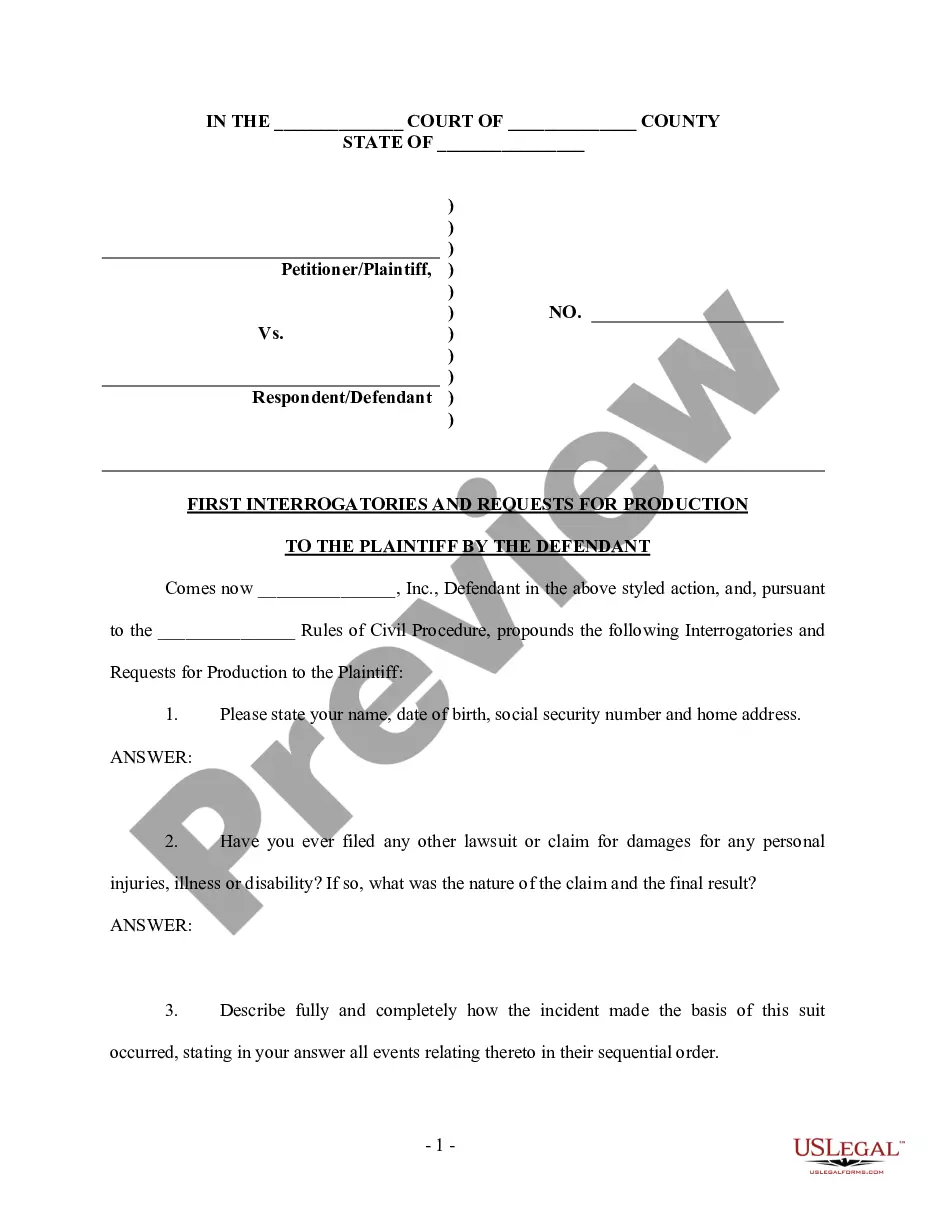
The Order to Answer Interrogatories is a legal document used during the discovery phase of a lawsuit. It compels a defendant to respond to written questions posed by the plaintiff regarding their assets and financial situation. This order is essential for gathering detailed information that can influence the outcome of a case, ensuring transparency and compliance with court procedures.
Main sections of this form
- Title section indicating the parties involved and the case number.
- Statement ordering the defendant to answer specific interrogatories concerning property and assets.
- Deadline for providing written answers, typically within thirty days.
- Provisions allowing the plaintiff to request more than thirty interrogatories if necessary.
- Space for the judge's signature and date of issue.



When to use this form
This form is used when a plaintiff needs more information about a defendant's financial situation during a lawsuit. It is particularly important in cases involving debt recovery, asset disputes, or any scenario where the plaintiff requires detailed disclosures to establish their claims or enforce a judgment.
Who needs this form
- Plaintiffs in civil lawsuits who seek specific information from defendants.
- Attorneys representing plaintiffs in discovery proceedings.
- Individuals or companies involved in legal disputes requiring asset disclosures.
Steps to complete this form
- Enter the names and addresses of the parties involved in the lawsuit.
- Write the case number as specified by the court.
- Detail the specific interrogatories that the defendant must answer.
- Provide a deadline for the defendant to respond, usually thirty days from service.
- Include the date the order is issued and the judge's signature line.
Notarization requirements for this form
This form does not typically require notarization to be legally valid. However, some jurisdictions or document types may still require it. US Legal Forms provides secure online notarization powered by Notarize, available 24/7 for added convenience.
Get your form ready online
Our built-in tools help you complete, sign, share, and store your documents in one place.
Make edits, fill in missing information, and update formatting in US Legal Forms—just like you would in MS Word.
Download a copy, print it, send it by email, or mail it via USPS—whatever works best for your next step.
Sign and collect signatures with our SignNow integration. Send to multiple recipients, set reminders, and more. Go Premium to unlock E-Sign.
If this form requires notarization, complete it online through a secure video call—no need to meet a notary in person or wait for an appointment.
We protect your documents and personal data by following strict security and privacy standards.

Make edits, fill in missing information, and update formatting in US Legal Forms—just like you would in MS Word.

Download a copy, print it, send it by email, or mail it via USPS—whatever works best for your next step.

Sign and collect signatures with our SignNow integration. Send to multiple recipients, set reminders, and more. Go Premium to unlock E-Sign.

If this form requires notarization, complete it online through a secure video call—no need to meet a notary in person or wait for an appointment.

We protect your documents and personal data by following strict security and privacy standards.
Common mistakes to avoid
- Failing to clearly specify the interrogatories can lead to incomplete responses.
- Not providing the correct case number may cause delays in processing.
- Missing the deadline for responses may result in legal consequences for the defendant.
Benefits of completing this form online
- Convenient access to a legally vetted form tailored for your needs.
- Editable format allows customization to fit specific case details.
- Instant download provides immediate access, streamlining the legal process.
Looking for another form?
Form popularity
FAQ
So, can you refuse to answer interrogatories? The answer is, no, you may not. You must answer a Rule 33 interrogatory within 30 days of being served with it. That answer must either permit inspection of the requested information or object to the production of the information for a specific reason.
Written questions submitted to a party from his or her adversary to ascertain answers that are prepared in writing and signed under oath and that have relevance to the issues in a lawsuit.No party can be compelled to answer interrogatories that involve matters beyond the party's control.
Unless you have been a party in a lawsuit before, you probably do not know what interrogatories are.Interrogatories are written questions that you have to respond to in writing, under oath. A California personal injury attorney can guide you through the process of responding to interrogatories.
Motions to Compel If a party doesn't respond to interrogatories or requests for production, then the party seeking those answers must file a motion to compel with the court. If the court grants the motion to compel, then the party who objected or failed to answer must then do so.
You are limited to 30 interrogatories per party in the case, unless a written stipulation is reached or the court authorizes. There is a statutory procedure for requesting additional interrogatories, and this procedure must be followed before the additional requests are made.
In most cases, a deponent cannot refuse to answer a question at a deposition unless the answer would reveal privileged or irrelevant private information or the court previously ordered that the information cannot be revealed (source). However, there are certain types of questions that do not have to be answered.
You can object to an interrogatory if the information sought is known by the requesting party or available to both parties equally. For example, you should raise this objection if the answers are publicly available or in a third-party's custody or control.
Unless otherwise stipulated or ordered by the court, a party may serve on any other party no more than 25 written interrogatories, including all discrete subparts. Leave to serve additional interrogatories may be granted to the extent consistent with Rule 26(b)(1) and (2).
You must answer each interrogatory separately and fully in writing under oath, unless you object to it. You must explain why you object. You must sign your answers and objections.