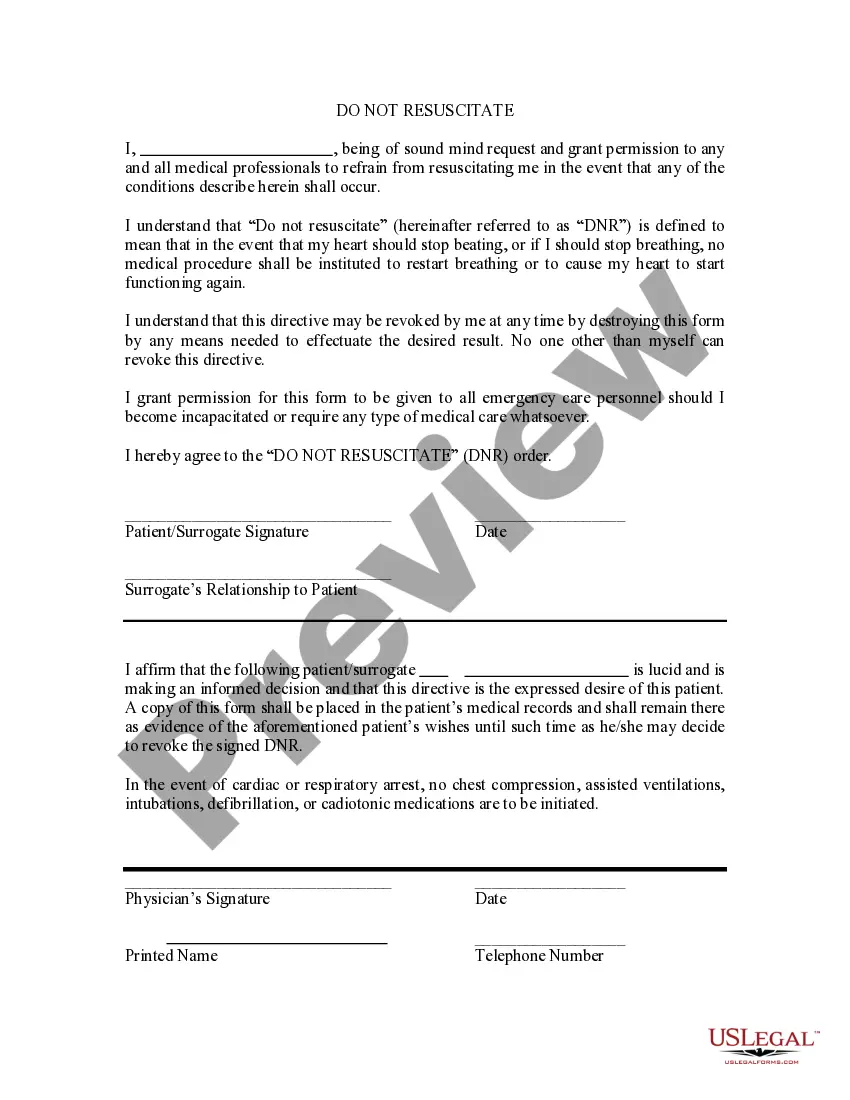
This is a form initiated by a patient requesting that he/she not be resuscitated should he/she stop breathing or should his/her heart stop beating. This form is also to be signed by a physician attesting to patient's wishes and to be placed in the patient's file.
Ohio Do Not Resuscitate Request - DNR
State:
Multi-State
Control #:
US-PRM-12
Format:
Word;
Rich Text
498 downloads
Description
Free preview

Get your form ready online
Our built-in tools help you complete, sign, share, and store your documents in one place.
Built-in online Word editor
Make edits, fill in missing information, and update formatting in US Legal Forms—just like you would in MS Word.
Export easily
Download a copy, print it, send it by email, or mail it via USPS—whatever works best for your next step.
E-sign your document
Sign and collect signatures with our SignNow integration. Send to multiple recipients, set reminders, and more. Go Premium to unlock E-Sign.
Notarize online 24/7
If this form requires notarization, complete it online through a secure video call—no need to meet a notary in person or wait for an appointment.
Store your document securely
We protect your documents and personal data by following strict security and privacy standards.

Make edits, fill in missing information, and update formatting in US Legal Forms—just like you would in MS Word.

Download a copy, print it, send it by email, or mail it via USPS—whatever works best for your next step.

Sign and collect signatures with our SignNow integration. Send to multiple recipients, set reminders, and more. Go Premium to unlock E-Sign.

If this form requires notarization, complete it online through a secure video call—no need to meet a notary in person or wait for an appointment.

We protect your documents and personal data by following strict security and privacy standards.
Looking for another form?


How to fill out Do Not Resuscitate Request - DNR?
Locating the appropriate legal document template can be a challenge. Certainly, there are numerous templates accessible online, but how do you find the legal form you require? Utilize the US Legal Forms website. The service offers thousands of templates, including the Ohio Do Not Resuscitate Request - DNR, suitable for both business and personal needs. All forms are reviewed by experts and adhere to federal and state regulations.
If you are already registered, Log In to your account and click on the Download button to obtain the Ohio Do Not Resuscitate Request - DNR. Use your account to view the legal forms you have previously acquired. Visit the My documents section of your account to obtain an additional copy of the document you require.
If you are a new user of US Legal Forms, here are simple steps you can follow: First, ensure you have selected the correct form for your city/county. You can browse the form using the Preview option and read the form description to confirm it is the right one for you. If the form does not meet your requirements, use the Search field to find the correct form. Once you are certain that the form is accurate, click the Get now button to acquire the form. Select the payment plan you desire and provide the required information. Create your account and complete the purchase using your PayPal account or credit card. Choose the file format and download the legal document template to your device. Finally, complete, revise, print, and sign the received Ohio Do Not Resuscitate Request - DNR.
The platform simplifies the process of obtaining legal documents, making it accessible for users at all levels.
- US Legal Forms is the largest collection of legal forms you will find many document templates.
- Utilize the service to download professionally created documents that meet state requirements.
- Access thousands of templates for various legal needs.
- Ensure compliance with both federal and state laws.
- Receive expert-reviewed forms for personal and business use.
- Easily manage your acquired documents through your account.
Form popularity
FAQ
How Do You Get A Do Not Resuscitate Order? If you decide you wish to have a DNR order put in place, inform your doctor. Your doctor is required to follow your wishes or transfer your care to a physician who is willing to carry them out. The doctor will fill out a form for a DNR order and add it to your medical record.
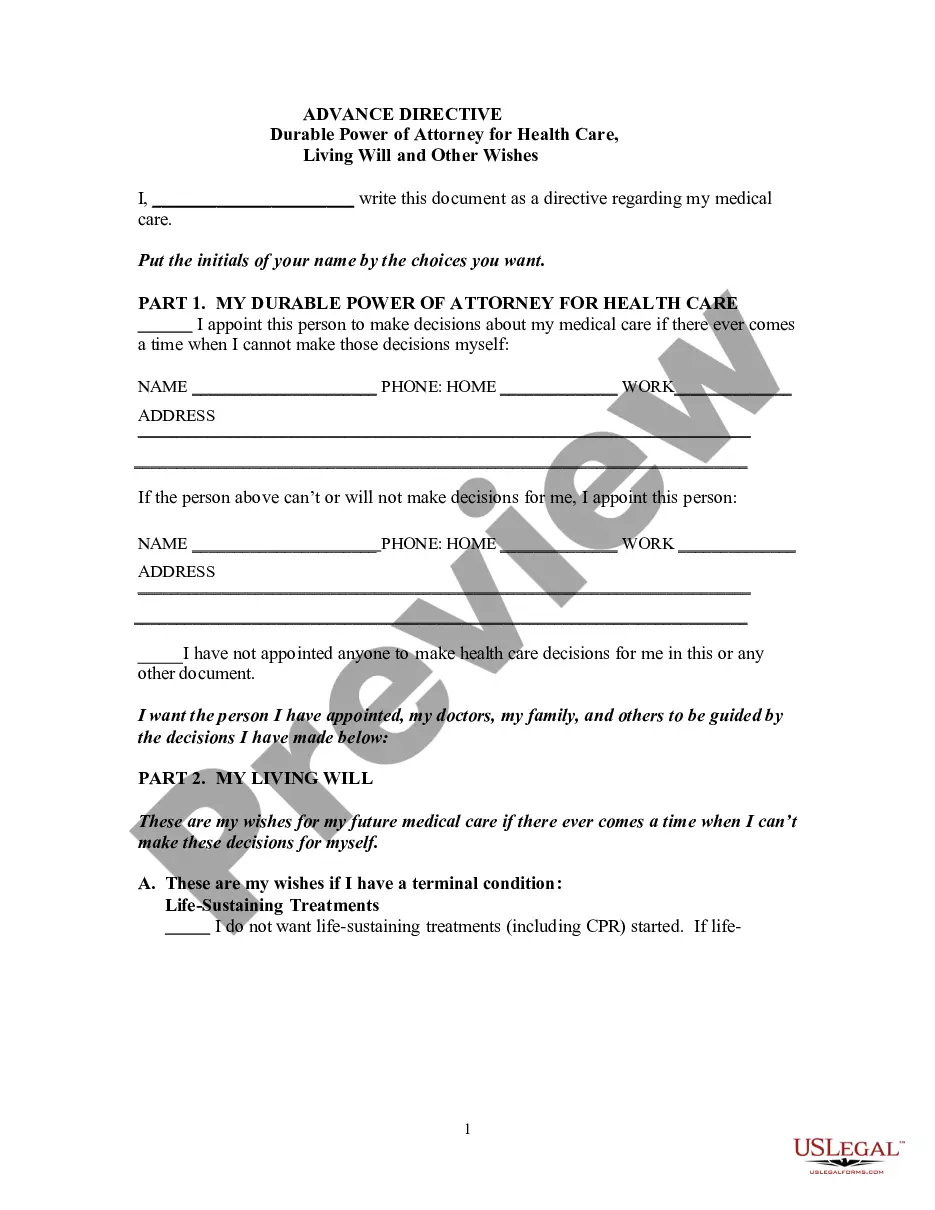
You can use an advance directive form or tell your doctor that you don't want to be resuscitated. Your doctor will put the DNR order in your medical chart. Doctors and hospitals in all states accept DNR orders. They do not have to be part of a living will or other advance directive.
Ohio's DNR law relieves emergency medical services (EMS) personnel and other medical professionals and facilities of their duty to resuscitate a person if that person has DNR identification or a DNR order, provided that the withholding or withdrawal of CPR is in accordance with the Ohio Department of Health's (ODH) do-
The DNR status, regardless of the circumstances, stands legally and ethically. The DNR is invalid because the spouse was not informed of the change. The DNR should be suspended until the patient's neurologic status is determined.
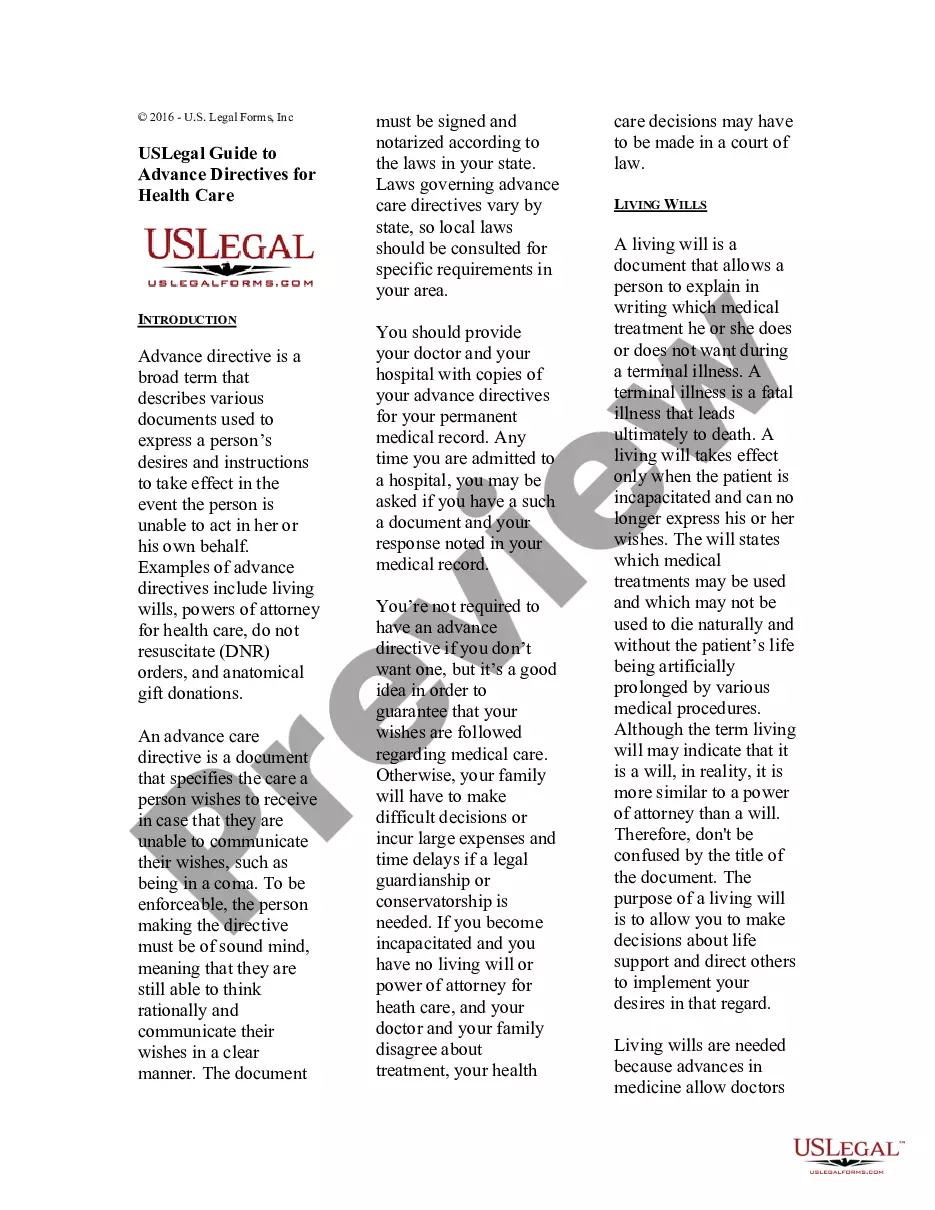
Do not resuscitate order A DNR is a request not to have CPR if your heart stops or if you stop breathing. You can use an advance directive form or tell your doctor that you don't want to be resuscitated. Your doctor will put the DNR order in your medical chart. Doctors and hospitals in all states accept DNR orders.
notresuscitate order, or DNR order, is a medical order written by a doctor. It instructs health care providers not to do cardiopulmonary resuscitation (CPR) if a patient's breathing stops or if the patient's heart stops beating.
Everyone who has capacity to do so can refuse CPR if they wish. This is a choice you can make at any time, for example when you are healthy or when you are approaching the end of your life. You can make it clear to your doctor or medical team that you do not want CPR if your heart or breathing stops.
A DNR can also be valid if: (1) it is not contrary to the directions of a patient who was competent at the time the patient conveyed the directions; (2) in the reasonable medical judgment of the patient's attending physician, the patient's death is imminent, regardless of intervention of CPR; and (3) the DNR order is
The most important factor to bear in mind is that the law does not require a patient, or their family to consent to a DNR order. This means a doctor can issue a DNR order, even if you do not want one (see section on what to do if there is a disagreement).
An Ohio Do Not Resuscitate (DNR) Order Form tells emergency medical service providers and other health care professionals that a patient does not wish to receive cardiopulmonary resuscitation (CPR) in the event of cardiac or respiratory arrest.