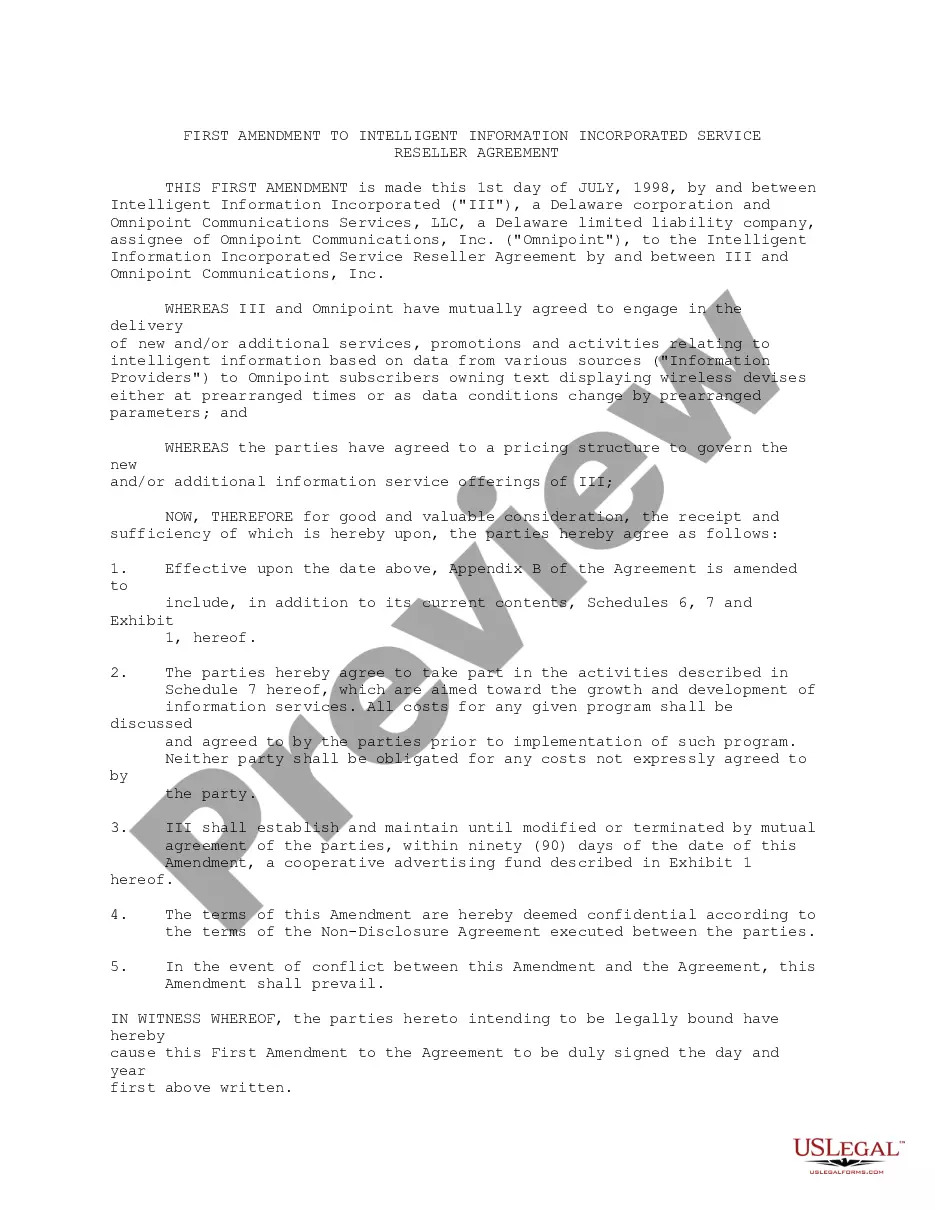
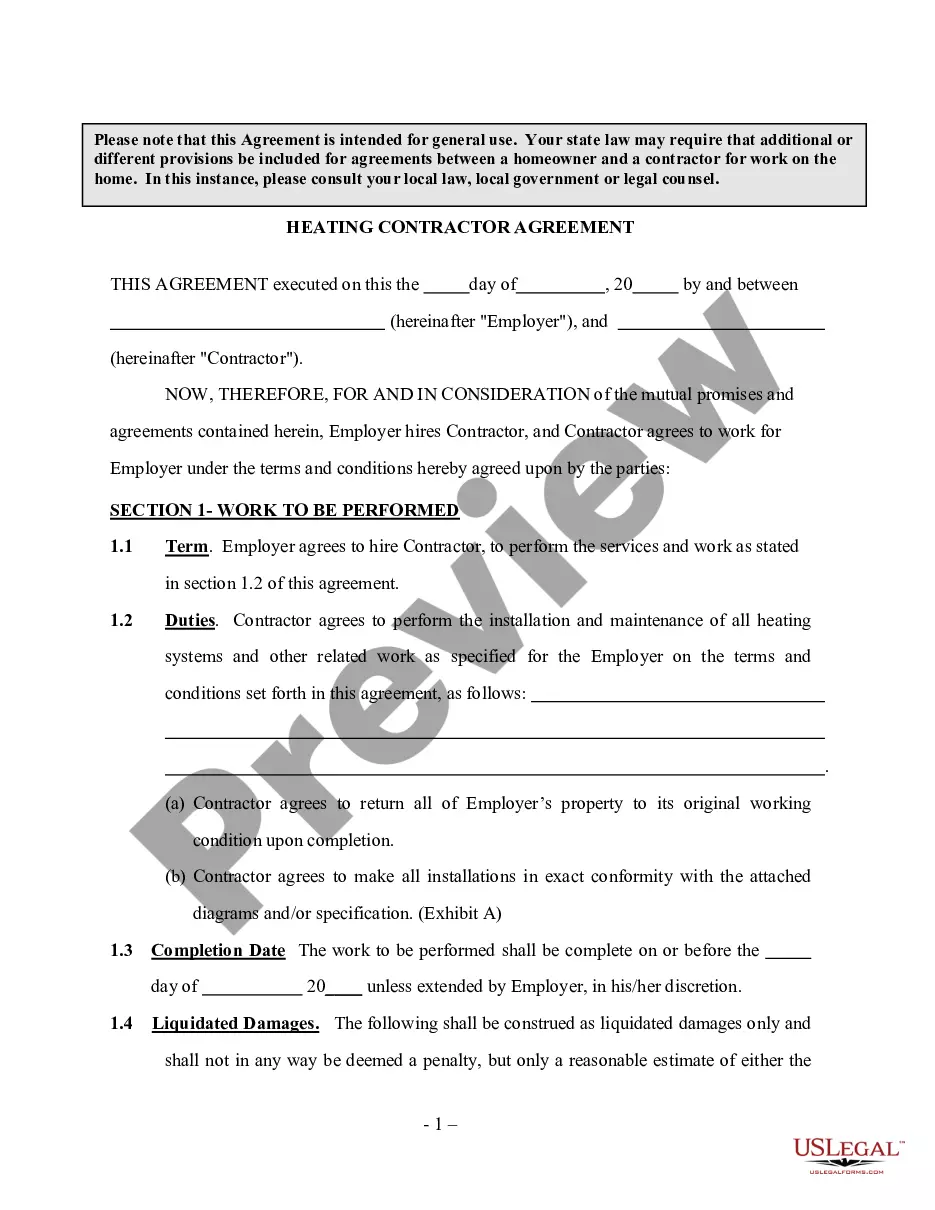
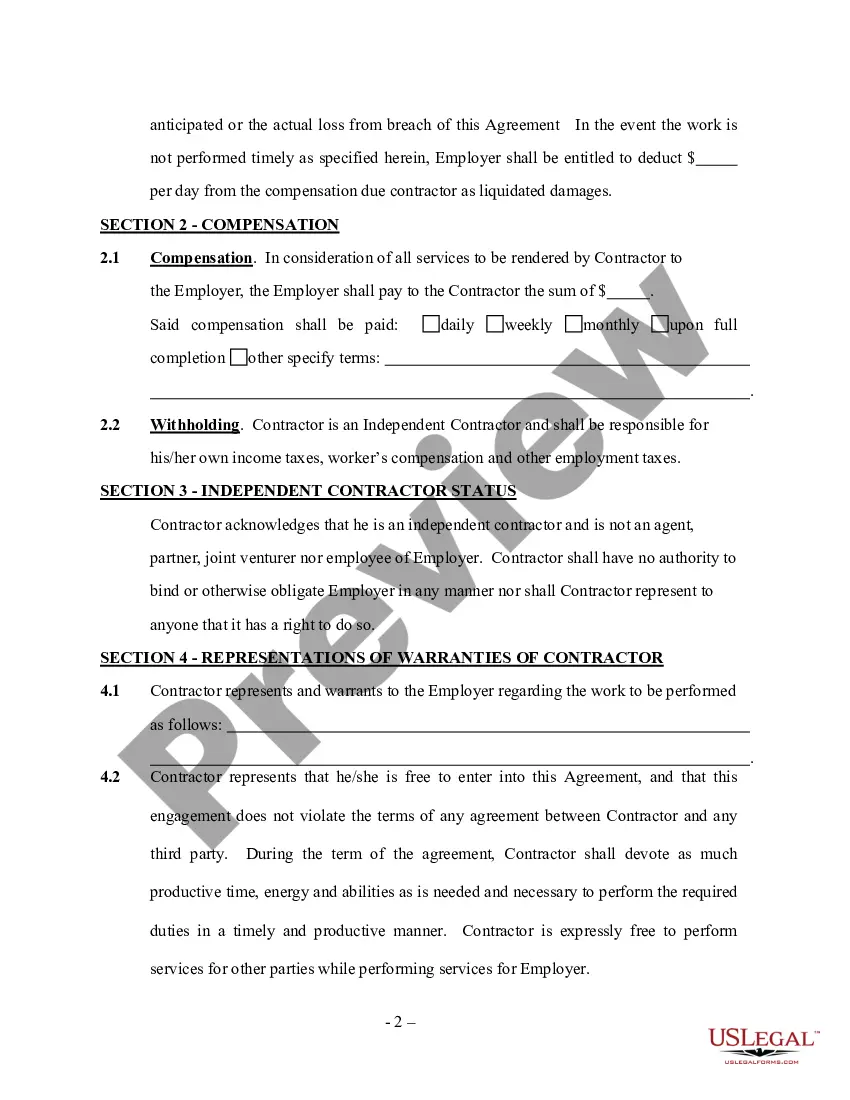
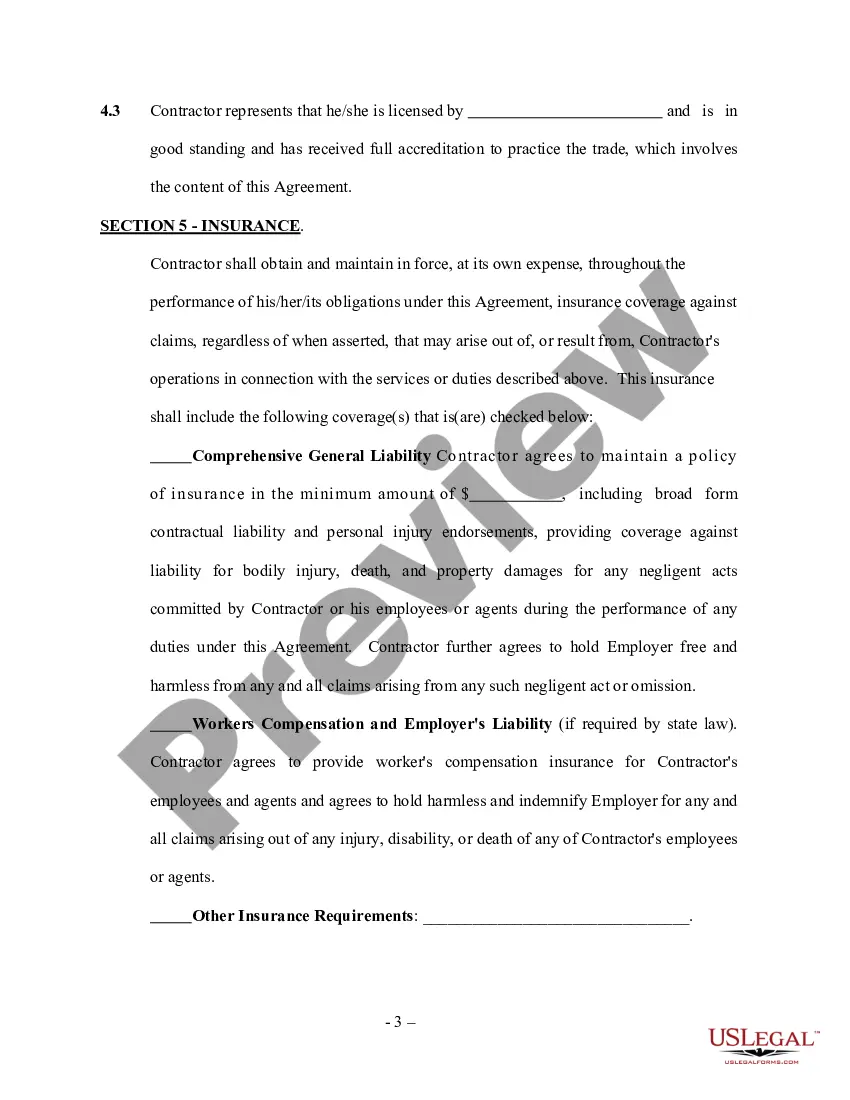
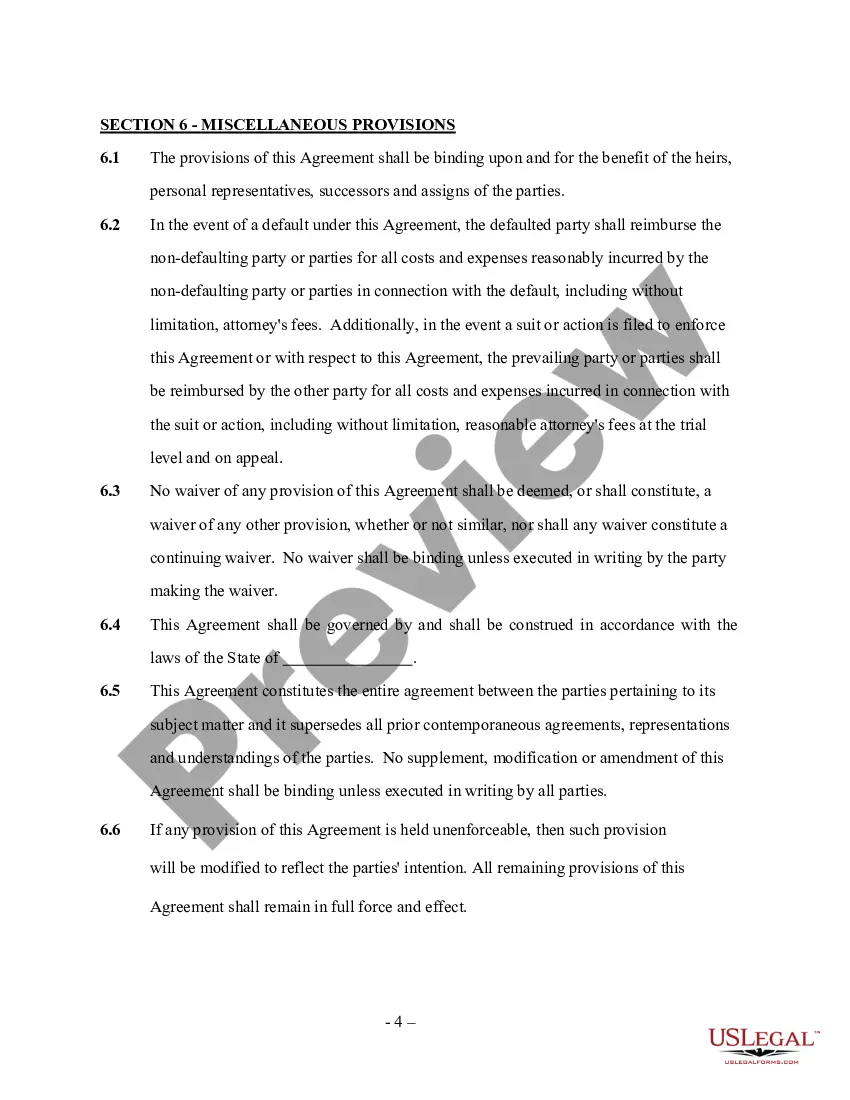
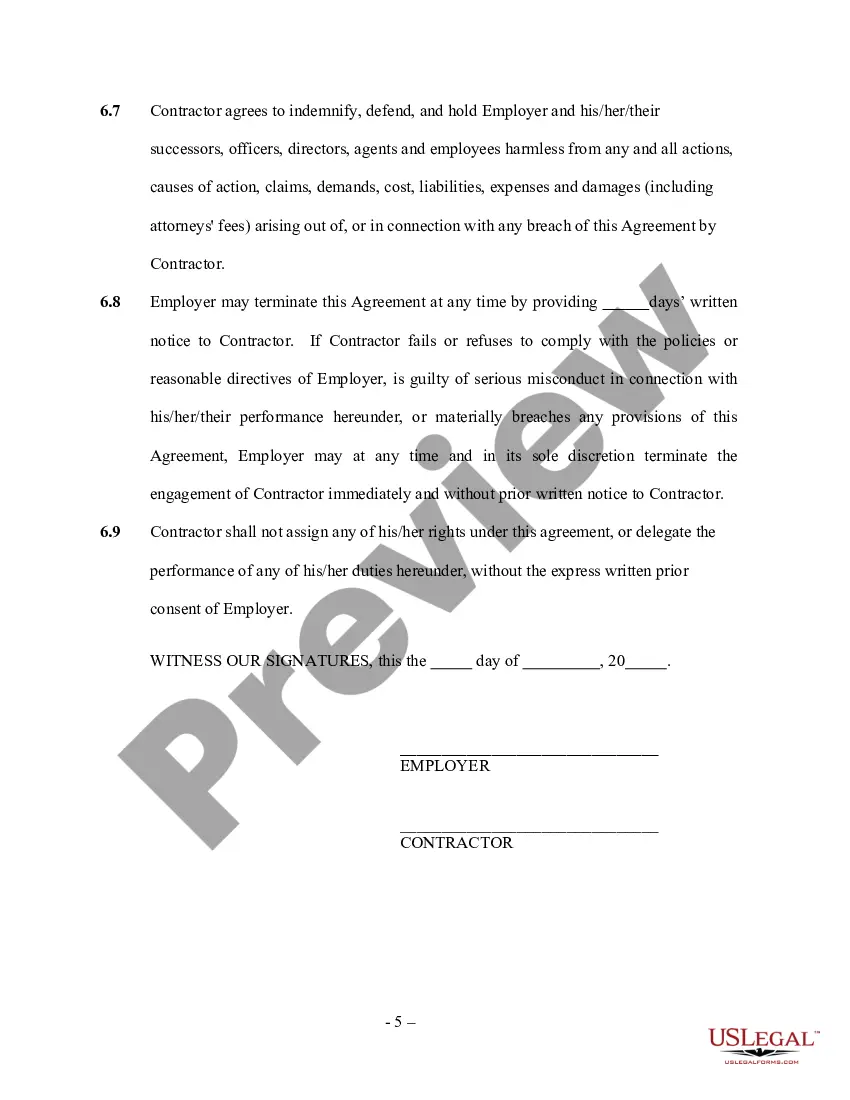
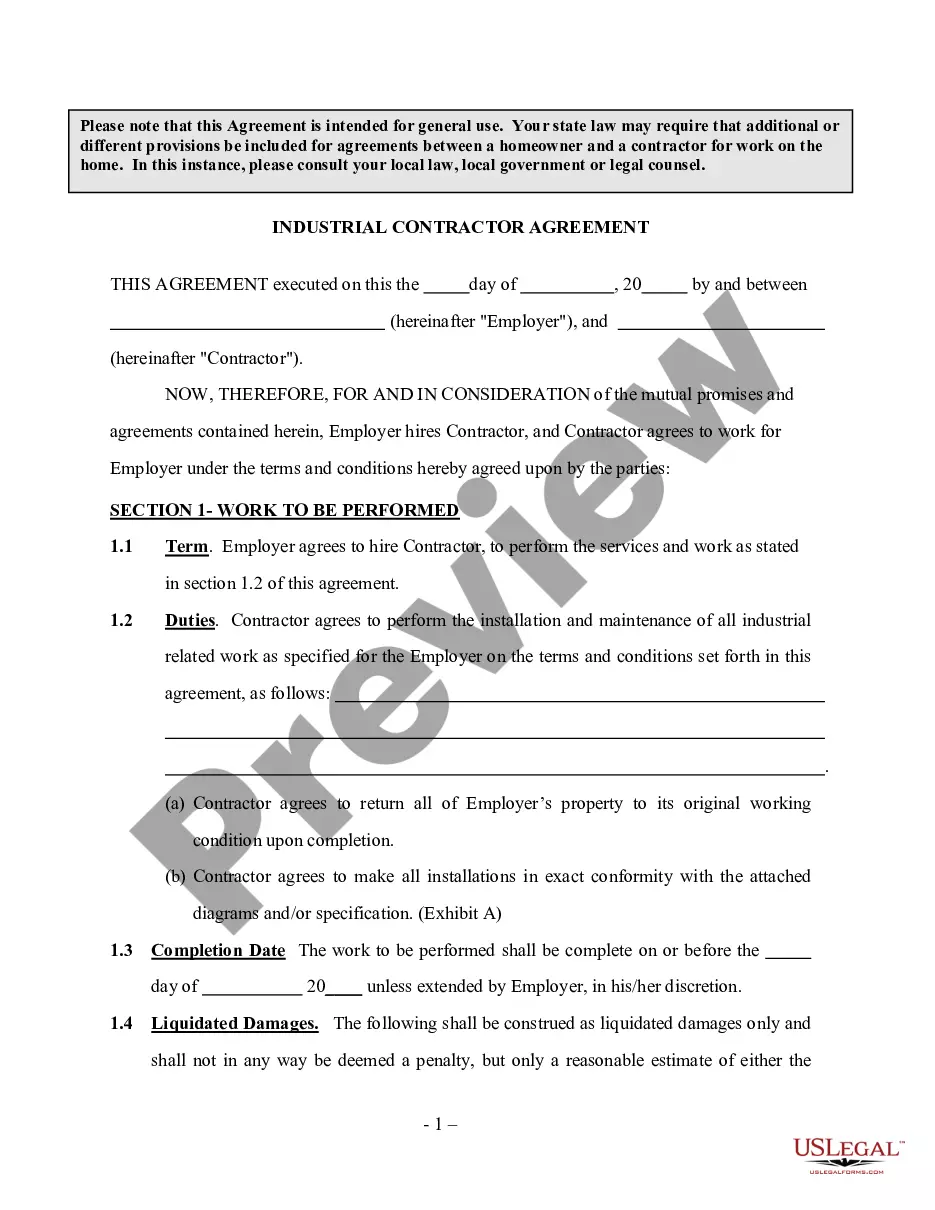
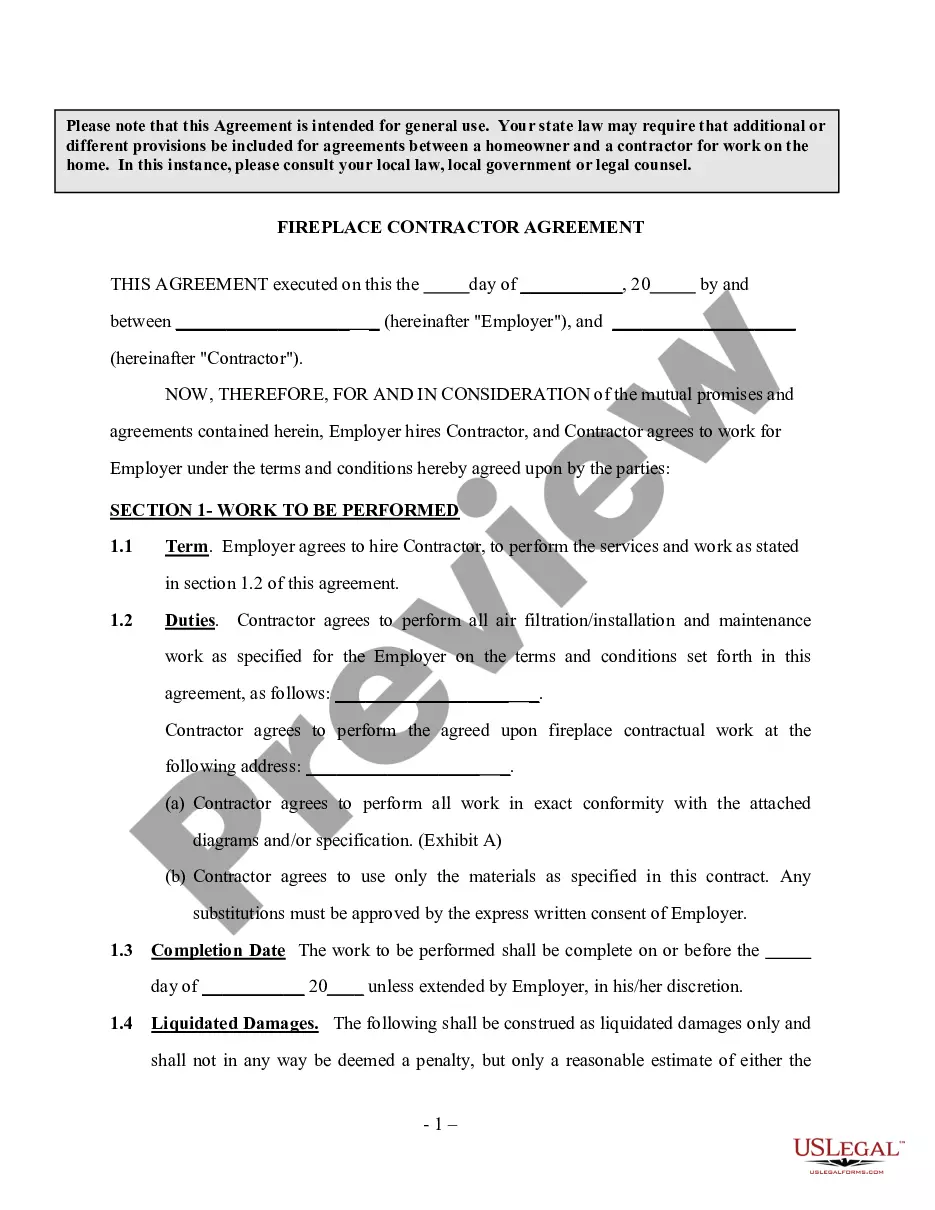
Employer contracts with an independent contractor to provide, install and service heating system as specified and agreed upon in the contract. Please note that this Agreement is intended for general use. Your state law may require that additional or different provisions be included for agreements between a homeowner and a contractor for work on the home. In this instance, please consult your local law, local government or legal counsel.
Ohio Heating Contractor Agreement - Self-Employed
State:
Multi-State
Control #:
US-INDC-109
Format:
Word;
Rich Text
Instant download
Description
Free preview





How to fill out Heating Contractor Agreement - Self-Employed?
If you wish to be thorough, obtain, or create authentic document templates, utilize US Legal Forms, the largest collection of authentic forms, accessible online.
Employ the site’s simple and efficient search to find the documents you need. Various templates for commercial and personal purposes are categorized by groups and states, or keywords.
Utilize US Legal Forms to retrieve the Ohio Heating Contractor Agreement - Self-Employed with just a few clicks.
Every legal document template you purchase is yours forever. You will have access to every form you downloaded in your account. Navigate to the My documents section and select a form to print or download again.
Be proactive and obtain, and print the Ohio Heating Contractor Agreement - Self-Employed with US Legal Forms. There are numerous professional and state-specific forms available for your business or personal requirements.
- If you are already a US Legal Forms user, Log In to your account and click the Download button to access the Ohio Heating Contractor Agreement - Self-Employed.
- You can also access forms you previously downloaded from the My documents tab of your account.
- If you are using US Legal Forms for the first time, follow the steps below.
- Step 1. Make sure you have chosen the form for the appropriate region/state.
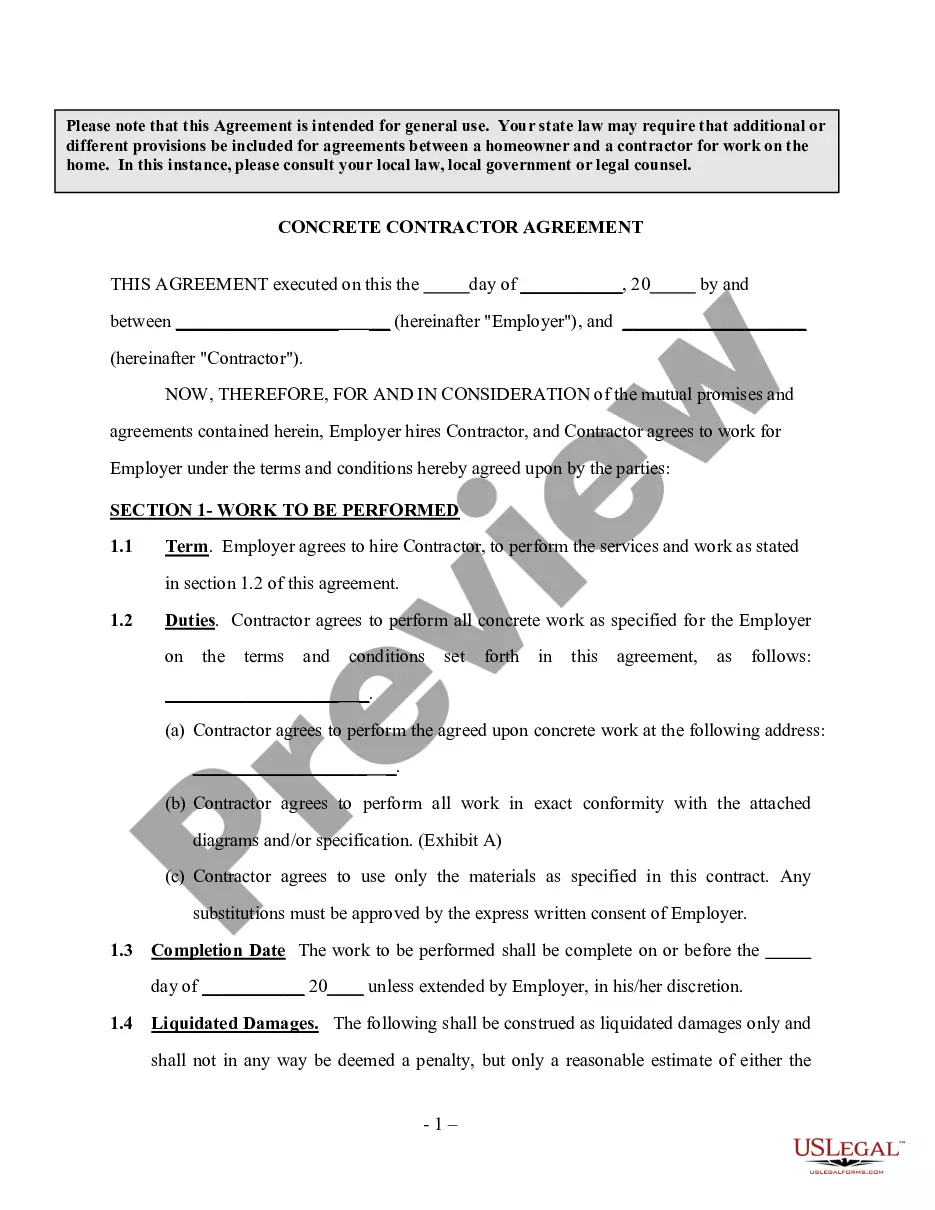
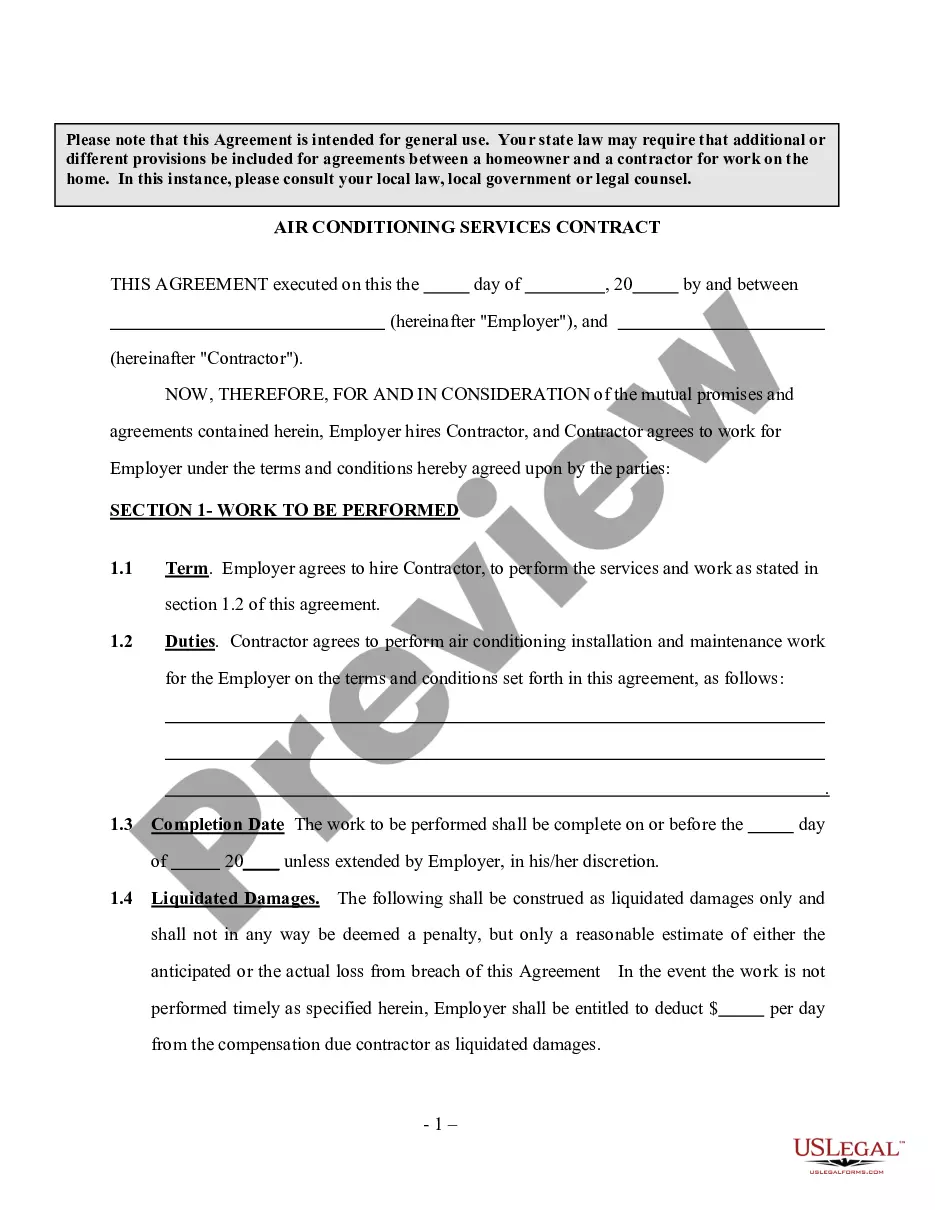
- Step 2. Use the Preview option to review the form’s content. Don’t forget to check the description.
- Step 3. If you are dissatisfied with the form, use the Search box at the top of the screen to find other versions of the legal form template.
- Step 4. Once you have found the form you need, click the Buy now button. Choose the payment plan you prefer and enter your details to register for an account.
- Step 5. Complete the transaction. You can use your credit card or PayPal account to finalize the purchase.
- Step 6. Select the format of the legal form and download it to your device.
- Step 7. Complete, amend, and print or sign the Ohio Heating Contractor Agreement - Self-Employed.
Form popularity
FAQ
Yes, independent contractors typically file as self-employed individuals. This classification means they report income from their work directly to the IRS, using forms like Schedule C. When it comes to creating an Ohio Heating Contractor Agreement - Self-Employed, understanding your tax responsibilities is crucial. Utilizing a platform like uslegalforms can help you draft the necessary agreements to ensure compliance and protect your interests.
In Ohio, independent contractors generally do not need workers' compensation insurance unless they have employees. However, it’s wise for contractors to consider securing coverage to protect themselves against work-related injuries. The Ohio Heating Contractor Agreement - Self-Employed can help clarify insurance responsibilities, ensuring protection for both parties involved.
Yes, an independent contractor is considered self-employed. This means they operate their own business and manage their taxes independently. The Ohio Heating Contractor Agreement - Self-Employed is tailored to meet the needs of these individuals, allowing them to outline their services while ensuring compliance with regulations.
An employment contract should include essential elements such as job title, salary, and working hours. For an Ohio Heating Contractor Agreement - Self-Employed, it is crucial to detail the services provided and payment schedule. Lastly, clauses regarding termination and confidentiality should also be included to safeguard both parties.
employed individual typically uses an independent contractor agreement, like the Ohio Heating Contractor Agreement SelfEmployed. This contract defines the working relationship, including compensation, project details, and rights. By using this type of agreement, both parties can have clear expectations, reducing misunderstandings.
A 1099 contract must clearly outline the scope of work, payment terms, and deadlines. Additionally, it should specify the responsibilities of both parties involved in the Ohio Heating Contractor Agreement - Self-Employed. Including information about confidentiality and dispute resolution can further protect both the contractor and the client.
Yes, a self-employed person can indeed have a contract. An Ohio Heating Contractor Agreement - Self-Employed serves as a formal document that outlines the expectations and responsibilities of both parties involved. This agreement provides clarity and legal protection, ensuring all terms are understood and agreed upon. Utilizing platforms like US Legal Forms can help you create an effective contract tailored to your situation.
To create an Ohio Heating Contractor Agreement - Self-Employed, start by outlining the terms of your work arrangement. Clearly define the scope of work, payment terms, and any deadlines. Additionally, include clauses regarding confidentiality and dispute resolution to protect both parties. Using a trustworthy resource like US Legal Forms can simplify this process, providing templates that meet your specific needs.
employed contract should include essential elements such as the contractor's name, project description, payment terms, and deadlines. Specifically, within the context of an Ohio Heating Contractor Agreement SelfEmployed, it’s important to outline responsibilities and expectations clearly. Be sure to also include any applicable legal requirements or local regulations to ensure compliance.
To write an independent contractor agreement, begin with the basic identification of the contractor and client, followed by a detailed description of the services to be provided. Be sure to include payment terms, confidentiality clauses, and an exit strategy, particularly focusing on the Ohio Heating Contractor Agreement - Self-Employed. An effective agreement reflects a mutual understanding and can help prevent future disputes.