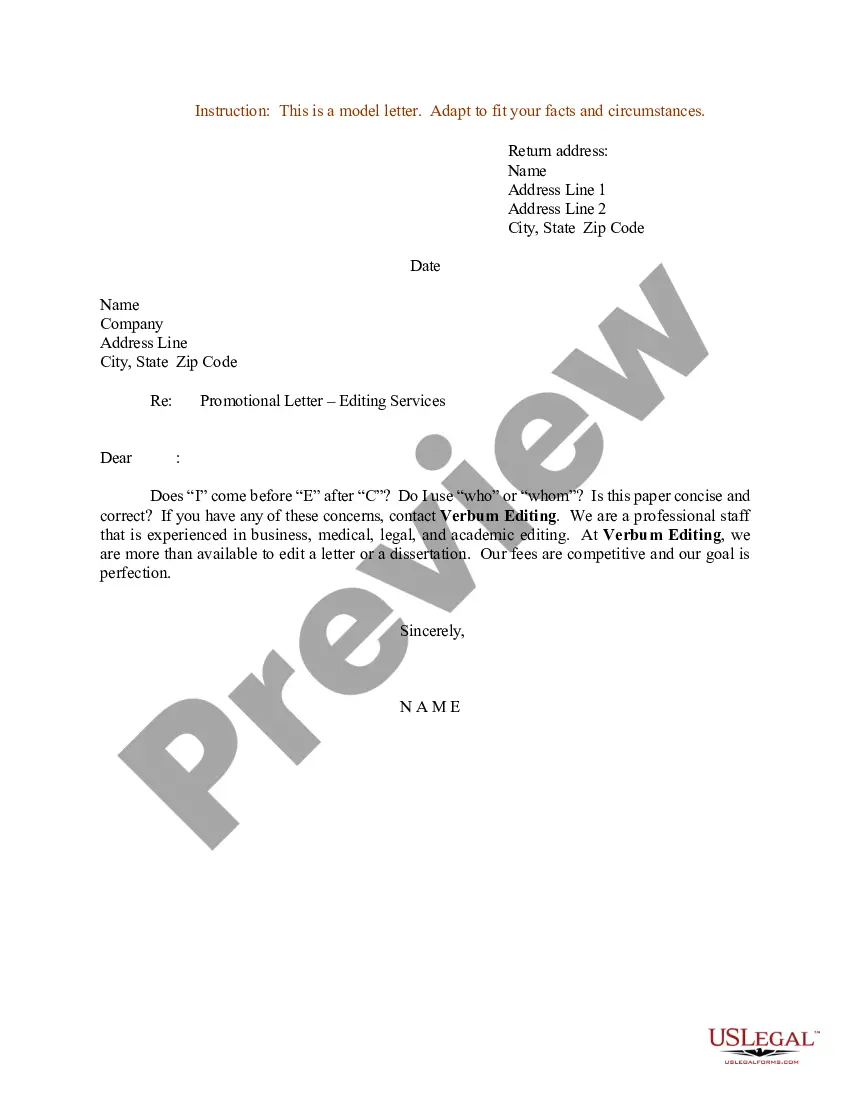
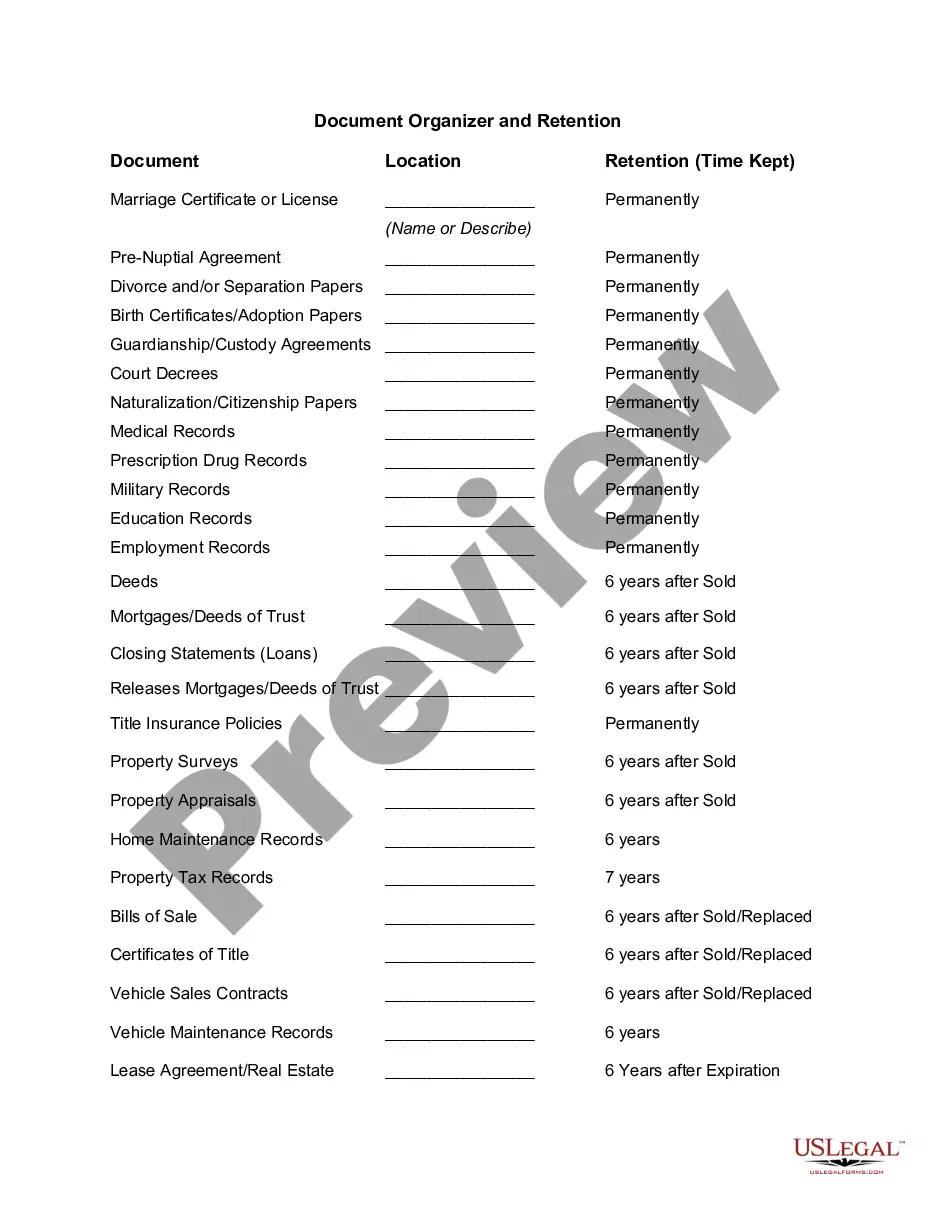
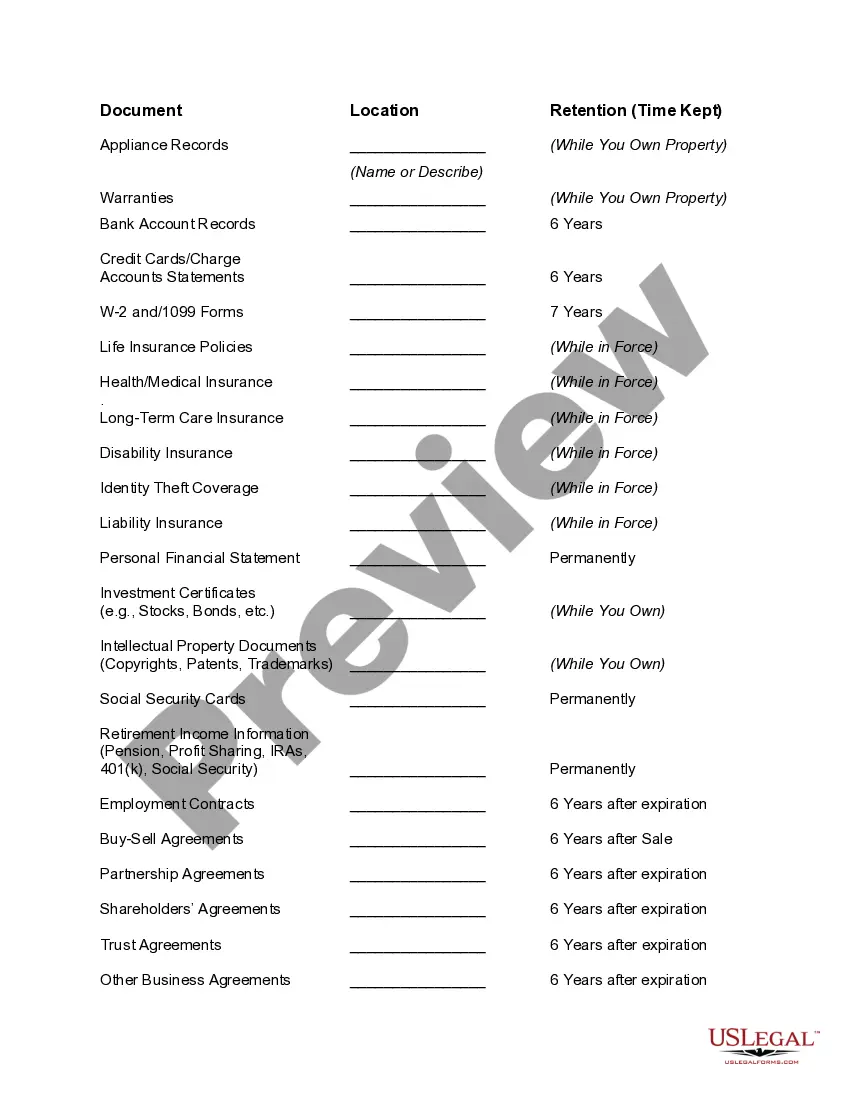
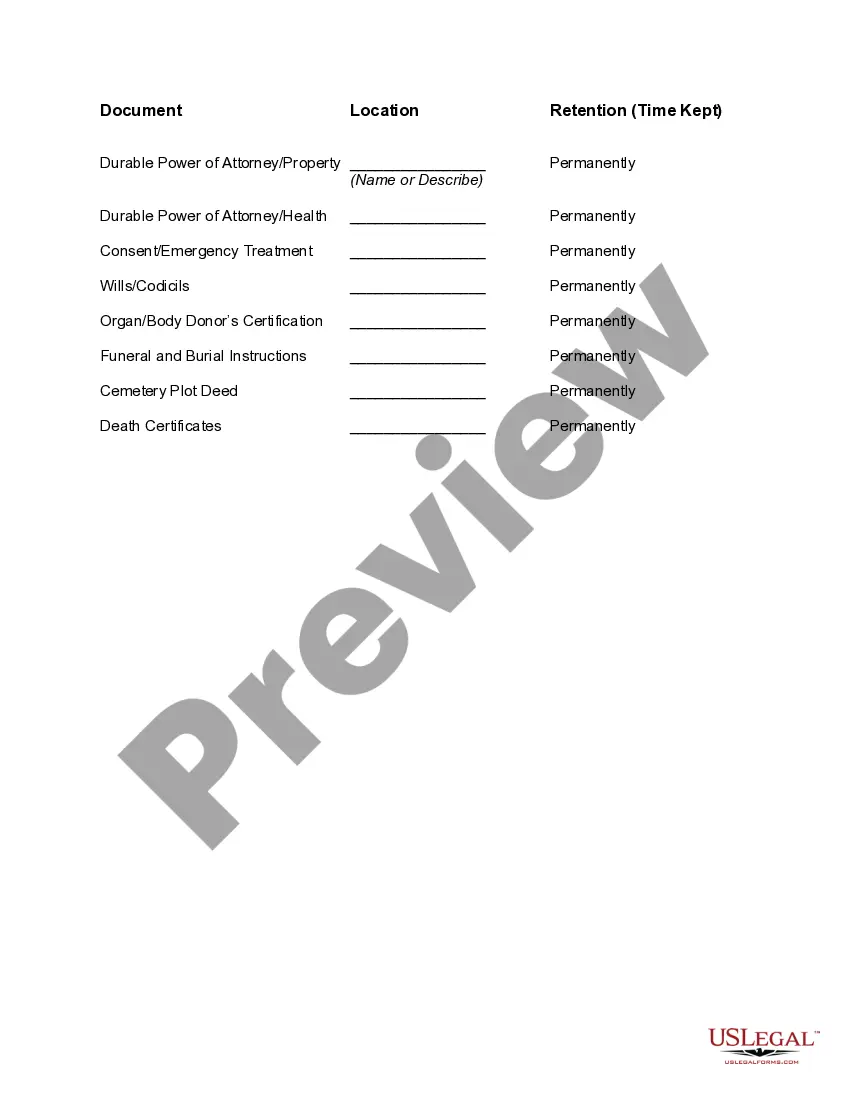
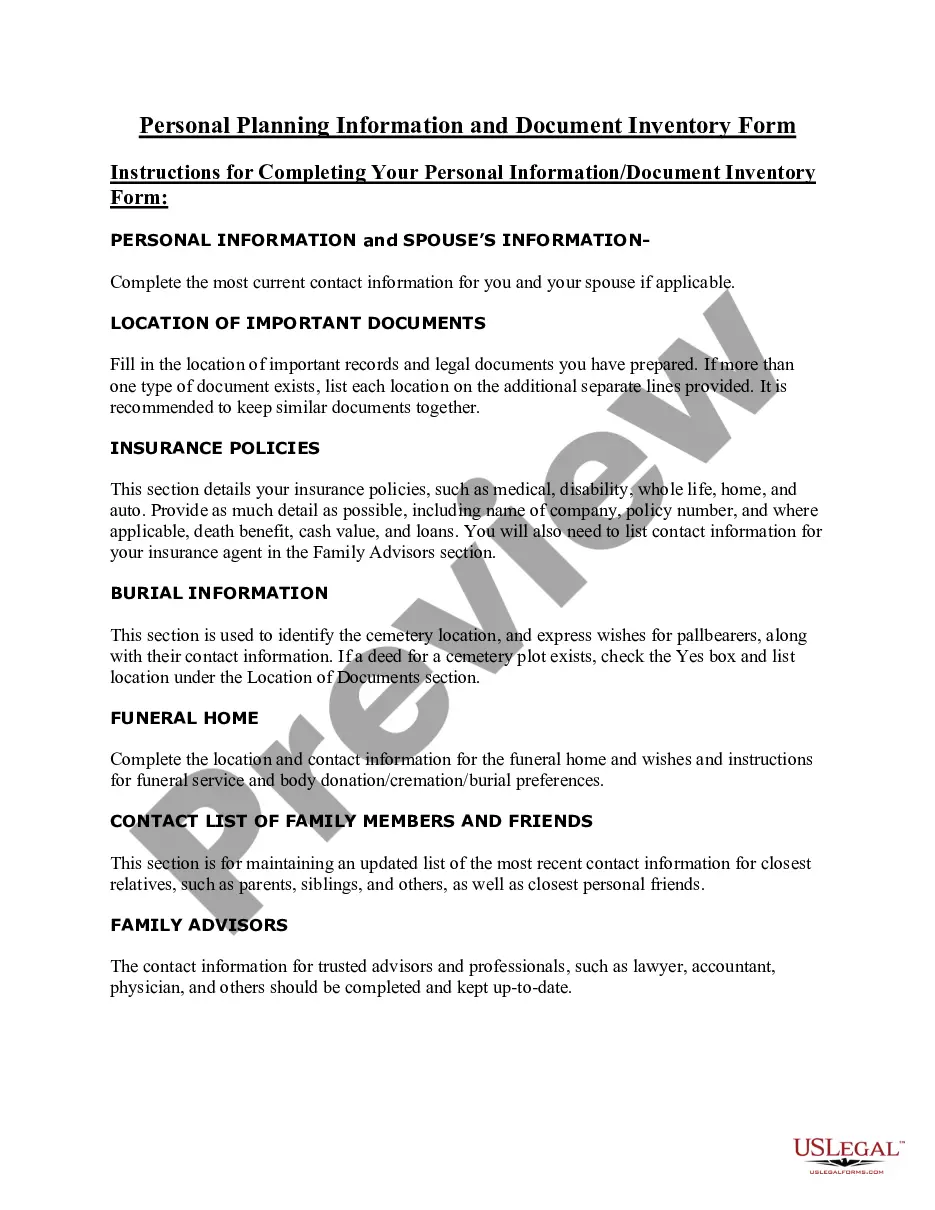
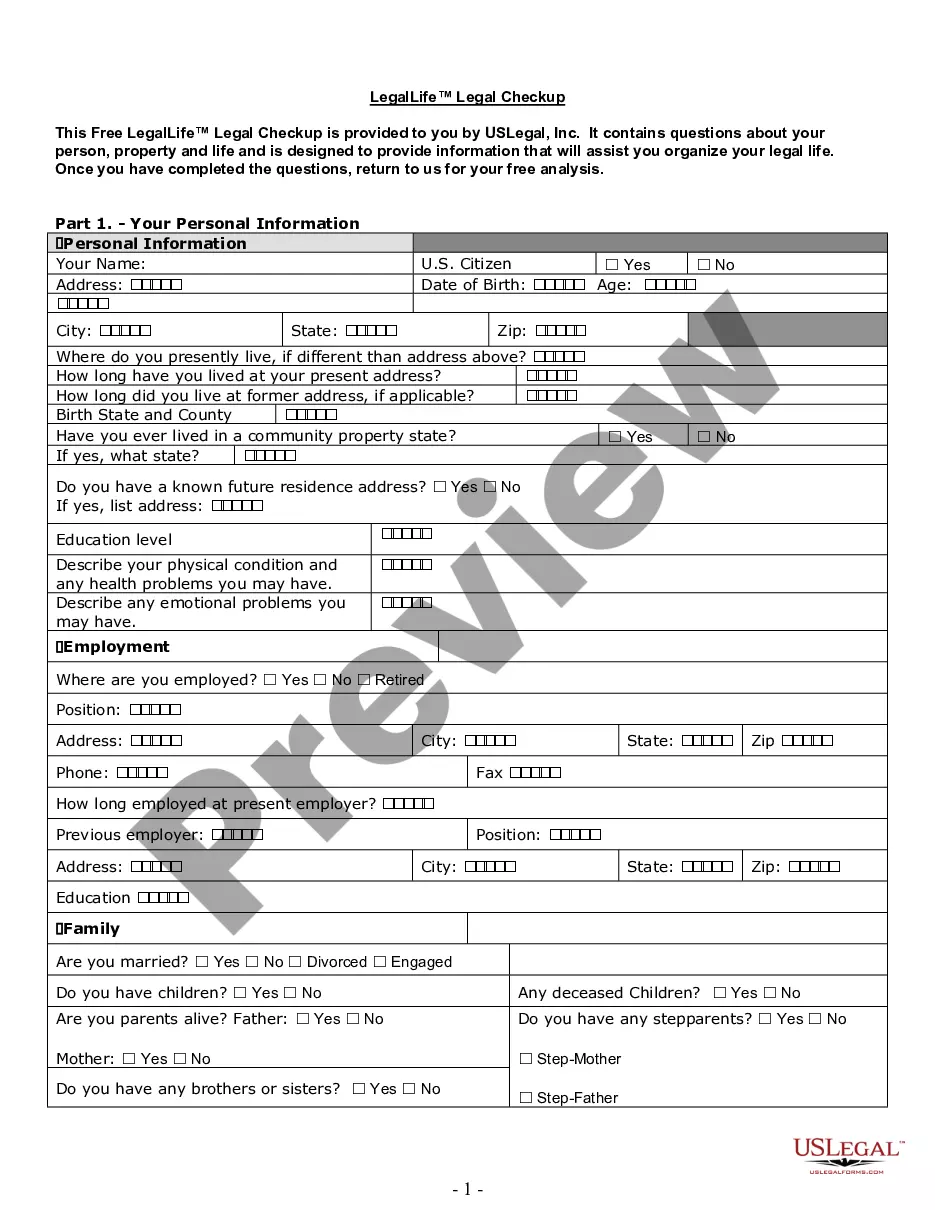
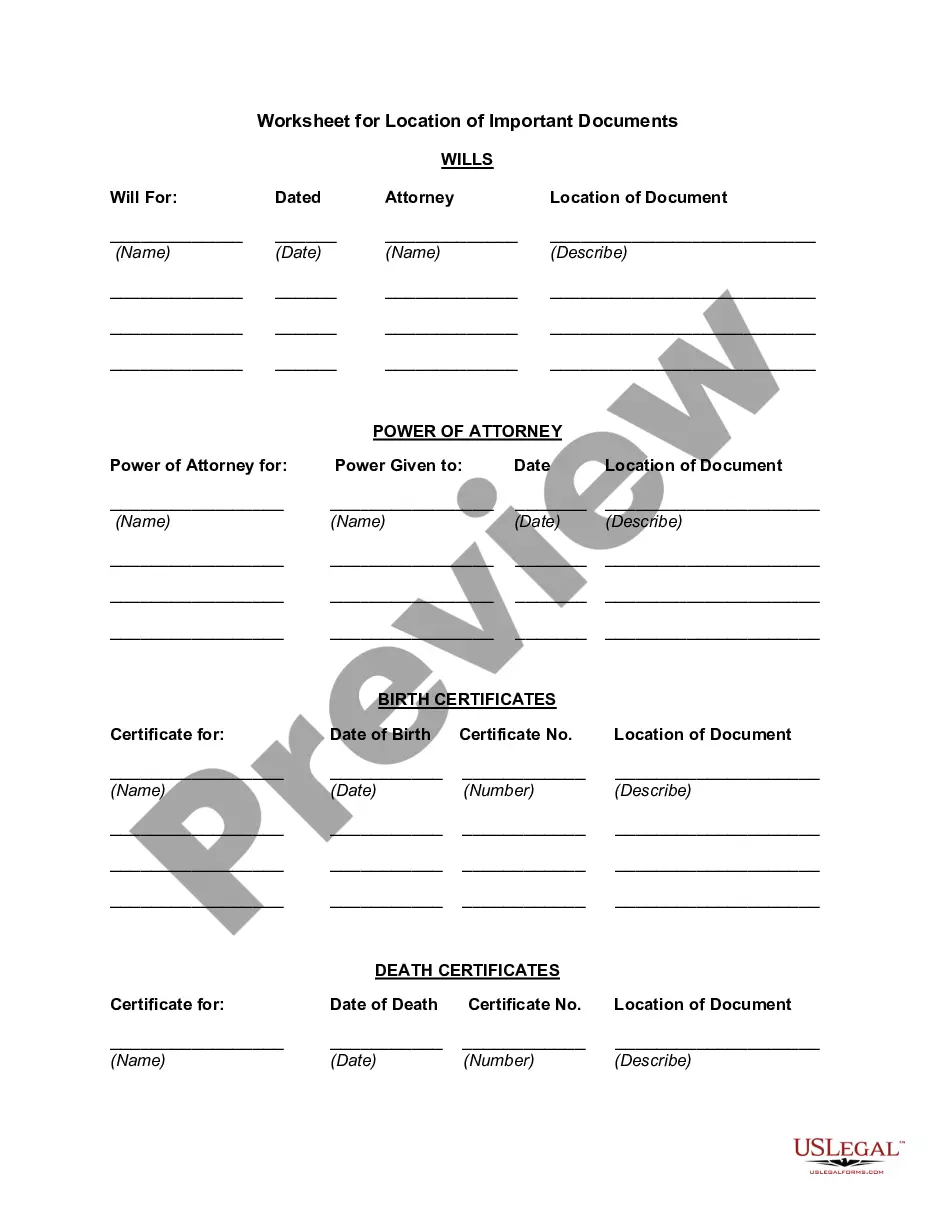
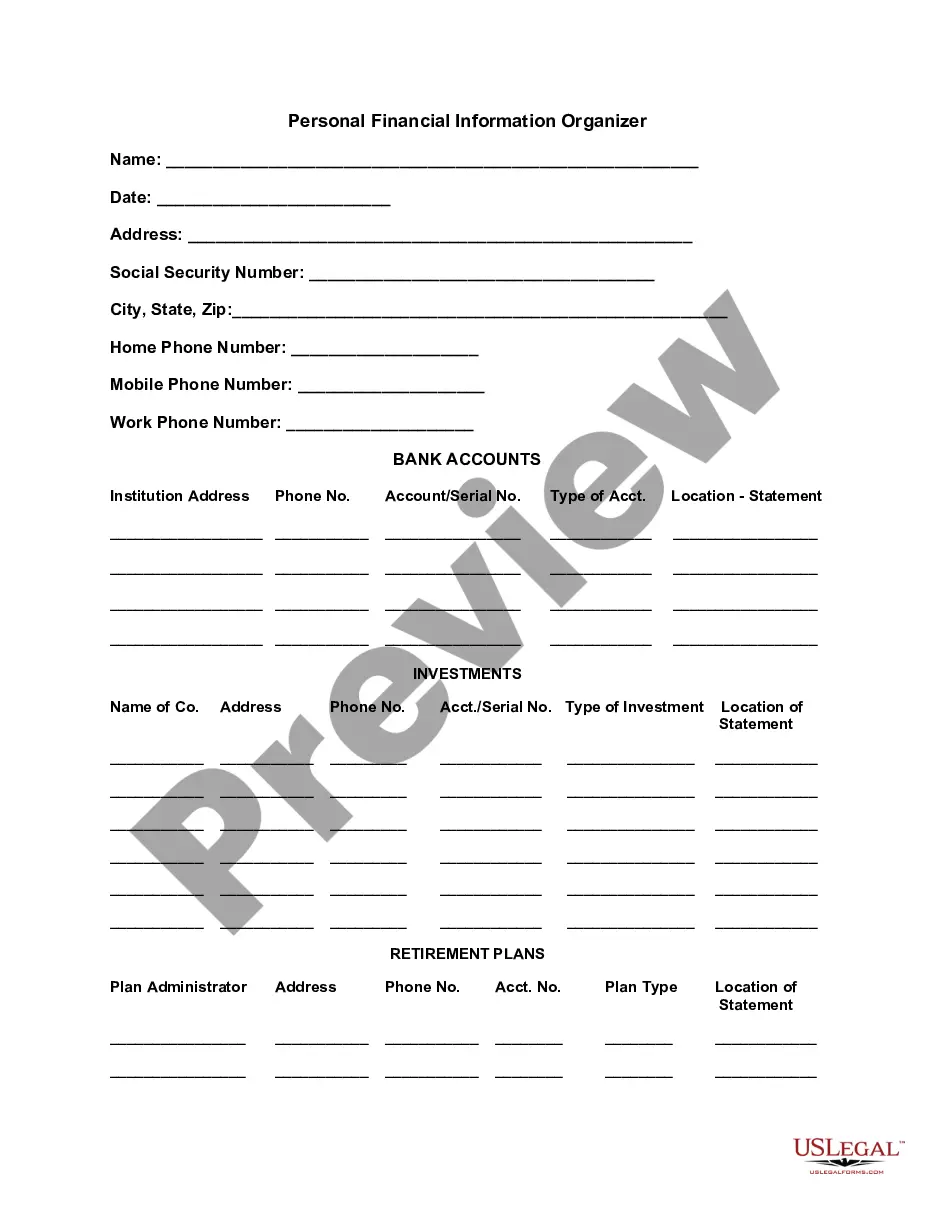
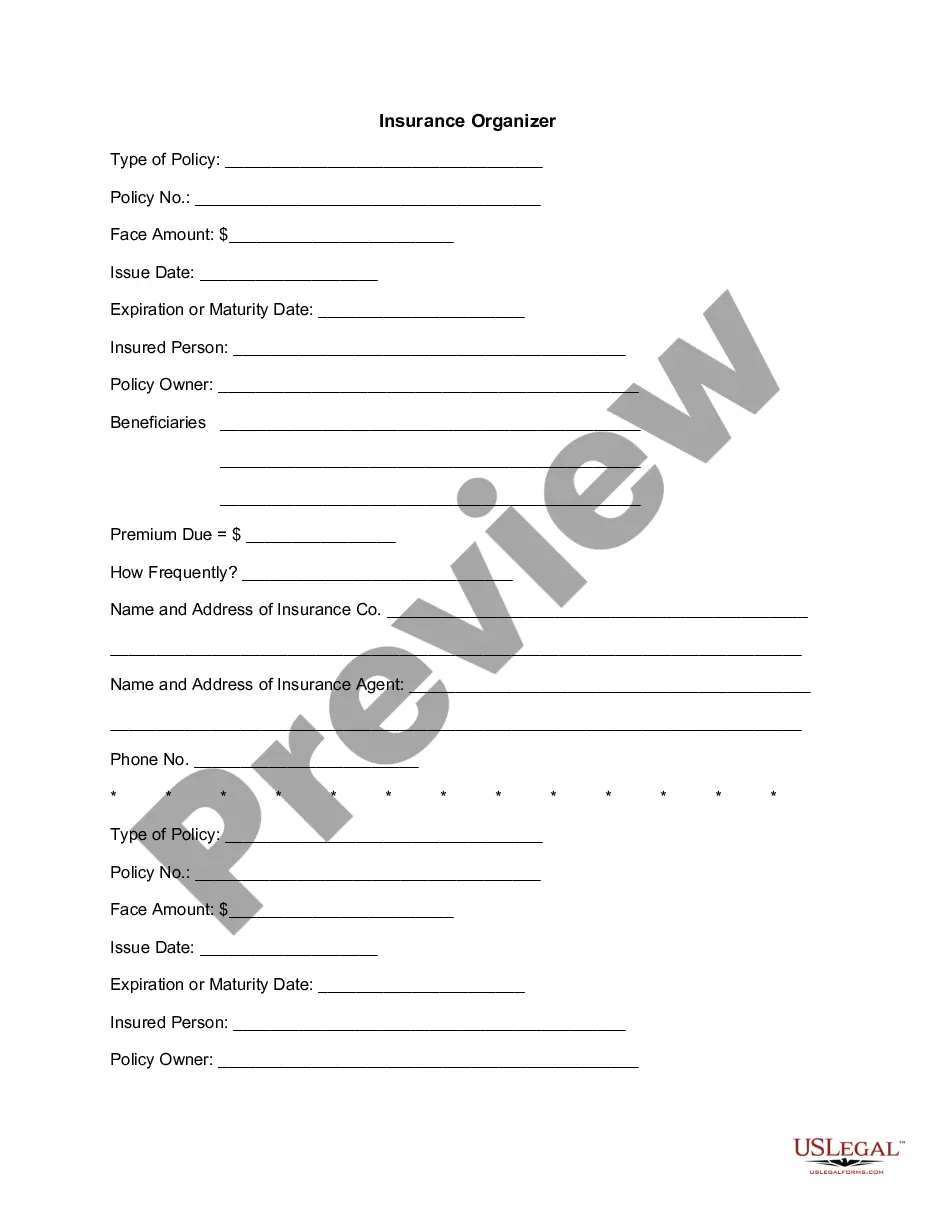
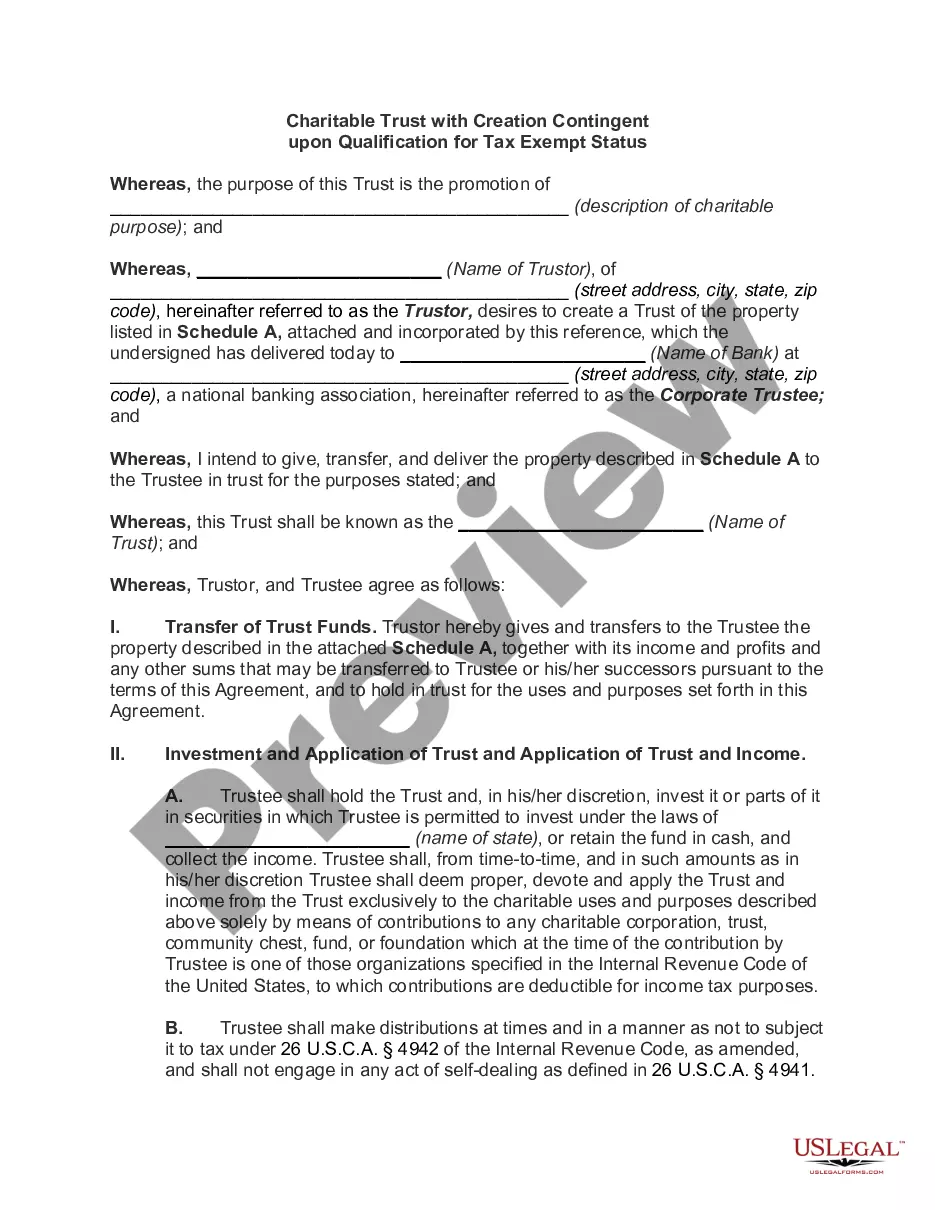
Ohio Document Organizer and Retention
Description
Get your form ready online
Our built-in tools help you complete, sign, share, and store your documents in one place.
Make edits, fill in missing information, and update formatting in US Legal Forms—just like you would in MS Word.
Download a copy, print it, send it by email, or mail it via USPS—whatever works best for your next step.
Sign and collect signatures with our SignNow integration. Send to multiple recipients, set reminders, and more. Go Premium to unlock E-Sign.
If this form requires notarization, complete it online through a secure video call—no need to meet a notary in person or wait for an appointment.
We protect your documents and personal data by following strict security and privacy standards.

Make edits, fill in missing information, and update formatting in US Legal Forms—just like you would in MS Word.

Download a copy, print it, send it by email, or mail it via USPS—whatever works best for your next step.

Sign and collect signatures with our SignNow integration. Send to multiple recipients, set reminders, and more. Go Premium to unlock E-Sign.

If this form requires notarization, complete it online through a secure video call—no need to meet a notary in person or wait for an appointment.

We protect your documents and personal data by following strict security and privacy standards.
Looking for another form?



How to fill out Document Organizer And Retention?
If you wish to complete, acquire, or print authorized document templates, utilize US Legal Forms, the largest array of legal forms accessible online.
Utilize the site’s straightforward and user-friendly search to find the documents you require.
Various templates for business and personal uses are organized by categories and states, or keywords.
Step 4. Once you have located the form you need, click the Get now button. Choose your preferred pricing plan and enter your details to register for an account.
Step 5. Process the payment. You may use your credit card or PayPal account to complete the transaction.
- Utilize US Legal Forms to retrieve the Ohio Document Organizer and Retention in just a few clicks.
- If you are already a US Legal Forms user, sign in to your account and click on the Download button to get the Ohio Document Organizer and Retention.
- You can also access forms you previously downloaded from the My documents section of your account.
- If you are using US Legal Forms for the first time, please follow the instructions below.
- Step 1. Ensure you have selected the form for your specific city/state.
- Step 2. Utilize the Preview option to review the form’s content. Do not forget to read the details.
- Step 3. If you are unsatisfied with the form, use the Search box at the top of the screen to find other versions of the legal form template.
Form popularity
FAQ
A document retention policy is also referred to as a records retention policy, records and information management policy, recordkeeping policy, or records maintenance policy. It codifies an organization's expectations for how its data is handled, from creation to destruction.
A document retention policy (also known as a records and information management policy, recordkeeping policy, or a records maintenance policy) establishes and describes how a company expects its employees to manage company data from creation through destruction.
Document retention guidelines typically require businesses to store records for one, three or seven years. In some cases, you will need to keep the records forever. If you're unsure what to keep and what to shred, your accountant, lawyer and state record-keeping agency may provide guidance.
A document retention policy is a company policy, which establishes the customary practice and guidelines regarding the retention and maintenance of company records, and sets forth a schedule for the destruction of certain documents received or created during the course of business.
A document retention plan is a policy that provides for the systematic review, retention and destruction of documents.
Retention policies help to manage many risks including lost or stolen information, excessive backlog of paper files, loss of time and space while internally managing records and lack of organization system for records, making them hard to find, just to name a few.
For example, if financial records have a retention period of five years, and the records were created during the 1995-1996 fiscal year (July 1, 1995 - June 30, 1996), the five-year retention period begins on July 1, 1996 and ends five years later on July 1, 2001.
It is commonly advised by records and information management (RIM) professionals that any and all retention periods applied to organizational information should be reviewed and approved for use by competent legal counsel, which represents the organization, and is familiar with the specific business needs and legal and
A retention and disposition schedule is a plan of action that indicates the period of time you should retain your records. Records schedules allow you to dispose of records in a timely, systematic manner by setting retention and disposal guidelines based on administrative, legal, fiscal, or research needs.
Six Key Steps to Developing a Record Retention PolicySTEP 1: Identify Types of Records & Media.STEP 2: Identify Business Needs for Records & Appropriate Retention Periods.STEP 3: Addressing Creation, Distribution, Storage & Retrieval of Documents.STEP 4: Destruction of Documents.STEP 5: Documentation & Implementation.More items...?