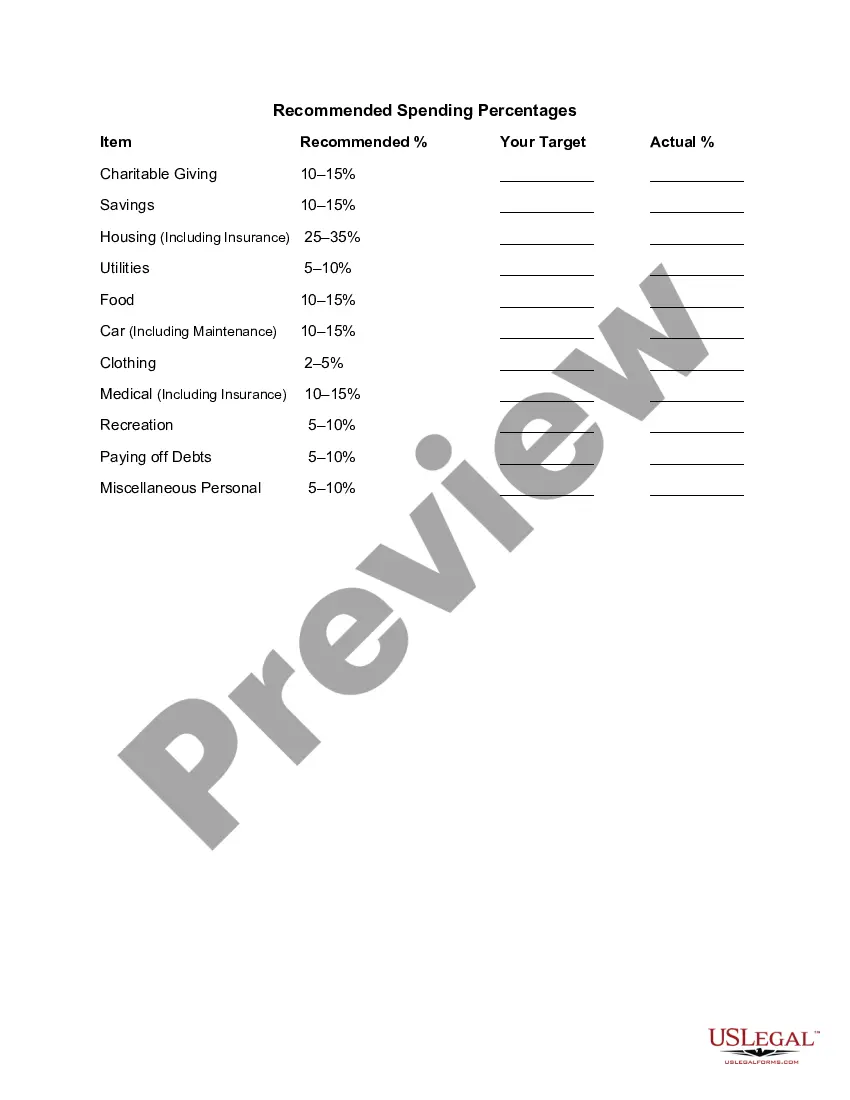
Ohio Recommended Spending Percentages
Description
Get your form ready online
Our built-in tools help you complete, sign, share, and store your documents in one place.
Make edits, fill in missing information, and update formatting in US Legal Forms—just like you would in MS Word.
Download a copy, print it, send it by email, or mail it via USPS—whatever works best for your next step.
Sign and collect signatures with our SignNow integration. Send to multiple recipients, set reminders, and more. Go Premium to unlock E-Sign.
If this form requires notarization, complete it online through a secure video call—no need to meet a notary in person or wait for an appointment.
We protect your documents and personal data by following strict security and privacy standards.

Make edits, fill in missing information, and update formatting in US Legal Forms—just like you would in MS Word.

Download a copy, print it, send it by email, or mail it via USPS—whatever works best for your next step.

Sign and collect signatures with our SignNow integration. Send to multiple recipients, set reminders, and more. Go Premium to unlock E-Sign.

If this form requires notarization, complete it online through a secure video call—no need to meet a notary in person or wait for an appointment.

We protect your documents and personal data by following strict security and privacy standards.
Looking for another form?
How to fill out Recommended Spending Percentages?
Finding the correct legal document template can be quite a challenge.
Of course, there are numerous templates available on the Internet, but how do you acquire the legal form you require.
Utilize the US Legal Forms website. The service offers a multitude of templates, such as the Ohio Recommended Spending Percentages, that can be used for both business and personal purposes.
First, ensure you have selected the correct form for your region/state. You can review the document using the Preview button and examine the form's details to ensure this is the appropriate choice for you.
- All of the forms are verified by experts and meet state and federal standards.
- If you are currently registered, Log In to your account and click the Download button to obtain the Ohio Recommended Spending Percentages.
- Use your account to browse the legal forms you have previously ordered.
- Visit the My documents section of your account to retrieve another copy of the document you need.
- If you are a first-time user of US Legal Forms, here are some simple steps for you to follow.
Form popularity
FAQ
More than half of FY 2019 discretionary spending went for national defense, and most of the rest went for domestic programs, including transportation, education and training, veterans' benefits, income security, and health care (figure 4).
Ohio's new operating budget bill passed in the Ohio General Assembly with bipartisan support. This is a balanced budget, it invests in kids, education, job training, infrastructure, our police and public safety, and we still have enough of a surplus to provide a tax cut for the people of Ohio," said Lt.
The U.S. Treasury disperses all federal spending into three groups: mandatory spending, discretionary spending, and interest on debts.
Ohio's largest spending areas per capita were public welfare ($2,533) and elementary and secondary education ($2,234). The Census Bureau includes most Medicaid spending in public welfare but also allocates some of it to public hospitals.
Every U.S. state other than Vermont has some form of balanced budget provision that applies to its operating budget. The precise form of this provision varies from state to state. Indiana has a state debt prohibition with an exception for "temporary and casual deficits," but no balanced budget requirement.
Revenues come mainly from tax collections, licensing fees, federal aid, and returns on investments. Expenditures generally include spending on government salaries, infrastructure, education, public pensions, public assistance, corrections, Medicaid, and transportation.
As part of the budget, Ohio passed a series of tax cuts including lowering the state's top individual income tax rate from 4.797 percent to 3.99 percent. Under the American Rescue Plan, Ohio will receive $5.4 billion in direct state fiscal aid and $4.4 billion in local government aid from the federal government.
Generally, a majority of the discretionary spending is budgeted towards national defense. The rest of discretionary spending is budgeted to other federal agency programs ranging from transportation, education, housing, social service programs, as well as science and environmental organizations.
It will be $80.8 billion in 2022 and $81.1 billion in 2023. $74 billion: The General Revenue Fund (GRF) contains flexible taxpayer dollars lawmakers allocate for public services. It will total $74 billion over the two-year (biennial) budget period: $34.8 billion in 2022 and $39.2 billion in 2023.