Ohio Accounts Receivable Monthly Customer Statement
Description


Get your form ready online
Our built-in tools help you complete, sign, share, and store your documents in one place.
Make edits, fill in missing information, and update formatting in US Legal Forms—just like you would in MS Word.
Download a copy, print it, send it by email, or mail it via USPS—whatever works best for your next step.
Sign and collect signatures with our SignNow integration. Send to multiple recipients, set reminders, and more. Go Premium to unlock E-Sign.
If this form requires notarization, complete it online through a secure video call—no need to meet a notary in person or wait for an appointment.
We protect your documents and personal data by following strict security and privacy standards.

Make edits, fill in missing information, and update formatting in US Legal Forms—just like you would in MS Word.

Download a copy, print it, send it by email, or mail it via USPS—whatever works best for your next step.

Sign and collect signatures with our SignNow integration. Send to multiple recipients, set reminders, and more. Go Premium to unlock E-Sign.

If this form requires notarization, complete it online through a secure video call—no need to meet a notary in person or wait for an appointment.

We protect your documents and personal data by following strict security and privacy standards.
Looking for another form?


How to fill out Accounts Receivable Monthly Customer Statement?
Selecting the optimal legal document template can be challenging.
It goes without saying that there are numerous templates accessible online, but how will you find the legal form you need.
Utilize the US Legal Forms website. The service offers thousands of templates, including the Ohio Accounts Receivable Monthly Customer Statement, which can be utilized for both business and personal purposes.
You can review the form using the Review option and read the form description to confirm it is suitable for you. If the form does not satisfy your requirements, use the Search field to find the correct form. Once you are confident the form is appropriate, select the Acquire now option to obtain the form. Choose the pricing plan you prefer and enter the required information. Create your account and complete your purchase using your PayPal account or Visa or Mastercard. Select the file format and download the legal document template to your device. Finally, complete, edit, print, and sign the received Ohio Accounts Receivable Monthly Customer Statement. US Legal Forms is the largest repository of legal forms where you can find various document templates. Utilize the service to download professionally crafted paperwork that adhere to state requirements.
- All of the forms are reviewed by experts and comply with state and federal regulations.
- If you are already registered, Log In to your account and click the Download button to retrieve the Ohio Accounts Receivable Monthly Customer Statement.
- Use your account to search for the legal forms you have previously purchased.
- Navigate to the My documents section of your account and obtain another copy of the document you require.
- If you are a new user of US Legal Forms, here are straightforward instructions for you to follow.
- First, ensure you have selected the correct form for your region/state.
Form popularity
FAQ
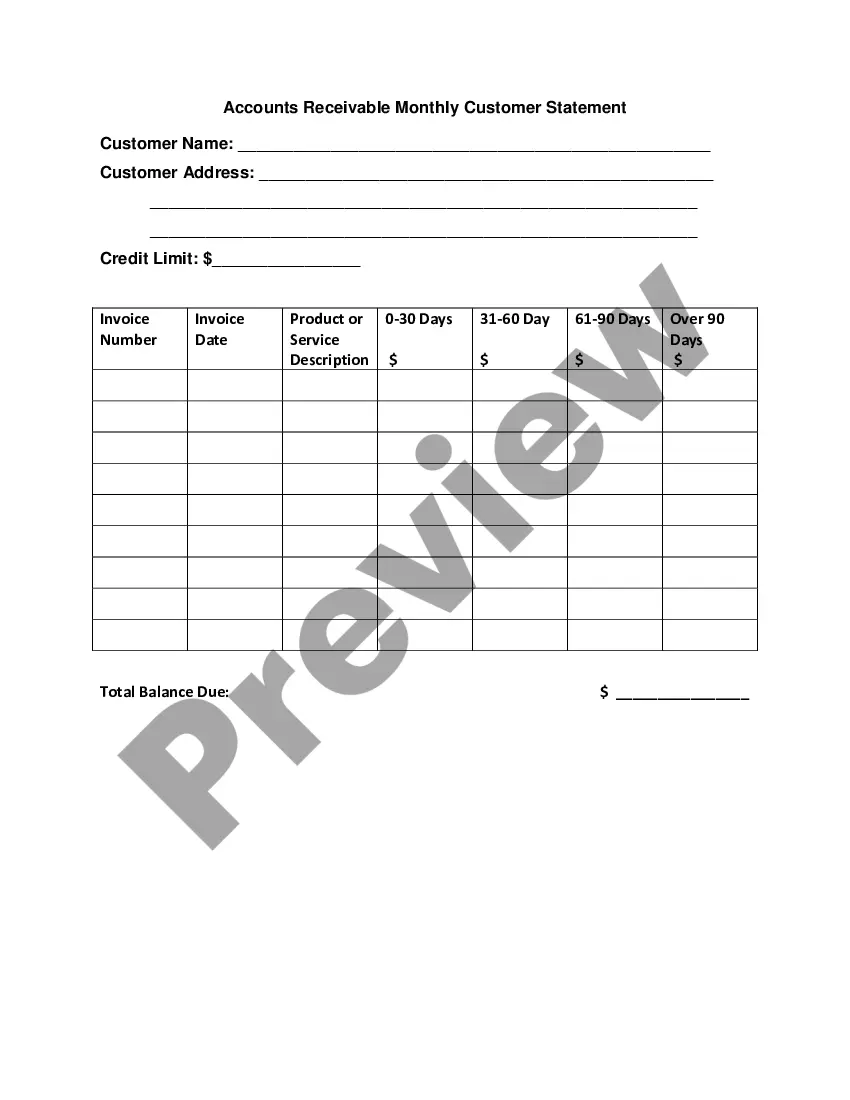
To create a statement for a customer, begin by compiling all relevant transaction data for their account. Utilize accounting software or templates that can generate an Ohio Accounts Receivable Monthly Customer Statement. Input necessary information, such as customer details, transaction dates, and amounts owed. Review the statement for accuracy before sending it to the customer, ensuring they have a clear understanding of their financial standing.
An account statement for accounts receivable is a financial document that summarizes a customer's transaction history over a specified period. In the context of an Ohio Accounts Receivable Monthly Customer Statement, it reflects all charges, credits, and payments related to that account. This statement serves as a crucial tool for both businesses and customers to track outstanding balances and financial obligations. Understanding this document helps maintain healthy financial relationships.
An effective Ohio Accounts Receivable Monthly Customer Statement should include the customer's name, account number, and the statement date. Detail each transaction, including invoice dates, amounts, and payments. Don't forget to highlight the total balance due, and any applicable terms or notes to clarify payment expectations. This transparency fosters trust and encourages timely payments.
To prepare an Ohio Accounts Receivable Monthly Customer Statement, start by gathering all transaction data for the month. Include details such as invoices issued, payments received, and any outstanding balances. Ensure you format the statement clearly, listing each item chronologically. This organized approach helps customers easily understand their account activity.
Ing to US GAAP, the company's accounts receivable balance must be stated at ?net realizable value?. In basic terms, this just means that the accounts receivable balance presented in the company's financial statements must be equal to the amount of cash they expect to collect from customers.
An account statement is a periodic statement summarizing account activity over a set period of time. Account statements can be thought of as a summary of the account and include statements of services provided, fees charged, and money owed.
An account receivable is an asset recorded on the balance sheet as a result of an unpaid sales transaction, explains BDC Advisory Services Senior Business Advisor Nicolas Fontaine. ?More specifically, it is a monetary asset that will realize its value once it is paid and converts into cash.
The Accounts Receivables Statements are documents that itemize all invoices, payments, and credits created during a specific time period, and whose intention is to remind the account holder of their account status. Statements can be mailed, emailed, faxed, or previewed.
Accounts receivable are listed on the balance sheet as a current asset. Any amount of money owed by customers for purchases made on credit is AR.
The Accounts Receivables Statements are documents that itemize all invoices, payments, and credits created during a specific time period, and whose intention is to remind the account holder of their account status.