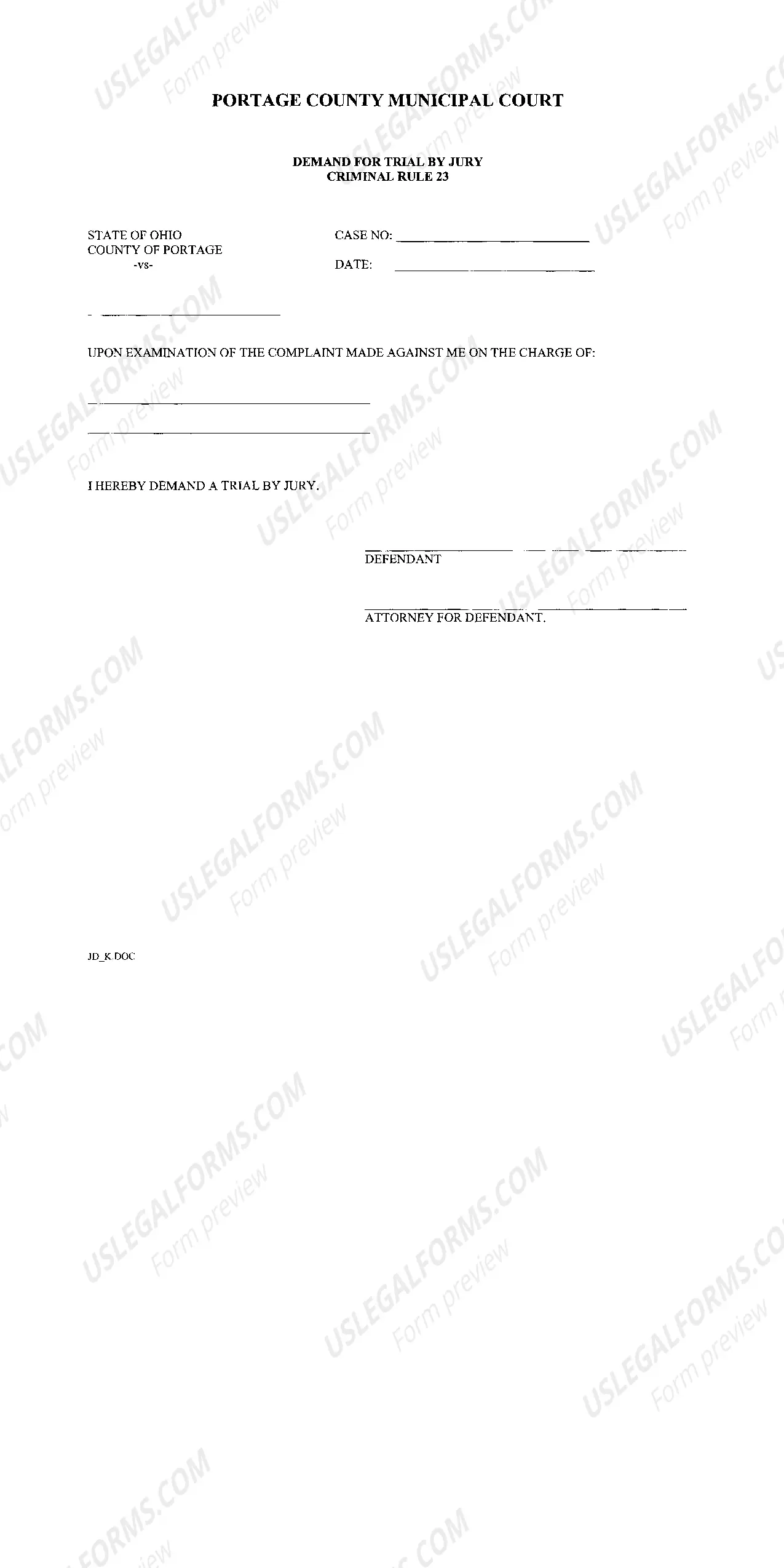
Ohio Demand For Trial By Jury - Criminal Rule 23
Description
Get your form ready online
Our built-in tools help you complete, sign, share, and store your documents in one place.
Make edits, fill in missing information, and update formatting in US Legal Forms—just like you would in MS Word.
Download a copy, print it, send it by email, or mail it via USPS—whatever works best for your next step.
Sign and collect signatures with our SignNow integration. Send to multiple recipients, set reminders, and more. Go Premium to unlock E-Sign.
If this form requires notarization, complete it online through a secure video call—no need to meet a notary in person or wait for an appointment.
We protect your documents and personal data by following strict security and privacy standards.

Make edits, fill in missing information, and update formatting in US Legal Forms—just like you would in MS Word.

Download a copy, print it, send it by email, or mail it via USPS—whatever works best for your next step.

Sign and collect signatures with our SignNow integration. Send to multiple recipients, set reminders, and more. Go Premium to unlock E-Sign.

If this form requires notarization, complete it online through a secure video call—no need to meet a notary in person or wait for an appointment.

We protect your documents and personal data by following strict security and privacy standards.
Looking for another form?


How to fill out Ohio Demand For Trial By Jury - Criminal Rule 23?
US Legal Forms is the most easy and affordable way to find suitable formal templates. It’s the most extensive web-based library of business and individual legal documentation drafted and checked by attorneys. Here, you can find printable and fillable blanks that comply with national and local regulations - just like your Ohio Demand For Trial By Jury - Criminal Rule 23.
Getting your template takes just a couple of simple steps. Users that already have an account with a valid subscription only need to log in to the web service and download the document on their device. Later, they can find it in their profile in the My Forms tab.
And here’s how you can obtain a properly drafted Ohio Demand For Trial By Jury - Criminal Rule 23 if you are using US Legal Forms for the first time:
- Read the form description or preview the document to make sure you’ve found the one corresponding to your needs, or locate another one utilizing the search tab above.
- Click Buy now when you’re certain about its compatibility with all the requirements, and select the subscription plan you like most.
- Create an account with our service, sign in, and purchase your subscription using PayPal or you credit card.
- Select the preferred file format for your Ohio Demand For Trial By Jury - Criminal Rule 23 and download it on your device with the appropriate button.
After you save a template, you can reaccess it whenever you want - simply find it in your profile, re-download it for printing and manual fill-out or import it to an online editor to fill it out and sign more efficiently.
Take full advantage of US Legal Forms, your reliable assistant in obtaining the corresponding official paperwork. Try it out!
Form popularity
FAQ
Responses to motions for summary judgment may be served within twenty-eight days after service of the motion. A movant's reply to a response to any written motion may be served within seven days after service of the response to the motion.
In Ohio, persons are selected for jury service by random drawing from either a list of registered voters or a combined list of the registered votes and the list of licensed drivers residing in the county or city that the court serves.
(B) Demand. Any party may demand a trial by jury on any issue triable of right by a jury by serving upon the other parties a demand therefor at any time after the commencement of the action and not later than fourteen days after the service of the last pleading directed to such issue.
(C) Challenge for cause. A person called as a juror may be challenged for the following causes: (1) That the juror has been convicted of a crime which by law renders the juror disqualified to serve on a jury. (2) That the juror is a chronic alcoholic, or drug dependent person.
In its demand, a party may specify the issues that it wishes to have tried by a jury; otherwise, it is considered to have demanded a jury trial on all the issues so triable.
Rule 32.3 - Revocation of Probation (A) Hearing. The court shall not impose a prison term for violation of the conditions of a community control sanction or revoke probation except after a hearing at which the defendant shall be present and apprised of the grounds on which action is proposed.
Rule 37 - Failure to Make Discovery: Sanctions (A) Motion for order compelling discovery. (1) In general. On notice to other parties and all affected persons, a party may move for an order compelling discovery.
In a case tried without a jury, the court must find the defendant guilty or not guilty. If a party requests before the finding of guilty or not guilty, the court must state its specific findings of fact in open court or in a written decision or opinion.