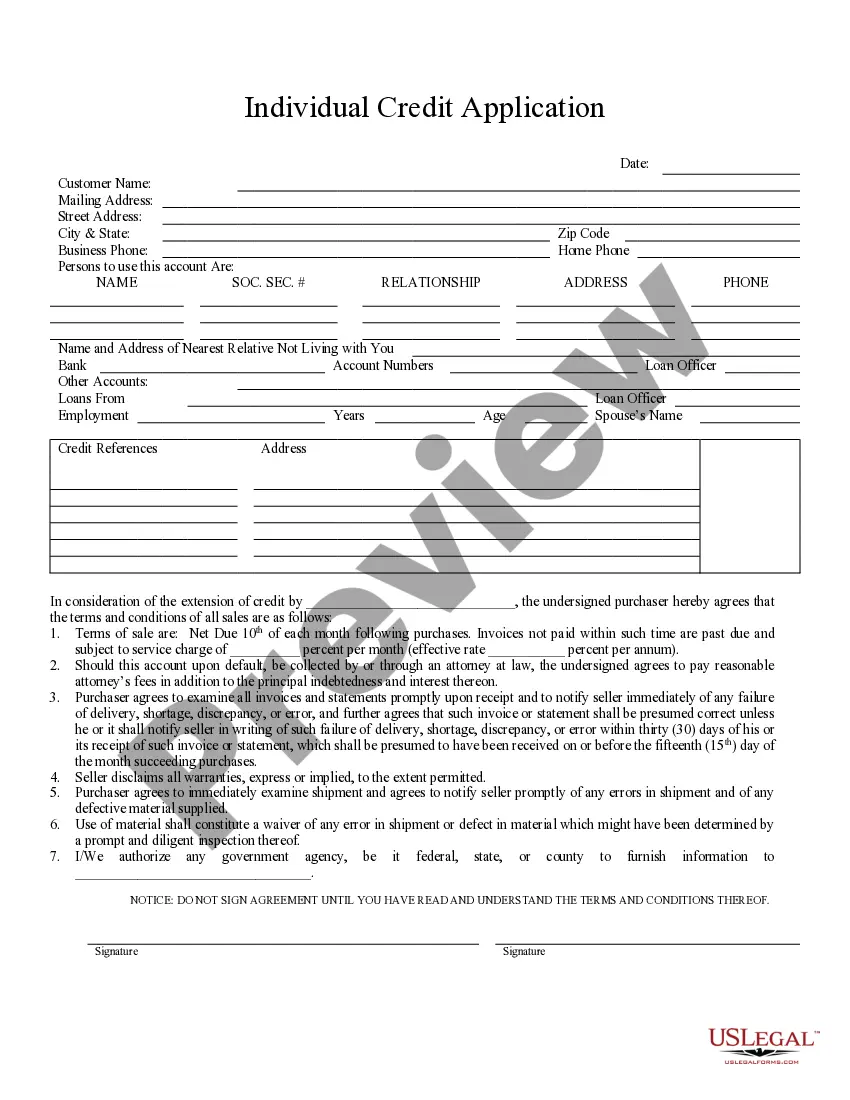
Ohio Individual Credit Application
What this document covers
The Individual Credit Application is a legal document used by individuals seeking to obtain credit for purchases. This form outlines the conditions of credit extension, including repayment terms, default provisions, and permissions for sellers to access personal information. It serves as a formal request that not only specifies the terms but also ensures both parties understand their rights and responsibilities, distinguishing it from other credit applications by its detailed clauses and conditions.
Key components of this form
- Terms of Sale: Specifies payment timelines and interest charges on late payments.
- Default Provisions: Details consequences of non-payment and potential attorney fees.
- Invoice Notification: Requires the purchaser to review invoices promptly and report discrepancies.
- Disclaimers: Seller disclaims implied warranties to protect against liability.
- Authorization Clause: Grants permission for the seller to obtain personal information from governmental agencies.
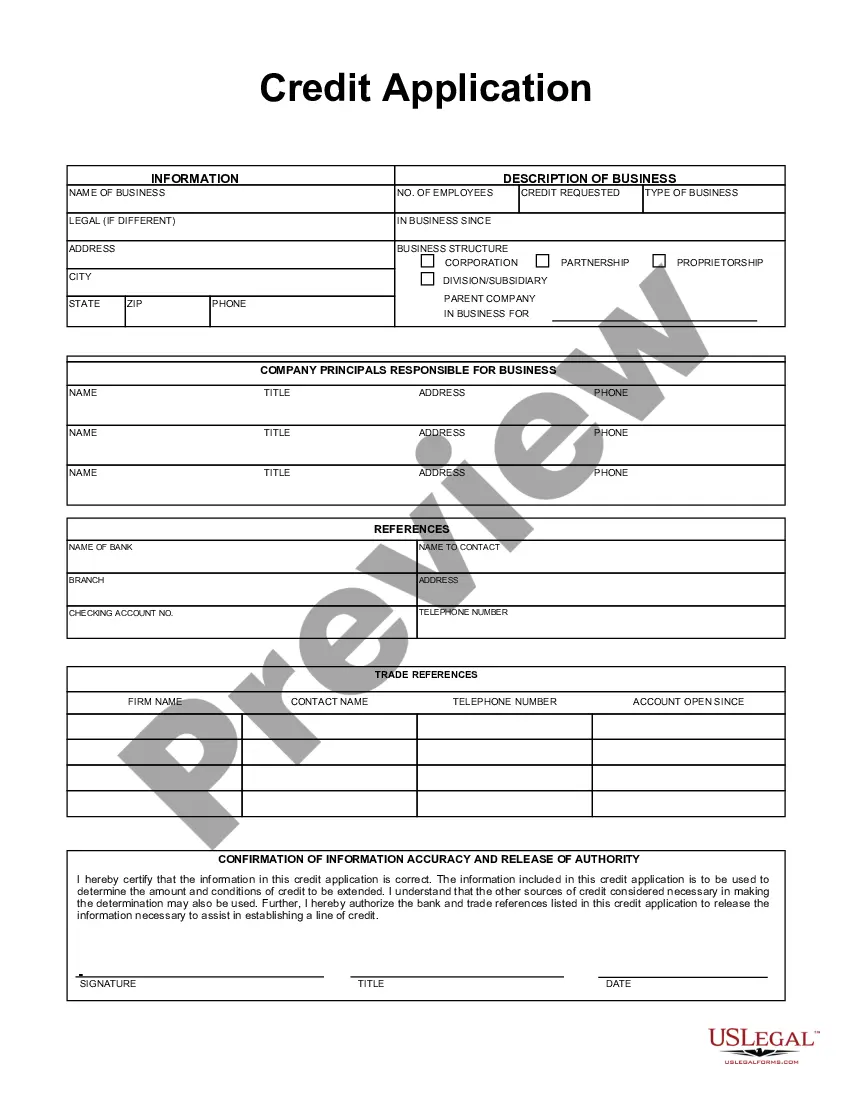



When this form is needed
You should use the Individual Credit Application when applying for credit in situations such as purchasing consumer goods, leasing equipment, or seeking financing for services. It is especially useful when a seller requires documentation to assess creditworthiness and to outline specific terms that govern the purchase agreement.
Who this form is for
This form is intended for:
- Individuals requesting credit from a business or seller.
- Small business owners seeking personal credit for company-related purchases.
- Consumers intending to make large purchases requiring financing.
How to prepare this document
- Identify the parties involved, including the buyer and seller information.
- Specify the payment details, including repayment timeline and interest rates.
- Include any applicable default provisions and service charges for late payments.
- Review and sign the authorization clause for personal information release.
- Carefully read the terms and ensure you understand them before signing.
Does this form need to be notarized?
Notarization is not commonly needed for this form. However, certain documents or local rules may make it necessary. Our notarization service, powered by Notarize, allows you to finalize it securely online anytime, day or night.
Get your form ready online
Our built-in tools help you complete, sign, share, and store your documents in one place.
Make edits, fill in missing information, and update formatting in US Legal Forms—just like you would in MS Word.
Download a copy, print it, send it by email, or mail it via USPS—whatever works best for your next step.
Sign and collect signatures with our SignNow integration. Send to multiple recipients, set reminders, and more. Go Premium to unlock E-Sign.
If this form requires notarization, complete it online through a secure video call—no need to meet a notary in person or wait for an appointment.
We protect your documents and personal data by following strict security and privacy standards.

Make edits, fill in missing information, and update formatting in US Legal Forms—just like you would in MS Word.

Download a copy, print it, send it by email, or mail it via USPS—whatever works best for your next step.

Sign and collect signatures with our SignNow integration. Send to multiple recipients, set reminders, and more. Go Premium to unlock E-Sign.

If this form requires notarization, complete it online through a secure video call—no need to meet a notary in person or wait for an appointment.

We protect your documents and personal data by following strict security and privacy standards.
Typical mistakes to avoid
- Not reviewing all terms and conditions before signing the agreement.
- Failing to notify the seller about any discrepancies in invoices within the specified time frame.
- Overlooking the importance of the authorization clause, which may affect credit evaluation.
Why use this form online
- Convenient access to legal documentation from anywhere at any time.
- Editable templates allow for personalization to suit specific situations.
- Reliable resources drafted by licensed attorneys ensure legal compliance.
Looking for another form?
Form popularity
FAQ
Single: $12,200 Up from $12,000 for 2018. Married filing jointly or qualifying widow: $24,400 Up from $24,000 for 2018. Married filing separately: $12,200 Up from $12,000 for 2018. Head of household: $18,350 Up from $18,000 for 2018.
No. According to the information that the IRS provides, you only need to file your 2020 tax return, which is the return for last year. The reason this return is important is that it provides a way for you to claim your Recovery Rebate Credit.
There are two types of exemptions: personal exemptions and dependent exemptions. Personal Exemptions: You may generally claim one tax exemption for yourself if you are a single taxpayer. If you are married and file a joint return, you may claim one tax exemption for yourself and one for your spouse.
Ohio does not have a state standard deduction, nor do they use the federal standard deduction amounts.
Ohio residents are eligible for the resident credit on any non-Ohio income if they were subject to, and paid tax on, that income in another state.Nonresidents who earn or receive income within Ohio will be able to claim the nonresident credit with respect to all items of income not earned and not received in Ohio.
The Ohio Form IT-4, Employee's Withholding Exemption Certificate, must be completed so that you know how much state income tax to withhold from your new employee's wages.If for some reason an employee does not file one, you must withhold tax as if the employee had claimed no exemptions.
There will be no personal exemption amount for 2019. The personal exemption amount was set to zero (0) under the Tax Cuts and Jobs Act. Kiddie Tax. The kiddie tax applies to unearned income for children under the age of 19 and college students under the age of 24.
It appears the an IT-1040 is the Ohio income tax form.It appears that most people with any almost any OH income (residents or business or property in OH) will need to file an IT-1040, unless they look closely at the exceptions.
You are entitled to a $1,850 - $2,350 deduction for each dependent exemption depending on your modified adjusted gross income. NOTE: You must claim the same number of personal and dependent exemptions on your Ohio return that you claimed on your federal return.