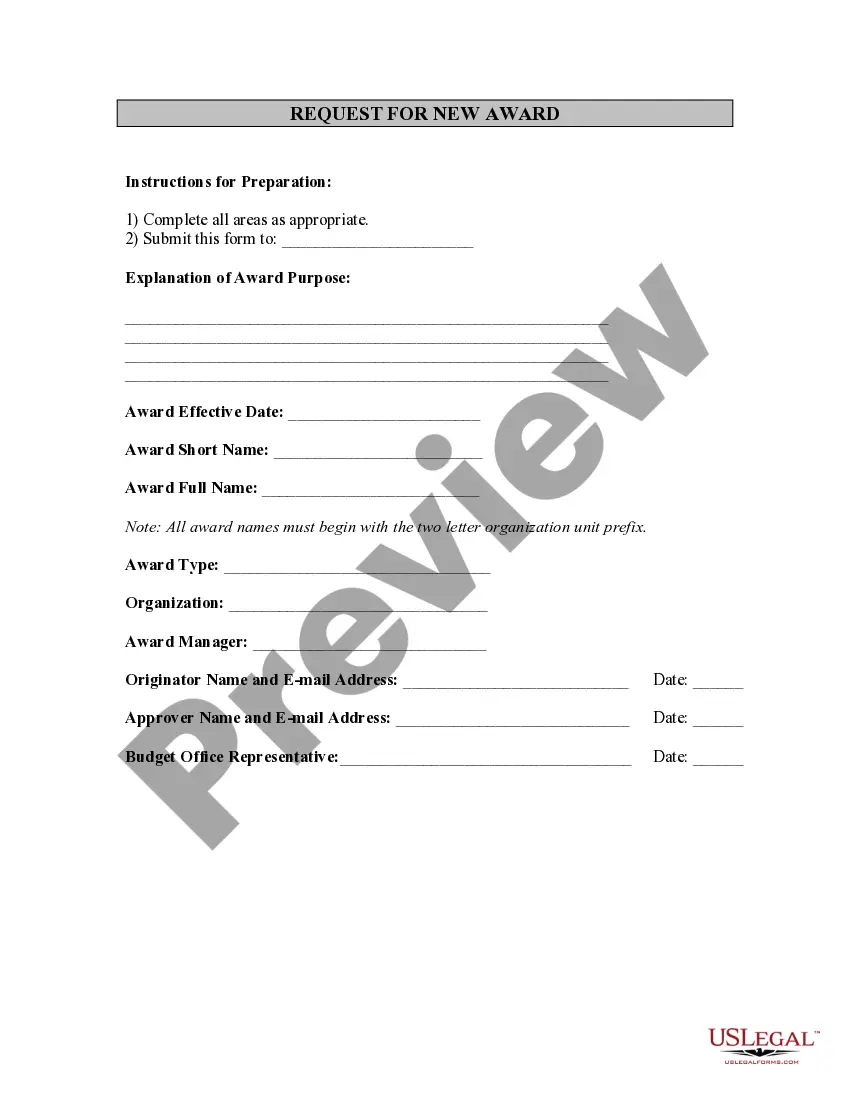
New York Request for New Award
Description
Get your form ready online
Our built-in tools help you complete, sign, share, and store your documents in one place.
Make edits, fill in missing information, and update formatting in US Legal Forms—just like you would in MS Word.
Download a copy, print it, send it by email, or mail it via USPS—whatever works best for your next step.
Sign and collect signatures with our SignNow integration. Send to multiple recipients, set reminders, and more. Go Premium to unlock E-Sign.
If this form requires notarization, complete it online through a secure video call—no need to meet a notary in person or wait for an appointment.
We protect your documents and personal data by following strict security and privacy standards.

Make edits, fill in missing information, and update formatting in US Legal Forms—just like you would in MS Word.

Download a copy, print it, send it by email, or mail it via USPS—whatever works best for your next step.

Sign and collect signatures with our SignNow integration. Send to multiple recipients, set reminders, and more. Go Premium to unlock E-Sign.

If this form requires notarization, complete it online through a secure video call—no need to meet a notary in person or wait for an appointment.

We protect your documents and personal data by following strict security and privacy standards.
Looking for another form?
How to fill out Request For New Award?
It is feasible to spend hours online looking for the legal document template that aligns with the state and federal requirements you need.
US Legal Forms offers a multitude of legal documents that have been reviewed by professionals.
You can download or generate the New York Request for New Award from the platform.
If available, take advantage of the Preview option to review the document template as well.
- If you already have a US Legal Forms account, you can Log In and click on the Acquire button.
- Then, you can complete, edit, print, or sign the New York Request for New Award.
- Every legal document template you purchase is yours permanently.
- To obtain an additional copy of any purchased form, visit the My documents tab and select the appropriate option.
- If you are using the US Legal Forms website for the first time, follow the simple instructions below.
- First, be sure you have selected the correct document template for the area/city of your choice.
- Read the form description to ensure you have chosen the right document.
Form popularity
FAQ
Top scholarships for SUNY students often include the SUNY Chancellor's Scholarship, the SUNY Honor Scholarship, and various campus-specific awards. These scholarships support outstanding academic performance and are accessible to many students in the SUNY system. When you're preparing your New York Request for New Award, researching these opportunities can enhance your chances of receiving financial support.
The Benefit Verification letter, sometimes called a "budget letter," a "benefits letter," a "proof of income letter," or a "proof of award letter," serves as proof of your retirement, disability, Supplemental Security Income (SSI), or Medicare benefits.
The processing of a TAP application may take three to five weeks. During certain times of the academic year processing times for "Requests for Information" and "Change Forms" may vary depending on additional review needed for income verification or residency review.
Most schools will send a revised award letter whenever the student's EFC or cost of attendance changes. Some schools will only send a revised award letter when the amount of financial aid or the composition of the financial aid package changes.
Notification of Award means the official notice issued by the Employer notifying the Contractor that his bid has been accepted.
It is intended to help you fill the gap between your ability to pay, your expected family contribution or EFC, and college costs, or the cost of attendance or COA. After you receive the award letter, you may be asked to return a signed copy of the letter in which you accept or reject each source of financial aid.
An award letter is the documentation sent from a college or university to the student that details how much financial support the student is eligible to receive.
The Notice of Award (NoA) is the official legal document1 issued to the grantee that indicates a federal grant award has been made and funds may be requested to be used, and reported on, in the approved manner. It is sometimes called a Notice of Grant Award (NGA).
An award letter is the documentation sent from a college or university to the student that details how much financial support the student is eligible to receive.
A Social Security Administration (SSA) award letter confirms that you have been approved for benefits. Unsurprisingly, these letters are sometimes also referred to as benefit letters. These are usually sent to people who have applied for disability coverage, as well as other Social Security programs.