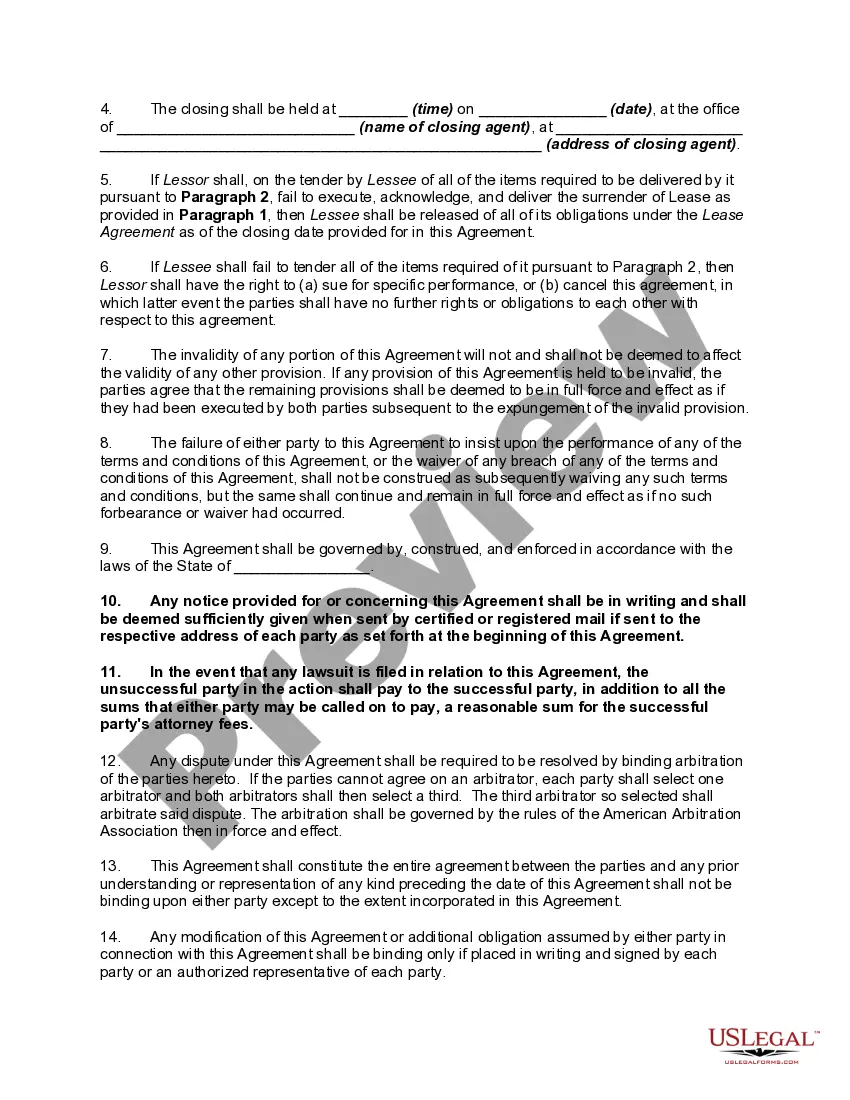
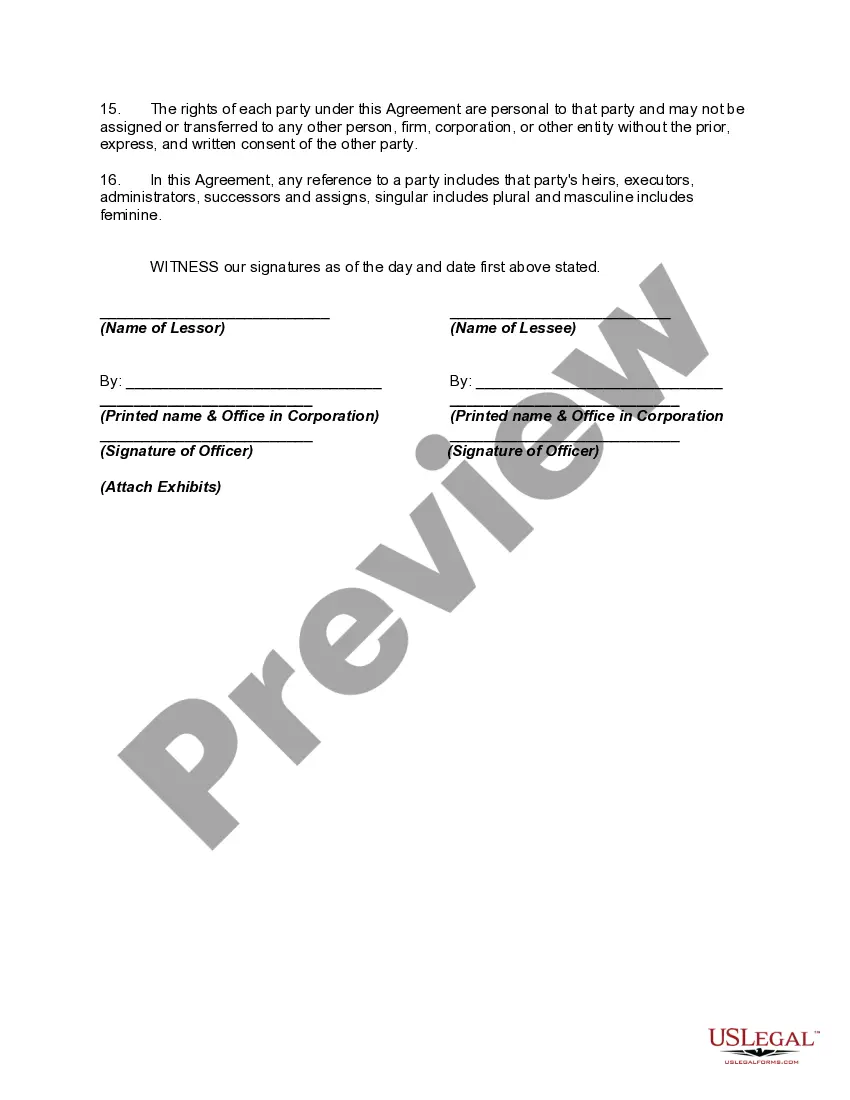
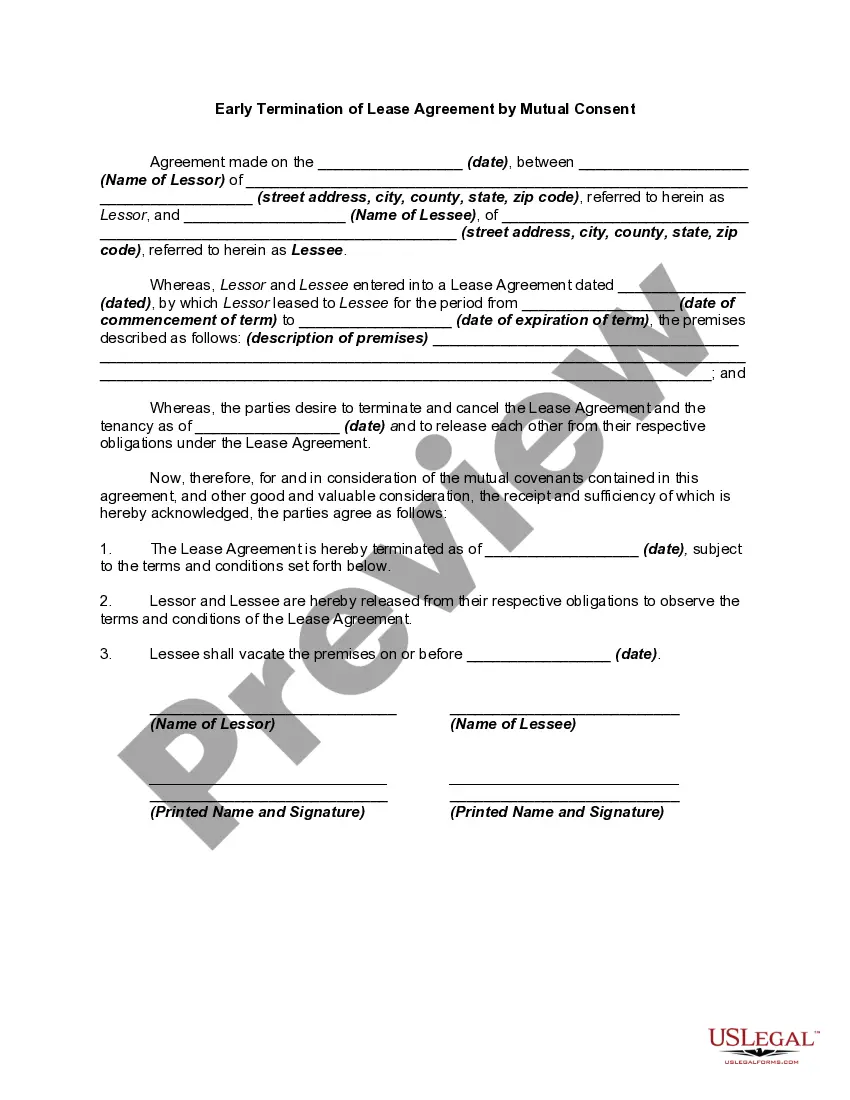
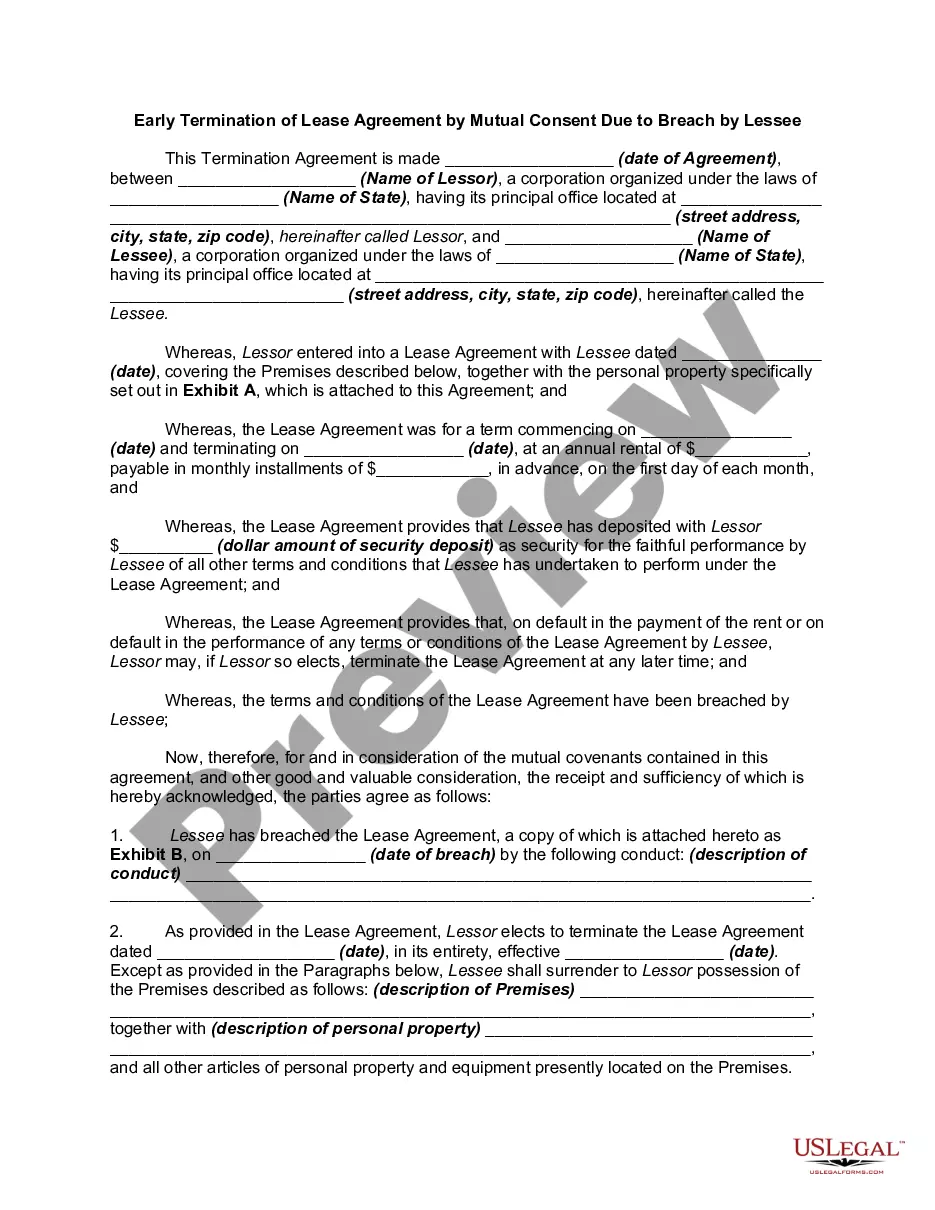
New York Agreement to Terminate Lease Agreement by Mutual Consent upon Termination of Lessee's Business
Description
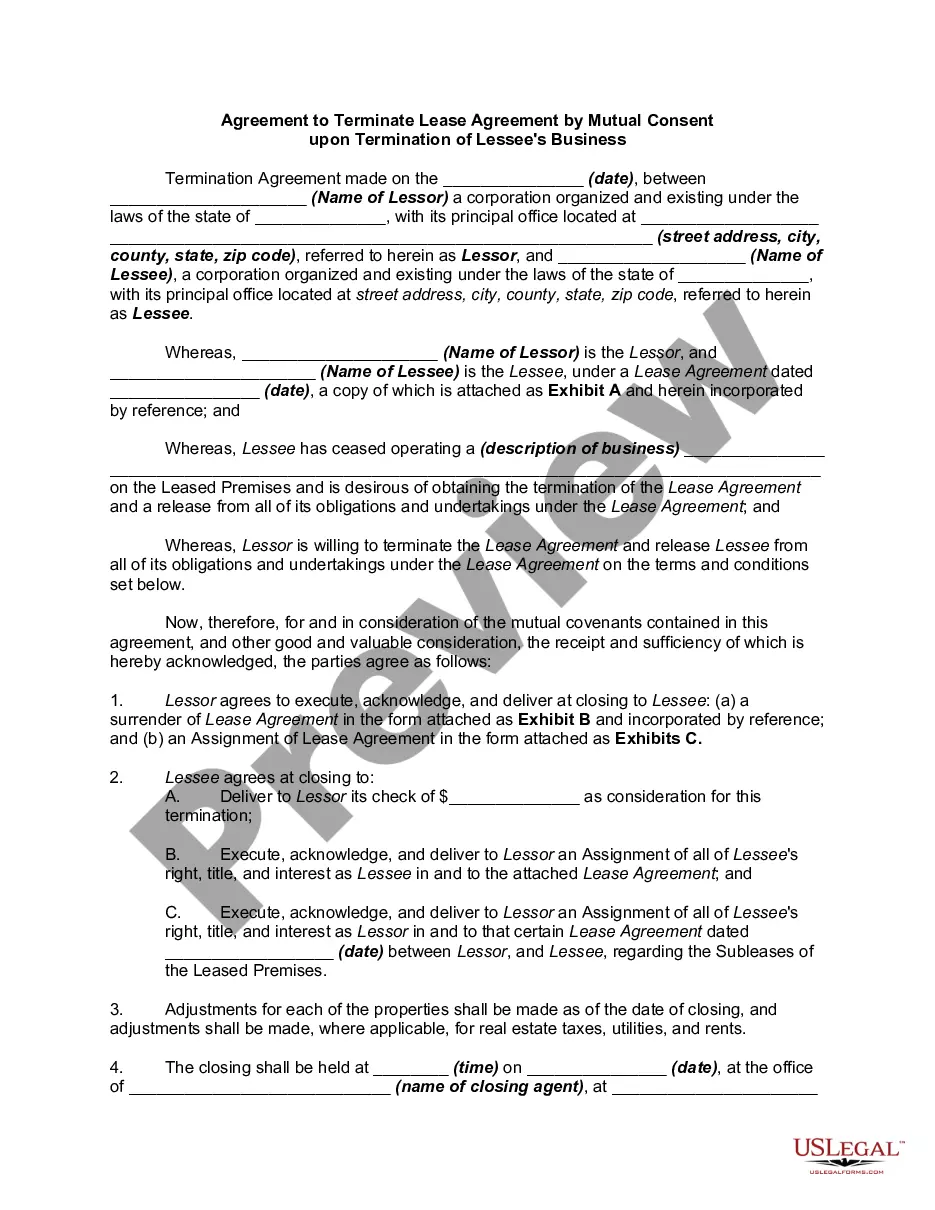
Get your form ready online
Our built-in tools help you complete, sign, share, and store your documents in one place.
Make edits, fill in missing information, and update formatting in US Legal Forms—just like you would in MS Word.
Download a copy, print it, send it by email, or mail it via USPS—whatever works best for your next step.
Sign and collect signatures with our SignNow integration. Send to multiple recipients, set reminders, and more. Go Premium to unlock E-Sign.
If this form requires notarization, complete it online through a secure video call—no need to meet a notary in person or wait for an appointment.
We protect your documents and personal data by following strict security and privacy standards.

Make edits, fill in missing information, and update formatting in US Legal Forms—just like you would in MS Word.

Download a copy, print it, send it by email, or mail it via USPS—whatever works best for your next step.

Sign and collect signatures with our SignNow integration. Send to multiple recipients, set reminders, and more. Go Premium to unlock E-Sign.

If this form requires notarization, complete it online through a secure video call—no need to meet a notary in person or wait for an appointment.

We protect your documents and personal data by following strict security and privacy standards.
Looking for another form?
How to fill out Agreement To Terminate Lease Agreement By Mutual Consent Upon Termination Of Lessee's Business?
US Legal Forms - one of the largest repositories of legal documents in the United States - provides a range of legal document formats you can obtain or print.
By utilizing the website, you can discover thousands of documents for business and personal purposes, sorted by categories, states, or keywords.
You can access the latest versions of documents such as the New York Agreement to Terminate Lease Agreement by Mutual Consent upon Termination of Lessee's Business in moments.
In case the document doesn’t meet your needs, utilize the Search field at the top of the screen to find the one that does.
If you are satisfied with the document, confirm your choice by clicking the Acquire now button. Then, select your preferred pricing plan and provide your details to create an account.
- If you already have an account, Log In and download the New York Agreement to Terminate Lease Agreement by Mutual Consent upon Termination of Lessee's Business from the US Legal Forms library.
- The Download button is available on every document you view.
- You can access all previously acquired documents from the My documents section of your account.
- If you are using US Legal Forms for the first time, here are simple steps to get you started.
- Make sure you have chosen the correct document for your area/region.
- Select the Preview button to review the document's contents.
Form popularity
FAQ
A landlord can't force you to move out before the lease ends, unless you fail to pay the rent or violate another significant term, such as repeatedly throwing large and noisy parties. In these cases, landlords in New York must follow specific procedures to end the tenancy.
In general, most states allow a landlord to terminate a lease or rental agreement if the tenant: Fails to pay rent; Violates a clause in the lease or rental agreement; Violates a responsibility imposed by law.
In general, you can only end the tenancy early if your landlord agrees. Your landlord does not necessarily have to do so. You will remain responsible for paying the rent until the end of the tenancy contract or the next break clause point.
Breaking a lease usually means paying between one and two months of rent as a penaltywhich in New York can be a significant chunk of change. Try these tips to reduce or get rid of your penalty fee.
NYS Tenant Safe Harbor Act (TSHA)Tenants who can prove they had financial hardship during the State COVID-19 emergency period (March 7, 2020 to June 24, 2021) may have a defense in court to eviction for non-payment of rent owed during that period, under the NYS Tenant Safe Harbor Act.
Dear Landlord, This letter will constitute written notice of my intention to vacate my apartment on date, the end of my current lease. I am doing so because explain the reason if you desire, such as a large increase in rent. Please recall that I made a security deposit of $ on date.
You may owe a penalty fee or lose your security deposit. In many cases, a landlord will let you out of your lease early as long as you pay a termination fee. The amount can vary. For Puliti, it was two months' rent, plus whatever she owed until her move-out date.
3 Steps to Break My Lease Read your lease. Read through your entire lease and confirm your lease end date. Reach out to your landlord and explain your situation. Ask to end your lease early. Post your apartment details on Leasebreak.com to try to find a new tenant.
A landlord can't force you to move out before the lease ends, unless you fail to pay the rent or violate another significant term, such as repeatedly throwing large and noisy parties. In these cases, landlords in New York must follow specific procedures to end the tenancy.