New York Reasonable Doubt by Single Juror
Description
Get your form ready online
Our built-in tools help you complete, sign, share, and store your documents in one place.
Make edits, fill in missing information, and update formatting in US Legal Forms—just like you would in MS Word.
Download a copy, print it, send it by email, or mail it via USPS—whatever works best for your next step.
Sign and collect signatures with our SignNow integration. Send to multiple recipients, set reminders, and more. Go Premium to unlock E-Sign.
If this form requires notarization, complete it online through a secure video call—no need to meet a notary in person or wait for an appointment.
We protect your documents and personal data by following strict security and privacy standards.

Make edits, fill in missing information, and update formatting in US Legal Forms—just like you would in MS Word.

Download a copy, print it, send it by email, or mail it via USPS—whatever works best for your next step.

Sign and collect signatures with our SignNow integration. Send to multiple recipients, set reminders, and more. Go Premium to unlock E-Sign.

If this form requires notarization, complete it online through a secure video call—no need to meet a notary in person or wait for an appointment.

We protect your documents and personal data by following strict security and privacy standards.
Looking for another form?






How to fill out Reasonable Doubt By Single Juror?
You can spend hours online trying to locate the legal document format that meets the state and federal requirements you need.
US Legal Forms provides thousands of legal documents that are reviewed by experts.
It is easy to obtain or print the New York Reasonable Doubt by Single Juror from my service.
If available, use the Review button to examine the format as well. If you wish to find another version of the form, use the Lookup field to discover the format that fits your requirements and needs. Once you have found the format you want, click Purchase now to proceed. Select the payment plan you prefer, enter your details, and register for an account on US Legal Forms. Complete the transaction. You can use your credit card or PayPal account to pay for the legal document. Choose the format of the file and download it to your device. Make changes to the document if necessary. You can complete, edit, sign, and print the New York Reasonable Doubt by Single Juror. Download and print thousands of document templates using the US Legal Forms site, which offers the largest selection of legal forms. Utilize professional and state-specific templates to address your business or personal needs.
- If you already have a US Legal Forms account, you can Log In and click the Download button.
- After that, you can complete, modify, print, or sign the New York Reasonable Doubt by Single Juror.
- Each legal document you acquire is yours forever.
- To get another copy of the purchased form, visit the My documents tab and click the appropriate button.
- If you are accessing the US Legal Forms website for the first time, follow the simple instructions below.
- First, ensure that you have selected the correct format for your state/city of choice.
- Read the form description to confirm you have chosen the right document.
Form popularity
FAQ
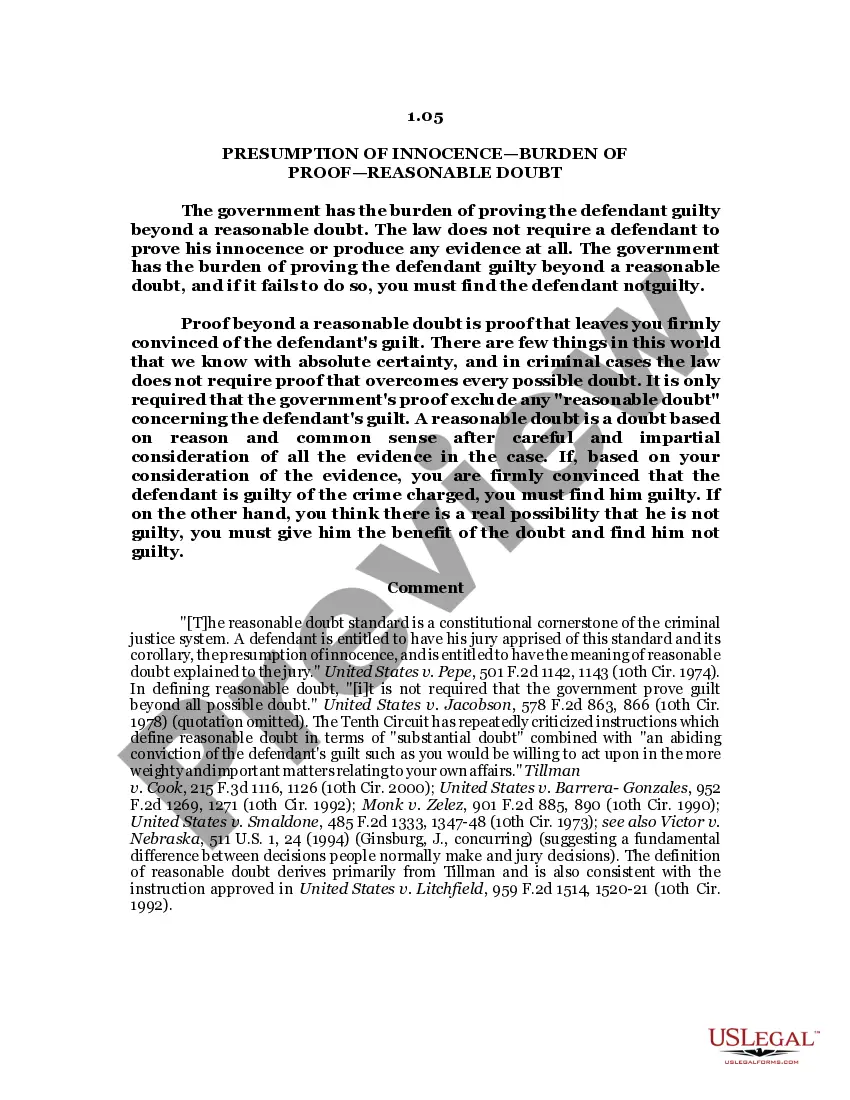
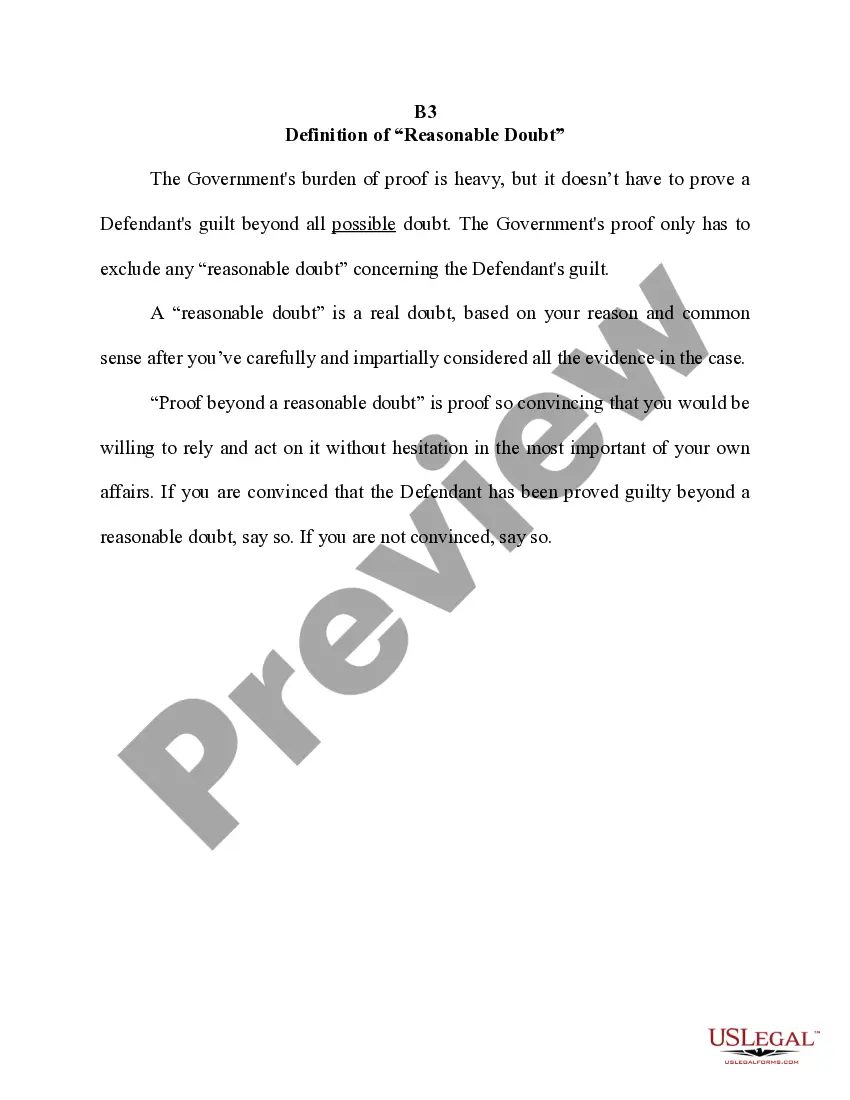
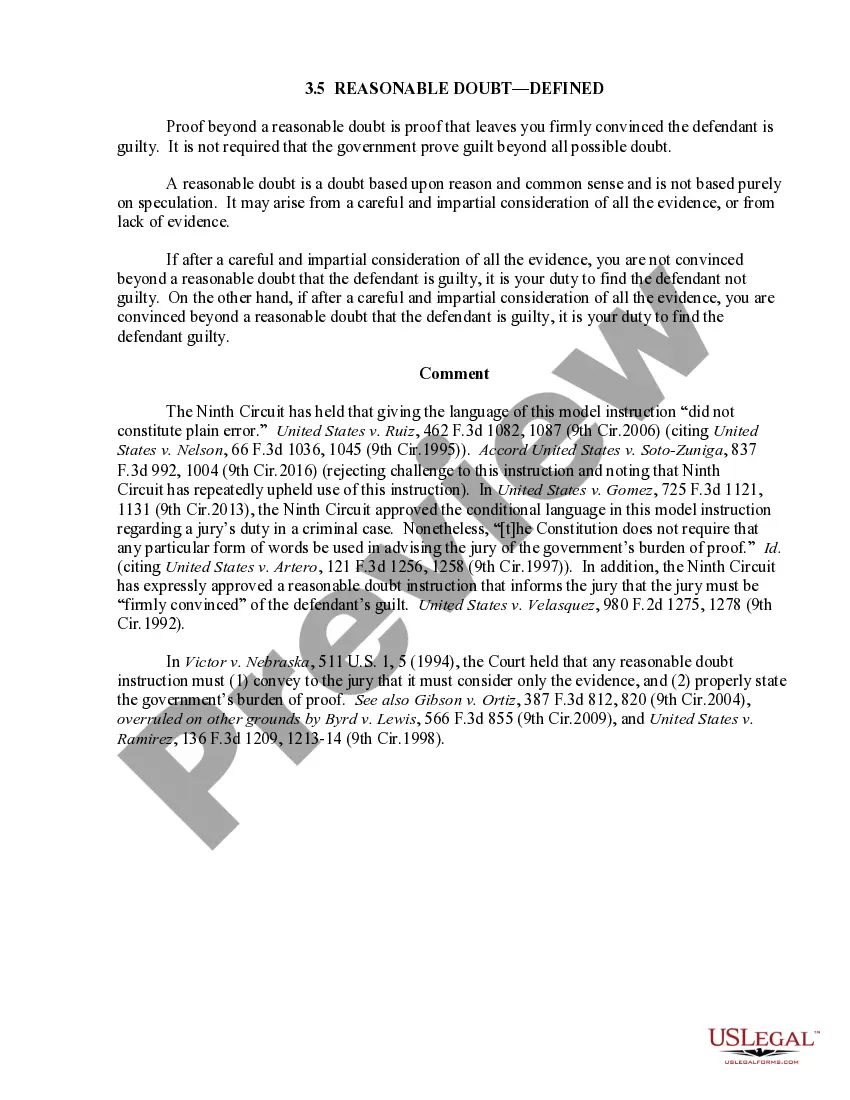
It is not required that the government prove guilt beyond all possible doubt. A reasonable doubt is a doubt based upon reason and common sense and is not based purely on speculation. It may arise from a careful and impartial consideration of all the evidence, or from lack of evidence.
Reasonable doubt is legal terminology referring to insufficient evidence that prevents a judge or jury from convicting a defendant of a crime. It is the traditional standard of proof that must be exceeded to secure a guilty verdict in a criminal case in a court of law.
If you are not convinced beyond a reasonable doubt that the defendant is guilty of a charged crime, you must find the defendant not guilty of that crime. If you are convinced beyond a reasonable doubt that the defendant is guilty of a charged crime, you must find the defendant guilty of that crime. CPL 300.10(2).
A hung jury is when the members of a jury are unable to reach a unanimous decision on whether or not the accused party is guilty beyond reasonable doubt. This occurs when there are opposing opinions among the jurors regarding the outcome of the case.
Reasonable doubt is insufficient evidence that prevents a judge or jury from convicting a defendant of a crime. If it cannot be proved without a doubt that a defendant in a criminal case is guilty, then that person should not be convicted.
The 'missing witness' instruction allows a jury to draw an unfavorable inference when a party fails to call a witness who would normally be expected to support that party's version of events (People v Savinon, 100 NY2d 192, 196 [2003]).
If a juror feels that the definition of reasonable doubt implies that 80% certainty is required to convict, then 80% is the juror's perceived standard of reasonable doubt. In a given case, if the juror feels that it is 90% likely that the defendant committed the crime, then the juror's level of perceived guilt is 90%.
The Impact on Criminal Proceedings The requirement of proof beyond a reasonable doubt acts as a safeguard against wrongful convictions and ensures that the presumption of innocence is upheld. It places a heavy burden on the prosecution to present compelling and credible evidence, leaving no room for lingering doubts.