New York Permanency Hearing Order
What this document covers
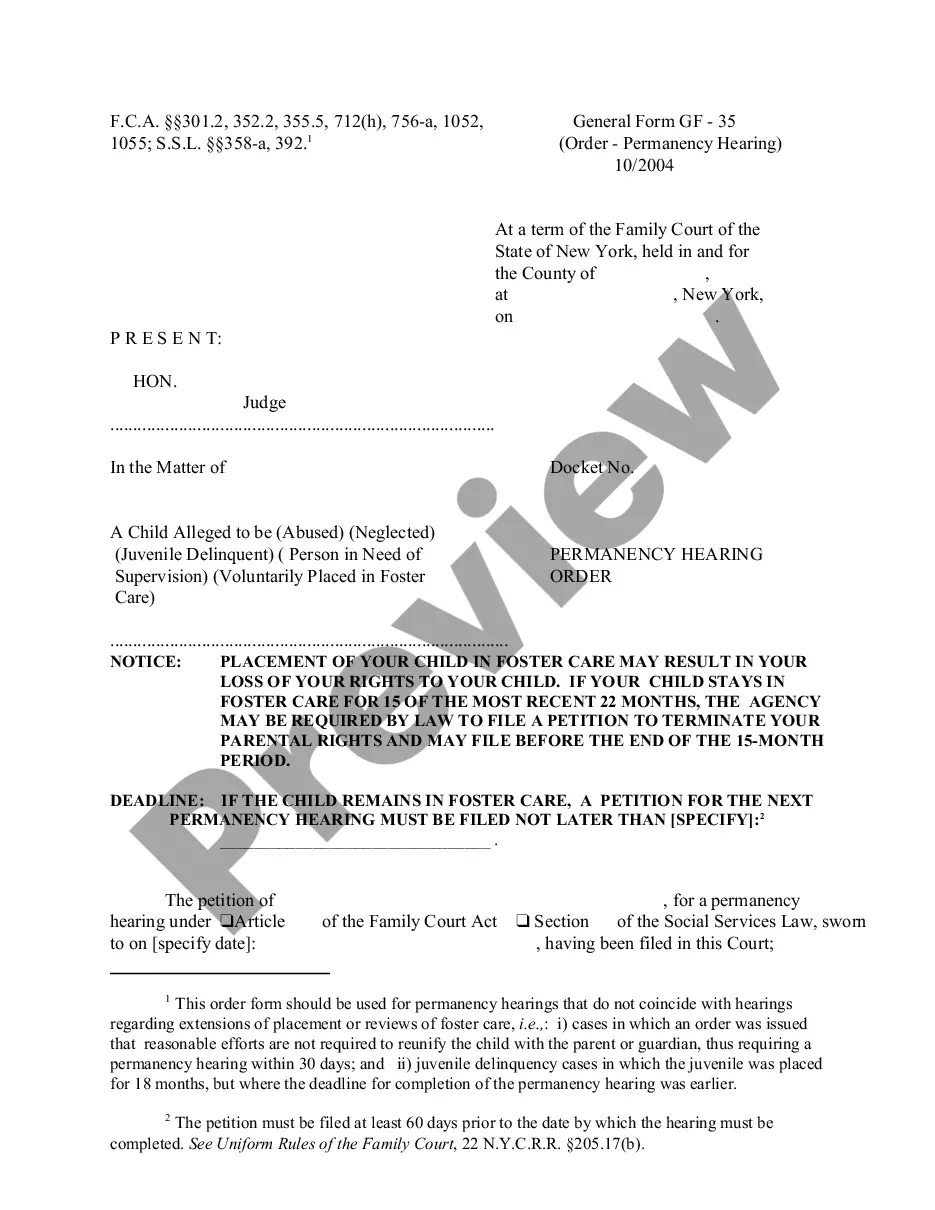
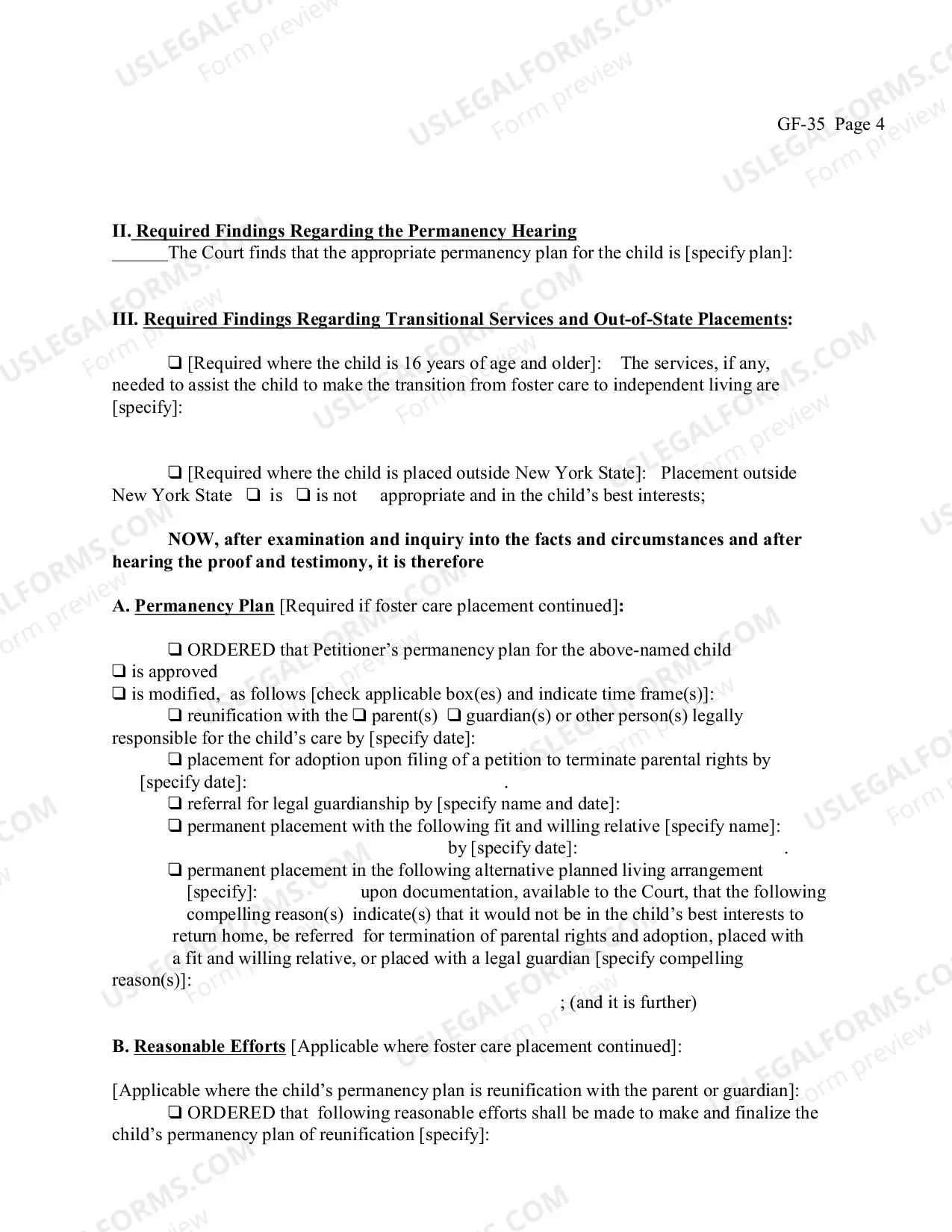
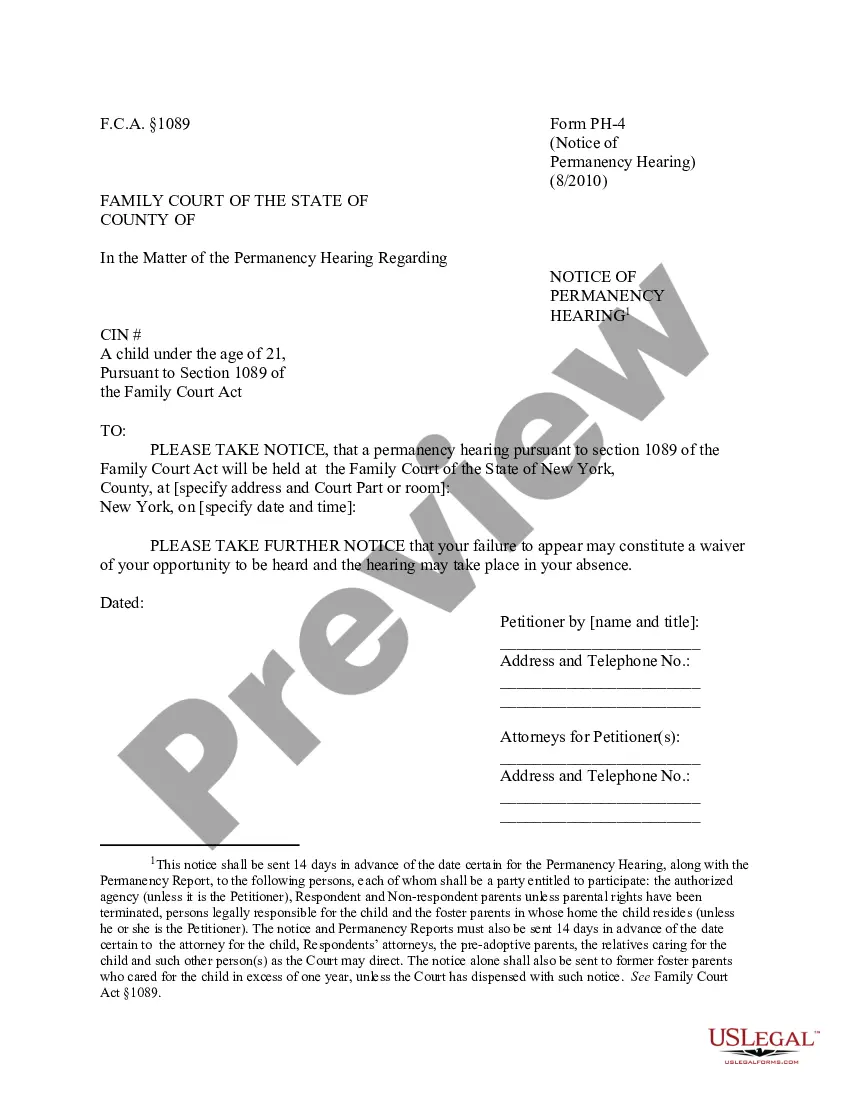
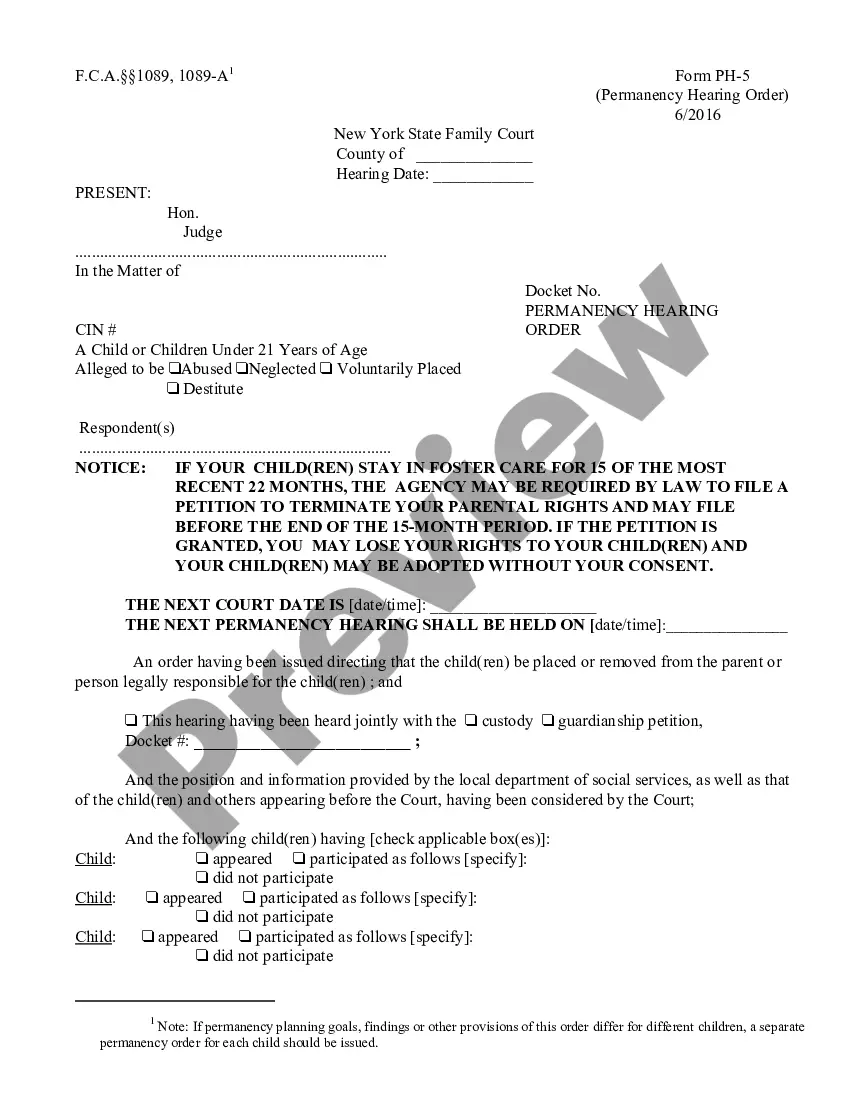
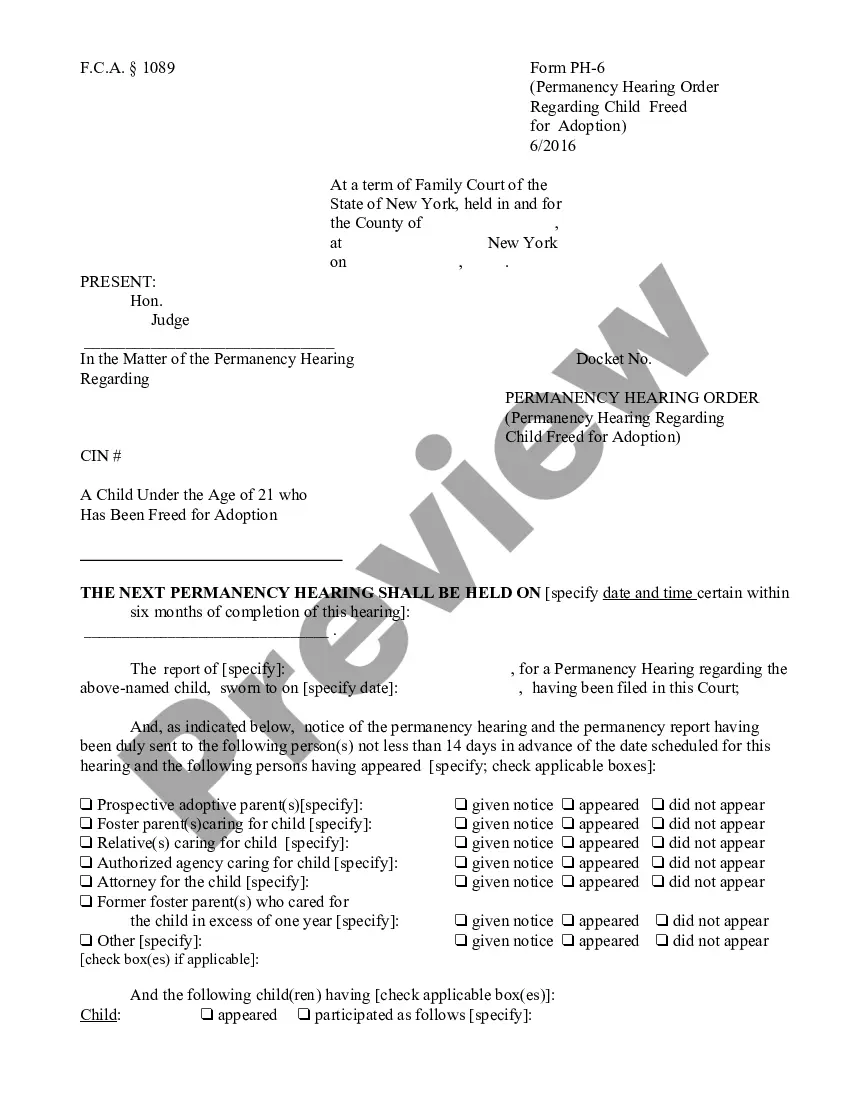
The Permanency Hearing Order is an official legal document used in New York family courts. This order is essential for permanency hearings, specifically for cases that do not coincide with foster care review hearings or extensions of placement. The purpose of this form is to establish a permanency plan for a child, ensuring that their best interests are prioritized in legal proceedings regarding their custody and care. It is distinct from other legal forms related to child welfare by focusing specifically on setting and approving long-term plans for children often placed in foster care.
What’s included in this form
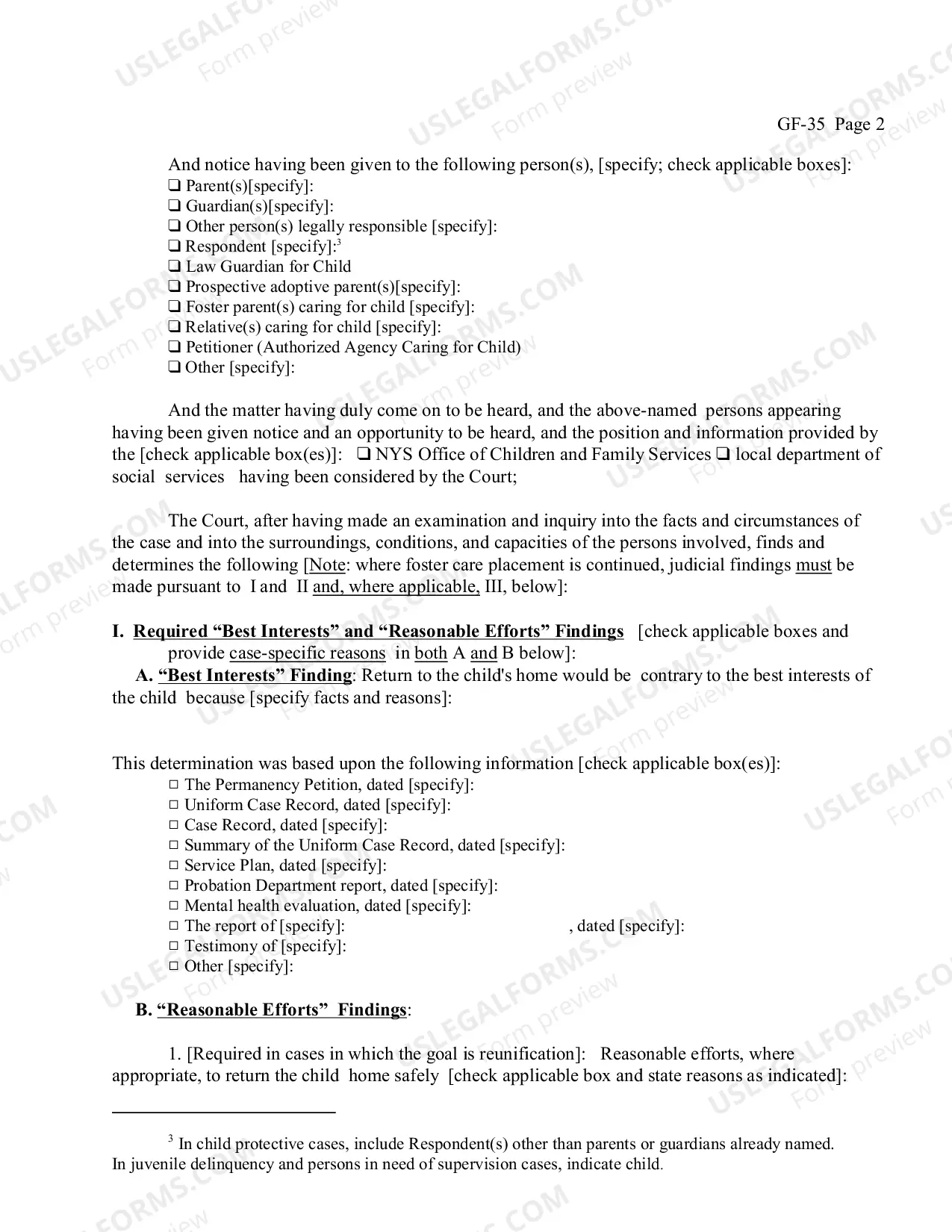
- The court's findings regarding the best interests of the child.
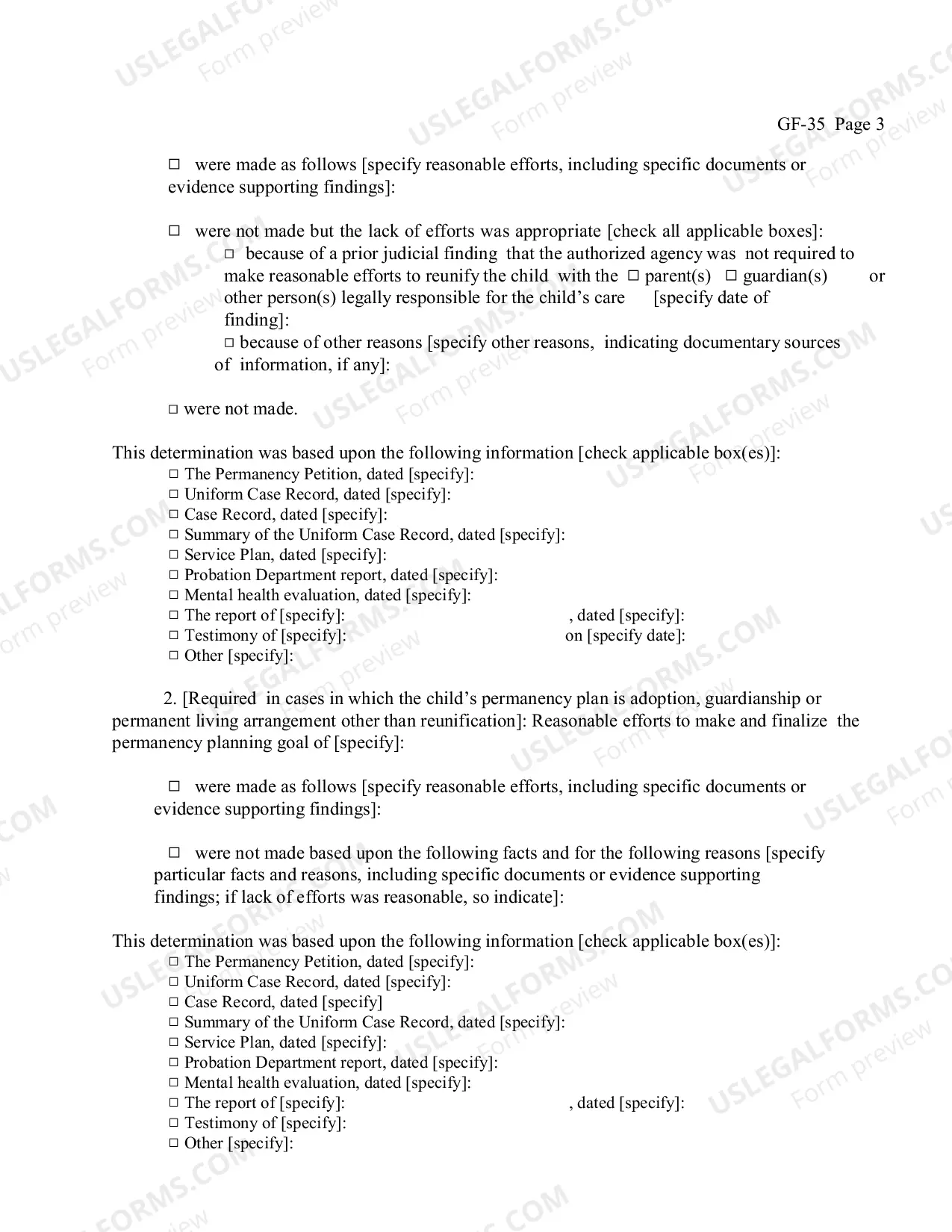
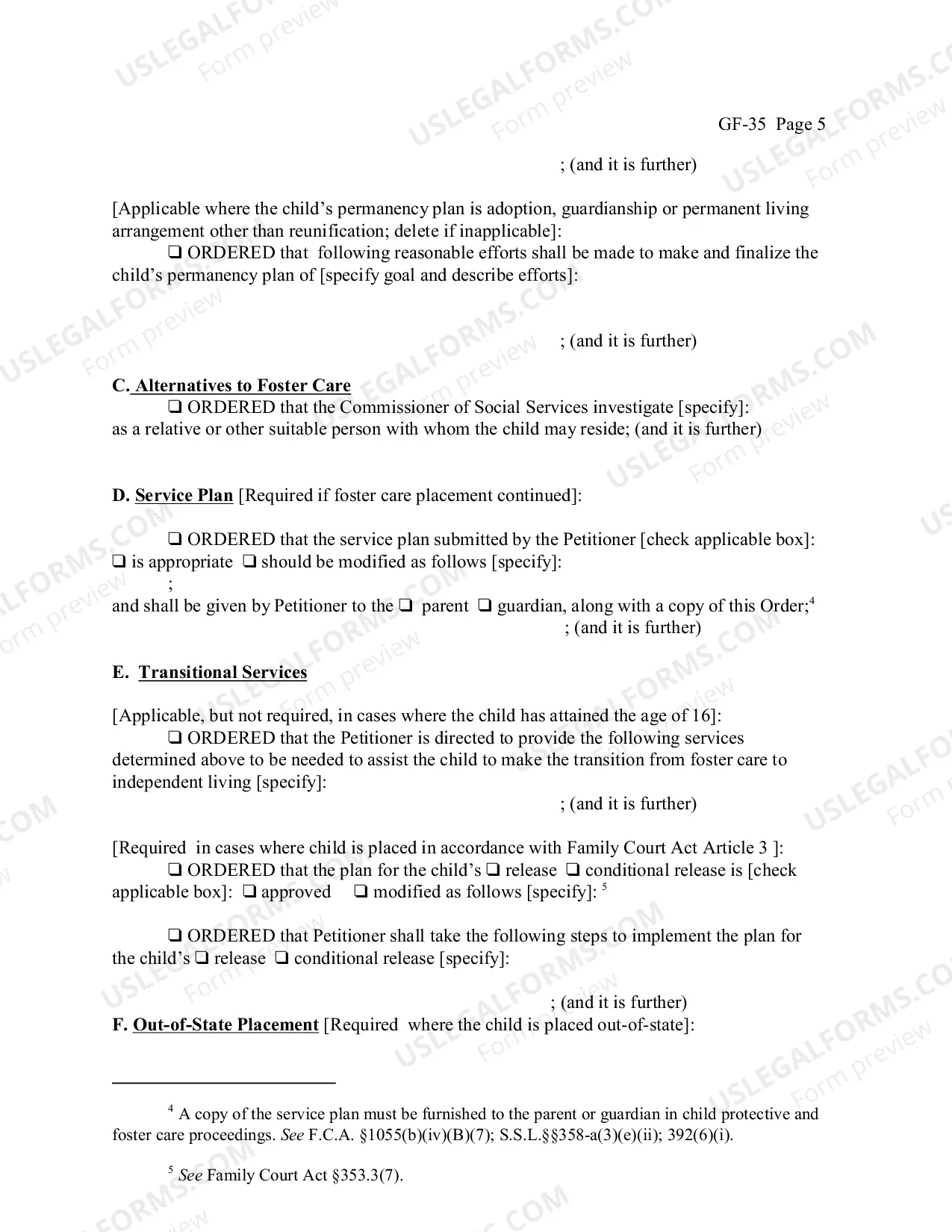
- Determination of reasonable efforts made toward reunification or alternative permanent arrangements.
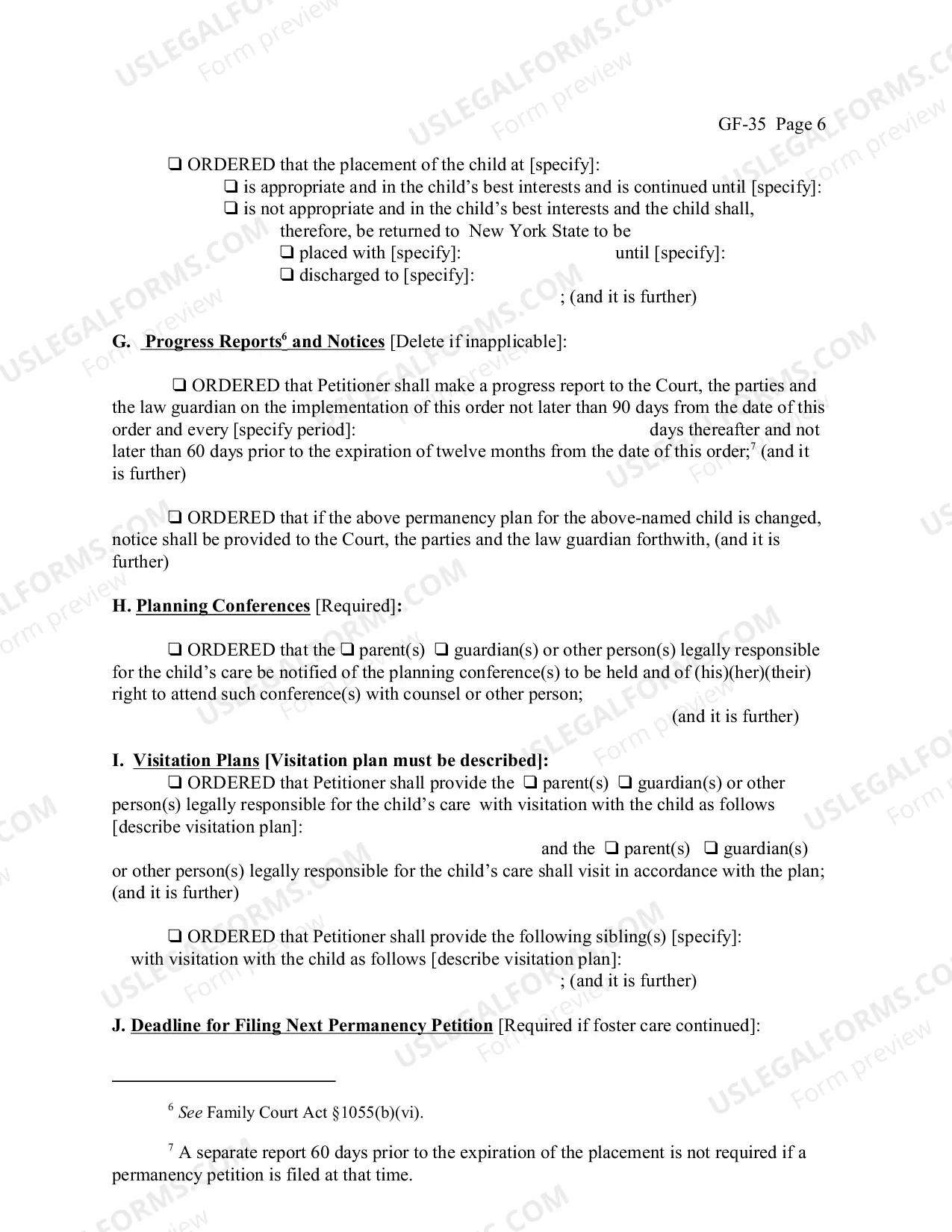
- Specific sections for identifying involved parties, like parents, guardians, and foster caregivers.
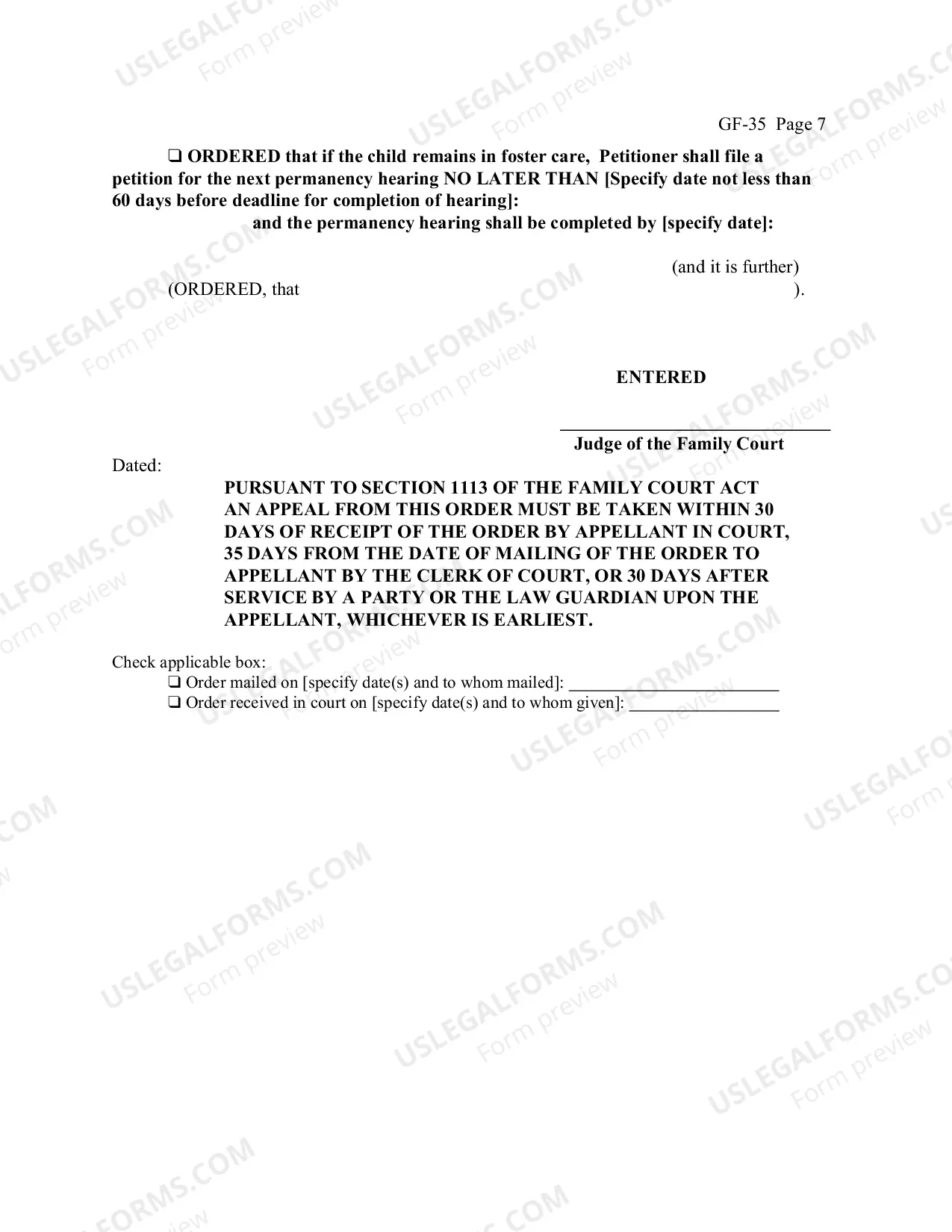
- Timeline requirements for filing the petition for future permanency hearings.
- Instructions for providing services to assist the child's transition from foster care.

When to use this document
This Permanency Hearing Order should be used during specific legal proceedings in family court, such as when a child has been placed in foster care for an extended period without a clear plan for their future. It is particularly relevant in cases where previous rulings indicated that efforts to reunify the child with their parents are not required, necessitating a timely examination of alternative living arrangements. This form ensures compliance with legal deadlines and establishes a formal record of the court's decisions regarding the child's welfare.
Who can use this document
- Parents or guardians involved in a child custody case.
- Authorized agencies responsible for the care of the child.
- Legal representatives (law guardians) advocating for the child's best interests.
- Individuals seeking to establish a permanent plan for a child currently in foster care.
How to complete this form
- Identify all relevant parties, including parents, guardians, and any responsible agencies.
- Enter the specifics of the case, including the childâs name, docket number, and relevant dates.
- Provide necessary findings regarding the child's best interests and any reasonable efforts made for reunification.
- Specify the proposed permanency plan for the child, including any potential placements or services.
- Sign and date the form before submitting it to the court, adhering to all filing deadlines.
Does this form need to be notarized?
This form does not typically require notarization unless specified by local law. Ensure to check local court regulations to confirm any notarization requirements for your specific case.
Get your form ready online
Our built-in tools help you complete, sign, share, and store your documents in one place.
Make edits, fill in missing information, and update formatting in US Legal Forms—just like you would in MS Word.
Download a copy, print it, send it by email, or mail it via USPS—whatever works best for your next step.
Sign and collect signatures with our SignNow integration. Send to multiple recipients, set reminders, and more. Go Premium to unlock E-Sign.
If this form requires notarization, complete it online through a secure video call—no need to meet a notary in person or wait for an appointment.
We protect your documents and personal data by following strict security and privacy standards.

Make edits, fill in missing information, and update formatting in US Legal Forms—just like you would in MS Word.

Download a copy, print it, send it by email, or mail it via USPS—whatever works best for your next step.

Sign and collect signatures with our SignNow integration. Send to multiple recipients, set reminders, and more. Go Premium to unlock E-Sign.

If this form requires notarization, complete it online through a secure video call—no need to meet a notary in person or wait for an appointment.

We protect your documents and personal data by following strict security and privacy standards.
Mistakes to watch out for
- Failing to file the petition within the required 60-day timeframe prior to the hearing.
- Not correctly identifying all relevant parties involved in the child's care.
- Leaving out required findings regarding the childâs best interests or reasonable efforts made.
- Not specifying a clear permanency plan, which can delay the court's decision.
Advantages of online completion
- Convenient access to downloadable templates available in various formats (Word, Rich Text, etc.).
- Editable forms allow for easy customization to fit the specific case details.
- Reliable templates crafted by licensed attorneys, ensuring compliance with legal standards.
Quick recap
- The Permanency Hearing Order establishes a long-term plan for a child in foster care.
- It is essential to adhere to specific filing timelines and include all necessary documentation.
- Correctly identifying all parties and their roles in the child's case is vital for the form's validity.
- Using the form online provides convenience and legal accuracy in preparing court documents.
Looking for another form?

Form popularity
FAQ
A workers' comp hearing determines whether you will receive benefits.At this hearing, the judge will review all of your evidence and then issue a decision awarding or denying your benefits. Because a workers' comp hearing involves specific rules and procedures, it is important to be well-prepared.
Like total PD, the weekly amount of benefits for partial PD will generally be two-thirds of your average weekly wages. But the maximum and minimum amounts are different depending on the date of your injury. For injuries between 2014 and 2018, the minimum is $160 per week, and the maximum is $290 per week.
Permanency, as permanent impairment is known, is determined by a doctor who is qualified to examine you and then look up your injuries in a book called the Guides to the Evaluation of Permanent Impairment, produced by the American Medical Association. It all gets converted into a percentage loss of function.
Permanency planning is the process of assessing and preparing a child for long term care when in out-of-home placements such as kinship, foster care or institutions. A care plan must centre on what is in the child's best interests, and therefore requires an ongoing assessment of the child and her needs.
At the permanency hearing, the DCP&P will present a plan for the child's permanent placement. The plan can be to return the child to his or her parent, terminate parental rights and find an adoptive family, or naming the relative who is caring for the child the legal guardian.
Permanent disability ratings are used to assess the degree of damage that resulted from your work-related injury or occupational disease.If an injury permanently impairs your physical condition and/or mental health condition in any way, no matter how minimal, then you have permanent impairment.
A permanency award is a form of workers' compensation. These are granted when an employee loses permanent use of a body part, such as a limb or organ.
Overall, there are typically more than one permanency hearing in a CPS case, however. About four months after the first permanency hearing, the second permanency hearing is typically the occasion on which you can expect to hear from the judge on whether your child can be returned to your home on a permanent basis.
Permanency hearings are held to decide if progress is being made on a case plan. If there is progress a judge can offer parent(s) a continuance to continue working toward RU (typically another 3 or 6 months, then they'd have another permanency hearing).
A permanence order is a new type of court order which will regulate the exercise of parental responsibilities and parental rights in respect of children who cannot reside with their parents but where contact or shared exercise of parental responsibilities and parental rights is or may be appropriate.